Rafaela Prifti spoke with Dr. Nevenka Tromp, University of Amsterdam, The Netherlands
“Silence is no longer the primary narrator of history. Is the world ready to listen now?”
Interviewer: Your review of Di Lellio and Kraja’s the Strongest Link acknowledges the shortcomings of the traditional legal system, as a structured disembodiment that overlooks the social, emotional and physical realities of women in wartime rape cases. The gender-neutral laws maintain a gender hierarchy and fail to account for differing experiences, i.e. wartime rape cases. Why is this such an important issue for women and the legal system or the need for reforms?
Dr. Nevenka Tromp: The book revisits the legacy of the International Criminal Tribunal for the Former Yugoslavia (ICTY) through one of its most ethically fraught terrains: the prosecution of sexual violence in the Kosovo war. Twenty years after the death of Milošević in 2006, the Kosovo indictments have produced very thin convictions for rape, although sexual assault is recognized as a war crime. More specifically, the story of Teuta, a protected witness and a survivor who faced Slobodan Milošević in The Hague, exposes the gap between legal truth and lived truth. Their work becomes both a historical reckoning, legal normative issue, and a philosophical opening toward what is known as a feminist approach to justice: a justice that listens, recognizes, and holds trauma as truth.
Interviewer: You described the story of Teuta, a protected witness and survivor, who testified and faced Slobodan Milošević in the Hague, as an “act of existential defiance.” In a legal system driven by physical evidence, what stands out about her assertion of truth?
Dr. Nevenka Tromp: It marks a shift of the meaning of truth from the evidentiary to the ontological. When Milošević, who was allowed to cross-examine her in the Hague, asked Teuta for proof beyond her word, she replied: “I did not come here to lie. That happened. In a courtroom defined by the rules of traditional retributive justice, women’s bodies are often treated as crime scenes to be mapped out..” She wasn’t just providing data for a conviction; she was asserting her existence against a system and a perpetrator that denies her truth. This is what we call the “justice of recognition
Interviewer: The Strongest Link highlights a painful paradox: Prosecutors “begged” Teuta to testify because their case depended on her pain, yet offered little emotional protection. Is international law inherently extractive when it comes to female trauma?
Dr. Nevenka Tromp: Unfortunately, yes. As Di Lellio and Kraja illustrate, survivors frequently felt their stories weren’t their own; they were mediated, translated, and “repurposed” into legal arguments. The system lives off this trauma to build its cases, yet it rarely grants the survivor authorship over their own narrative. A feminist approach to justice does treat trauma merely as “fuel” for a verdict but allows facilitating it with a sensitivity that prevents re-traumatization.
Interviewer: You have linked this work to the “Age of Witness Evidence,” tracing back to the Eichmann trial. How do the testimonies in The Strongest Link evolve our understanding of what a trial is supposed to achieve?
Dr. Nevenka Tromp: In the Eichmann trial, trauma entered the courtroom as a historical record. In The Strongest Link, the testimonies of survivors carry a transformative effect. For example, Teuta mentioned feeling “liberated a little,” only for the pain to return. This tells us that justice isn’t a “closure” or a door that slams shut. It is a continuance. It is the ethical act of “hearing trauma into being” so that silence is no longer the primary narrator of history.
Interviewer: How does the “Fourth Wave of Feminism” defined by movements like #MeToo—change how we read the stories of Kosovo’s women twenty years later?
Dr. Nevenka Tromp: The Fourth Wave has been instrumental in moving sexual violence from “private shame” to “global public discourse.” What Di Lellio and Kraja have done is emancipate these stories from intimate hiding places and place them on a deliberative global stage. By allowing the survivors testimonies to be a participatory narrative, we are not just looking for a “guilty” verdict; we are looking for a public archive where the survivor’s agency is restored.
Interviewer: Given that Kosovo indictments have resulted in very few convictions for rape despite it being a recognized war crime, does The Strongest Link offer a different kind of “conviction”?
Dr. Nevenka Tromp: It offers a moral and historical conviction that the law failed to provide. If we measure justice only by “thin convictions,” we fail the survivors. This book serves as a record of “deliberative justice.” It makes the truth audible and archived. Even if the legal gates didn’t swing wide enough, the publication of these voices ensures their truth is heard “wide and loud.” The question remains, as the authors suggest: Is the world finally ready to listen to what it couldn’t hear twenty years ago?
Thank you for the interview!
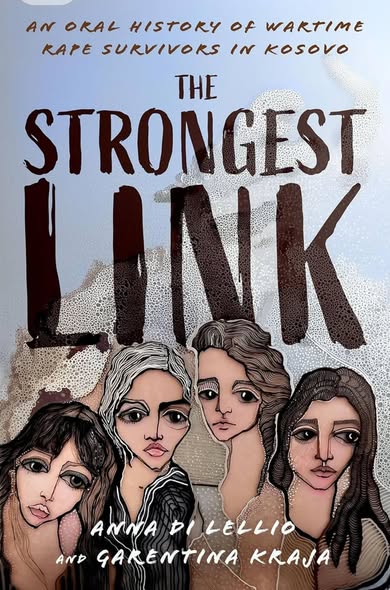
The Strongest Link: An Oral History of Wartime Rape Survivors in Kosovo (Oxford Oral History Series)