For Kosovo, relations with Serbia do not begin in Brussels or end at the negotiating table. They begin in places like Reçak.
by Elmi Berisha | 16 January 2026
On January 15, 1999, Serbian police, military, and paramilitary forces carried out a coordinated operation in the village of Reçak, south of Pristina. By the end of the day, 45 Kosovo Albanian civilians were dead. They were unarmed. Many were killed at close range. Several were executed while attempting to flee. Their bodies were later found scattered in and around a ravine overlooking the village, dressed in ordinary winter clothing.
The killings were documented almost immediately by the OSCE’s Kosovo Verification Mission. William Walker, then head of the mission, publicly described what he saw as a crime against humanity. That assessment was not incidental. Reçak became the moment when the Kosovo conflict could no longer be framed as a symmetrical clash between armed groups. It exposed a pattern of state violence against civilians and collapsed the remaining diplomatic ambiguity surrounding Belgrade’s conduct.
For the United States and its allies, Reçak clarified a central question: whether continued restraint would reduce violence—or legitimize it. Within weeks, negotiations accelerated, patience narrowed, and NATO intervention moved from contingency planning to political decision.
That history matters today because it was never resolved.
Serbia continues to deny that the killings at Reçak constituted a massacre, insisting that the victims were combatants killed in fighting with the Kosovo Liberation Army. This claim has been rejected by international forensic investigations and human rights organizations, yet it remains embedded in Serbia’s official narrative and public discourse.
This denial is not a symbolic dispute. It has concrete consequences for present-day relations.
In post-conflict settings, acknowledgment of wrongdoing is often the minimum threshold for trust. In the absence of accountability, denial becomes policy, and policy shapes behavior. For Kosovo, Serbia’s refusal to recognize Reçak as a crime against civilians signals more than historical disagreement; it signals an unwillingness to accept limits on state power or responsibility for past actions.
That signal is amplified by survivor testimony. Families from Reçak continue to describe how civilians were separated, beaten, marched, and executed while trying to escape. Their accounts are consistent, detailed, and unchanged over time. The absence of justice has frozen these experiences in the present tense.
This year, for the first time, Kosovo’s Special Prosecution filed an indictment in absentia against 21 former Serbian officials and security personnel connected to the operation in Reçak. The indictment describes a coordinated action involving Yugoslav Army units, Serbian police, and special forces, detailing murders, torture, inhuman treatment, destruction of property, and forced displacement. It traces chains of command and names victims.
The likelihood of arrests remains uncertain. But the significance of the indictment lies elsewhere: it formalizes the claim that Reçak was not an aberration or battlefield accident, but a command-driven operation carried out under state authority. For Kosovo, this is not about reopening the past—it is about correcting the record where political processes have failed.
The implications for today’s Kosovo–Serbia relationship are direct. Dialogue premised on “normalization” struggles to advance when foundational facts are contested. Confidence-building measures are fragile when one side denies the most documented crime associated with the conflict. Security assurances ring hollow when historical accountability is treated as optional.
For U.S. diplomats and policymakers, Reçak offers a cautionary lesson. Stability built on unresolved crimes is inherently brittle. The same denial that once enabled violence now complicates deterrence, trust, and crisis management. It narrows the space for compromise and widens the gap between formal agreements and lived reality.
Reçak matters today because it explains why Kosovo views Serbian rhetoric, military signaling, and historical revisionism not as isolated behaviors, but as part of an unresolved continuum. It also explains why Kosovo places such weight on international presence, legal record-building, and moral clarity.
The massacre at Reçak ended ambiguity in 1999. The failure to fully reckon with it continues to shape relations in 2026.
In the Balkans, history does not stay buried simply because diplomacy prefers forward-looking language. What is unresolved has a way of returning—quietly at first, then insistently—until it is addressed.
About the author:
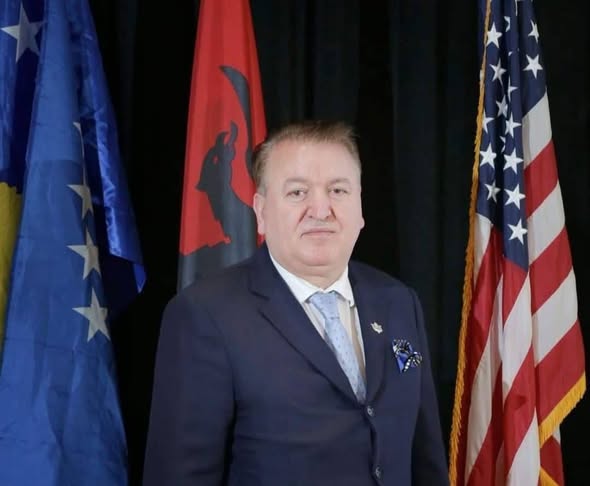
Elmi Berisha is a prominent Albanian-American community leader and businessman based in the New York area, best known as the President of the Pan-Albanian Federation of America “Vatra” (Federata Panshqiptare e Amerikës VATRA), the oldest Albanian patriotic organization in the United States, founded in 1912.
ISSN: 3070-2186