By David L. Phillips*/ Forget talk about ‘re-sets’ in relations; the US is on collision course with two implacable adversaries that are bent on testing its leadership and resolve.
The US is on a collision course with China and Russia over both ideology and influence. As a liberal democracy, the US system of government is antithetical to the authoritarian model of government in China and Russia, both egregious violators of human rights. Far from the “peaceful rise” proclaimed by Premier Xi Jinping, China in tandem with Russia is fomenting conflict in the Western Balkans, the South China Sea, and Ukraine – proving grounds of America’s resolve.
Fraternity between China and Russia dates back to the founding of the Chinese Communist Party, CPC, 100 years ago. China’s Communists were inspired by the 1917 Bolshevik Revolution and its consolidation across the vast Russian Empire. Likewise, Communist China was born in the cauldron of conflict. CPC cadres vanquished both the Japanese occupation and nationalist forces of Chiang Kai-shek. Chinese troops were deployed to the Korean peninsula in 1950. China was also at war with itself, during the Cultural Revolution of the 1960s. China assumed leadership of the Communist world when the Soviet Union collapsed in 1991. Russia is a world power in decline; China is on the rise. Xi and Russia’s President, Vladimir Putin, are united in their sense of historic humiliation by Great Powers and opposition to the West.
Neither China nor Russia wants to directly confront the US. For now, they foment conflicts out of the spotlight and in cyberspace. Their goal is to deny universal values of freedom and democracy, while undermining US leadership and western institutions such as NATO and the EU. After the Biden-Putin summit, Russian Foreign Minister Sergey Lavrov warned: “Your hegemony is over. Your rules don’t apply.”
China and Russia will continue to test the limits of their power until they are stopped. When the bayonet meets flesh, it plunges deeper. Xi recently warned that those who try to block China’s ascent will be met with a “wall of steel”. Were his remarks a warning to the West, or for domestic consumption? Xi’s reputation has been tarnished by his handling of the Covid-19 pandemic. China’s economic miracle is slowing down, its economy growing just 6.6 per cent in 2018, the lowest rate in 28 years. Its population is ageing, further slowing economic development. The CPC is comprised of elites, hardly representative of 1.4 billion Chinese.
Ukraine meanwhile is a flashpoint for conflict escalation between Russia and the West. Russia supports separatist militias in Donbas, in southeast Ukraine. It recently escalated tension by confronting HMS Defender, a British warship sailing in international waters near Crimea, which Russia annexed in 2014.
Britain does not recognize Russia’s illegal annexation of the Crimea, or its claim to Ukrainian territorial waters in the Black Sea. According to UK Prime Minister Boris Johnson, “The important point is that we don’t recognize the Russian annexation of Crimea. This is part of a sovereign Ukrainian territory, it was entirely right that we should vindicate the law [of the sea] and pursue freedom of navigation in the way that we did.”
Russia’s response was swift, including military and diplomatic reprisals. Russian war planes allegedly fired warning shots during the Defender’s passage through the Crimean coastal corridor. Moscow summoned the British ambassador, warning of additional measures if British ships continued to sail along the Crimean coast.
China is similarly confrontational. The South China Sea is an energy-rich waterway through which $3.4 trillion in trade passes annually. Control of maritime routes is not only critical to commercial traffic, but to China’s growing navy that projects power in the region. In violation of laws of the sea, Chinese navy vessels rammed and sunk a Vietnamese fishing boat near the Paracel Islands last year.
China is building navy bases, which it calls “research stations” on Fiery Cross Reef, the Subi Reef, as well as military outposts on shoals, reefs and rock outcroppings. In 2016, the Philippines challenged China’s actions before the international Arbitral Tribunal, which ruled in favor of the Philippines and nullified China’s claim. China simply ignored the court’s finding, ratcheting up tensions with the Philippines, Vietnam, the, Brunei, Malaysia and Taiwan. China also confronts Japan over control of the Senkaku Islands in the Sea of Japan.
The Obama administration responded with “freedom of navigation operations”. US warships sailed within 12 nautical miles of disputed islands without providing notification or seeking permission. By upholding the Law of the Sea, the US implicitly opposes China’s “might makes right approach.” The Biden administration has resumed freedom of navigation operations. Will this be enough to deter China’s maritime aggression?
The Western Balkans are also a dangerous flashpoint. Backed by Russia, Serbia refuses to recognise that Kosovo is an independent and sovereign state. It blocks Kosovo’s efforts to gain greater global recognition by joining international organizations and establishing diplomatic relations with other states.
Russia and Serbia have sought to intimidate Kosovo by establishing military outposts near the Kosovo border. It claims that the base in Nis, southern Serbia, is for a civil emergency response and humanitarian operations. The base is actually used to gather intelligence on Western activities. Serbia has established 11 more military facilities near Serbia’s border with Kosovo. This show of force is intended to deter Kosovo’s efforts to join NATO and gain recognition by all EU member states. Russia backed a coup against the governments of North Macedonia and Montenegro when they sought NATO membership.
Negotiators from Serbia and Kosovo have been meeting for more than 10 years. They resumed their dialogue in Brussels on June 15, 2021. Serbia picked that day for a major military exercise involving 15,000 troops using Russian equipment, such as T-72M tanks, MIG-29 war planes and Mi35 attack helicopters. Weaponized drones acquired from China were also a part of the exercise. “Operation Lightning Strike” was a warning for Kosovo to abandon its goal of Euro-Atlantic integration. China’s expanding footprint is also agrowing concern.
Vucic refuses to recognize that Serbia lost Kosovo due to Slobodan Milosevic’s crimes. A free, independent and pro-Western Kosovo will never rejoin Serbia. As Kosovo readies for the next phase of its dialogue with Serbia, there is a growing clamor to abandon talks until the Nis base and Russian military facilities are closed. Kosovo’s leaders cannot show up in Brussels with a gun held to their heads. Nor can they negotiate independence, which was already recognized by more than 110 countries.
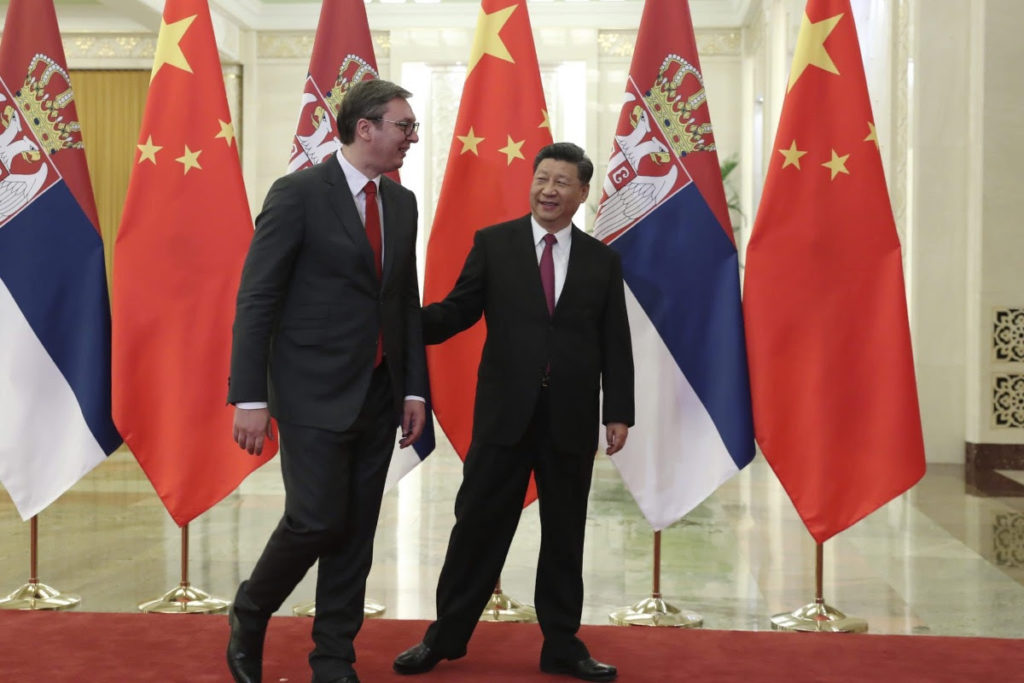
China and Russia work in tandem in the Balkans. Serbia is a major beneficiary of China’s Belt and Road Initiative. In exchange, Serbia supports China’s crackdown on democracy in Hong Kong, its human rights abuses in Xinjang, and tough stance towards Taiwan. Vucic threatens the EU by officially supporting steps to elevate Serbia-China relations and expanding military cooperation.
The Russian Intelligence Agency, GRU, is active in Serbia and worldwide. The US Department of Homeland Security’s Cybersecurity and Infrastructure Security Agency confirms that the GRU spies on US government agencies and industries. The GRU was likely behind the ransomware attack, targeting Colonial Pipeline that transports oil, gas, and jet fuel to the East Coast. Russia also used malware to disrupt the 2016 US election system, including voter registration and voting machines. Russia is behind malign influence operations that seek to exacerbate divisions in American society, thereby weakening America’s unity and resolve.
The US cannot turn a blind eye to coordinated aggression from China and Russia. It should work multilaterally to expand naval operations in the South China Sea. It should also support freedom of navigation in the Black Sea by supporting Britain’s naval exercises. Toughening sanctions would show that the US and its allies have zero tolerance for Russian aggression against Ukraine.
When it comes to Kosovo, the US is at a fork in the road. The Kosovo-Serbia dialogue is a charade. If the US wants it to work, it should appoint a Special Presidential Envoy to mediate. It can coerce Serbian President Aleksandar Vucic to recognize Kosovo by threatening to freeze the offshore assets of Vucic and his brother. Talks cannot be about the status of Kosovo. They must focus on the status of Kosovo-Serbia relations as independent and sovereign states. To show that it means business, the US should demand the closure of the Nis base and other Russian military facilities in Serbia, while imposing an arms embargo on Serbia. Spies at the Chinese and Russian embassies, operating as political officers, should be evicted.
China and Russia are strategic adversaries of the US. They are testing America’s resolve worldwide. To avoid a major military confrontation in the future, the US must firmly oppose provocations today. No more wishful thinking or happy talk about a reset in US relations. Now is the time to confront China and Russia, exacting a price for their malign activities.
David L. Phillips is currently Director of the Program on Peacebuilding and Human Rights at Columbia University. He served as a Senior Adviser and Foreign Affairs Expert during the Clinton, Bush and Obama administrations.