“When I get a new book, I open and smell it”: An Albanian Kadare fan remembers when books could be dangerous/ There have been some interesting after-shocks from my New York Times Book Review piece last weekend: First, I made the headlines in Tirana. My contention that Ismail Kadare should have received a Nobel long ago is apparently controversial. Second, I got retweeted by Kadare’s daughter, Besjana Kadare, the Albanian Ambassador of Albania to the UN. And finally, I received the email below, from Albanian-born Kadri Brogi, a tech manager at Hunter College in New York City. He is obviously a Kadare fan of, and gives some insight into the devotion Albanians have for the language’s first international writer (and I include his second letter below):


“When I get a new book, I open and smell it.”
Thank you for writing that piece about Ismail Kadare. Your analyses is spot on.
I am originally from Albania and grew up reading his books. It was one of very few things we could look forward to there. The rest of the literature was just “socialist realism.” He had some of that as well, but he has explained why. As you correctly noted, he has been very much inspired by the ancient Greek literature. Most of his work reflects that.

Protection? Forget it.
I think one of the main reasons why he has not been considered for the Nobel prize has to do with the perception that he has been too close to the communist nomenclature. He was from the same town as Enver Hoxha, and many think that served as protection. I don’t believe that, because Enver Hoxha did not offer protection to anyone. He murdered is brother-in-law (his sister’s husband) who had paid for Hoxha’s education in France before the war.
About fifteen years ago, Kadare was invited to the Columbia University Rotunda. I was there. He was bombarded with questions about his past, mostly from Albanian immigrants, and he explained everything very well. He said that he had never pretended to be a dissident. He said he made a compromise in order to survive.
Modeled himself on Dante.
He said that, like Dante Alighieri (his words), he has to build his environment and surrender himself from that reality in order to produce what he did. He was referring to Dante’s status when he had criticized the Pope and was treated very unfavorably. That was the reason (according to Kadare) that Dante created his own isolated reality where he produced great works like The Divine Comedy. Kadare said that he had two options: compromise and continue to write books that we can read or end up with a bullet in back of his head and be a hero.
His writings were very ambiguous in many cases. I read every single book he published before 1990 and went back and read few of them again after 1990. It was then I was able to read between the lines.
I think he will eventually be nominated for the Nobel.
Thank you again for your piece and I look forward to getting your new book.
Kadri gives some insight into Albanian life under the Hoxha regime in a follow-up email:
There were two things you could do in Albania when we were growing up, sports and reading. I wasn’t good at sports so I picked reading.
In elementary school I would read all kind of books. I took some piano lessons then but other kids made fun of me saying that piano is just for girls so I quit. By today’s definition, that would have classified as bullying but not then and there . One teacher came to my father and expressed concern that I read too much and it might be unhealthy. To this day I read at least 15-20 books a year.
 I live in NJ but commute to NYC every day. My phone is filled with audiobooks that I listen while staying on traffic.
Reading was something that helped me grow and develop. I learned English by myself with some old English books called Essentials.
At that time Russian was dominant in schools even though we had broken away from the Eastern bloc a long time ago. We could manage to get some prohibited books at that time (they were called yellow books) that if caught it meant jail.
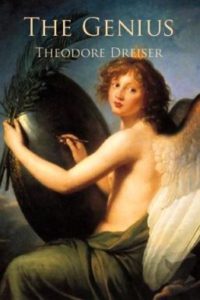
I remember when I read the first American book in 1982. The Genius from Theodore Dreiser. I was mesmerized.
I read pretty much everything, but mostly historical books, memoirs, biographies and military because I served for many years. I was an Early Warning RADAR Engineer.
I teach computer science but try to encourage students to read as much as I can. I feel like many now consider reading as an archaic thing.
My daughters make fun of me because whenever I get a new book, I open and smell it.

Ismail Kadare: “There is real literature, and then there is the rest.”
My review is online at The New York Times Book Review today here, and in the print edition this weekend. The book under discussion: the Albanian maestro Ismail Kadare‘s A Girl in Exile. Every year, the Nobel committee seems to look the other way while a matchless collection of novels, plays, essays pours out from Paris and Tirana, his dual homes.
An excerpt from my review:
Kadare is still mapping out the boundaries of Albanian, a relatively recent literary language, where everything is new and newly sayable. He is the first of its writers to achieve an international standing. But how to describe something beyond words? “Better if you don’t know” is a repeated phrase in the book, along with variations of “it’s complicated.”
The two girls, “daughters of socialism, as the phrase went,” resolve their eternal love triangle with a stunning metaphysical selflessness. And they reply to injustice and repression not by resistance or retaliation, but with an utterly new, unconditioned response that leaves the reader lightheaded, transcending even that which we value as “freedom.” In Kadare’s words, they move “beyond the laws of this world.”
Read the whole shebang here.

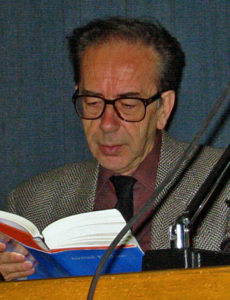
Are you listening, Stockholm? (Photo: Lars Haefner)
Kadare’s relationship to his mother tongue intrigued me, especially given its affinities with classical Greek. I googled the language. I reached out to a Albanian Facebook group. I tried phoning the consulate. No joy anywhere. Who could tell me more? The most informative source turned out to be … Kadare himself. So I read more about it over at The Paris Review. “For me as a writer, Albanian is simply an extraordinary means of expression—rich, malleable, adaptable,” he explained to his interviewer, Shusha Guppy, in 1997. “As I have said in my latest novel, Spiritus, it has modalities that exist only in classical Greek, which puts one in touch with the mentality of antiquity. For example, there are Albanian verbs that can have both a beneficent or a malevolent meaning, just as in ancient Greek, and this facilitates the translation of Greek tragedies, as well as of Shakespeare, the latter being the closest European author to the Greek tragedians. When Nietzsche says that Greek tragedy committed suicide young because it only lived one hundred years, he is right. But in a global vision it has endured up to Shakespeare and continues to this day. On the other hand, I believe that the era of epic poetry is over. As for the novel, it is still very young. It has hardly begun.”
He’s just warming up:
“Listen, I think that in the history of literature there has been only one decisive change: the passage from orality to writing. For a long time literature was only spoken, and then suddenly with the Babylonians and the Greeks came writing. That changed everything.” It’s a bracing interview because of the unexpected turns the conversation takes. He never takes the predictable position, the weathered road.

Faster than a speeding bullet
“For example, they say that contemporary literature is very dynamic because it is influenced by the cinema, the television, the speed of communication. But the opposite is true! If you compare the texts of the Greek antiquity with today’s literature, you’ll notice that the classics operated in a far larger terrain, painted on a much broader canvas, and had an infinitely greater dimension: a character moves between sky and earth, from a god to a mortal, and back again, in no time at all! The speed of the Iliad is impossible to find in the modern author. The story is simple: Agamemnon has done something that has displeased Zeus, who decides to punish him. He calls a messenger and tells him to fly to earth, find the Greek general called Agamemnon and put a false dream into his head. The messenger arrives in Troy, finds Agamemnon asleep and pours a false dream into his head like a liquid, and goes back to Zeus. In the morning Agamemnon calls his officers and tells them that he has had a beautiful dream, and that they should attack the Trojans. He suffers a crushing defeat. All that in a page and a half! One passes from Zeus’s brain to Agamemnon’s, from the sky to earth. Which writer today could invent that? Ballistic missiles are not as fast!”
In sum: “All this noise about innovations, new genres, is idle. There is real literature, and then there is the rest.”
After a few paragraphs to lure you in, the Paris Review interview is behind a paywall … well, I’ve effectively done the same, haven’t I? But my review is free. It’s here.(The New York Times)