• Home
  • Politics
  • Opinion
  • Culture
  • Sports
  • Economy
  • Interview
  • Reporting
  • Community
  • Vatra

Dielli | The Sun

Albanian American Newspaper Devoted to the Intellectual and Cultural Advancement of the Albanians in America | Since 1909

Shqiptarët e Amerikës dhe tensionet politike në SHBA

January 13, 2021 by dgreca

NGA ILIR IKONOMI-ZERI I AMERIKES/

Si i shohin shqiptaro-amerikanët zhvillimet e fundit politike në SHBA në prag të inaugurimit të Presidentit të Zgjedhur Joe Biden? Zëri i Amerikës bisedoi në Skype me dy prej tyre. Më 6 janar, ditën kur një turmë e dhunshme sumoi Kapitolin, Marko Kepi, mbështetës i Presidentit Donald Trump nga Nju Jorku, ishte në Uashington.

“Ne ishim në pjesën ku mbajti fjalimin Presidenti Trump, që ishte më shumë afër Shtëpisë së Bardhë se sa afër Kapitolit. Kur iu afruam Kapitolit, pas fjalimit të Presidentit, e pamë që filloi rrëmuja dhe me grupin tonë vendosëm të largoheshim që të mos bëheshim pjesë e trazirave. Ishte një gjë shumë negative, që nuk duhet të ndodhte, sidomos këtu në Amerikë. U duk si një gjest ballkanik dhe jo si një gjest amerikan,” thotë zoti Kepi, i cili drejton organizatën Albanian Roots.

Shumë amerikanë ndajnë mendimin se me zhvillimet e fundit, siç ishte sulmi kundër Kapitolit, saga e gjatë e zgjedhjeve dhe sidomos teoritë konspirative që qarkullojnë me lehtësi në mediat sociale, demokracia amerikane është e kërcënuar si asnjëherë.

Edhe zoti Kepi shpreh shqetësimin e tij për kërcënimet ndaj demokracisë. Ai nuk është dakord, për shembull, me vendimin e kompanisë Twitter që i mbylli llogarinë presidentit Trump.

“Në një anë them se po, është e kërcënuar, sepse kur sheh akte të tilla që një kompani ia bllokon Presidentit të SHBA të drejtën e fjalës, ky është një shqetësim për demokracinë amerikane. Qeveria duhet të reagojë që të mos ndodhin këto gjëra. Nëse kjo i ndodh presidentit, atëhetë ç’mund të thuhet për ne? Sa i përket shtetit dhe ligjit nuk shikoj se do të ketë një ndryshim shumë të madh. Shteti amerikan gjithnjë do të funksionojë, sepse kemi Kongresin, Senatin dhe dy parti që mundohen të ruajnë ekuilibrin.” thotë zoti Kepi.

Richard Lukaj, themelues i grupit bankar Bank Street në Stamford të shtetit Konektikat, është i regjistruar si republikan dhe në të kaluarën ka patur rastin të njohë si Presidentin Trump gjatë marrëdhënieve të biznesit me të, ashtu edhe Presidentin e Zgjedhur Joe Biden. Ne e pyetëm zotin Lukaj nëse një proces shërimi në SHBA është i mundur me ardhjen e administratës së re:

“Mendoj se është shumë e mundur. Vazhdimisht në këtë vend ka patur erëra ndryshimesh. Votuesit kësaj here u shprehën për një ndryshim në drejtimin e vendit, një ndryshim të tonit, një ndryshim në karakterin e presidentit madje edhe përtej kësaj, siç u pa me fitoren e dy senatorëve në shtetin Xhorxhia, njëri prej të cilëve afrikano-amerikan dhe tjetri hebre. Mendoj se mesazhi ishte shumë i qartë. Era e ndryshimit e ka lënë pas retorikën populiste që pamë disa vite më parë,” thotë zoti Lukaj.

Por zoti Lukaj mendon se situata është ende shqetësuese, kur dëgjohen paralajmërime për kërcënime ndaj sigurisë në ditën e inaugurimit që po afron:

“Është ende një kohë tensionesh, kur zërat e njerëzve të arsyeshëm duhet të dëgjohen. Mendoj se mendjet inteligjente në të dyja anët e spektrit politik duhet të bien dakord se e ardhmja e vendit është më e mirë kur ka pajtim dhe dialog konstruktiv për zgjidhjen e problemeve, se sa grindje politike që e përçajnë vendin.”

Në mënyrë të veçantë, Partia Republikane ka qenë kohët e fundit mjaft në qendër të debateve politike. Për mbështetës të zotit Trump si Mario Kepi, e ardhmja e partisë është ende e panjohur. Kjo parti prej disa vitesh lëkundet mes besnikërisë ndaj Presidentit Trump dhe largimit nga ndikimi i tij.

“Si anjëherë më parë, nuk shikoj që ky kandidat, ose ky president që ne kishim, do të jetë si të tjerët që thjesht kryejnë mandatin dhe zhduken. Ai nuk kishte thjesht votues por një bazë që e ka mbështetur, një grup personash që më shumë besojnë tek ai sesa tek partia. Mendoj se mënyra se si do të sillet Partia Republikane me Presidentin Trump, do të tregojë për të ardhmen e kësaj partie,” thotë republikani Kepi.

Në komunitetin shqiptaro-amerikan pasionet politike nuk mungojnë. Richard Lukaj beson se politikisht ky është një komunitet si gjithë të tjerët, i integruar thellë në jetën e vendit, por me tiparet e veta sa i përket prirjeve politike.

“Mendoj se komuniteti shqiptaro amerikan nuk është ndryshe nga pjesa tjetër e vendit… Shumica e shqiptarëve që emigruan në SHBA erdhën këtu me një preferencë për të djathtën, siç ishte familja ime dhe të tjerë që ikën nga regjime socialiste dhe komuniste. Por është interesant se me kalimin e kohës, përvoja amerikane bëri që preferencat e tyre partiake të balancoheshin, duke arritur gati 50 me 50 për qind,” thotë bankieri Lukaj.

Ai shpjegon se ashtu siç ka ndodhur edhe me pjesën më të madhe të vendit, shqiptaro-amerikanët janë luhatur nga njëra anë e spektrit tek tjetra në varësi të çështjes që ka patur përparësi për komunitetin.

“I tillë ka qenë konflikti në Kosovë, kur simpatitë shkonin drejt sekretares Madeliene Albright dhe Presidentit Bill Clinton. Në fillim të viteve 90, kur Shqipëria po shkëputej nga komunizmi, ishte sekretari James Baker dhe presidenti Xhorxh Bush i vjetër që nxorën më në pah prirjet republikane tek komuniteti shqiptar,” thotë ai.

Zoti Lukaj bën thirrje që në momentin e tanishëm njerëzit të jenë më objektivë e më të peshuar, larg ndikimit të emocioneve që errësojnë gjykimin.(Ndiqini intervistat ne Zerin e Amerikes)

Filed Under: Interviste Tagged With: Ilir Ikonomi, Shqiptaret e Amerikes, tensionet politike ne SHBA, VOA

COVID AND ITS IMPACT ON MENTAL HEALTH

December 18, 2020 by dgreca

DIELLI EXCLUSIVE INTERVIEW WITH DR. BASHKIM KADRIU

COVID AND ITS IMPACT ON MENTAL HEALTH

Interviewed by Rafaela Prifti

“The impact of COVID-19 pandemic has affected all facets of society. Yet the toll is uneven for vulnerable individuals, those who struggle with chronic conditions, disabilities, and those with severe mental illnesses. My concern is that this impact will continue to be present in our lives in years to come.” 

Bashkim Kadriu MD, FACP, currently holds the position of Director, Clinical Leader, Neuroscience Experimental Medicine (Neuroscience Therapeutic Area) at Janssen Research & Development, La Jolla, California. Previously he has served as Acting Deputy Director at the Office of Clinical Research, and Clinical Fellow and Neuroscientist at the Experimental Therapeutics and Pathophysiology Branch, National Institute of Mental Health, NIH, Bethesda, being the first Albanian Physician-Scientist at the prestigious research institute.

After completing your medical school training at the University of Prishtina, Kosova, you relocated to Chicago. For nine years, you worked as research postdoc and scientist at Chicago’s University of Illinois and later at Albert Einstein College of Medicine, New York City where you completed your Psychiatry Residency training. You received a Fellowship at the National Institute of Mental Health, Bethesda. What were some of your previous interests? 

My work at the University of Illinois in Chicago focused on studying the epigenetic regulation of risk genes in diseases such as schizophrenia and mood disorders, while my later work at the National Institute of Health consisted on the neurological correlations on treatment-resistant mood disorders with an emphasis on discovering biosignatures that guide novel fast-acting therapies that help individuals suffering from depression and mood disorders. I was fortunate to work with some of the best leaders who mentored me through the years and guided me into publishing my work at high-impact reputable journals. I have published over 55 peer-reviewed journal articles, several book chapters and presented work at prestigious scientific journals and conferences in the field. 

You are certified by the American Board of Psychiatry and Neurology and have received numerous awards for exceptional clinical care and professional accolades including a recent NIMH Dr. Richard J. Wyatt Award for Translational Research and NARSAD Investigator Award from Brain and Behavioral Research Foundation. You were granted US citizenship through the path of exceptional accomplishments in science. Recently you relocated to the West Coast where you have accepted a new position. What was the adjustment like for you under the circumstances? What has been the focus of your work recently?

Yes, indeed I moved to Southern California in the last 2 months and I have been adjusting slowly but no without challenges. I recently moved to industry where I landed a job and my work currently focuses on early drug discovery in relation to mood disorders. This has been a tough time for everyone, especially at the height of an ongoing world pandemic. Personally, the biggest challenge of my moving to the West Coast was leaving my patients, although I still continue to provide care for some of them through the telemedicine platforms, which took off during this pandemic. Coming from academia to the industry takes some adjustment but the overall transition here has been smooth. It is my hope to continue the research of developing new and better treatments for patients who suffer from severe mental illnesses. 

Due to social restrictions and isolation regime imposed by the CDC guidelines, groups of individuals such as seniors and special needs are especially vulnerable. Particularly individuals with a compromised mental health are in a precarious situation. One tragic element is the number of suicides. According to studies done in the past on suicide prevention, you have stated that in the last 20 years there has been a 30% increase in the number of suicides in the US. What are some other findings of the study?

Unfortunately despite the research and advances in suicide prevention, the rates of suicide have seen an increase in the US over the years. Based on previous assessments, a large portion (~90%) of individuals who commit suicide have an ongoing mental illness. Aside from the devastating loss of life, the impact of mental health illnesses in America comes with a high economic cost of around 1 trillion dollars as a consequence of missing workdays, lower productivity and the expenses incurred by hospitalization and the treatment of such conditions. 

Self-isolation and the limiting of social interactions continue to have major impact on the mental health of the population. Have there been studies that focus on the topic? 

As a rule, major crisis have an enormous impact on the public health. Some of the examples is the financial collapse of 2008 or other critical disruptions of daily lives cause or are associated with a significant increase in mental disorders. Among the most exposed groups are the front line health workers, who deal with the pressures of increased workload in the number of patients that need medical care and attention but also the daunting levels of stress and exhaustion, physical, emotional and mental. Studies conducted in Asia, Europe and most recently in the US have shown that front line workers, the medical staff in charge of COVID patients have experienced and exhibited symptoms of serious depression, anxiety and sleep disorders. Some studies published in Lancet found that 50% of the patients that underwent ICU treatment due to Coronavirus experienced PTSD, amplified by the social isolation or quarantining before and after hospitalization. When it comes to general population, the health pandemic has impacted all facets of society. Yet the toll is uneven for the vulnerable population such as individual who suffer with struggle with chronic conditions, disabilities and those with severe mental illnesses.

What is your concern with respect to that particular segment of the population?

My concern is that the impact will continue to be present for years to come. We are already seeing the impact of loneliness, social isolation, disruption of daily routines and the lives caused by the pandemic. The latest numbers issued by CDC and NIMH show a staggering increase in rates of depression, anxiety, and suicide cases here in the US and elsewhere. I fear that these trends will continue to rise in months ahead as the pandemic effects continue to be present in our lives. 

You have stated that the symptoms experienced at this extraordinary time are not unlike the signs manifested by post-war societies in the post-conflict period. Drawing a parallel with the home countries like Kosova and Albania, you have shared your personal experience during the Kosova conflict and the isolation from the outside world. 

Even though there has been two decades since the days of the NATO bombings, the enormous impact of that experience is long lasting in the psychological and mental context. I made the analogy with the current situation in the sense of the repercussions and influence on the population. One positive outcome out of this situation is the lowering of the stigma associated with mental health as more and more people find themselves in similar circumstances and in need of dealing with post-traumatic stress disorders caused by a global pandemic. For medical personnel this could mean finding better ways to help those who are in need of treatment, without fear of being stigmatized. 

Can you elaborate on your analogy with the Kosova war in relation to mental health and well-being?

Well, although the two experiences are completely different, as someone who endured a long pre-war conflict and experienced 78 days of NATO air strikes in Kosovo, I drew a parallel with the pandemic-related isolation as well as the associated element of fear of uncertainty and ‘the fatigue’ people experience over time. As tough as it is, we are gradually adapting to the new normal, learning to deal with the unpredictability of our daily routine and inability to plan our future. The new vaccine in the horizon offers hope that we are seeing the beginning of the end of this pandemic that devastated many lives and ravaged many families. 

You have underscored the importance of being aware of one’s state of mind and emotions. What’s your advice to minimize the effects on mental health in terms of recognizing depression symptoms and take mitigating steps?

Some signs or indications of depression include increased anxiety, sleep disorders, fatigue and loss of interest or motivation. It is very important to set a goal and follow through with it. Under the current circumstances, when daily routines are disrupted, it is very helpful to have an activity that helps you stay energized which gives a sense of purpose and motivation for your general well-being. 

A study conducted by the University of Oxford found that 1 in 5 diagnosed with COVID have a subsequent psychiatric diagnosis in the following 14 to 90 days. The research compared patients recovering from COVID with those recovering from other medical events such as the flu. Can you explain the study for our readers?

I read that study, and the findings there seems staggering from many angles. This study measures the incidence and hazard ratios for psychiatric disorders, dementia, and insomnia, during the first 14 to 90 days after a diagnosis of COVID-19. Individuals affected and recovering from COVID compared to those of influenza (common flu) report significant increased rates of physical and mental fatigue, memory/concentration issues, headache, pain, insomnia, as well as higher rates of anxiety and depression. While these findings are worrisome in many aspects, controlled longitudinal designs studies are needed in the future to see if these findings hold for longer period of time and how they may affect our mental and physical health. 

The same study found that the relationship between mental illness and COVID-19 is actually bidirectional, people with psychiatric diagnosis were about 65% more likely to be diagnosed with COVID-19 than people without. What have you seen in your line of work?

In my line of research and expertise as specialized clinician, we do notice that individuals with severe mental illnesses have weakened immune system and increased rates of medical comorbidities such is obesity, hypertension, diabetes etc. There is also finding indicating that in a subset of patients who suffer from depression or bipolar disorder, there is an immune based  etiology triggering their individual symptoms. Thus, it is not surprising that individuals struggling from psychiatric illnesses have higher rates of COVID-19 incidence.

While most of us may experience fatigue or some sense of anxiety during the time of the pandemic, the study is talking about a diagnosis. Can you explain the difference?

Feeling some sense of anxiety, stress and being preoccupied with the future is often just a normal response, in fact it is the reason why we wake-up every day and get going to carry out our routines. This pandemic has taken a heavy toll on all our lives. So, experiencing heightened-level of stress and anxiety is normal. However, anxiety becomes pathological when it is excessive and disproportional to the situation, when it occurs most of the days and lasts over weeks to months. Generalized anxiety impacts personal health, daily routine, social interactions and other domains of daily life circumstances such as sleep, ability to focus and concentrate, feeling nervous or restless and even panic symptoms at times. If anyone experiences these symptoms, please pay attention to it and seek medical help to a local provider, therapist or psychiatrist.

And what is your message to the community?

To the Albanian community here in US and beyond, I say to focus on helping each-other and, being there for our loved ones, family, friends, and fellow countrymen. More than ever, we really need to raise awareness in our community about the detrimental impact that untreated mental illnesses may cause to our families and daily lives.

Thank you for the work that you do and for the interview!

Filed Under: Interviste Tagged With: Dr. Bashkim Kadriu, Interviste, Rafaela Prifti

Kreu i Veteraneve të UÇK: Ne nuk e kemi pushtuar Serbinë, ne jemi të pafajshëm

December 18, 2020 by dgreca

Kryetari i Organizatës së Veteranëve të Luftës së Ushtrisë Çlirimtare të Kosovës, Hysni Gucati u deklarua i pafajshëm në paraqitjen e parë para gjykatësit të procedurës paraprake, pas konfirmimit të aktakuzës kundër tij.

“Në gjitha pikat që m’u lexuan deri ndjehem i pafajshëm dhe plotësisht i pafajshëm”, tha Gucati të premtën para Dhomave të Specializuara të Gjykatës Speciale, me seli në Hagë. 

“Ne nuk e kemi pushtuar Serbinë, ne jemi të pafajshëm, une kam të drejtën e lirisë dhe shprehjes dhe të drejtën e shprehjes së mendimeve të mia. Është e drejtë e imja që në mënyrë të ligjshme të mbrojë vlerat e kombit shqiptar dhe të UÇK-së dhe do të vazhdojë t’i mbrojë këto vlera deri në fund”, tha ai.

Paraqitja e Gucatit para Dhomave të Specializuara u bë disa orë pasi të premten para kësaj Gjykate u paraqit edhe nënkryetari i Organizatës së Veteranëve të Luftës së UÇK-së, Nasim Haradinaj.

Gjykatësi i Procedurës Paraprake i Dhomave të Specializuara të Kosovës në Hagë, Nicolas Guillou ka konfirmuar aktakuzën ndaj Gucatit dhe Haradinajt më 11 dhjetor.

Në njoftimin e Dhomave të Specializuara më 14 dhjetor, është thënë se aktakuza lidhet me “vepra penale kundër administrimit të drejtësisë, konkretisht për pengim të personave zyrtarë në kryerjen e detyrave zyrtare, për frikësim të dëshmitarëve, për hakmarrje dhe për shkelje të fshehtësisë së procedurës”.

Këto vepra penale dyshohet se janë kryer në periudhën 7-25 shtator 2020.

Sipas aktakuzës, Gucati dhe Haradinaj zbuluan pa autorizim informacion të mbrojtur prej Ligjit të Dhomave të Specializuara, ndër të cilat të dhëna identifikuese të disa dëshmitarëve (të mundshëm), në tri konferenca shtypi dhe aktivitete të tjera të transmetuara, si edhe nëpërmjet shpërndarjes së mëtejshme ku përfshihen deklaratat në rrjetet sociale.

Haradinaj dhe Gucati janë arrestuar më 25 shtator në Prishtinë nga Zyra e Prokurorit të Specializuar, me mbështetjen e Misionit të Bashkimit Evropian për Sundimin e Ligjit në Kosovë, EULEX, dhe të Policisë së Kosovës.

Tri herë gjatë shtatorit, Organizata e Veteranëve të Luftës ka thënë se ka pranuar – në mënyrë anonime – dosje që lidhen me Prokurorinë Speciale.

Përmbajtja e tyre nuk është bërë e njohur dhe nuk është konfirmuar nëse ato janë autentike ose jo.

Dhomat e Specializuara dhe Prokuroria e Specializuar në Hagë, që ndryshe njihen si Gjykata Speciale, merren me hetimin e krimeve të supozuara të luftës të pjesëtarëve të ish-Ushtrisë Çlirimtare të Kosovës.

Deri më tash, ky institucion ka njoftuar se ka konfirmuar aktakuzën për krime lufte kundër disa ish-eprorëve të Ushtrisë Çlirimtare të Kosovës, në mesin e tyre: Hashim Thaçi, Kadri Veseli, Rexhep Selimi, Jakup Krasniqi dhe Salih Mustafa.

Të gjithë këta të fundit ndodhen në objektet e paraburgimit në Hagë.

Filed Under: Interviste Tagged With: Gucati, ne nuk e pushtuam, Serbine

DIELLI EXCLUSIVE INTERVIEW …

November 25, 2020 by dgreca

DIELLI EXCLUSIVE INTERVIEW WITH PHYSICIAN OF INTERNAL MEDICINE AT ILLINOIS NORTHSHORE UNIVERSITY:-“Healthcare workers continue to be incredible examples of courage, empathy, and collegiality”-

by Rafaela Prifti-

In an exclusive interview with Adela K., Physician at Northshore University Healthsystem in Evanston Illinois, she detailed the current surge and demands on hospital capacities in the days leading to Thanksgiving holiday. She said that “for healthcare workers, even the most mundane tasks have turned into logistical nightmares from arranging reliable childcare, adding new steps to self-disinfecting after the work shift, maintaining social distance even when they go home, finding time for grocery shopping and meal preparation, helping children with remote learning all the way to their heightened sense of urgency in addressing issues such as advance directives and living wills.” Faced with extreme physical and mental exhaustion, “healthcare workers continue to be incredible examples of courage, empathy, and collegiality”

As a physician of the Department of Internal Medicine at Illinois Northshore University, what data do you have that indicates the severity of the current surge of the pandemic and how does it compare with the previous one?

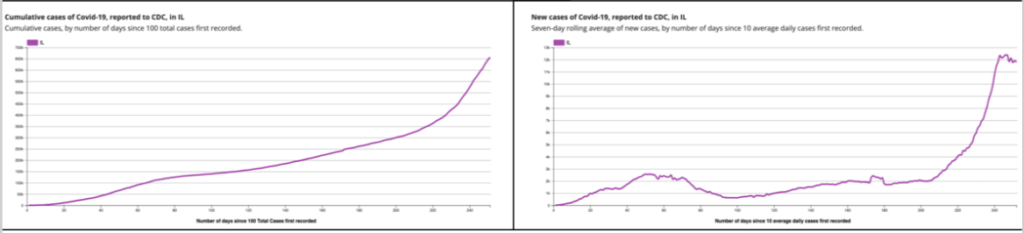
There has been a steady increase of cumulative cases in Illinois since the start of the pandemic as data provided by CDC recording the metric of cumulative cases of Covid-19 by number of days since 100 total cases first recorded, as shown in Graph 1. The number of new cases in the state is detailed in Graph 2. As of November 23, the number of infections statewide has totaled 664,620, and 11,552 Covid-19 related deaths. In my view, the severity of the surge correlates best with the number of new cases, the positivity rate, indicated in Graph 2 and other metrics such as mortality rate and the capacity of the healthcare system to handle the demands. Last week Illinois was averaging 12,384 new cases per day, the highest 7-day average since the start of the pandemic. This past week, luckily, we have seen a slight improvement from that number down to 8,322 of new confirmed and probable cases of COVID-19 on Monday Nov 23rd. But it is too early to tell if this is true bending of the curve or just a statistical fluctuation. And there’s the threat of holiday gatherings that can quickly undo any improvement.

The next three pictures provide a comparative view as they list the number of cases, deaths, total number of tests and test positivity given as cumulative count as well as in the last month and last week. The data shows that the positivity rate is at above 10 % this past month and past week, not quite as high as it was in the spring when it was above 20 %, but that is a reflection of more people being tested. The worst month in terms of deaths was May, with around 3000 deaths. On the bright side, we have learned a lot about SARS-CoV-2 and its management, so the death rate from the disease is lower now compared with the spring. That being said the cumulative number of SARS-Co-V-2 patients is much higher and therefore we are seeing the number of deaths increasing.

What about the capacity of the healthcare system to handle the current demand?

In terms of the capacity of the healthcare system to handle the demand, Chicago Tribune published an article to describe the situation in detail as of November 24. Here’s a chart showing the number of hospitalizations over time.

The guidance and advice of the public health officials is to break away from the traditional Thanksgiving gatherings in order to keep the holiday from having a negative impact on the current situation with the pandemic. What do you hear from your patients?

I practice in the inpatient setting. Since my patients are sick enough to be hospitalized, Thanksgiving travel plans are out of the question. We do recommend that after discharge, they continue to isolate for 20 days since the day of the positive test.

With consideration to the impact of the pandemic, some studies have focused on the connection between anxiety and mental illness and COVID-19:. I read some news reports about “long-haulers”? What can you tell us about it?

My practice is limited in the hospital setting. During the hospitalization period we do see a lot of encephalopathy which manifests as lethargy and confusion which are neurologic manifestations of Covid-19. Most people do improve by the time they are ready to be discharged, but I have seen a few cases of elderly who got sick in the spring, and have returned for different issues still not recovered mentally. It is a picture very similar to that of advanced dementia, some with behavioral disturbances. They require significant assistance with the activities of daily living. Then there is the separate group of the so-called “long haulers” who in addition to the physical symptoms experience significant anxiety and depression. There is a ripple effect in the society as a whole when we consider the impact the pandemic is having on the mental health of family members, associated with a significant level of stress compounded by limitations in visitation policies. I see a lot of anxiety, feeling of helplessness and being overwhelmed.

You mentioned that you will be in the Covid team for the next several days. Explain what that means, please.

We rotate as attending physicians for Covid patients. So in the next few days all my patients will be Covid patients who are hospitalized. I am part of the team that will be handling their management on the general medical floor.

For months now, one group, in particular, has been overwhelmed and overburdened to the brink of endurance. What can you tell us about the general mood of the health workers?

This is such a loaded question. For healthcare workers dealing with challenges and crisis has always been a daily occurrence. But the magnitude of this pandemic has faced health workers literally with the fight of their lives. In addition to the physical and mental demands of the job, there are new and significant challenges in our personal, family and social lives.

For us as essential workers who can not work from home, even the most mundane tasks all of a sudden have turned into logistical nightmares. Things like arranging reliable childcare, adding new steps to self disinfecting after work, maintaining social distance even within the home, finding time for grocery shopping and meal preparation, helping our children with remote learning, the list goes on. Even though most people I know avoid talking about it, especially in households where both parents are healthcare workers with young children, there is a heightened sense of urgency in addressing issues such as advance directives and living wills.

This pandemic is far from over and we have to keep going. Despite the physical and mental exhaustion they face, healthcare workers continue to be incredible examples of courage, empathy, and collegiality.

Filed Under: Interviste Tagged With: Dielli Exclusive, Interview, Rafaela Prifti

Brenda çdo gruaje fle një poete…

November 23, 2020 by dgreca

Intervistë me poeten Neviana Shehi/

Brenda çdo gruaje fle një poete, që pret orën e saj për t’u “zgjuar”… 

Takimi me poezinë e Neviana Shehit nuk është një takim i zakonshëm, pasi edhe mjetet dhe tekonolgjia e saj poetike nuk janë të zakonshme. Neviana është poete e imazhit, e figurës së gjallë dhe të freskët, e depërtimit në thellësi të vetvetes dhe në raportet ndërpersonale, ku gjen dhe sendërton trajtat dhe gjendjet, formën dhe përmbajtjen e poezive të saj. 

Poezia e saj dallohet për sinqeritetin, ngrohtësinë, thellësinë e ndjenjës dhe sofistikimin e mendimit poetik. Dallohet për elegnacën e fjalës dhe befjen e imazhit, gjetjet e holla dhe finesën e përcjelljes së mesazheve tek lexuesi. Në këtë poezi ka ritme jete, vrullim ndjenjash, vlim pasioni, por mbi të gjitha ka kërkim harmonie e bukurie, tek të cilat me sa duket beson poetja dhe tenton t’i gjejë dhe t’i artikuloj në çdo varg e strofë, në çdo poezi. 

Poezia e saj thuret e shthuret në alkiminë e një pasioni të qëndrueshëm, që herë herë endet në kurba të epërme dhe ritmet me të cilat na fton poetja të ecim në rrugëtimin jetësor nuk janë ato të së rëndomtës, të së zakonshmes e të së përditshmes, pasi lënda e parë me të cilën ajo gatuan “bukën poetike” janë rezistenca ndaj të keqes, ndaj manipulimit, janë flirti, joshja dhe emocioni, të cilat përcjellin gjendje të dridhshme, të etshme, kërkuese, klithëse e trallisëse të unit. 

Në këtë intervistë, ajo rrëfën me zemër në dorë “sekretet” e poezisë që shkruan, shtysat dhe motivimet e brendshme, rruëgtimin jetësor, pjesë e të cilit është dhe rrugëtimi i saj në fushën e poezisë…  

-Çfarë është poezia për Ju?

-Është aq i gjërë dhe njëherësh specifik një përcaktim i mundshëm rreth termit poezi. Poezia për mua është një akt dashurie e poetit për jetën, për veten dhe ata që e rrethojnë, për vetminë, iluzuionin, ëndrrën, është një depërtim në të panjohurën, që banon në thellësitë e shpirtit dhe të pavetëdijes. Poeti dallohet nga njerëzit e tjerë, njerëzit e zakonshëm që ka pranë, pasi me anë të shkrimit estetik, konkretisht poezive, e kthen në energji pozitive gjithçka, gjendjen, kujtesën, emocionin, dhimbjen, vuajtjen, dështimin dhe duke bërë këtë, ai çlirohet nga pengesat brenda vetes dhe ecën me hap më të sigurtë përpara. Thënë ndryshe, poezia është një lloj kat’harsisi shpirtëror, një lloj “liturgjie”, që pastron shpirtin dhe e bën më të pastër qenien humane. 

-Kush është Neviana Shehi? Diçka rreth jetës suaj dhe fillimeve letrare…

Kam lindur në qytetin e Durrësit, në një familje arsimdashese…

Deti, aroma e jodit, stërkalat e valëve dhe loja e dritëhijeve, që përthyhen në këtë bregdet magjik, do të ishin substrakti i një kujtese që me kohë do të përcillej nga unë si ndjesi malli e pritjeje, me anë të poezive që do të pasonin njëra tjetrën. Edhe sot këto imazhe janë aq të afërta e të prekshme, sa më duket se me anë të vargjeve dhe strofave i rrok dhe i rikthej në  kohë, tashme si metafora dhe simbolika në ikje. 

Shkollimin e mesëm e kreva në vendlindje Durrës, në gjimnazin me shumë tradita “Naim Frashëri”. Ambienti letrar i këtij gjimnazi dhe puna e mirë e mësuesit të letërsisë me nxënësit me prirje, më nxitën pasionin dhe talentin në fushën e poezisë. Të kësaj periudhe janë disa cikle poetike, të cilat për vetë kushtet e kohës, nuk munden te shikonin dritën e botimit. 

Megjithatë, kjo shkollë u bē stacioni i parë dhe i rëndësishëm i kontaktit tim me emrat e mëdhenj te letrave shqipe dhe botërore. Leximet e shumta të romaneve, novelave, tregimeve, si dhe leximet kolektive të veprave letrare në familje, ndikuan në rritjen time kulturore dhe të dashurisë së ndërsjellte midis meje dhe librit, zgjeruan diapazonin tim krijues dhe liritë e fantazisë. 

-Ikja nga Shqipëria, kontaktet me poezinë dhe kulturën perëndimore,  duket i dhanë një implus të ri talentit tuaj poetik…Çfarë mund të na thoni në lidhje me këtë?

-Ikja nga atdheu, si shumë të tjerë, në kërkim të një jete tjetër, më krijoi mundësi të reja në të gjitha drejtimet. Së pari, bëri që të vendosja kontakte me kulturën letrare italiane dhe gjermane, solli rifomatime të ndjeshme brenda meje, duke bërë që ta vështroja gjithçka nën një optikë të re, sociale, etike e, sigurisht, edhe estetike. Pra, m’u zgjerua vizioni i lirisë dhe ana konceptuale e poezisë, të cilën tani e vështroja në një plan tjetër dhe në rrafshin krahasues, me atë çfarë shkruhej e botohej në lëmin e poezisë italiane, gjermane dhe evropiane në përgjithësi. 

Gjatë qëndrimit në Gjeramani, kreva studimet e larta në FU, Berlin, në degën Hospitality Management dual studium, studim-punë. Për disa vite kam punuar në agjensinë e menxhimit të eventeve të ndryshme kultutore, shkencore, politike -Unitech und Reisen- në Berlin. Kjo përvojë, përveçse më shërbeu në krijimin e një shtrati të qëndrushëm profesional, ishte dhe një shkollë e çmuar, një proces njohjeje e thellë e vetvetes dhe psikologjisë së këtyre vendeve perëndimore, pa të cilën udhëtimi im poetik do të ishte, në mos  i mangut dhe i cunguar, të paktën, i pa plotë. 

Këto kontakte do të thosha ma zgjeruan vizionin e lirisë si dhe anën konceptuale të poezisë, e cila u pasurua me elementë të rinj artistik, ku vendin kryesor e zënë figurat e gjetura dhe simbolikat e guximshme.

-Poezia juaj dallohet për një një simbolikë të fortë, figura të gjalla dhe imazhe fluide që të mbeten në mendje. Cilat janë disa “sekrete” të saj?…

-Mendoj se poezia është një gjendje trazimi të gjithëkohshëm, që vjen një çast e del nga thellësitë e shpirtit në sipërfaqe, në formën e vargjeve dhe strofave, si një komunikim i veçantë, përtej diskursit të së folurës dhe të së shkruarës sonë të përditshme. “Sekretet” e saj janë të shumta, por “sekreti” im mendoj se është spontaniteti. Ky spontanitet më ka çuar dhe më çon tek ato gjendje dhe imazhe, të cilat i hedh në letër siç më vijnë, pa artifice dhe shtirje. I hedh të gjitha ngjyrat pa retushim në telajon poetike; mungesën, flirtin, dashurinë, ëndrrën, ngjyrat e trishta, pezmin, dhimbjen, ankthin, gjithçka që gëlon në jetë, por që unë në poezi i rikonfiguroj në diçka tjetër, në energjinë pozitive të shpirtit, që ka një nevojë urgjente për t’u çliruar nga rëndomësirat dhe që vjen tek lexuesi si një mesazh për ndryshim dhe përsosje. 

Në vargjet e mia hedh copëra realiteti dhe imagjinate, endjet e mia kërkimtare, si kohë arkitipale, si lëvizje fizike, si perceptim, si kujtesë, si arkeologji e ëndrrës së kulluar. Nuk ka një definacion rreth gjithë kësaj, është më tepër një gjendje e kulluar përjetimi metafizik, që më shtyn drejt poezisë si drejt një “meshe” të shpirtit, duke më mundësuar të rikrojoj një minibotë, me anë të një strukture të moderuar të sendërtimit të artit tim poetik. E gjithë kjo tingëllon mbase disi e sofistikuar dhe do të doja ta thjeshtoja në maksimum, duke pohuar se fundja poezia më bën të ndihem mirë, e plotësuar dhe në harmoni me veten dhe të tjerët. Kaq më mjafton.

-Në Itali duket se gjetët, si të thuash, “Itakën”poetike dhe shpërhimet e tua qenë befasuese. Nga njëri vëllim me poezi në tjetrin duket një hop cilësor dhe një pasurim mbresëlënës i spektrit meditativo-lirik dhe modernitetit. Diçka më shumë rreth kësaj…

Pas Gjermanisë, më pas veprimtaria ime transferohet ne Arezzo, Itali, ku kontaktet me poezinë moderne italiane dhe evropiane ishin në pikën më të lartë dhe gjatë kësaj periudhe i kam dhuruar lexuesit tre vellime poetike: “VJESHTE FATESH” 2018, Shtëpia botuese “Klubi i poezisë”, “PËRTEJ VALEVE” 2019, Shtëpia botuese “Klubi i poezisë”, “BURRI I NETËVE TË MIA” 2020, shtëpia botuese “Armagedoni”, Prishtinë, Kosovë. Gjithashtu krijimet e mia janë botuar në gazeta dhe revista të ndryshme letrare, Kosovë, Shqipëri dhe Maqedonia e Veriut. Në konkursin kombëtar kushtuar pandemisë botërore, Covid 19, poezia ime konkuroi me shumë sukses, krahas qindra konkuruesve të tjerë,duke merituar vendin e dytë.

Nëse tek libri “Vjeshtë fatesh” isha në fillesat e rrugës poetike, me një lloj tërheqje, krejt normale për poetët e pa afirmuar, pritja e ngrohtë nga lexuesi dhe kritika e këtij libri, do të thosha modest, më bëri që në librin tjetër me titull “Përtej valëve” të “sulmoja” më me “vrull”,  duke e pasuruar qoftë fjalorin dhe figurën poetike, qoftë strukturimin formal me elemente të rinj, çfarë me kohë do të më jepte një farë sigurie në këtë rrugëtim sa të bukur, aq dhe të vështirë.

Libri i tretë “Burri i netëve të mia” sapo ka dalë dhe vërej se ka një interes në rritje nga ana e lexuesit për ta pasur në raftin e librave, plus interesimi i kritikës ka qenë në një shkallë të kënaqshme, çfarë më shtyn të mendoj se jam në një kurbë rritjeje estetike dhe do ta vazhdoj pa u ndalur për asnjë çast rrugëtimin poetik. 

-Poezia juaj dallohet për sinqeritetin, ngrohtësinë, thellësinë e ndjenjës dhe sofistikimin e mendimit poetik. Gjithashtu spikat për elegnacën e fjalës dhe befjen e imazhit, gjetjet e holla dhe finesën e përcjelljes së mesazheve tek lexuesi…Ndiqni ndonjë “shkollë” poetike apo gjithçka ju vjen natyrshëm dhe sponatnisht?

-Faleminderit për konsideratën. E thënë nga një kritik profesionist si ju, më pëlqen. Ju thashë, kontaktet me poezinë aktuale moderne që shkruhet në Gjermani dhe Itali, njohjet me poetë të ndryshëm evropianë, kanë pasur dhe vazhdojnë të kenë ndikimin e tyre. Por poet nuk të bën asnjë lloj shkolle, poeti lind dhe spontaniteti, ajo që të fal natyra si dhunti dhe talent, janë kryesorja dhe i vënë “vulën” çdo shkrimi letrar, në rastin tim, artit poetik. Pra, e thënë më shkoqur, unë nuk ndjek asnjë “shkollë” poetike, por ritmet e zemrës dhe ndjesitë e shpirtit, që më shtyjnë drejt zbulimit të oazeve estetike, drejt vargjeve dhe strofave, që shprehin unin tim, kujtesën dhe emocionin me të gjitha raportet e ndërlikuara të aktit poetik.  

-Të qenit bashkëshorte dhe nënë, a duket se e tkurr dimensionin poetik, a e kufizon mundësinë e arritjes së maksimimit nga ana juaj?

  – Jo, përkundrazi. Të qenit nënë dhe bashkëshorte, sigurisht që është një ngarkesë dhe përgjegjësi e madhe në familje. Një gruaje dhe një nëne i duhet shumë përkushtim për të bërë më të mirën e mundshme për familjen e saj dhe kjo në një farë mënyre ka “koston” e vet në krijimtari. Por kjo, mua jo vetëm nuk më ka penguar, por më ka nxitur të vazhdojë më me këmbëngulje rrugëtimin poetik, të kemë prurje të kënaqshme, me vlera cilësore në krijimtarinë time, siç është shprehur kritika profesioniste. Motivimet poetike të një nëne, të një bashkëshortje, mendoj se janë shumëfishi i atyre të një femre “të lirë”, pasi brenda çdo gruaje dhe çdo nëne “fle” një poete, që pret vetëm orën e saj për t’u “zgjuar”. 

-Cilat janë projektet e tua në të ardhmen?

-Kam shumë plane dhe “ëndrra”, por të sendërtuara në projekte konkrete, që mendoj t’i realizoj së shpejti, janë dy libra të tjerë, një me haiku dhe tjetri me prozë.

Intervistoi: 

Dukagjin HATA 

Filed Under: Interviste Tagged With: Dukagjin Hata, Neviana Shehi

  • « Previous Page
  • 1
  • …
  • 67
  • 68
  • 69
  • 70
  • 71
  • …
  • 216
  • Next Page »

Artikujt e fundit

  • Kullat e familjeve të mëdha patriotike si objekte të trashëgimisë historike
  • ALARM SIGURIE DHE NDËRGJEGJËSIMI KOMBËTAR
  • Edith Durham – Shqiptarët dhe serbomalazezët në 1910-1912
  • Public Statement from VATRA
  • “Universi Biblik” si pasuri e Muzeut të Artit Mesjetar
  • Lavdi përjetë martirëve të 2 prillit!
  • KOSOVA DHE PAVARËSIA E SAJ NË KËNGËT E ARIF VLADIT
  • Masakra e Tivarit – Një e vërtetë e shtypur për shumë kohë
  • Pasqyrimi në filateli i mbështetjes amerikane ndaj Shqipërisë gjatë L2B
  • MASAKRA E TIVARIT, 1945: HESHTJA ZYRTARE QË VAZHDON TË VRASË
  • DR.ATHANAS GEGAJ, EDITORI I “DIELLIT” NË OPTIKËN E DOKUMENTEVE ARKIVORE TË VATRËS (1963-1971)
  • Kujtojmë në ditën e lindjes patriotin e shquar Kostandin Çekrezi, figurë e rëndësishme e historisë dhe publicistikës shqiptare
  • Vasil Rakaj, malësori që ngjizi me shkëmb, metal, dru, baltë dhe shpirt, altarin e përjetësisë
  • “Ajo që pashë në Raçak më ndryshoi jetën”, ambasadori Walker rrëfen në Boston çfarë ndodhi në Kosovë
  • VATRA Boston dhe Kisha “Holy Trinity” promovuan librin “Saint Paul in Dyrrach” të profesor Thanas Gjikës

Kategoritë

Arkiv

Tags

albano kolonjari alfons Grishaj Anton Cefa arben llalla asllan Bushati Astrit Lulushi Aurenc Bebja Behlul Jashari Beqir Sina dalip greca Elida Buçpapaj Elmi Berisha Enver Bytyci Ermira Babamusta Eugjen Merlika Fahri Xharra Frank shkreli Fritz radovani Gezim Llojdia Ilir Levonja Interviste Keze Kozeta Zylo Kolec Traboini kosova Kosove Marjana Bulku Murat Gecaj nderroi jete ne Kosove Nene Tereza presidenti Nishani Rafaela Prifti Rafael Floqi Raimonda Moisiu Ramiz Lushaj reshat kripa Sadik Elshani SHBA Shefqet Kercelli shqiperia shqiptaret Sokol Paja Thaci Vatra Visar Zhiti

Log in

This website uses cookies to improve your experience. We'll assume you're ok with this, but you can opt-out if you wish. Cookie settingsACCEPT
Privacy & Cookies Policy

Privacy Overview

This website uses cookies to improve your experience while you navigate through the website. Out of these cookies, the cookies that are categorized as necessary are stored on your browser as they are essential for the working of basic functionalities of the website. We also use third-party cookies that help us analyze and understand how you use this website. These cookies will be stored in your browser only with your consent. You also have the option to opt-out of these cookies. But opting out of some of these cookies may have an effect on your browsing experience.
Necessary
Always Enabled
Necessary cookies are absolutely essential for the website to function properly. This category only includes cookies that ensures basic functionalities and security features of the website. These cookies do not store any personal information.
Non-necessary
Any cookies that may not be particularly necessary for the website to function and is used specifically to collect user personal data via analytics, ads, other embedded contents are termed as non-necessary cookies. It is mandatory to procure user consent prior to running these cookies on your website.
SAVE & ACCEPT