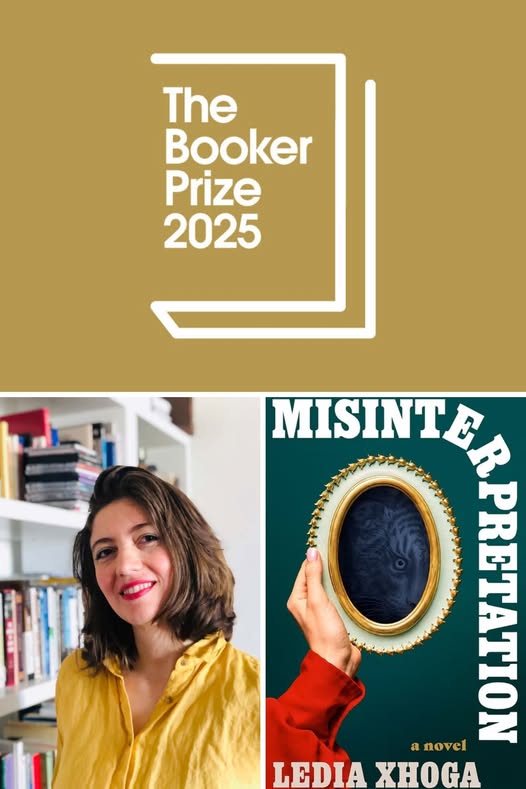
Interviewer Rafaela Prifti/
Congratulations on the nomination! You are the first Albanian-born female novelist longlisted for the Booker Prize. What jumps to mind instantly is Ismail Kadare’s winning the first Man Booker International Prize in 2005 (now International Booker Prize) – an award that honored his entire body of work. What is it like to be up there?
-Being longlisted certainly increases the book’s visibility and opens up opportunities. I feel beyond honored and hugely intimidated to see my name next to Kadare, whom I grew up reading. It’s also a bit strange, honestly, as it puts a strong spotlight on a person, and most writers are introverts who have a hard time with that kind of attention. As far as gender is concerned, six other wonderful writers who are women are on the list, so I’m in good company.
Living in-between is a central concept of the imigrant experience that you explore through the nameless protagonist, the Albanian American profesional interpreter, and a whole cast of imigrants from around the world in your debut novel.
-Yes, there are many immigrants in the story and they’re all experiencing the in-between. They all want something that’s beyond their reach, some are trying to become legal or heal themselves, some simply want a life where they’re not harassed. They all have their goals. The novel starts in January and I had the feeling, while writing it, that it would end in spring, which worked well metaphorically showing the possibilities of regeneration and renewal in that final scene.
“The Albanianess” is interwoven with the main theme of caring too much, a strong trait that leads the protagonist into dangerous situations. Since the book is released in Albanian by Botimet Dudaj, I will ask you to choose three words to describe it in Albanian.
Dinamik, mbërthyes, i paparashikueshëm.
The protagonist’s drive to help fellow immigrants, though admirable, becomes an unchecked compulsion. You had said that a brief personal experience as an interpreter for a New York organization, provided the premise of the story “that was ready to be told.” Was that unusual or is that an habitual workflow?
-It was actually a volunteer opportunity someone told me about. The man I was to interpret for had the same history as Alfred and he was a survivor of torture. But I’ve never worked professionally as an interpreter or translator. Yes, of course, it takes a while for some stories to get off the ground. A select few flow much easier it seems. Writers call them a gift. I wouldn’t say this story was a gift though. But although I struggled with the structure of the novel initially, there was something propulsive in the storyline, which allowed me to finish it.
In the story, silence is not just the absence of sound, it could indicate represion or rebellion, which is evident each time the narrator opts to say nothing to Billy, her husband, or Alfred, the Kosovar Albanian client that she is helping. What do the novel’s reflective spaces convey to the reader?
-It’s common for astute readers to notice things that writers don’t even intend, at least not consciously. I wasn’t aware of the role of silence, thank you for bringing it up. Billy’s attention to the unspoken is mentioned in regard to his interest in silent film and is consistent with the fact that he is also attuned to his wife’s moods, and he can read her reactions, even when she doesn’t tell him things. And then there’s the silence that happens after they fight, since they’re both upset. It offers a moment of introspection perhaps and it also reveals her feelings as she reflects upon their relationship. I like your interpretation that silence represents rebellion and repression, I’m sure that’s true, too.
The mother figure manifests itself in a fascinating ensemble of female characters such as the narrator’s mother, and Anna’s, Alma’s, Billy’s, Alfred’s. How does their presence – physical, emotional, psychological – enhance the larger narrative of the story?
-You are right, we get to know the mother of nearly every character! I think that the mothers in the novel embody the histories of the countries the characters come from as well as the ongoing emotional and psychological issues that affect generation after generation. Although they are trying to solve the issues that deal with their day to day life, these characters carry their pasts like shadows. This is something that the interpreter and Alfred sense about each other, by the way, and it connects them.
The interplays between dualities (the narrator’s father and uncle), contradictions in intents and motivations, echoes of the past in her family and the history of Albania build up the tension in several plot points with a thriller like quality.
-As people we are wired to notice similarities and differences, some of which are mundane and some are revealing from a character perspective. If you listen to any conversation in a coffee shop or bus, you’ll find statements like that, people trying to make sense of one another and pointing at differences. Of course, in fiction we have to think about how these characteristics fit in the bigger story. What did it mean for the interpreter to have a father who never sugarcoated things? So, the opposites serve to clarify characters, but they have to fit in the fabric of the story.
Would you please introduce yourself to the readers and your journey as a writer and a playwright? For anyone interested, there is a list of more than a dozen short and full length plays on your website lediaxhoga.com, a few of them are available for online watching.
-I’ve lived in New York City for a long time, for twenty years. I now am a parent and live in Brooklyn with my family. I worked in book publishing in Manhattan for many years, but then I wanted to write fiction, so I got an MFA in Fiction writing at Texas State. Yes, I’ve always been interested in Playwriting and had many short plays produced. I love writing dialogue. I also like screenwriting and would love to write a screenplay that turns into a movie someday.
What is the best way for the readers and fans to find out more about you and your work?
Thank you so much for reaching out to me about this. My website is lediaxhoga.com and I’m on
Instagram.
Your nomination is a remarkable achievement! The debut novel is a testament of your outstanding talent. Best of luck, Ledia!
The interview was conducted via email and edited for length and clarity Booker Prize is a prestigous literary award conferred annually for a single work of fiction written in English published in the UK. It was founded in 1969. Ledia Xhoga’s debut novel is among 13 works longlisted out of over 150 titles for 2025. The Booker Prize will announce its six-book shortlist tomorrow at the Royal Festival Hall in London.