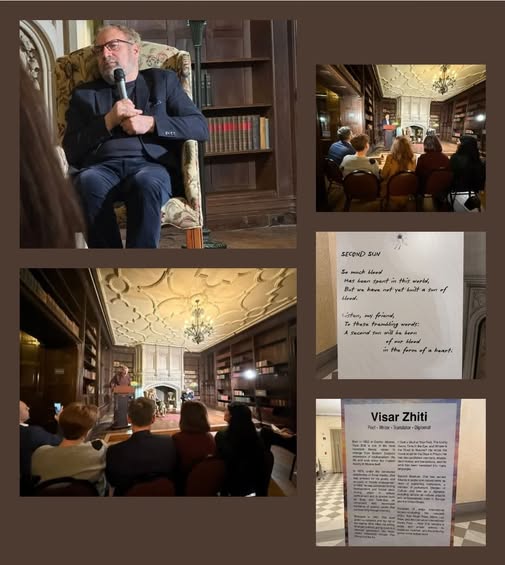
Last night, our wonderful young activists at AACI created a magical event to celebrate the unique 2025 official proclamation by Illinois Governor JB Pritzker, honoring freedom and our Visar Zhiti. It’s January 2026 in the USA, and we just had some of the darkest days in the history of this country and nation. We are experiencing a rupture in the fabric of the model of freedom, and last night, many of us needed to hear someone like Visar Zhiti talk about freedom. He has a unique life journey that gives him visibility from the darkest corners of humanity into the brightest moments of humanity. America should learn from Visar Zhiti and my hope was there will be more Americans last night who needed to hear Visar. It’s one of the reasons I decided to write about it in English and share my thoughts with those young Albanian-Americans who need to hear Visar talk about freedom. I will try to braindump my notes for you.
In his opening statement ,Visar with endless empathy, acknowledged that while he will share with us some of the struggles in his life journey, he knows about the struggles and difficult life journeys of all Albanians surrounding Albania. Coming back to the struggles of Albanians in communist Albania, he referred to themselves as “luftëtarë pa luftra” (warriors without wars) compared to our warriors in actual wars. The conversation was masterfully led by young AACI board member, Ada Hoti, and in preparing for the event Visar and Ada had decided, in the spectrum from darkest to brightest, this evening to focus on the side of good to cherish some moments of hope about freedom.
The first Visar’s poem that was shared was “Mirënjohja” (Gratefulness). Visar has found the strength to forgive all those involved who interrupted his youth and freedom. He spoke briefly about this moment and considered being grateful and forgiving as a way to give yourself back freedom. “Ndonjëherë e ke burgun në mendime” (Sometimes you have jail in your thoughts) was a very powerful statement. If there’s something in your life that keeps your thoughts jailed, you should find the strength to liberate your thoughts by forgiving and being grateful.
We then took a dive in “Në detin e Homerit” (In Homer’s Sea). This is a massive realm to explore, and Visar shared some of his thoughts looking back at the time he wrote that poem and how he wrote so much around the shoe metaphors. His novel “Këpuca e aktorit” (The Actor’s Shoe) dances around the object of the shoe. “Këpuca të mbron, po edhe te ndan nga ndjenja e tokës” (Shoe both protects you, but it also separates you from feeling the ground).
Going back to our dark and cold January 2026 realities, I feel we have lost the ability to feel grounded. As some of you may have noticed, I consider algorithms the enemy. Our eyeballs and thoughts have these “shoes” of violence, and we can’t seem to get out of this vicious cycle. I will try to further explore that realm of thoughts as I go through my notes from the event. Visar shared more thoughts on why he loves using shoe metaphors, as they are also a symbol of motion, travel, and exploration.
“Udhëtari udhëton dhe kthehet. Unë shpresoj që gjithë udhëtojmë të kthehemi” (The traveler travels and then returns. I hope we are all traveling to return). This was another thought-provoking moment to step back and think if we are all on a road to somewhere, is that destination always the start of our journey? We are born there, live here, and we get buried back where we were born? Visar then shared another moment for those free-spirited Albanians who lived locked in communist Albania. “Ne mund të ishim më të ikur duke ndenjur në vendin tonë” (Maybe we would have been gone more by staying in our country). This is a powerful feeling of not belonging where you live. You are not where you feel you are supposed to be, and so you pack and go where you feel free. The ultimate pursuit of happiness is also a journey, and while some feel they will be free in America, others feel they will be free in Albania, in Kosovë, in Kërçovë… We should all pursue our happiness.
Visar then spent some more time around his topics in his latest novel, “Këpuca e aktorit” (The Actor’s Shoe). “Njeriu e mendon të keqen më të fortë nga e mira (sipas Frojdit), mirëpo unë besoj që e mira është më e forta” (We think evil is stronger than good (Freud), but I believe that good is the strongest). Visar has seen and experienced the worst in humans. When I had the privilege to have a longer conversation with him, I mentioned to him many eye-opener moments during my days as a student in Albania, when I would hear horrific stories of what was happening amongst Albanians behind the iron curtain of communist Albania. Although these moments are painful and revisiting them causes pain, I think we need to share these stories with future generations to ensure we have our own “never again”. I think these stories also need to be shared with our fellow Americans who need to hear how bad things can become if we continue on this path of self-destruction.
Visar then shared his formative moment when he got a bit of taste of freedom through Whitman’s poetry. In a very brief period of light shining through the darkness of communist Albania, some Western literature was translated into Albanian. Skender Luarasi translated “Leaves of Grass” (Fije bari), and due to the glorious ignorance of whoever was removing Western books from libraries, this one survived as an agricultural book.  So, thanks to agriculture, Visar got to experience some of Whitman’s poetry, which not only inspired him but also shaped him as a person. There were many metaphors he shared from this formative moment and how his life journey changed as you start thinking “liria është si ajri” (freedom is like air). We can’t live without air, and we can’t live without freedom.
The next chapter of the event on freedom featured one of our freedom heroes, Musine Kokalari. Visar shared many inspiring moments of Musine’s life journey. She studies in a prestigious university in Italy, and for her graduating thesis, she bravely chose to study one of her own – Naim Frashëri. Her work shines a light on Albanian studies as a foundation for so much more that needs to be done. She has a huge influence on many more Albanians who bravely followed her, including Ismail Kadare. Yesterday was going to be Kadare’s 90th birthday, so it was a wonderful moment to connect his inspirations with his incredible life’s work. Visar shared some details about how much the communist regime feared Musine. She gets arrested with her brothers, in a shameful moment for Albanians, she is accused and sent to serve prison in the harshest conditions. After serving her sentence, she is placed in a Rrëshen suburb. Visar described how this place looked: if Albania at the time was in dark corners of the world, Rrëshen was in the dark corners of Albania, and this Rrëshen suburb was the dark corners of Rrëshen. That’s where Musine was placed to live the rest of her life by the regime, afraid of her power of freedom. Even when she died, the inhumane regime had wrapped her body with barbed wire and tossed her in an unmarked spot. After the fall of the regime, Albanians found her remains in the barbed wire. She now has a memorial in Rrëshen and will live forever in our memories of freedom and resistance.
Visar then shared some of his highlights about the most famous Albanian, Saint Mother Theresa. She is a joint pride of all Albanians, as she was born in Shkup, her parents from Kosovë, and her mother lives in Albania – we are all parts of what formed Saint Mother Theresa. Visar and his wife, Eda, have explored her activities in Chicago to learn more about her, and he shared with us some of their findings. “Lutjet e saja janë poezi” (Her prayers are poetry) and “Nënë Tereza është liria e dritës” (Mother Theresa is the freedom of light) are some of the expressions he used to describe her. He shared how she knew how to deal with the worst of the dictators of her time. Goes to Cuba and meets Castro. Asks him to allow her to open a house for the poor. Castro responds that nobody is poor in Cuba, as we are all equal. She responds not to worry about it, as she will find them.  Tiny lady but mighty fighter. Visar’s wife, Eda, had also collected another intimate moment that was shared by one of the ambassadors’ wives who participated in the sainthood ceremony in the Vatican. After Mother Theresa is finally allowed to come visit Albania by the communist regime after many years of begging them to visit her mother, Mother Theresa meets with Ramiz Alia. Similar to her demands to Castro, she asks to open a house for the poor in Albania. She gets no response, just a fake smile from him. She then also meets with Nexhmije Hoxha, who was suddenly going to lecture Mother Theresa about the rules of capitalism and that the house will be sold to the highest bidder. Mother Theresa responds: “doja të të jap rastin të jesh një herë e mirë” (I wanted to give you an opportunity to be kind once).
The next topic was the poem “Nënë” (Mother). Visar shared the darkest moments of his trial when he “wrote” this poem in his head. In those darkest hours, when he was experiencing the worst that fellow humans can do to another, his thoughts went to his mother. To cope with these dark hours, he mentally blocked out reality and thought about this poem. After he is placed in his jail cell, he talks with his jailmate, who asks him to share this poem in his thoughts. Visar shares it with him and hears back “poezitë duhen shpëtuar!” (poems must be saved!). In the darkest hours, these two cellmates were now on a mission to save poetry and thus save humanity. They shared them with other cellmates who were reciting them in their heads to make sure they wouldn’t be forgotten in case all the paper was destroyed. This moment of two fellow humans coming up with this mission to save humanity by saving poetry should be our call to action in these dark hours of January 2026. We need to band together to save our souls, to save our children from the doomscrolling jail, we need to stand up to fascism taking over the US before there are more fellow humans killed by the ICE Gestapo-like officers. “O fëmi, na edukoni!” (Oh children, educate us!) was how jailed Visar and his fellow jailmates were looking for hope. They were hoping there would be another generation to stop the madness of placing in jail those who think and write about freedom. We are at a tipping point of the rupture. This land and its people may be in the first days of lynching, like the Musine Kokalari lynching, we may be in the dark days of government placing in jail other Visars because they don’t have papers, because they are brown-skinned, because ICE didn’t like them.
Writing these notes and thoughts in the early morning after the event, as the sun serves up a brand new day, I am hopeful we will learn from Visar. He shares his lessons through his literature, and these talks, like the one last night. Similar to that moment of “poezitë duhen shpëtuar” (poems must be saved), I decided this talk needed to be captured and shared. Hope you managed to arrive here, reading all this, and now “save it too”. Many thanks to all the wonderful Albanians at AACI who worked to organize this event, and forever grateful to Visar for everything. “Dalshim gjallë”* 
ILIR ZENKU
Chicago, January 29th, 2026.
(Written first hours at dawn of the day after AACI event with Visar Zhiti held on January 28th, 2026, celebrating “Day of Freedom” as proclaimed by Illinois Governor JB Pritzker)
* ”Dalshit gjallë” (May you come out alive) was the salute amongst jailmates in Spaç mine as they were changing shifts. Those who were coming out of the mine would wish for the ones going into the dark mine just to come out alive. My slight modification to this salute is that I hope we all come out of this dark period alive and well.