AFA/
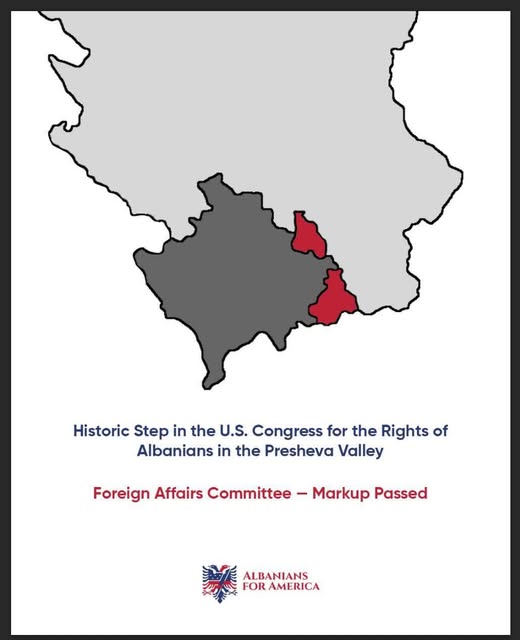
Albanians For America (AFA) is proud to announce that the Presheva Valley Discrimination Assessment Act has advanced in the U.S. Congress—an important step toward accountability and protection of ethnic Albanian rights in southern Serbia.
The legislation directs the U.S. Secretary of State to prepare a comprehensive report on the treatment of ethnic minorities in Serbia, with a specific focus on ethnic Albanians in the Presheva Valley. It examines critical issues including the passivization of Albanian addresses that restrict access to identity documents and voting rights; limitations on the use of the Albanian language in public institutions; lack of proportional representation in state bodies; discrimination in education, including denial of Kosovo diplomas and shortages of Albanian-language textbooks; economic neglect through unequal government funding; and intimidation through law-enforcement practices. It also addresses the suppression of cultural symbols and the long-term sustainability of life for Albanians in the region.
This milestone reflects the strong partnership between Albanians For America and our congressional champion, Keith Self, whose leadership and commitment made this legislation possible. Through sustained advocacy, research, and engagement on Capitol Hill, AFA worked closely with his office to ensure that the concerns of ethnic Albanians in the Presheva Valley are formally recognized by the United States Congress.
We extend our sincere appreciation to Brian Mast, Chairman of the House Foreign Affairs Committee, as well as to Ranking Member Gregory Meeks, and the members of the Committee for their leadership, attention, and commitment to advancing human rights and democratic values in the Western Balkans. Their support is essential to ensuring these issues receive the serious consideration they deserve.
What comes next: Once the bill passes committee markup, it will be reported out of the House Foreign Affairs Committee and sent to the full U.S. House of Representatives for a vote. If passed, it moves to the U.S. Senate. Should the Senate pass the same version, the bill will be sent to the President for signature. If amended, a joint House–Senate conference committee will reconcile differences before final passage.
If enacted, the law will require the U.S. State Department to report to both the House Foreign Affairs Committee and the Senate Foreign Relations Committee within 180 days—elevating these human rights concerns to the highest levels of U.S. foreign-policy decision-making.