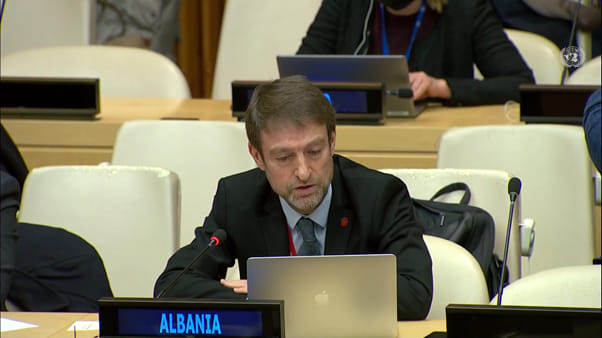
Mr. Chair,
I thank the UAE Mission for organizing this Meeting on the linkages of climate change and pace and security.Thank you, Minister Sultan Al Jaber, for chairing and for your insightful remarks.Chair,While we all would like to devote our time to crucial issues like the one proposed today, which affects us all, we may not miss from voicing – at the outset – our outrage about the Russia’s unprovoked aggression against Ukraine, for all the good and fundamental reasons we all are aware of. If we fail to do so, we would agree, willingly or by silence, that the very foundations of this house, of the UN System and the International rules-based order, are put into question.When we finally saw some light at the end of the tunnel of the long, disastrous and tragic Covid-19 pandemic, the act of aggression by Russia on Ukraine has caused a new and enormous tragedy, the ones that we thought are, in our part of the world, once and for all left behind.As we see every day, the escalating and deteriorating situation on the ground does not just have disastrous humanitarian consequences; bombardments, explosions, ammunitions, large scale destructions have also a negative impact on the environment, and, as we have seen in recent days, also endangers nuclear security in Europe.Further, the distraction and shift of focus away from the other great global threat that has been looming – climate change – may be catastrophic in the long term. Mr. Chair,Climate change and environmental degradation act as threat multipliers, amplifying security risks and threatening human rights already under attack all over the world.They have profound negative consequences for peace and security, our well-being and ultimately our survival.We already see a fight for resources, a rise in intercommunal violence, and a growing threat of terrorism in many areas affected heavily by climate change.Mr. Chair,Climate plans for 2030 are politically very ambitious. This is right and welcome. But they will fail unless they are appropriately financed. In accordance with their capacities, countries need to increase their contributions and close the financing gaps for the adoption and resilience plans for low- and middle-income countries, especially those in fragile and post-conflict setting.Here are some key elements in what we think should be a common to-do list:We must strengthen partnerships, especially with the private sector and international financial institutions, as Secretary Kerry highlighted.We must strengthen theunderstanding on the climate and security nexus at the UN. We need to consistently incorporate the effects of climate change into the planning and implementation of the UN Mission. This will help the UN Missions to increase their capacities to analyze threats arising from climate change and the resulting loss of land or extreme weather events and at the same time help donors to better understand the co-benefits of climate action, for peace and security.It was not a long time ago that many of us tried to have this issue rightfully sanctioned by a resolution of the Security Council, which was unfortunately vetoed by Russia. This prevents the Council’s ability to deal with the negative effects of Climate Change and the resulting security threats significantly. We must therefore use the IEG more strategically to mitigate this loss in the Council’s toolbox.Finally, we need to include civil society consistently in our efforts to address climate related risks.Mr. Chair,Let me conclude by highlighting what we are doing in this respect. Although a small country with a low emission contribution, Albania is absolutely determined to do its part in this very important process and has taken several concrete actions to support green growth and revitalization.Albania is the first country in the Region with an endorsed Strategy on Climate Change and related Action Plans, with policy objectives and concrete actions to reduce greenhouse emissions.A special law on “Climate Change” has been adopted on December 2020. Further, in support of the objectives of the European Union Green Deal, Albania has signed two Declarations in November 2020: the Western Balkan countries on the Green Agenda, as well as the creation of a Common Regional Market, which aim at making the economy sustainable and climate-neutral by 2050. Albania has committed to reduce greenhouse gas emissions by 45% in the next decade, and to achieve net zero emissions by 2050.Mr. Chair,We are responsible for what we do, but also for wat we do not do. With respect to climate change, with what we know now, there is not excuse. Albania is already doing its part. Thank you!