Halit Daci/
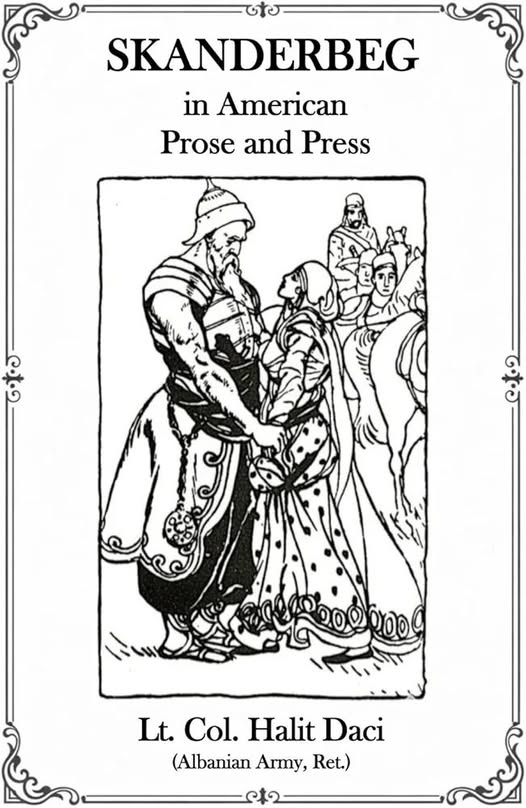
“Skanderbeg in American Prose and Press” reintroduces two fictional narratives about the legendary Albanian hero Gjergj Kastrioti—also known as Skanderbeg or Iskander Bey. Published roughly half a century apart, these accounts capture distinct moments in the transatlantic transmission of Skanderbeg’s legend. While one of these narratives achieved a lasting, if evolving, public presence, the other faded into near-total obscurity. Nevertheless, these recovered texts remain virtually unknown to contemporary readers and scholars.
The first of these narratives is James M. Ludlow’s well-known novel The Captain of the Janizaries, which has remained accessible in both book and digital formats, making a new edition of the text itself seemingly unnecessary. This volume, however, recovers an overlooked manifestation of Ludlow’s work: its illustrated newspaper serialization. Prepared for syndication in 1903 and published in 1905, this version—distinct from the bound book editions—was the first to introduce Skanderbeg’s legend to a mass American readership.
By contrast, the second work, John H. Crabb’s In the Crescent’s Dark Shadow, published in 1952, has nearly vanished from American literary memory. Only a small number of copies survive in library holdings and private collections, and the novel has no known digital presence. Its absence in scholarly discourse is striking, particularly given its sustained engagement with Iskander Bey’s legendary narrative. Whether the novel was an early exercise in the ardor scribendi of a young historian-author or simply lacked the promotional support of an established publisher, it quietly slipped from public circulation.
Together, these two novels trace the movement of Skanderbeg’s legend through American prose and the periodical press. They demonstrate that this legacy was shaped not only by authorial imagination but also by the specific mechanisms of print culture—namely, serialization, illustration, and the reading practices of an expanding audience. Through their respective narratives, Ludlow and Crabb reveal how the fifteenth-century Albanian hero was recast and reimagined in forms that resonated across national and temporal boundaries.
The recovery of these texts for the present edition was made possible through regional archives, historical societies, extensive digital newspaper databases, and private book collections. This volume therefore provides a new opportunity to examine how Skanderbeg’s story was constructed, disseminated, and reimagined in American print culture. Accordingly, this critical edition serves both as a restoration of long-forgotten literary works and as an invitation to reassess Skanderbeg’s representation within the broader framework of American literary history.