Washington is being sold a strategic partnership with a constituency that rejects it — at the cost of partners who actually deliver.
By Elmi Berisha | 8 April 2026
Donald Trump Jr.’s visit to Banja Luka on April 7 was, taken on its own terms, unremarkable. Private citizens travel for business. Republika Srpska, whatever its politics, is not a prohibited destination. The meeting with local officials and business figures was the kind of engagement that happens across the Balkans without generating international coverage.
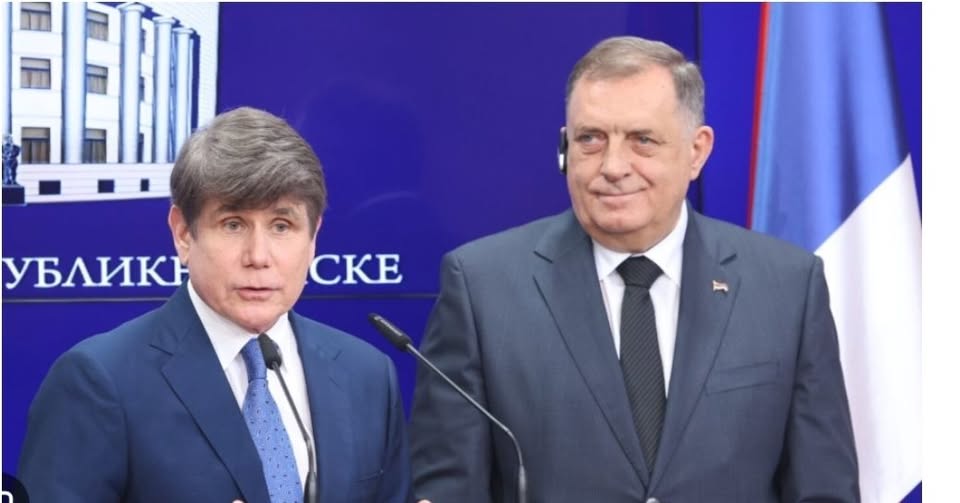
What is not unremarkable is the X post that followed — published by Rod Blagojevich, registered foreign agent for Republika Srpska, distributed by RRB Strategies LLC on behalf of its client, with the FARA disclosure buried where such disclosures are designed to be buried: at the end, after the argument has already landed.
The argument Blagojevich made was this: the visit represents an important step toward a “new strategic partnership” with “Orthodox Christian Serbs in the Balkans who love America and love President Trump.” Two claims, both falsifiable, neither true. The first concerns the nature of the civilizational language being deployed. The second concerns Serbian public opinion. Together they constitute a product designed for domestic American consumption — and the price of buying it is being charged to relationships that actually matter.
What the language carries
The phrase “Orthodox Christian Serbs” is not, in the Balkan context, a neutral ethnic or demographic descriptor. It is a civilizational claim with a documented function. In the political culture that produced the 1990s wars, this framing positioned the Bosnian Serb project as the defense of Christian Europe against Ottoman encroachment — a narrative that the leadership of the time used not to describe the conflict but to authorize it. The International Criminal Tribunal for the former Yugoslavia documented extensively how this civilizational self-understanding operated within the command structures responsible for Srebrenica and the siege of Sarajevo. The language did not cause those events. But it provided the moral architecture within which they were organized and justified.
When a registered foreign agent for Republika Srpska deploys this same framing in American conservative media, he is not making a neutral rhetorical choice. He is activating language with a specific and documented history in this geography. A Washington policymaker who does not know that history may read the phrase as a simple statement of religious identity. The governments in Ankara, Riyadh, and Amman that will read the same phrase carry a different set of associations — and they are not wrong to carry them.
The question the White House and State Department should be asking is not whether Blagojevich intended those associations. The question is whether the administration is comfortable being positioned within that frame, and whether anyone in a policy role was consulted before that positioning occurred.
The polling Blagojevich does not mention
The claim that Serbs “love America” is not a simplification of a complex reality. It is an inversion of the measurable one. The Gallup Balkan Monitor, which has tracked public attitudes across the Western Balkans across multiple survey cycles, consistently shows Serbia as the regional outlier on Euro-Atlantic orientation — with low NATO favorability, high pro-Russia identification, and EU accession support well below the levels recorded in Albania, Kosovo, or North Macedonia. The Belgrade-based CRTA has documented similar patterns in domestic Serbian polling. The International Republican Institute, whose Balkans surveys carry particular weight in conservative foreign policy circles, has recorded the same basic picture.
The source of this orientation is not obscure. The 1999 NATO bombing campaign is a foundational event in Serbian political culture, taught as such, commemorated as such, and invoked consistently whenever the question of Western alignment arises. Serbian public ambivalence about the Euro-Atlantic order is not a residue of communist-era attitudes. It is an active, sustained, and politically organized posture.
Republika Srpska is not a moderated version of this. Milorad Dodik has spent years cultivating Russian patronage — attending events in Moscow, framing RS’s future as outside the Euro-Atlantic order, and treating EU integration as a structural threat to the political project he leads. His political base is the constituency in the Balkans most consistently oriented toward the power that is prosecuting a war of territorial conquest in Ukraine. The idea that this constituency “loves America” is not an exaggeration. It is a fabrication constructed entirely for audiences who will not check it.
The strategic cost being ignored
The Trump administration has invested significantly in Gulf relationships — with Saudi Arabia, the UAE, and Qatar — that are load-bearing pillars of American posture on energy markets, counterterrorism cooperation, and the Abraham Accords architecture the administration seeks to expand. Turkey remains a NATO member whose cooperation on the Bosphorus, on migration management, and on Eastern Mediterranean security is not optional. Jordan and Pakistan provide access and cooperation the United States cannot replicate from other partners.
These are not governments for whom Srebrenica is a historical abstraction. The Organisation of Islamic Cooperation has passed formal resolutions on Srebrenica’s status as genocide on multiple occasions, establishing an institutional framework through which member states read signals about Western alignment in the Balkans. Turkey commemorates the massacre at state level. These are not diplomatic sensitivities to be managed around the edges. They are established positions that will be activated when a civilizational frame invoking Orthodox Christian identity appears in American political media bearing proximity to the president’s family.
The cost calculation is not close. Republika Srpska’s leadership offers symbolism and a narrative. The governments that will register the civilizational signal negatively offer material cooperation the United States actively depends on. This is not a balanced trade. It is an asymmetric exposure being created by a foreign agent operating outside the normal channels of foreign policy review.
How the operation works
This is how foreign influence operations work when they are working well. They do not ask for policy changes directly. They build the domestic political environment in which certain policy changes become natural, and others become awkward. By the time the State Department engages formally with the question of U.S.-RS relations, Blagojevich will have already shaped the terms on which that conversation happens in Republican foreign policy circles. The constituency for the partnership will have been manufactured before anyone in government decided whether the partnership was coherent.
The FARA disclosure at the bottom of the post is legally compliant. It is also, in format, a concession that the message could not survive transparent identification of its source. Paid advocacy presented as organic political alignment is the basic unit of this operation. The foreign agent’s job is to supply “Orthodox Christian, anti-woke, pro-Trump” and let the American conservative imagination assemble the rest. The polling, the history, and the strategic cost are not part of the product. They are what the product is designed to make invisible.
Washington is being sold an alliance that does not exist, with a constituency that does not hold the values attributed to it, by a registered foreign agent whose client’s political base is oriented toward the power prosecuting a war of territorial conquest in Ukraine. The cost of the transaction is being charged to relationships with governments that actually deliver. That is not a strategic partnership. It is a product. Someone in Washington should read the label before buying it.
Elmi Berisha is a prominent Albanian-American community leader and businessman based in the New York area, best known as the President of the Pan-Albanian Federation of America “Vatra”, the oldest Albanian American organization in the United States, founded in 1912.
ISSN: 3070-2186