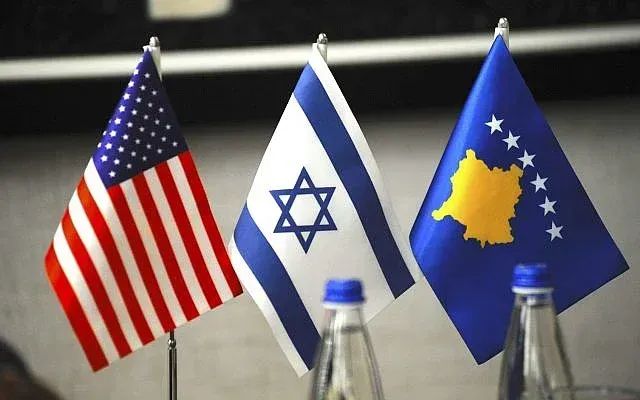
Kosovo’s extraordinary Security Council session signals something larger than a regional reaction — it reaffirms a strategic doctrine of alignment.
By Elmi Berisha | 1 March 2026
Late on Februart 28, in Pristhina, an extraordinary meeting of Kosovo’s Security Council was convened at the request of Prime Minister Albin Kurti. The trigger was the U.S.-led military operation “Epic Fury” against the Islamic Republic of Iran.
Small states often respond to global military escalation with caution bordering on silence. They wait for the European Union’s phrasing. They calibrate against Berlin’s tone. They hedge.
Kosovo did not hedge.
The official communiqué is unusually direct. Prime Minister Kurti “reiterated the clear position of the institutions of the Republic of Kosovo that they stand unwaveringly alongside our friends and strategic allies, and in particular the United States of America, in efforts to preserve international peace, security and stability.”
The word unwaveringly is not accidental.
Clear Support, Framed as Prevention
The statement goes further. Kosovo “supports the actions undertaken by the United States against the objectives of the regime of the Ayatollahs in Iran, assessing them as measures aimed at preventing further escalation and limiting destabilizing capacities in the region.”
This is not the language of reluctant endorsement. Nor is it ideological enthusiasm. It is a strategic framing: deterrence as prevention.
The formulation matters in Washington. It places Kosovo firmly within the doctrine that limited, targeted force can serve stability rather than undermine it. That view, forged in the Balkans in 1999, remains foundational to Kosovo’s political DNA.
Kosovo does not see American military intervention as an abstraction. It sees it as history.
Regime Versus People
Equally important is the moral distinction embedded in the communiqué. While supporting U.S. action against the regime, Kosovo “expresses its solidarity with the people of Iran and their legitimate aspirations for freedom, dignity, and fundamental rights.”
That separation is deliberate.
Kosovo understands the difference between confronting a destabilizing regime and condemning a nation. Its own statehood emerged from precisely that distinction — international action against a regime, not against a people.
In diplomatic terms, this shields Prishtina from accusations of endorsing collective punishment. In moral terms, it aligns Kosovo with democratic solidarity.
A Signal to Washington
The communiqué concludes with a statement that is not written primarily for domestic consumption: “The Republic of Kosovo remains a reliable and committed partner of the Euro-Atlantic community and will continue to contribute to joint efforts for peace, security and global stability.”
Reliable. Committed. Contribute.
In a fractured transatlantic environment, reliability is currency.
Kosovo’s strategic architecture — from security sector reform to NATO interoperability — has been built in close coordination with the United States. Its military transformation follows NATO standards. Its diplomatic positioning consistently aligns with Washington on sanctions regimes and security policy.
When the United States acts, Kosovo does not simulate neutrality.
That consistency is not rhetorical. It is structural.
Domestic Readiness and Hybrid Awareness
The statement also contains a layer of internal security posture. Kosovo’s institutions, it says, “have undertaken all necessary measures to preserve order and security” and are “closely monitoring developments in the Middle East, as well as potential implications for Kosovo and the region.” It adds that Kosovo is in “close and continuous communication with our strategic partners.”
This is not boilerplate.
The communiqué explicitly calls on citizens “to remain calm and to inform themselves only through official channels and credible sources,” warning against “disinformation and propaganda aimed at destabilizing the country and creating insecurity, tensions, or spreading narratives against the statehood and security of the Republic of Kosovo.”
That final clause is telling.
Kosovo anticipates that geopolitical escalation does not travel only through missiles. It travels through narratives. Through hybrid interference. Through attempts to exploit regional fault lines.
Prishtina is signaling awareness — and readiness.
The Contrast in the Balkans
In the Western Balkans, global crises often expose strategic ambiguities. Some actors calibrate between Brussels, Moscow, Beijing, and Washington depending on advantage.
Kosovo’s statement contains no such calibration.
It aligns clearly with the United States. It frames that alignment within its Euro-Atlantic orientation. It couples support for deterrence with solidarity for civilians. And it reassures its own population about internal stability.
This is not a loud statement. It is a disciplined one.
For Washington policymakers assessing credibility in Southeastern Europe, discipline is more valuable than volume.
Kosovo is a small state. But in moments of strategic consequence, it behaves like an ally that understands exactly where it stands.
About the author
Elmi Berisha is a prominent Albanian-American community leader and businessman based in the New York area, best known as the President of the Pan-Albanian Federation of America “Vatra”, the oldest Albanian American organization in the United States, founded in 1912.
ISSN: 3070-2186