Rafaela Prifti/
Her Albanian heritage may not be recognizable in the name Elena Dorfman, yet her camera unveils the artistic explorations of the maternal homeland at art exhibits in the West Coast and half way around the world. The photographer and filmmaker-based in Los Angeles since 1989 has gravitated towards the self-isolated land of her ancestors, first in her imagination as a child growing up in New England, and later on, as an artist that went further and deeper in decoding Albania’s past through the language, she is very well versed at, art and cinema.
Though the seventies Elena was raised outside of Boston, by an Albanian mother and a father of Austrian descent, who was fifth generation Bostonian. “My mother was Virginia Spiro, whose parents were born in Korce, and later immigrated from there to Taunton, Mass, around 1915. My siblings and I were raised in the Albanian diaspora of New England, with friends and relatives who lived throughout the region. Unfortunately, I never knew my grandparents who died relatively young. My mother, too, died young, at 52, in 1984. Her funeral was presided over by her dear friend, father Artur Liolin, remembering the passing of his death this month two years ago.”
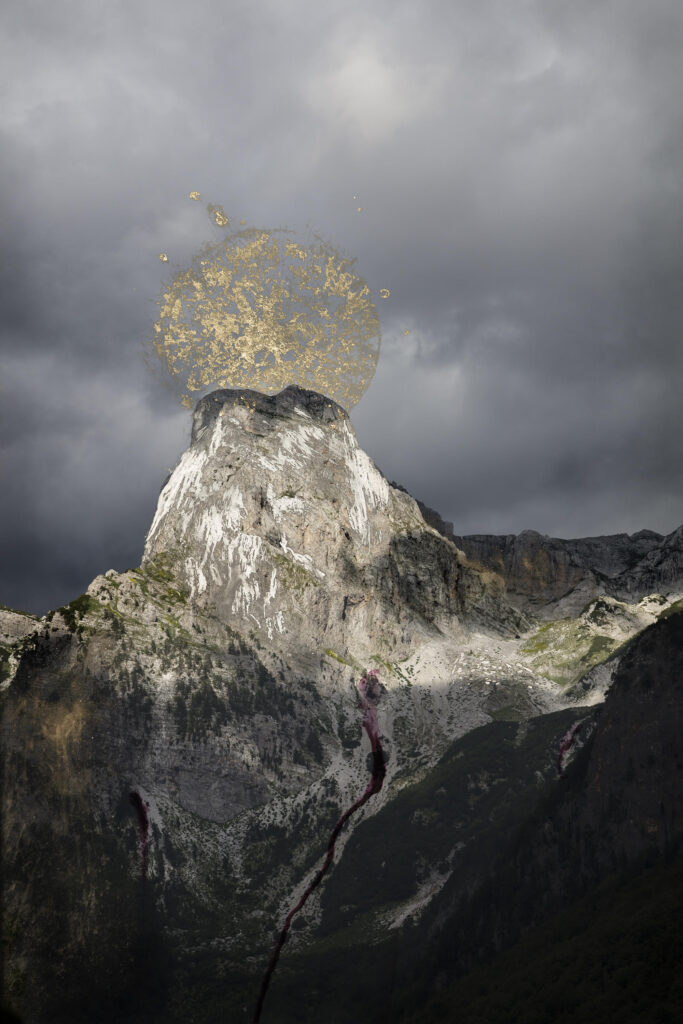
Elena’s internal curiosity about Albania, which she first visited in 1993 and returned nearly every year since, was to take photographs. And she took thousands of them. In 2016, she found herself captivated by the Northern, mountainous region of Valbona. “From the images I made in the region, I created large-scale mixed media artworks that were included in a series called Transmutation. This series features photographs that were collaged and then gilded, using precious metals — 23 karat gold, palladium and silver — adhered to the surface of the picture, such as the Golden Dome, illustrated below. Also, based on my photographs a beautiful set of woven Jacquard tapestries were produced – these are decorative, heavy, woven textiles with intricate patterns that are woven directly into the fabric. These striking artworks were shown in galleries, such as Modernism, in San Francisco, CA, and Fredric Snitzer gallery, Miami, Florida; and reviewed in ArtForum,” says Elena.
Inclined to exploring images in a broader cultural context, the artist launched a project with the Albanian National Film Archive, in 2018, after meeting then-Director of the Archive, Iris Elizi. What Elena discovered was that nearly none of the films had been digitized in the years since the fall of communism. “In October of 2021, I hired and brought in a professional digitizer from Israel, and we worked together in the theater of the archive scanning as many of the films as we could over the course of the month. In total, we scanned about 80 films, both features and documentaries produced between 1947 – 1991 by Albania’s Kinostudio, and were kept in poor storage conditions. By 2018, the films have been in a climate controlled environment, properly stored.”
Elena did extensive research that involved “watching nearly all of the three hundred features and dozens of documentaries from the Era, but also traveling back to Tirana in 2022 to interview a
number of the actors, directors, technicians and archivists. I read everything available about Albania’ film history in order to both pay homage to this cultural artifact, and also help shape my own film.”
Hundreds of editing hours later, focused on selecting the right shots and cuts in her studio, in 2023 and 2024, Elena created her unconventional film, generally known as video art or installation THE DREAM & THE LIE. A unique reinterpretation of Cold War Albanian cinema, the production is comprised of approximately seventy remixed and reedited films from the New Albania Kinostudio. Intended to disrupt the propagandistic narratives of Hoxha-era films, the style is non-linear and experimental. Just as importantly, it is also an homage to the incredible artistry, creativity and dedication of the actors, technicians, writers and directors of the time.” I very much wanted to give back to the country of my maternal heritage. I felt that this project served two purposes: giving back, and also expanding my own artistic endeavors.”
“With little understanding of the Albanian language, I was drawn to films that were visually arresting, initially gravitating toward the directors who were formally trained in the Soviet Union and other Eastern Bloc countries. Films directed by great directors such as Dhimiter Anagnosti, Piro Milkani, Kristaq Dhamo and Viktor Gjika, among others, that were visually distinctive and identifiable by their signature styles.” With the recent passing of Anagnosti, her project feels like the highest form of tribute to these talented and pioneering artists. In THE DREAM & THE LIE, there are excerpts from popular films like Malet me blerim mbular, Furtuna, Në kufi të dy legjendave, Toka Jone, and many more.
Elena Dorfman’s film premiered in early June followed by a Q&A with the artist in Shkodra’s Festival Ekrani i Artit at the invitation of its founder, Albanian artist, Adrian Paci https://www.instagram.com/adrian_paci/?hl=en. Shkodra Festival caters to experimental and modern works presenting the perfect venue for contemporary artwork such as Elena’s.
“My film is comprised of both feature and documentary films produced by the New Albania Kinostudio, under Hoxha. It plays over three screens—a triptych—and although it loosely follows a narrative thread, it is primarily a non-linear format, offering viewers an impression of the types of films and storylines produced over nearly five decades, but with motifs that also refer to the brutality of life during communism, which I felt very compelled to include.” Albanians who grew up watching these movies, the millennials who are not familiar with them as well as non-Albanian audiences have reacted positively to this artifact – appreciating the artistic breakdown of the government narrative designed to perpetuate the power of the regime. To that point, she deliberately picked the title that echoes Picasso’s first overtly political work “The Dream and the Lie of Franco” that prefigures his iconic painting “Guernica”.
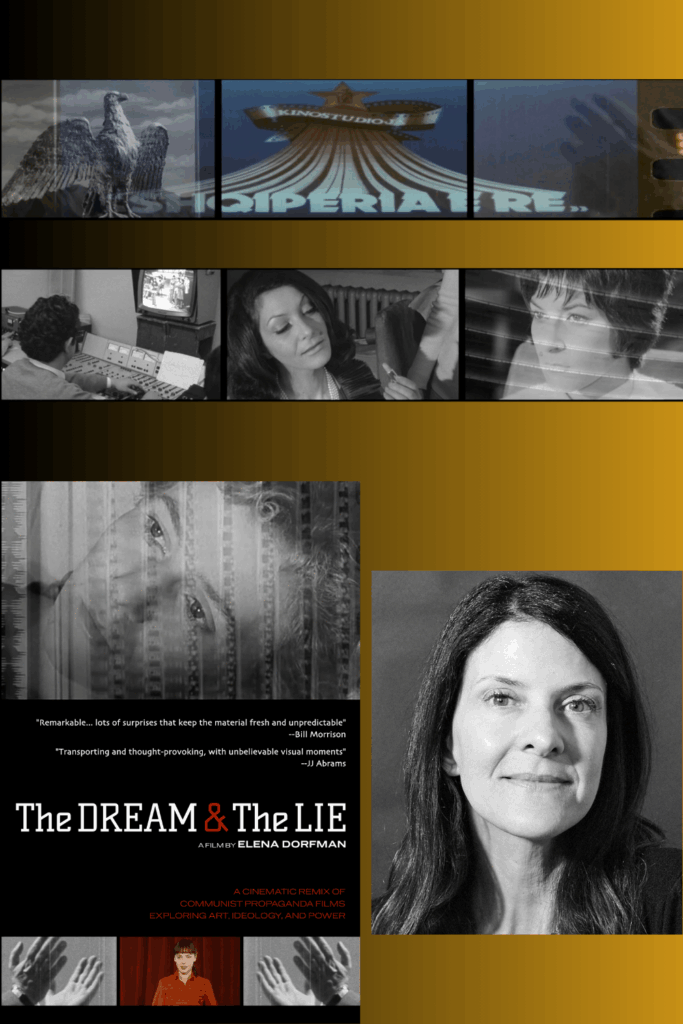
The film’s poster depicts a close shot of the renowned Albanian actor Tinka Kurti in her break out role in Tana (1958) the first full-length Albanian feature movie. Her portrait is overlaid with footage of 35mm film, that appear in the horizontal lines, indicating montages in THE DREAM & THE LIE. The triptych at the bottom of the poster represents the film layout.
Albania’s art and cinema of the previous era, depicted in Dorfman’s lens, invites the viewer to “decode” the underlying meaning or the subtext versus the overt representation, what is hidden or implied versus what is explicit and on the surface – it is the artistic vision of the Albanian American artist, Elena Dorfman!