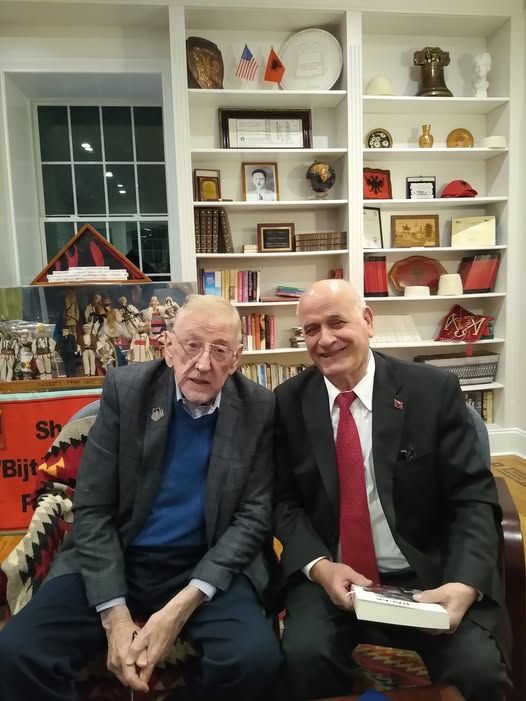
Ambassador William G. Walker:” Reçak, a story of a war crime” – a book review.
Dr. Sadik Elshani
It’s a great pleasure to have tonight among us a great Albanian friend, a diplomat par excellence, a wonderful human being. Tonight’s gathering is a multipurpose event: a promotion of the book “Reçak, a story of a war crime”, written by our guest, Ambassador William Walker. Also to express our thanks and gratitude to the Ambassador Walker for his great contributions towards Kosova’s freedom and Independence. And most importantly, to pay our tribute to the victims of Reçak massacre and all the victims of the bloody Kosova conflict. Though, for most Albanians the name William Walker it’s become synonymous with Reçak, Ambassador Walker prior to that terrible event had a 40 years long distinguished carrier as an Officer in the U. S. Foreing Service. As the title clearly states the main focus of this book is the massacre of Recak, but also on these pages are described prior engagements of Ambassador Walker in many diplomatic posts and positions, mostly in Latin and Central America.
Just to name a few for illustrations: Deputy Consul in Peru and Okinawa, Chief of Political Section in Brazil, Deputy chief in Honduras and Bolivia, Ambassador to El Salvador. Ambassador Walker worked in EPA, a healthy appointment – quit smoking. Also, he was Vice President of NDU. He Held many other positions at State Department and US Mission at the UN. Latin and Central America at the time were regions on turmoil, a conflict zone with many social and armed conflicts. In the book are described many events and episodes that look more like scenes from the movies. In those many events that we read in newspapers or watched on TV news also was present Ambassador Walker. It was this rough environment, that shaped Ambassador Walker’s character and personality. Challenges, adversity, and rough experiences are necessary to build strength, resilience and true experience. As the saying goes; “Calm seas don’t make skilled sailors”.
These experiences made Ambassador Walker a perfect candidate for the engagement in the conflict in former Yugoslavia, in the words of Ambassador Bob Gelbard, to practice “real diplomacy”. First, he served as a director of peacekeeping operations in Eastern Slavonia, UNTAES, in Vukovar, August 1997 – January 1998. Prior to this appointment Ambassador Walke never herd the name of this city. The dissolution off the Former Yugoslavia was very brutal and terribly violent. There were committed the worst atrocities in the European continent since WWII. When Ambassador Walker showed a picture off Vukovar, his youngest son said: “Dady this is not Vukovar, it’ s Hiroshima”. This boy’s description was the right one, an appropriate metaphor to describe the scale of destruction in Bosnia and Croatia. When the bad things were happening in Kosova the rest of Yougoslavia they just were watching like nothing was going on there, but doctor Rugova warned them that if they don’t do anything to stop the Slobodan Miloshevic’s regime one day all they are going to become Kosova.
In the book are given the portraits of some personalities with whom Ambassador Walker delt during his missions in Croatia and Kosova: Slobodan Milosheviq, Franjo Tudjman, Ibrahim Rugova, Adem Demaçi Dushan Lonçar, Nikola Shainovic, Richard Holbrook, and many others. Those are descriptions of their behaviours, characters, the way how they treat and interact with others. I like the observation and comparation how the architecture and style of the cities of Belgrade and Zagreb reflect on the personalities of their respective inhabitants, Sllobodan Milosheviq and Franjo Tudjman.
In late 80 – es until second middle of 90 – es of the last century Albanians of Kosova did not have any good choices but to choose a nonviolent (some they called peaceful) resistance, led by Dr. Ibrahim Rugova, who internationalized the plea of Kosovar Albanians for freedom and independence. This movement for some time was successful, but started to run it’s course with time, especially after the Dayton Accords in 1995 in which Serbia, Croatia and Bosnia and Hercegovina reached an agreement on ceasing all hostilities and recognizing each – others statehood. However, Kosova was not included in these Accords, thus in turn giving Millosheviq a free hand to turn his efforts to get rid of the Albanians of Kosova by expelling them from their homes, their lands, killing them indiscriminately.
This led to the armed resistance and creation of the KLA. Albanians took arms to defend their homes, honor and dignity of their families from the genocidal Serbian regime. The brutal regimes do not understand the peaceful means they do understand only the means, language of force. Some called this freedom fighters terrorists, but they should have known that according to our code of honor, code of conduct (kanun) it is unacceptable, it is prohibited for an Albanian to attack unarmed civilians, innocent people, women, children and elderly, regardless of their nationality or religion. KLA fighters were fighting only against heavy – armed Serbian military and police forces who were terrorizing the Albanian population. What Albanians should have done under these tragic circumstances, to watch how their houses burning, family members are killed, women raped?!
On March 5th, 1998 Serbian police and military forces undertook an attack against Jashari family in Prekaz where more than fifty family members were killed. Fighting between KLA fighters and Serbian forces intensified in the Summer of 1998. People left their hoses and escaped in the forests living in the plastic shades. On the fall of that year was reached an agreement between Ambassador Richard Holbrook and Sllobodan Milosheviq to allow for an international Verification Mission to monitor the ceasefire, to facilitate prisoner exchange, etc. The presence of this international force was welcomed by all Albanians, it provided some sense of security, resurrected the hope that finally somebody is paying attention to the Albanians plea for freedom. In the book are described in detail the efforts to put together this Mission, grim situation in Kosova, constant destruction attempts of the Serbian site for derailing the success of this Mission. Again, Ambassador Walker was selected to lid the Mission.
Then come massacre of Reçak. On January 15th 1999. Serbian forces slaughtered 45 innocent unarmed civilians: young and elderly men, children. Ambassador Walker that day was in Montenegro to talk to the President of that country and returned in the evening, got a call from his deputy DZed who informed him for what happened in Reçak. They took measures to preserve the scene, to not compromise the evidence. The Day later on 16th of January early morning Ambassador Walker was at the scene of the massacre, where in a valley, were laying the massacred bodies. These were atrocities, people shot in the short range and not people killed in the battle as the Serbian site was claiming. This was an overpowering experience for Ambassador Walker who in his long diplomatic carrier has seen many horror scenes, but none like this one. Latte that same day in a news conference he spread the news to the world for what happened in Raçak and declared: “From what I personally saw, I do not hesitate to describe the event as a massacre, obviously a crime very much against humanity”.
We just saw the video and here we have present Ambassador Walker, so I will not go further into details. In these defining situations, as tragic as they may be, it is important to be witnessed by a person of great integrity, dignity who cherishes human values, human life, possesses courage and committed to find the truth. Some 54 years before Reçak another great American, then general Eisenhower, witnessed similar horrors, and acted in the same way. When allied forces liberated the Ohrdruf concentration camp in early April, 1945 and they saw the atrocities committed there by Nazis, general Eisenhower went personally to see the crime scene with his own eyes: “I made this visit deliberately, in order to be in position to give first hand evidence of these things if ever, in the future, there develops a tendency to charge these allegations merely to propaganda”.
Is a Jewish saying: “What you don’t see with your eyes, don’t witness with your mouth” If Ambassador Walker wouldn’t be personally that day in Reçak, or if in his place were his deputy, French diplomat, Gabriel Keller, for sure we would have quite a different outcome – these victims would be only numbers in a long list of thousands of others. Serbs to this date do not admit their guilt, take responsibility and apologize for crimes committed against Albanians. To the contrary, they are claiming that this a great deception, they are developing conspiracy theories, that this is just propaganda, staged by KLA, or this massacre was organized with CIA to trigger NATO bombing, and many more bizarre stories of this nature. They even killed their own people, 6 young Serbs in caffe “Panda” in Peja, just to blame the Albanians.
Thank God in this unfortunate situation was present an experienced American diplomat who rose to the occasion and with his persistence, dedication got to the bottom of the causses of this massacre. He alarmed the western governments, diplomats, military leaders that this is not an isolated case, but a deliberate action, the beginning of a large – scale military operation to finish the Millosheviq’s plan to get rid of Albanians by killing them all. This was the answer that Millosheviq gave to general Clark when he asked how he is going to deal with the Albanians. By now they should have known that Millosheviq never was a man of peace, he always was an evil person.
Massacre of Reçak was a turning point in Kosova’s conflict and Kosova’s modern history that led to her freedom and independence. Ambassador Walker worked tirelessly to make sure that these innocent victims didn’t die in vain. With his actions, dedication and insistence Ambassador Walker gave them a powerful voice for freedom and dignity of life. Like in Albanian legends, ballads these innocent victims became sacrifice (Alb. kurban) for Kosova’s freedom. Finally, the echo of this massacre awoke the sleeping conscience, indifference of Western capitals, set in motion diplomatic, military factors that something needs to be done to stope this carnage. This led to Rambuillet conference and shortly to NATO bombing and the liberation of Kosova.
“Reçak, a story of a war crime” is a fascinating, powerful and well written book with a clear and straightforward language about conflicts in the Former Yugoslavia, and in particular, Kosova, bringing the events from the terrain and behind the scenes of Western diplomacy. It is a rich mosaic of events form a long carrier of a distinguished and experienced diplomat. This book is a written monument to the memory of Reçak victims. Is going to be a great contribution, reference book for historians, scholars and students of Kosova’s history, as it provides firsthand accounts, firsthand testimony from a person who was there when those events were unfolding. Also, very useful for diplomats, a valuable lesson how to conduct real diplomacy, diplomacy in action. Is going to be a history lesson for younger generations to remind them for sacrifices of Albanian people for freedom and independence.
Albanians are a very thankful people, and we thank Ambassador Walker for his great efforts toward Kosova’s freedom and independence. As it is in our tradition on memorializing important events and personalities in songs, many songs are dedicated to Ambassador Waker and the Reçak massacre. A bronze statue of Ambassador Walker stands toll near the Memorial of Reçak victims. Mr. Ambassador, we never will have enough words to express our gratitude for what you have done for Kosova – hopefully a big thank you will do it. Shume faleminderit! We are proud to call you a dear friend.
May the memory of Reçak victims be eternal!
Philadelphia, 7 February, 2026
Presented at the book promotion of “Recak, a story of a war crime”, by Ambassador William G. Walker, organized by the Albanian – American Association“Bijte e shqipes”, Philadelphia.