By Frud Bezhan*/
PRISTINA — The rain beats down as the muezzin’s call for Friday prayers rings out from the main mosque in Pristina.Hundreds of men and young boys stream into the 15th-century Sultan Mehmet Fatih mosque in the Kosovar capital’s old quarter. Outside the packed mosque, scores of worshippers spread plastic sheets across the garden and kneel in the rain. Others spill out onto the surrounding pavements because of a lack of space.
The scene at the Ottoman-era mosque, the biggest in the city, is becoming the norm in Kosovo — a traditionally secular state with a liberal Muslim population, where conservative Islam is taking root.
“More people, especially the young generation, are coming to pray,” says Hakif Sikirocha, the caretaker of the Sultan Mehmet Fatih mosque. The weary-looking 70-year-old, who is sporting an Islamic cap, has worked at the mosque for the past 14 years. “More and more” Kosovars are turning to Islam, he says.
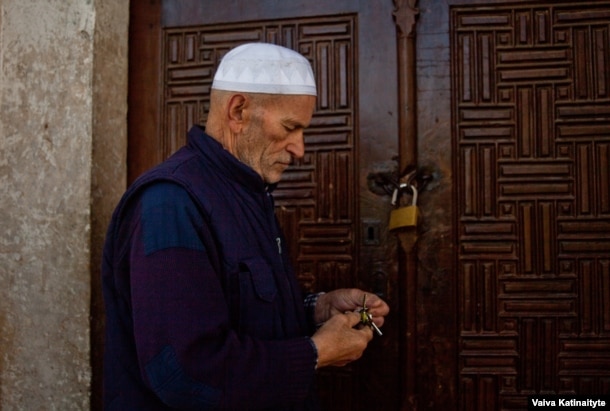
Mosque caretaker Hakif Sikirocha says more and more people are turning to Islam in his country.
Kosovo, where 96 percent of its 2 million inhabitants are Muslim, is still a Western and largely pro-American country where bars are located on the same streets as mosques. Many of Pristina’s streets pay tribute to former U.S. presidents, owing to NATO’s 1999 bombing campaign in the former Yugoslavia that ended the Kosovo War and also Washington’s support for Kosovo’s independence.
But there are growing signs that conservative Islam is taking a foothold in society. There were about 200 mosques after the war in 1999. Today, there are more than 800. A new mosque is built every month.
Religious Resurgence
In the streets of Pristina, more and more women walk covered in black, fully covered Islamic dressing. It is more common to see men with untrimmed beards and calf-length trousers, a hallmark of Muslim conservatives.
Dozens of shops in Pristina have sprung up to cater for the devout. One of them — Al Jilbab — has faceless mannequins erected at the front of the shop. Inside, the bearded owner says he sells Korans as well as CDs and DVDs that teach you how to pray. In the back of the brightly lit shop, there are black, blue, and grey hijabs, conservative Islamic dress for women. At the opposite end, there are Islamic beads, prayer mats, and long, baggy pants for men.
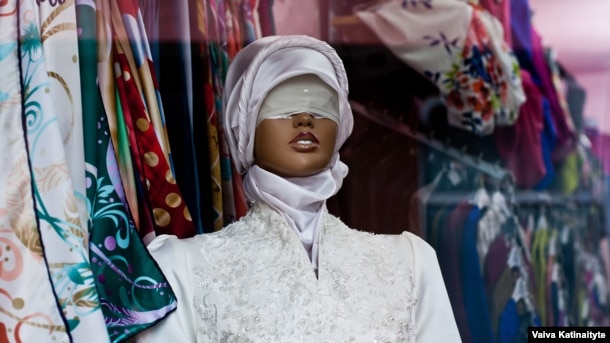
Shops have sprung up all over Pristina to cater for devout Muslims.
“There is an element of society and certain parts of Kosovo that are becoming more religious,” says Naim Rashiti, an analyst at the Balkan Policy Research Group, a Pristina-based think-tank. “[People are becoming] more religious than we have ever been at least for the last 60 or 70 years. This is a new experience for us.”
As an autonomous province in post-World War II communist Yugoslavia, Kosovo was traditionally secular. For decades, Yugoslav authorities stamped out religious identities and ethnic affiliations. It was after the collapse of the former Yugoslavia that Kosovo’s religious resurgence gathered steam.
“[There’s been an] expansion of practicing more robust religion, women covering their heads, and the youth going to the mosque,” says Rashiti. One of the main reasons conservative religious ideas have spread, he says, is Kosovo’s weak institutions. He adds that Islamic charities have tried to fill the vacuum in communities neglected by the government.
Identity Crisis
It is only eight years since Kosovo unilaterally declared independence from Serbia. It remains a fragile, postwar country, which is still in limbo with regard to its identity.
Many Kosovar Albanians are not emotionally attached to the blue-and-yellow Kosovo flag — which is remarkably similar to the European Union flag. In Pristina, even in government buildings, the Albanian red flag with a black, double-headed eagle is widely used.
Many here see themselves as Albanians — and wish to be reunited with their ethnic brethren — but also feel separate from Albanians in Albania.
For many Kosovars, Islam has filled that identity gap and offered a clear sense of belonging. One of them is Gentiana Sadiku, who studied at a madrasah, or religious school, and then joined the Faculty of Islamic Studies, an independent institution that has the only religious studies course in Kosovo.
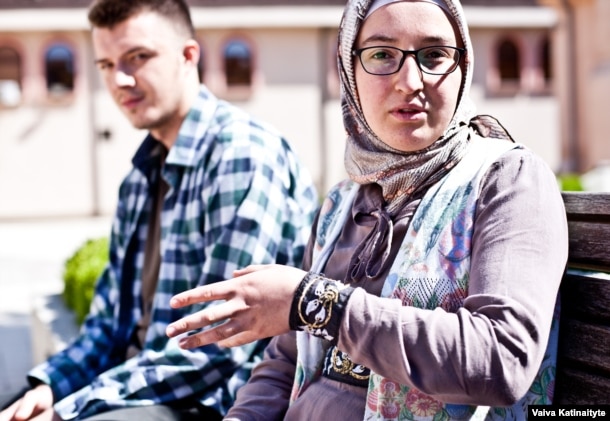
Gentiana Sadiku attends classes at the Faculty of Islamic Studies at the University of Pristina
“Islam has given me purpose and motivation,” says 21-year-old Sadiku, who is covered in a white hijab and has henna painted on her hands. “I have found inner peace through Islam.”
Sadiku, a third-year student in Islamic studies, says the government is “unfriendly” toward devout Muslims like her. “The university is the only place where I can freely express my beliefs,” she says. “Women cannot get a job if they wear a hijab,” she claims, adding that devout Muslim women are looked down upon as “narrow-minded” and “uneducated.” Sitting on a bench in the empty courtyard of the faculty, she says she currently cannot exercise her “rights” as a Muslim woman.
Radical Influence
The Islamic Community of Kosovo, an independent institution that oversees Islamic affairs in the country through an appointed mufti, or religious leader, has tried to keep tight control over Islamic activities. But the institution has been accused by critics of being lax about the registration of official mosques, and allowing unregistered religious schools and informal mosques to flourish throughout the country.
Of particular concern for the Kosovar authorities has been what they perceive as the radicalizing influence of foreign donors. In late 2014, Kosovar officials closed 14 Middle Eastern-funded charities, which were suspected of having ties to Islamic extremist groups. In addition to Saudi-funded organizations, Turkish and Iranian charities have also been closed in the past two years.
The growing religious conservatism in Kosovo is particularly visible in rural towns like Kacanik and Gjilan, where Gulf-funded Islamic charities have radicalized poor communities The charities have penetrated communities that have been neglected by the government and where unemployment is around 50 percent, making young men easy targets for indoctrination.
Under a new law, Kosovo can jail citizens for up to 15 years if they participate in foreign wars. More than 300 people from Kosovo have gone to fight for extremist groups in the Middle East, making it the biggest contributor per capita in Europe. Kosovo authorities say around 50 homegrown jihadists have been killed in fighting in Syria and Iraq, and around 120 have returned to Kosovo. More than 100 people in Kosovo have been arrested or are under investigation for recruiting or fighting abroad on behalf of the Islamic State extremist group.
In 2009, Kosovo’s government banned religious garb in primary and high schools, prompting protests by devout Muslims. The government defended the decision, saying that it was in line with the country’s secular constitution. Some Kosovars agree, saying that women covering their heads in public is against the country’s secular traditions.
“There is some radical influence because you can see people on the street with long beards, long pants, and girls totally covered from their heads to their toes,” says Nora Bezera, a 28-year-old translator in Pristina. “Kosovo always had a majority-Muslim population, but in the last few years radical Islam has been increasing. As a young, Western-oriented woman, I am concerned about this influence.
‘Imaginary Equality’
There is concern among many Kosovars that outwards signs of Islam represent a radical influence.
“Because of recent terrorist attacks in Paris, Brussels, and Istanbul and the fact that a considerable number of the youth from Kosovo joined the war in Syria, people began to worry about this new phenomenon,” says Majlinda Aliu, a journalist at Radio Television of Kosovo. “Moreover, the number of people who are becoming conservative is constantly rising and many other traditional believers are afraid that these people can easily become radicalized.”
Down the street from the Sultan Mehmet Fatih mosque is Baristas Coffee, a bustling cafe teeming with suited government workers, young bearded men, and headscarf-clad women from the neighborhood.
Hisen Krasniqi, a grinning young man with a blonde ponytail, owns the cafe. In between barking orders at his staff, he says his cafe does not serve alcohol, a recent policy change.
“We don’t want to take sides,” says Krasniqi, referring to the growing religious-secular split he sees in society. “Out of respect we only serve coffee,” he says.
The huge Cathedral Of Blessed Mother Teresa makes a dent in Pristina’s skyline. One of the tallest buildings in the city, the church was built in 2010 for the estimated 4 percent of Kosovar Albanians who are Catholics.
Many Kosovar Muslims do not oppose the church, but some such as Faruk, who only wants to gives his first name, bemoan that while a huge cathedral has been built for the country’s tiny Catholic population, Muslim worshippers are forced to spill out from the city’s mosques onto the streets.
“The church is a political move; it’s done to please America and Europe,” says Faruk, adding that Pristina allowed the Roman Catholic Church to build the cathedral to illustrate its “European values” in the hope of joining the European Union and NATO.
But the 27-year-old says there is only “imaginary equality” in Kosovo. He says Kosovo faces an “important choice” over whether to permit religious expression or stick with its secular values. “That will define our identity,” he says.
Photo:Conservative Islam is fast taking root in Kosovo, and this is particularly apparent among the younger generation.