
Rafaela Prifti/
Interviewer: Your work as a prominent scholar in gender studies and oral history focuses on North Adriatic women in times of war. In your review of the Strongest Link – an Oral History of Wartime Rape Survivors in Kosovo by Anna Di Lellio and Garentina Kraja, you call the book “an extraordinarily important contribution to anthropological and historiographical studies on the Balkans and the former Yugoslavia, as well as to gender and trauma studies more broadly.” The authors themselves say that the book attempts to close the “knowledge gap” regarding the 1998–99 Kosovo War. What is that gap and how do the authors address it?
Marta Verginella: The authors Anna Di Lellio and Garentina Kraja equip readers with the necessary background on Albanian-Serbian relations and the specific chronology of the crisis that led to the war. They move beyond general war histories to map specific accounts highlighting not only causes and long term consequences but also reasons of the “long silence and erasure” surrounding survivors of sexual violence. Lastly, the book connects the specific Kosovo conflict to broader global issues of otherness, wartime discourse and challenges of post-war justice.
Interviewer: Is that how this book challenges the scholars?
Marta Verginella: Yes, it challenges them by demanding they confront a significant “knowledge gap” in the history of the Kosovo war. Specifically, it pushes experts to analyze rape as a strategic weapon of ethnic cleansing rather than an incidental byproduct of war. It tasks scholars with uncovering the sociological and political reasons behind the “long silence and erasure’ surrounding survivors of sexual violence during the war in Kosovo and in times of war around the world. Ultimately the this is relevant work in the pursuit of justice.
Interviewer. Sexual violence in general and in Kosovo specifically was one of the “weapons of ethnic cleansing.” How did Serbian propaganda specifically manipulate gender and “the dehumanization of the Other” to enable this violence? As a renowned scholar on the topic, what can you tell us about the transition from racist rhetoric to physical wartime atrocities.
Marta Verginella: Serbian propaganda fostered violence by depicting Albanian men as rapists and women as “reproductive machines” which is an effective strategy that dehumanizes the population and justified state-led sexual violence. In the chapter “Gendered Nations” the authors delve into the discourse, similar to tactics used in Bosnia, creating a climate that fueled and enabled violence against women to begin well before the war.
Interviewer: Strongest Link is grounded in oral history and what the authors call “narratives” of 20 women, mostly from rural Drenica and Dukagjin regions collected between 2015 to 2018. How is the methodology of Alessandro Portelli applied in the book in terms of intersections of survivor experiences?
Marta Verginella: Through the power of narratives that are not told in isolation but understood in a broad context. The authors applied the oral history approach based on Alessandro Portelli’s methodology by conducting extensive fieldwork, earning the trust of survivors to recount their experiences, which are situated within the broader historical context of the collapse of socialist Yugoslavia.
Interviewer: One of the factors tied into this, as you point out, is the book’s contribution to understanding conflict, in “the distinct divide between rural regions like Drenica and urban centers like Pristina.” How did this impact the way women experienced both the war and its aftermath?
Marta Verginella: The rural-urban divide created contrasting experiences for the Albanian women during the years of conflict in Kosovo. Both environments, however, were defined by a deep sense of insecurity that shaped women’s lives during and after the war.
Interviewer: How are we to understand silence not just as the absence of speech, but a complex choice, compounded by “external constraints” and internal urges that force survivors to remain muted even decades later such as patriarchal norms, family stigma, or fear of being discredited?
Marta Verginella: Through the polyphonic narrative of the book, we understand the causes of the long institutional silence and the difficulties survivors faced and are still facing today. The authors document the gradual opening of dialogue with survivors and the political and social changes that eventually made testimony possible—that is how speaking becomes “an antidote to shame.” The book emphasizes that silence is a complex phenomenon—often equivalent to speech—not merely its absence.
Interviewer: What is the book’s greatest strength and why does it matter?
Marta Verginella: The Strongest Link shows how important it is to give voice to survivors and to create the broader social and political conditions that make speech possible—conditions that allow the strongest link among women to endure. Its extraordinary strength lies in the powerful testimony of wounded, raped women who found the courage to speak about what they lived through. Above all, thanks go to the survivors who found the strength to share their suffering, offering a message of hope to all those who could not speak and who are still awaiting justice.
Interviewer: From your extended work on borderlands, memory and the ‘margins’ of history, would you say that Kosovo gender studies and conflict have received less significant scholarly attention compared to other parts of the Yugoslavian dissolution such as Bosnia or Croatia?
Marta Verginella: Kosovo’s gender scholarship is tied to state-building and international intervention which can sometimes obscure the lived experiences of local women. My research often highlights how women are cast as passive victims or “mothers of the nation” in post-war transitions. Kosovo has received “less” attention in terms of long-term social history compared to the more established archives of the “North-Eastern Adriatic” such as Slovenia, Croatia that the EIRENE Project explores.
Thank you for the interview!
Marta Verginella is a prominent scholar in gender studies and oral history. She presented her review titled How Speaking became the Antidote to Shame on the book the Strongest Link at the 2025 ASEEES in Washington DC. Notable as one of the most prominent contemporary Slovene historians, she is considered a pioneer in the history of family relations in the Slovene Lands. Marta Verginella, PhD, is a History Professor at the University of Ljubljana. She has written and co-written twelve scientific monographs, several of which have been translated in multiple languages.
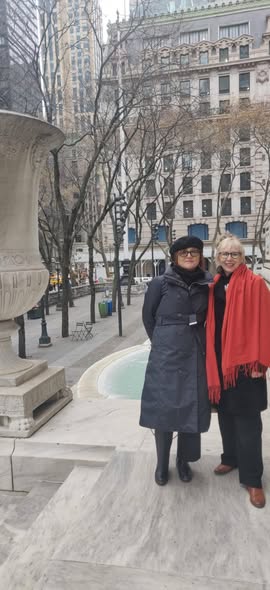
Photo Marta Verginella, Rafaela Prifti at the steps of the New York Public Library