• Home
  • Politics
  • Opinion
  • Culture
  • Sports
  • Economy
  • Interview
  • Reporting
  • Community
  • Vatra

Dielli | The Sun

Albanian American Newspaper Devoted to the Intellectual and Cultural Advancement of the Albanians in America | Since 1909

PARADA 2017- TAKIMI I PARE ME 4 MARS

February 28, 2017 by dgreca

RRËNJËT SHQIPTARE-ALBANIAN ROOTS-  FTOJNË KOMUNITETIN NË TAKIMIN E PARË PËR PARADËN 2017, QW DO TW MBAHET NW VATWR ME 4 MARS 2017, ORA 1.00 PM/

1 Albanian Roots

Presidenti i Rrënjëve Shqiptare(Albanian Roots), z. Marko Kepi, përmes një postimi në fb dhe përmes emaileve drejtuar të gjitha organizatave dhe grupeve të biznesit i ka ftuar ata që të marrin pjesë në takimin e parë për organizimin e Paradës për vitin 2017.

Në takimin e parë që do të mbahet me 4 Mars 2017 në orën  1.00 PM në Selinë e Vatrës, në Adresën 2437 Southern BLVD, Bronx, NY 10458, do të diskutohet për: Temën e Paradës, Kush do do të jetë Parade Grand Marshall & Marshall-së, numri i organizatave pjesmarërse, Performanca dhe të tjera.

Në këtë njoftim përfshihet lista e organizatave të ftuara, nëse ndonjë organizatë apo grup i interesuar nuk e sheh veten në listë ai mund të njoftojë dhe të bëhet pjesë e takimit.

Përfaqësuesit e organizatave që do të marrin pjesë duhet të informojnë gjatë takimit përafërsisht edhe numrin e ndjekësve të tyre, sa njerëz i ndjekin. Konfirmoni pjesmarrjen tek Albanian Roots!

Albanian Roots ~ Rrenjet Shqiptare

  • 2744 Hylan Blvd Suite# 513
  • Staten Island, New York 10306
  • AlbanianRoots.org

Ja Organizatat e Ftuara:

  1. Ana Malit,
  2. Plave e Guci
  3. Malesia
  4. Dibra
  5. Vatra
  6. Peja
  7. Chameria Organization
  8. Albanian American Educators
  9. The Women’s Organization “Hope & Peace”
  10. Albanian American Open Hand Association
  11. Alba Life
  12. Shkolla Shqipe Bronx
  13. Shoqata Rugova
  14. Shoqata Atlantiku
  15. Albanian American Civic League
  16. Rozafati Dance
  17. Albanian American National Organization
  18. Albanian Institute
  19. Albanian Film Week
  20. APEN
  21. Grupi Artistik Zerat e Rinje
  22. Albanian Excellence Organization
  23. Korabi Foundation
  24. Kosova Consulate
  25.   Assemblyman Mark Gjonaj’s office
  26. Illyria Society (NYPD)
  27. Shtepia drejtesise dhe pajtimit kombetar
  28. Albanian American Medical Society
  29.   Kraja Organization

Filed Under: Featured Tagged With: albanian roots, ME 4 MARS, PARADA 2017- TAKIMI I PARE

Kosovë-Përkushtim për rimëkëmbjen e Trepçës

February 28, 2017 by dgreca

ZKP-07-Pritje në 28 vjetorin e grevës së Minatorëve të Trepçës: Qeveria e Kosovës është e përkushtuar për rimëkëmbjen e Trepçës/

ZKP-05

-Greva  e urisë e 1.300 minatorëve të Trepçës, nga 20 deri 28  shkurt 1989, ishte në mbrojtje të Kosovës nga sulmet e Serbisë/

1 Greva trepce

PRISHTINË, 28 Shkurt 2017-Gazeta DIELLI-B.Jashari/ Qeveria e Kosovës është e përkushtuar për rimëkëmbjen e Trepçës, tha sot kryeministri Isa Mustafa, në takim përfaqësuesit e menaxhmentit, të sindikatës dhe një numër të minatorëve.Në këtë pritje me rastin e shënimit të Javës së Minatorëve për nder të 28 vjetorit të grevës së Minatorëve të Trepçës, ku ishin të pranishëm edhe zëvendëskryeministri i parë, Hajredin Kuçi dhe ministri i Zhvillimit Ekonomik, Blerand Stavileci, u bisedua për problemet që janë me prioritet për Trepçën.Kryeministri Mustafa vlerësoi përpjekjet, punën dhe kontributin e minatorëve në rimëkëmbjen e Trepçës, jo vetëm tani por në të gjitha proceset e shtetndërtimit. “Kontributi i minatorëve të Trepçës ka qenë i rëndësisë esenciale në të gjitha proceset e ndërtimit të Kosovës, edhe në proceset e pavarësisë dhe të lirisë”, tha kryeministri.Ai theksoi përpjekjet maksimale të qeverisë për rikthimin e Trepçës në një dimension krejtësisht të ri.

ZKP-03

“Është aprovuar Ligji dhe ka kaluar edhe sfidën e Gjykatës Kushtetuese dhe po punohet për përcaktimin e kritereve për zgjedhjen e bordit, shpalljen e konkursit, në mënyrë që të jenë njerëzit më të mirë që e njohin punën, që e njohin atë fushë dhe mund të kontribuojnë që Trepça të zhvillohet si duhet”, tha Mustafa, duke shktuar se është gati edhe studimi i fizibilitetit.Zëvendëskryeministri Hajredin Kuçi tha se jo vetëm greva e minatorëve, por edhe puna e bërë me djersë, është shembull i mirë si mbrohet dhe si duhet vendi.Duke folur për ndryshimet ligjore me Trepçën, zëvendëskryeministri i parë Kuçi tha se ato kanë për qëllim që gjiganti ekonomik të kthehet në një ndërmarrje e cila është e gatshme të ballafaqohet me ekonominë e lirë të tregut.“Ne do të kemi gatishmërinë e plotë që ta ndihmojmë Trepçën, dhe pastaj Trepça ta ndihmoj edhe Buxhetin e Kosovës, ta ndihmoj ekonominë e Kosovës në tërësi”, theksoi zëvendëskryeministri Kuçi  dhe përgëzoi për “Javën e Minatorëve”.Ministri i Zhvillimit Ekonomik, Blerand Stavileci, theksoi përkushtimin që viti 2017 të jetë vit i zgjidhjes së problemit ekonomik dhe social të kombinatit Trepça.“Viti 2015 ka qenë vit i shpëtimit nga likuidimi i Trepçës. Viti i kaluar ka qenë vit i zgjidhjes ligjore dhe ky vit do të jetë vit i zgjidhjeve ekonomike dhe sociale”, tha ministri.Stavileci njoftoi minatorët edhe për dy projekte konkrete, konferencën më të madhe për sektorin e minierave që në fokus do ta ketë Trepçën dhe projektin tjetër me shtetin gjerman i cili krijon mundësi për hapjen e vendeve të reja të punës.Drejtori Menaxhues i Ndërmarrjes Trepça, Ahmet Tmava, tha se këtë vit “Java e Minatorëve” është shënuar me një gjendje më të relaksuar, duke shtuar se ethet se Trepça do të hyj në procedurë të likuidimit i takojnë të kaluarës, ndërsa drejtuesit e sindikatës paraqitën kërkesat e tyre, mes të cilave për njohjen e përvojës së punës së minatorëve gjatë viteve të 90-ta.Manifestimet e “Javës së Minatorëve”, të përkujtimit dhe vlerësimit, tradicionalisht organizohen në përvjetorët e grevës së madhe të minatorëve të Trepçës të vitit 1989 në mbrojtje të Kosovës.Greva  e urisë e 1.300 minatorëve të Trepçës, nga 20 deri 28  shkurt 1989, ishte në mbrojtje nga sulmet e Serbisë, rezistencë e fuqishme kundër rrënimit të dhunëshëm dhe kundërkushtetues të autonomisë që kishte Kosova si element konstituiv me të drejtë vetoje i federatës, me Kushtetutën e vitit 1974.Greva minatorëve, e përkrahur nga populli dhe në kërkim të lirisë, demokracisë e të drejtave të plota për shqiptarët,  u pasua me demonstratat e gjithëpopullore të po të para 28 vjetëve, në të cilat vetëm brenda dy ditëve, në 27 e 28 mars 1989, në shtetrrethimin e hekurt ushtarako-policor të vendosur nga Beogradi u vranë 22 shqiptarë e plagosën qindra të tjerë në Prishtinë, Podujevë, Mitrovicë, Zhur e Dushanovë afër Prizrenit, Deçan, Gjilan e në anë të tjera të Kosovës.Në këto rrethana tragjike terrori, Serbia në Kuvendin e saj në 28 mars të vitit 1989 miratoi “kushtetutën e tankeve”, që përgjakshëm, me forcë e në mënyrë kundërkushtetuese rrënoi autonominë që kishte Kosova.Trepça, me minera plumbi, zingu, argjendi e ari, ka pasur mëse 22 mijë punëtorë deri në vitin 1990, kur administrata e dhunëshme e instaluar nga Beogradi dëboi shqiptarët nga puna. Përfundimi i luftës para afër 18 viteve Trepçën e gjeti me shkatërrime të mëdha nga shfrytëzimi kolonial.


Filed Under: Featured Tagged With: Behlul Jashari, Kosovë-Përkushtim për, rimëkëmbjen e Trepçës

Ndodhi sot: Kosova 114 njohje, njohja e re- Bangladshi

February 27, 2017 by dgreca

1 Bangladehs

PRISHTINË, 27 Shkurt 2017-Gazeta DIELLI/ Bangladeshi ka njohur shtetin e Kosovës, u njoftua sot në seancën e Kuvendit të Kosovës që po vazhdon. Kryesuesi i seancës,  nënkryetari i Kuvendit Xhavit Haliti, tha se ky është njoftimi zyrtar që sapo ka arritur në Ministrinë e Jashtme të Kosovës.Ndërkohë, ministri i Jashtëm Enver Hxhaj, në ‘facebook’ ka shkruar:“NJË LAJM I JASHTËZAKONSHËM. Bangladeshi njeh pavarësinë e Kosovës. Lajmi më është konfirmuar para pak çastesh edhe zyrtarisht. Kanë qenë vite përpjekjesh për të lobuar dhe marrë këtë njohje. Faleminderit. Tani kemi 114 njohje. URIME !”.Kosova kështu ka arritur 114 njohje nga shtetet anëtare të OKB për pavarësinë e shpallur para 9 viteve në 17 Shkurtin historik 2008./b.j/

***

Bangladeshi e ka fituar Pavaresine me 26 Mars 1971. Ka nje popullsi prej 168.957. 745 banore. Popullsia vendase eshte “bengalis”, qe zene 98 per qind te popullsise, vetem 2 per qind jane minoritetet.  Kryeqytet i shtetit eshte Dhaka.

***

KRYEMINISTRI MUSTAFA FALËNDERON BANGLADESHIN PËR NJOHJEN E KOSOVËS

Kryeministri i Republikës së Kosovës, Isa Mustafa, ka përgëzuar qytetarët si dhe ka falënderuar Bangladeshin për njohjen e Republikës së Kosovës.Me këtë rast, kryeministri Mustafa ka thënë se njohja nga Bangladeshi, është dëshmi e forcimit të vazhdueshëm të shtetësisë dhe subjektivitetit ndërkombëtar të Republikës së Kosovës.“Arritjet e Kosovës në politikën e jashtme, janë rezultat i argumenteve globale politike, juridike dhe ndërkombëtare që po jep shteti i Kosovës në të gjitha fushat si dhe qëndrimet parimore në raport me zhvillimet dhe vlerat universale botërore. Procesi i njohjes së Kosovës do të vazhdojë më tutje, deri në anëtarësimin e Kosovës në Kombet e Bashkuara, proces që po përkrahet edhe nga miqtë tanë ndërkombëtar, në krye me Shtetet e Bashkuara te Amerikës. Në emër të Qeverisë dhe popullit të Kosovës falënderojmë Bangladeshin për njohjen dhe presim vendosjen e marrëdhënieve diplomatike”, thuhet në mesazhin e kryeministri Mustafa.


Filed Under: Featured Tagged With: 114 njohje, Bangladeshi, kosova

Luftë verbale në Ballkan

February 26, 2017 by dgreca

1 Treni seb2

Nga Frank Hofman/Nga Beogradi në Banja Lukë e Prishtinë politikanët flasin për luftë e shkëputje. Kuptohet menjëherë: kemi të bëjmë me politikanë, të cilëve po iu marrin fund argumentet për ruajtjen e pushtetit, mendon Frank Hofmann.

Për ambasadën amerikane në Sarajevë, Milorad Dodik është ndërkohë persona non grata. Presidenti i pjesës serbe të Bosnje-Hercegovinës flet prej vitesh për shkëputje të rajonit të drejtuar prej tij nga territori i përgjithshëm i Bosnjes. Vëmendja e diplomacisë amerikane duhet t’i ketë pëlqyer e me sa duket, ajo i ndihmon imazhin të tij si shpëtimtar i serbëve, imazh, të cilin ai do ta çimentojë përmes një referendumi.

Retorika do menduar deri në fund

Për të kuptuar se çfarë fshihet pas kësaj politike, duhen skicuar në mendje pasojat deri në fund. Nëse ky territor serb do të donte të shkëputej, nuk përjashtohen protestat e pakicave kroate dhe boshnjake në këtë rajon, gati gjysma e territorit të përgjithshëm të shtetit. Pasoja: trazira, me shumë gjasë të dhunshme, forca boshnjake të policisë, të cilat nuk do ta përballonin dot gjendjen. Si pasojë do të thirrej në ndihmë misioni ushtarak i BE-së, “Althea”, i stacionuar deri tani vetëm në aeroportin e Sarajevës. Ky duhej të sigurojë stabilitetin dhe të ndihmojë autoritetetet boshnjake për ta jetësuar këtë. Nëse këto nuk janë në gjendje ta bëjnë këtë, misioni ka mundësinë të dërgojë një trupë të shpejtë ndërhyrjeje, rreth 1200 ushtarë të NATO-s, që brenda pak ditësh mund të patrullonin në rrugët e Banja Lukës dhe të Sarajevës dhe të ndërhyjnë në rastin më esktrem edhe ushtarakisht.

Dodik në agoni politike

Me këtë do të merrte fund sovraniteti i udhëheqjes bosnjako-serbe në Banja Luka dhe lideri i serbëve boshnjakë me shumë gjasë do të merrte fund politikisht – sepse qeveria mike në kryeqytetin e Beogradit nuk mund ta mbështeste më nxitësin. Kryeministri serb ndjek një kurs proevropian. Por kjo nuk e bën politikën e Beogradit të mos flasë më për luftë. Tomislav Nikoliç është president i Serbisë dhe komandant i forcave të armatosura të vendit. Së fundmi ai kërcënoi, se do të dërgonte ushtrinë ruse në Mitrovicë, sepse pakica serbe atje ndjehet e kërcënuar. Më parë Beogradi kishte dërguar një tren me donacione ruse ku shiheshin mbishkrime në 20 gjuhë “Kosova është Serbi”- një provokim për Kosovën e dominuar 90% nga shqiptarët. Në gazetat e Beogradit flitet për shkëputjen e pjesës së dominuar nga serbët në veri të lumit Ibar. Edhe ky skenar këtu do të nënkuptonte dhunë. Retorika e presidentit kosovar para disa javësh, nuk ishte më pak marciale: Beogradi ndjek në Kosovë një politikë, si Moska në Krime, deklaroi Thaçi pa u trembur.

Kjo do të thoshte gjakderdhje në Kosovë

Nëse Beogradi do të përpiqej të shkëpuste pjesën veriore të Mitrovicës, demonstrues shqiptarë do të hynin menjëherë në enklavat e tjera serbe në kosovë. Aty ata do të ndesheshin me forca serbe të veshur civilë dhe sipas disa raportimeve të autoriteteve serbe që tani të pajisur me armë të lehta. Pasoja do të ishte gjakderdhje. Si pasojë NATO do të kërkonte përforcim të trupës së saj që të siguronte stabilitetin. Por nëse Beogradi do të dërgonte ushtrinë, kjo do të neutralizohej me forcën e NATO-s. Një luftë që nuk mund të fitohej.

Të gjithë këto skenarë lufte kanë të përbashkët kthimin mbrapa me së paku me dhjetë vjet të zhvillimit ekonomik të këtyre vendeve. Me pasojën që këto shoqëri jo vetëm nga ana ekonomike, por edhe politike do të vareshin më shumë nga fqinji i madh, Bashkimi Europian. Elitat që sundojnë tani me retorikë nacionaliste do të rrëzoheshin nga pushteti, dhe do të arrinin të kundërtën e asaj që synonin -sigurimin e pushtetit.

Elita politike jashtë kohe

Kështu replikat e forta në Ballkan aktualisht nuk janë më shumë se fraza boshe, jashtë kohe. Mbetje gjuhësore të një gjenerate politikanësh, të cilët i solli në pushtet procesi i shkatërrimit të Jugosllavisë në vitet 80-të. Shteti multietnik socialist pas më shumë se katër dekadash sundimi totalitar mori fund, ndërsa varrëmihësit nacionalistë të tij kanë mbijetuar deri më sot. Ka shumë mundësi që tani po merr fund edhe epoka e tyre. Ende ata përpiqen tani që me retorike jashtë realitetit të fshehin para elektoratit bilancin mizerabël politik në krijimin e vendeve të punës dhe mirëqenies. Ende mungojnë alternativat politike -por kjo mund të ndryshojë.

Ju mund të jepni mendimin Tuaj në fund të këtij artikulli. Ne ju mirëpresim!

Filed Under: Featured Tagged With: Luftë verbale, ne Ballkan

Fan Noli et al:Memorandum on Albania

February 25, 2017 by dgreca

1Uilson

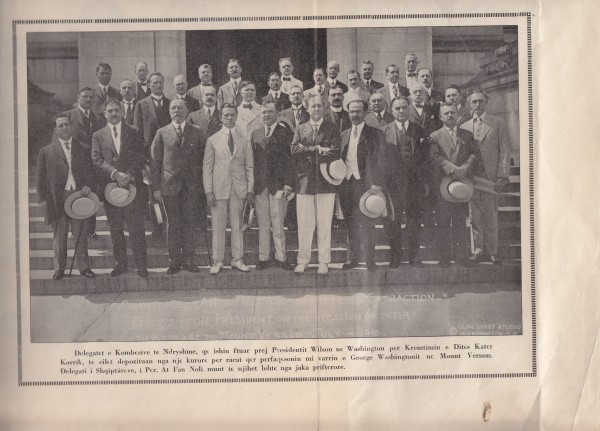
The following memorandum was sent to U. S. President Wilson and Secretary of State Lansing a few days before a delegation of Albanian-Americans left for France to take part in the Paris Peace Conference of 1919. Copies of the memorandum were sent to the foreign ministries of the Allied Powers and their ambassadors in Washington. The aim of the text and of the delegation was to ensure the continued recognition of Albania as a sovereign state. Many of the idealized views expressed in this memorandum, signed by leading clergymen of the Albanian Orthodox Churches of America, among whom Fan Noli (1882-1965) of Boston, can still be heard among Albanians today.

Albania’s titles to independence are sealed with the blood of her sons shed in their long struggles for the defence of their fatherland and the preservation of their race from prehistoric times to the present day. They are based on history as well as on actual occupation, on justice and humanity as well as on necessity for permanent peace in the Balkans, on international agreements as well as on the inalienable right of self-determination, and furthermore on valuable services rendered to civilisation by the Albanian race, which justify its claims to a fair chance to develop its genius for the benefit of the human race.

The land extending from Dulcigno to Preveza on the eastern shore of the Adriatic sea and covering the old Turkish vilayets of Scutari, Kossovo, Janina and the western part of Monastir, is occupied by a compact and homogenous population of more than 2,500,000 Albanians, speaking the same language and solidly united in their determination to become an independent nation. The Albanians, the most ancient race of Europe, have been there from time immemorial long before the Greeks and the Slavs had come into the Balkan Peninsula. They are the direct descendants of the old Illyrians, Macedonians, and Epirotes, and their language is the only living specimen of the tongues spoken by the aboriginal Aryan settlers of Southeastern Europe. They are a distinct race with distinct national characteristics, customs and traditions.

Their survival after centuries of epic struggles against the recurring hosts of invaders speaks well for their virility and tenacity in defending their national patrimony. Placed on one of the most coveted spots of Europe, they had to repel one invasion after another and became by the force of circumstances a nation of fighters par excellence. With their back on their bleak crags they fought against the overwhelming armies of the Romans, the Goths, the Venetians, the Slavs, and the Turks, voiceless through the centuries, with hardly an armistice, with no friend or disinterested protector, and somehow managed to emerge unbroken and unassimilated upon the stage of twentieth century Europe. They refused to bow to any conqueror, although their numbers were decimated by age-long wars and their territory, once covering the whole Balkan Peninsula and the whole eastern shore of the Adriatic, dwindled to what is known today as Albania. Under Alexander the Great, they smashed the Persian empire and conquered the East, under Pyrrhus they defeated the proud legions of Rome, under Scanderbeg they humbled the greatest Sultans of Turkey. Of all the Balkan nations, they were the last to surrender to the Turk but never acknowledged his rule and never bowed to him. While all the other Balkan races were utterly crushed, the Albanians under the leadership of the semi-independent Bushatlis of Scutari, and Ali Pasha Tepelen of Janina, still defied the Turk early in the nineteenth century.

The neighboring Balkan races were liberated one after the other by their European protectors, while the Albanians were invariably abandoned to the mercy of the Turks. The treaty of Berlin not only denied them independence but started the first partition of Albania by ceding Plava and Gusinia to Montenegro, Nish and Vrania to Serbia, and part of South Albania up to Kalama river to Greece. An independent Albania did not suit Germany and Austria at the time because it would have formed a barrier for the Drang nach Osten of Germany and the descent of Austria to Salonica. The appeals and protests of the Albanian League of Prizren, organized for the defense of the national territory were disregarded. Turkey was ordered to compel the Albanians to submit to the decisions of German-led Europe and an international fleet was sent to the Adriatic to enforce them. It was the most cowardly act ever recorded in the annals of modern history. The Albanians defied both Turkey and Europe and succeeded in modifying the stipulations of the Berlin treaty. The Greek frontier had to stop at Arta, the Montenegrins renounced the highlands of Plava and Gusinia, contenting themselves with the ports of Antivari and Dulcigno, which the Albanians could not defend against an international fleet, while the Serbians occupied the districts of Vrania and Nish with the assistance of a Turkish army which came to crush the forces of the Albanian League. Lord Fitzmaurice and Lord Goschen in 1880 advised the British government to erect an independent Albanian State, comprising the four Turkish vilayets of Scutari, Kossovo, Monastir and Janina, as the only just solution of the Balkan tangle but the other Powers opposed their suggestions and the Turks were left free to settle the Albanian question by force of arms. The Albanian League was dissolved, its leaders sent to prison or to exile.

The savage persecutions that followed are well-known to students of Balkan affairs. Albanian schools, Albanian societies, any printed matter in Albanian were prohibited under severe penalties. Albanian leaders and teachers were sent to jail or to exile without any trial. The Greek Patriarchate and the Greek bishops of Albania allied themselves with the Turkish government and terrorised the Albanians through Greek bandits imported from Greece and through solemnly stupid excommunications of the Albanian language and of all those participating in the movement for national regeneration. The use of the Albanian language in the church was strictly forbidden. Father Christo Negovani and Father Stathi Melani were murdered by Greek assassins under the most revolting circumstances for preaching in Albanian; other priests, excommunicated, or forced to leave the country. The only school where Albanian could be taught was the American school for girls at Koritza. But the spirit of the Albanians could not be broken. In 1908 the Albanians joined the Young Turks and compelled Sultan Abdul Hamid to grant a constitution and later on to abdicate. But when they saw that the Young Turks were worse than the Old Turks, they rose against them in 1910, 1911 and 1912, defeated their armies single-handed in Kossovo, and compelled them to grant autonomy to Albania. The success of the Albanian revolutions encouraged the Balkan states to attack and defeat Turkey in 1912. The Albanians declared their independence at Vallona on November 28 of the same year but that did not save them from invasion by the Balkan allies, who occupied all Albania except Vallona and claimed to partition the country among themselves.

The London Conference of 1913, which was called upon to settle the territorial disputes arising out of the Balkan wars, guaranteed the independence and neutrality of Albania, which was placed under the joint protection of the Great Powers of Europe. The delimitation of the frontiers of the new state was in reality a second partition, which was the more revolting in view of the important part played by the Albanians in bringing about the collapse of Turkey. Two thirds of the national Albanian territory with more than 1,500,000 Albanians were cut off and distributed to the neighboring states: the highlands of Hoti, Gruda, Plava and Gusinia and the cities of Ipek and Jakova went to Montenegro; Serbia obtained the province of Kossovo with the cities of Prizren, Uskup, Mitrovitza, Prishtina, Dibra, Struga and Okhrida; Greece extended her frontier beyond the Kalama river, thus annexing the province of Chameria with its seacoast from Preveza to the canal of Corfu. But the Greeks and the Serbians, having annexed, wanted to annex more and practically destroyed the Albanian state by their unprovoked aggressions. The Greeks refused to evacuate the districts of Koritza and Argirocastro, or Northern Epirus as they call it, which were assigned to the Albanian state by the London Conference. They continued their occupation by means of lawless bands which terrorised, massacred and devastated those Albanian regions from 1912 to 1916, until they were expelled by the French and Italian armies. When Prince William was starved out of Durazzo on September 1914, the Serbs and the Montenegrins reoccupied Central and North Albania and vied with the Greeks in exterminating the Albanians. They were driven out in their turn by the Austrians under whose occupation the Albanians starved by thousands from 1915 to 1918. Finally Albania was liberated by the Franco-Italian armies after Austria collapsed and surrendered. Thousands of Albanian volunteers fought in the ranks of the Franco-Italian armies against the Austro-Germans.

It is difficult to say how many Albanians survived this unparalleled series of invasions and counter-invasions, the systematic massacres of their Balkan neighbours, the blockade, the war diseases and the ruthless Austro-German requisitions. But what frightens the Albanians most is the danger of a third and final partition and enslavement as advocated by Serbia and Greece. Such an injustice is unthinkable after a war of liberation fought for the rights of small nationalities and the sacredness of international covenants. Albania is a small friendly nation and her independence was guaranteed by a solemn international treaty in 1913, which was reasserted by the French at Koritza on December 1916 and by the Italians on June 1917. Moreover, the partition of Albania, beside being cowardly, would also prove a dangerous folly, which will further complicate the Balkan embroglio and sow the seeds of another war in the near future, as it is impossible to satisfy the parties concerned. On the other hand, the Albanians, as their history shows, will never submit to a foreign rule and will certainly not fail to avail themselves of the rivalries of their oppressors in order to regain their independence. It is therefore in the interest of peace, as well as of justice, humanity and international morality that all secret bargains concluded under the stress and storm of military exigencies should be disregarded now that Prussianism has been crushed beyond recovery.

America and the Allies who have pledged themselves to the noble principles expounded by President Wilson are bound in honor to do justice to the ancient Illyrian race which has survived the bloody tyranny of the Turk. In accordance with these principles, the political and economic independence of Albania must be restored and guaranteed against future aggressions, by America and her Allies. The boundaries of the Albanian state must be rectified so as to include all territories purely or predominantly Albanian, carved off by Prussian tactics in the past, such as the seaport of Dulcigno, the highlands of Hoti, Gruda, Plava, Gusinia, the province of Kossovo with the cities and districts of Ipek, Prizren. Jakova. Mitrovitza, Prishtina, Uskup, Dibra, Struga and Okhrida, as well as the province of Chameria, or South Epirus, as the Greeks call it, extending from the canal of Corfu to Preveza. To dispute the Albanian character of these districts is to fly in the face of hard facts attested by every impartial observer. The Serbians frankly gave up the job and claim the Albanian province of Kossovo on hazy historical grounds and on recollections of the short-lived empire of Czar Dushan. The Albanians answered that they were there centuries before the appearance of the Serbians on the Danube and are today the actual possessors of the land. Moreover, the Serbians have no reason and no right to extend southward now that they can legitimately expand northward and secure their outlets to the sea through lands inhabited by kindred races.

The Greek claim to South Albania is based on a stupid confusion of religion with race. According to the Greek theory, all Albanians belonging to the Greek Church are claimed as “Greeks.” The absurdity of this theory is self-evident, but the Greeks, knowing the weakness of their position, add that all the Christian Albanians of the South want to be united with Greece. This contention falls to the ground when it is remembered that some of the most prominent Albanian leaders are Christians of the South. The undersigned, Christian clergymen from the South, voice the sentiment of thousands of Christian Albanians in America and in South Albania in declaring that they oppose the annexation of their native districts by Greece. On the other hand, no district of South Albania is exclusively inhabited by Christians, the Mohammedan Albanians being almost everywhere in a majority and fiercely opposing a Greek annexation. A plebiscite can prove this assertion provided it is conducted after a previous occupation of the contested regions by the armies of disinterested nation like America which has no axe of its own to grind. The same thing could be done in all northern districts contested by the Serbians and the Montenegrins.

Ethnographic reasons are not the only ones which militate for a rectification of frontiers on behalf of Albania. The permanent loss of the fertile regions of Kossovo and Chameria, or South Epirus, will cripple the economic life of the Albanian State. The cities of Ipek, Prizren, Jakova, Struga and Dibra, ceded to Serbia and Montenegro, are the market places of districts which were left to Albania by the absurd and unjust delimitation drawn up by the London Conference. Geographically, these cities belong to the Drin Valley, which must go as a whole to Albania. On the other hand, the delimitation of the southern boundary left to Greece a considerable part of the only carossable road existing in South Albania, which connects the city and district of Koritza with its seaport of Santi Quaranta. The mountainous character of South Albania makes the construction of another road between these points an extremely costly affair if not a physical impossibility. Geographically, all the southern districts down to Preveza belong to Albania, as it can be easily ascertained by a mere examination of a map and the course of the rivers. Another reason for the inclusion of the southern districts in the independent Albanian state is the fact that the Albanians of the South, whether Christians or Moslems, are the most advanced, the most cultivated and the most patriotic element of their race and their loss would be fatal to the future development and progress of the Albanian state. The city of Koritza, the cleanest city in the Balkans, is also the cradle of Albanian literary and national renaissance.

That the Albanian harbors must belong to Albania needs no extensive discussion. Their population is purely Albanian and their secure possession is an absolute necessity for the normal economic development of a maritime country like Albania.

 The accusation that the Albanians themselves were responsible for the collapse of the Albanian state, and therefore should not be given another chance, becomes ridiculous when the following facts are taken into consideration. The Albanians had practically no voice in the conduct of the affairs of their country; the International Commission of Control, appointed by the Powers to draw up the constitution of the new state and to organise the finances and the administration of Albania, could not agree on any measure on account of the jealousies of the representatives of the rival groups; the condominium of Austria and Italy degenerated into a pandemonium; an inexperienced German prince, selected and imposed on the Albanians by the European Powers, added to the general confusion by his blunders; the loan promised by the Powers to Albania has never materialised and nothing could be done without money; Greece has never evacuated the districts of South Albania, assigned to the new state by the London Conference, and Albania had to fight from the outset against lawless Greek bands; after the outbreak of the European war, Albania was attacked and overrun by Greece, Serbia and Montenegro, without any provocation, for the simple reason that these states availed themselves of the general conflagration to carry out their plan of partitioning Albania among themselves.

 The Albanians do not claim to be as advanced and refined as the western nations of Europe but they justly resent any implication that they are inferior to any other Balkan nation. There is more illiteracy in Montenegro, which has been free for a century, than in Albania where national schools were prohibited by the Turks. As a matter of fact, the trade of Montenegro is entirely in the hands of Albanian merchants. The Roman Catholic clergy of North Albania, composed of two archbishops, four bishops and over 300 priests, is the best-educated clergy throughout the Balkans. The Greeks, after a century of national life, have been unable to create a literary medium, Their written language being an artificial and barbaric jargon, neither ancient nor spoken Greek, while the Albanians in less than thirty years and under the most trying circumstances have cultivated their language and produced powerful poets and writers, like Father George Fishta, Anton Chako, and Faik Bey Konitza, with whom no modern Balkan author can stand a comparison. So far as religious toleration is concerned, the Albanians are easily superior to all Balkan races and to some highly civilised western nations of Europe; Albania is the only country in the world where Mohammedans, Roman Catholics and Greek Catholics have always lived in peace and harmony, have always sunk their religious differences and united for the defense of their common fatherland, Christians electing a Mohammedan leader and Mohammedans electing a Christian leader without being prejudiced by religious considerations; the Pan-Albanian Federation of America had a Mohammedan president, when the majority of its members were Christians, a Protestant president when no other member professed his religion, and now that the majority of its members are Mohammedans the president is an Orthodox Christian; which explains why the Jews of South Albania and especially of Janina prefer to live under Albanian rather than Greek rule. On the other hand, it is a well known fact that the Rumanians of Pindus, or Kutzovlachs, have several times appealed to the Powers since the London Conference to be included in Albania and thus escape Greek oppression and misrule. Similarly the Bulgarians of western Macedonia would not hesitate for a moment to opt for Albania if the alternative for them were to be subjected to either Greece or Serbia. The arrogant claim of Greeks and Serbians to “civilise” the Albanians by dividing their lands can find a stern rebuke in the pages of the report of the Carnegie Commission where their atrocities and massacres in Albania and Macedonia have been duly recorded by impartial investigators with documentary evidence, while the chivalrous conduct of the Albanians during the disastrous retreat of the Serbian armies through Albania in 1915 might serve as a contrast, fully illustrating the civilisation and humanity of the races involved.It has been asserted by the enemies of Albania, and a good many well-meaning foreigners have been led to believe, that an Albanian state cannot be financed on account of the alleged unwillingness of the Albanians to pay taxes. This is a gross exaggeration. The vast majority of the Albanians had been accustomed for years to pay taxes to Turkey, only a negligible minority of some highlanders of the North being exempt, and even these consented to submit to taxation by a national Albanian government in 1914. Another equally gross exaggeration advanced by interested parties is that Albania is composed of various clans which are unwilling to submit to a central government and that cantonal autonomy should be given to each clan. As a matter of fact the only clans existing in North Albania scarcely number 60,000 members and it is a matter of history that these clans scrupulously submitted to orders from the central government of Vallona and Durazzo and obeyed the officials sent to administer their districts in 1913 and 1914. The whole affair of Albanian cantons was a suggestion of interested parties which tried in that fashion to create foreign spheres of influences. The Albanians themselves rejected this plan with unanimity, which left no doubt in the minds of the foreign intriguers.

 A simple enumeration of the achievements of some famous Albanians and their contributions to human civilisation and progress may give an idea of the potentialities of the Albanian race: Alexander the Great conquered the East and carried European civilisation to the heart of Asia and Africa; Emperor Diocletian of Rome performed the stupendous task of reorganizing the tottering Roman empire; Emperor Constantine, the first Christian ruler of Europe, proclaimed Christianity as the official religion of the Roman empire; Saint Jerome translated the Bible into Latin and thus helped to christianise Europe; George Castriot Scanderbeg, one of the greatest Champions of Christianity and the last king of Albania, fought victoriously against the Turks for twenty-five years and saved Europe from the horrors of Turkish invasion in the fifteenth century; the Bushatlis of Scutari and Ali Pasha Tepelen of Janina continued the struggles of Albania against the unspeakable Turk for over half a century; Mehmed Ali Pasha liberated Egypt, Palestine and Syria and but for the intervention of the European Powers would have conquered Constantinople and abolished the Turkish empire a century ago; most of the leaders of the Greek wars of liberation, like Canari, Miauli, Chavella, Bochari and others were Albanians; the leaders of the Albanian revolutions of 1910, 1911, and 1912 undermined the morale of the Turkish army and were mainly responsible for its defeat during the Balkan wars. Finally, the Albanians have done their bit in the cause of civilisation and humanity by fighting on the side of the French and the Italians against the Austro-Germans on the Balkan front, while numerous Albanians have shed their blood under the Stars and Stripes in France.

 In view of these achievements, the Albanian race can rightly claim a chance to develop freely its genius and contribute its share to the cause of human progress and civilisation. With proper assistance and disinterested guidance, such as have been freely given to all other Balkan nations in their first steps towards national life, Albania, instead of being the cockpit of conflicting interests, will soon become a factor of peace and progress in the Balkans. The Albanians hope that America and the Allies will gladly help Albania to get on her feet, thus settling the Balkan question on a just basis, saving an ancient and promising race from extermination and enslavement, and giving it the place among the civilised nations of the world for which she has fought the longest and hardest of battles through the centuries.

 For the Orthodox Albanians of America

 Very Rev. Fan S. Noli,

Rev. Naum V. Cere,

Rev. Damian Angeli,

Rev. Mark J. Kondili,

Rev. Pando Sinitza,

Rev. Vangel Chamche.

 Boston, Massachusetts, November 27, 1918

[published in: The Adriatic Review, Boston, Vol. 1, No. 3, November 1918, p. 97 104. Reprinted in: Bejtullah D. Destani (ed.), Albania & Kosovo: Political and Ethnic Boundaries, 1867-1946. Documents and Maps. Slough: Archive Editions, 1999, p. 406-412.]

Filed Under: Featured Tagged With: Bejtullah D. Destani, fan noli, memorandum was sent to, U. S. President Wilson

  • « Previous Page
  • 1
  • …
  • 531
  • 532
  • 533
  • 534
  • 535
  • …
  • 902
  • Next Page »

Artikujt e fundit

  • DIMENSIONET ETNOKULTURORE DHE NARRATIVE NË ROMANIN “SHTJELLË FATESH”
  • Mbreti Zog I, themeluesi i shtetit të parë modern shqiptar, burrshtetas, politikan dhe diplomat i rralle e shumë dimensional
  • 𝗔𝗹𝗯𝗮𝗻𝗶𝗮𝗻 𝗡𝗶𝗴𝗵𝘁 @ 𝗬𝗮𝗻𝗸𝗲𝗲 𝗦𝘁𝗮𝗱𝗶𝘂𝗺
  • 27 Vjetori i Betejës së Koshares – Një epokë lavdie, sakrifice dhe bashkimi kombëtar
  • Historia e Krizës së Kosovës 1999-2000 përmes Zarfave Postare
  • Ali Dino – deputeti i Çamërisë dhe artisti i shquar
  • “Rikoshete e fatit” dhe “Nusja e Topiajve”, botimet më të reja nga shkrimtarja Raimonda Moisiu -Sade
  • Zgjidhje urgjente për kërkesat e studentëve shqiptarë në Maqedoninë e Veriut
  • STILISTIKA DHE BOTA E PERSONAZHEVE
  • Nga kërcënimi te kompromisi: Realpolitika e armëpushimit Trump–Iran
  • KRYENGRITJA E MALËSISË SË MADHE E VITIT 1911 DHE RËNDËSIA E SAJ HISTORIKE
  • The Alliance That Doesn’t Exist
  • MAXIMILIAN LAMBERTZ – DIJETARI AUSTRIAK QË IA KUSHTOI JETËN STUDIMIT TË GJUHËS DHE FOLKLORIT SHQIPTAR
  • Shkodër, 8 prill 1937, kur vetëdija jonë kombëtare u lartësua nga “Lahuta e Malcis”, rrokaqielli i eposit në vargje i At Gjergj Fishtës
  • MASAKRA E TIVARIT DHE AJO NË FRONTIN E SREMIT – KRIM KUNDËR NJERËZIMIT!

Kategoritë

Arkiv

Tags

albano kolonjari alfons Grishaj Anton Cefa arben llalla asllan Bushati Astrit Lulushi Aurenc Bebja Behlul Jashari Beqir Sina dalip greca Elida Buçpapaj Elmi Berisha Enver Bytyci Ermira Babamusta Eugjen Merlika Fahri Xharra Frank shkreli Fritz radovani Gezim Llojdia Ilir Levonja Interviste Keze Kozeta Zylo Kolec Traboini kosova Kosove Marjana Bulku Murat Gecaj nderroi jete ne Kosove Nene Tereza presidenti Nishani Rafaela Prifti Rafael Floqi Raimonda Moisiu Ramiz Lushaj reshat kripa Sadik Elshani SHBA Shefqet Kercelli shqiperia shqiptaret Sokol Paja Thaci Vatra Visar Zhiti

Log in

This website uses cookies to improve your experience. We'll assume you're ok with this, but you can opt-out if you wish. Cookie settingsACCEPT
Privacy & Cookies Policy

Privacy Overview

This website uses cookies to improve your experience while you navigate through the website. Out of these cookies, the cookies that are categorized as necessary are stored on your browser as they are essential for the working of basic functionalities of the website. We also use third-party cookies that help us analyze and understand how you use this website. These cookies will be stored in your browser only with your consent. You also have the option to opt-out of these cookies. But opting out of some of these cookies may have an effect on your browsing experience.
Necessary
Always Enabled
Necessary cookies are absolutely essential for the website to function properly. This category only includes cookies that ensures basic functionalities and security features of the website. These cookies do not store any personal information.
Non-necessary
Any cookies that may not be particularly necessary for the website to function and is used specifically to collect user personal data via analytics, ads, other embedded contents are termed as non-necessary cookies. It is mandatory to procure user consent prior to running these cookies on your website.
SAVE & ACCEPT