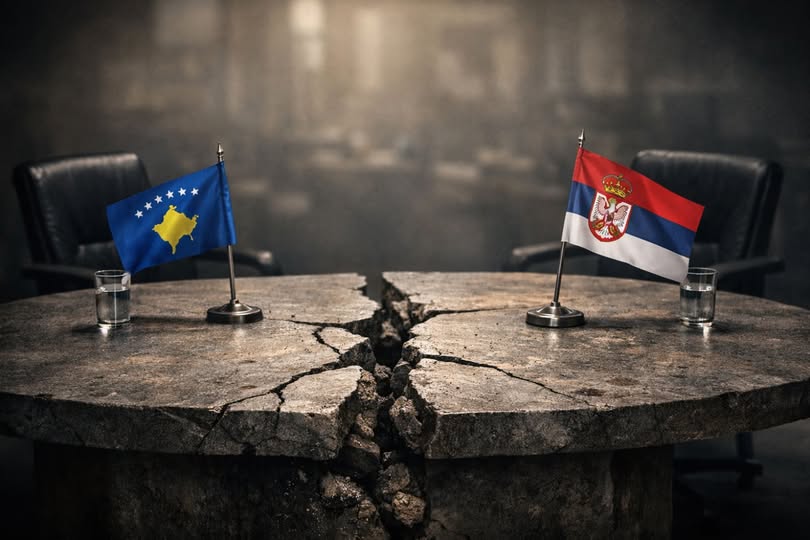
Serbia presents itself as a partner for normalization while advancing narratives built on unproven claims — a dual track that undermines the foundations of reconciliation.
By Elmi Berisha | 21 March 2026
Serbia premiered a film on March 17. It was not a cultural event. It was a policy statement.
Harvest — an American-Serbian-Italian co-production funded by the Serbian Film Center, promoted by Serbia’s Director of Public and Cultural Diplomacy, attended at its Belgrade premiere by senior government officials — advances a specific historical claim: that the Kosovo Liberation Army ran systematic organ trafficking operations against Serbian civilians after 1999. That claim was investigated by a dedicated international court with full mandate and years of resources. It issued indictments, pursued high-profile cases, and charged murder, persecution, and unlawful detention. It did not charge systematic organ trafficking.
No indictment. No prosecution. No conviction.
Serbia chose to make this film anyway. That choice is not incidental.
Serbia presents itself in Brussels and Washington as a government committed to dialogue, to normalization, to a negotiated resolution of its relationship with Kosovo. Its officials sit at tables. They sign frameworks. They speak the language of European integration. Simultaneously, the same government funds and promotes a cinematic production asserting, as documented truth, allegations that its own court — a court Serbia helped bring into existence — could not sustain.
These are not contradictory tracks. They are coordinated. Serbia has spent years constructing a parallel public narrative in which it is the primary victim of the 1999 war — of NATO, of Albanian violence, of international bias — while engaging Western capitals on terms that require those same capitals to treat it as a responsible regional actor. Harvest is the most visible recent expression of that construction. It is not in tension with Serbia’s diplomatic posture. It serves it.
I have sat in rooms where Serbian and American officials discussed the region’s future. And I have watched, over those same years, Serbia’s cultural diplomacy tell a different story to a different audience — one in which the KLA harvested organs and the international community ignored Serbian suffering to serve its own agenda. The film playing in Belgrade’s cinemas today is the product of that effort, refined over years and now export-ready.
Normalization between Kosovo and Serbia — genuine normalization, not managed tension mistaken for progress — requires a minimum foundation. Not agreement on every historical question. Post-conflict societies rarely achieve that. But a baseline: an acknowledgment that documented crimes occurred, that victims were real, that the international legal record matters. Serbia has not offered that baseline. It has not acknowledged the systematic expulsion of nearly a million Albanians. It has not acknowledged the massacres documented in ICTY judgments and confirmed by Serbian state records. The village of Reçak, where 45 unarmed civilians were killed on January 15, 1999, remains, in Serbian official discourse, a battlefield engagement rather than what international forensic investigation established.
Harvest does not operate in isolation from that denial. It is its continuation — produced with better resources and wider international reach than any previous iteration. The film’s central device is designed to make unproven allegations feel like lived experience. It does not invite the audience to evaluate evidence. It bypasses evidence entirely. It replaces verification with experience. What is felt becomes what is remembered. What is remembered becomes what is true. In policy environments where attention is limited and primary documents go unread, that mechanism does real work — not in Belgrade, but in the diaspora networks, parliamentary offices, and diplomatic channels where Serbia’s international standing is actually negotiated.
Western silence is not neutrality. It is the condition that makes this strategy viable.
This is not a call for rupture with Belgrade. The dialogue process has value. American engagement in the Western Balkans has been essential and must continue. But engagement requires honesty about what it is engaging with. A government that funds disinformation about unproven atrocities while presenting itself as a peace partner is not expressing two contradictory impulses in tension. It is running a calculated dual track, and it has concluded — not without reason — that the cost of doing so is acceptable.
Reconciliation between Kosovo and Serbia remains possible. It will require Serbian leaders to tell their own population something harder than any film will tell it — that the crimes documented in international courts were real, that the victims were real, and that no narrative campaign changes either fact.
A partner that manufactures victimhood while refusing to acknowledge documented crimes is not yet ready for the table it claims to want.
Washington and Brussels are allowed to say so.