• Home
  • Politics
  • Opinion
  • Culture
  • Sports
  • Economy
  • Interview
  • Reporting
  • Community
  • Vatra

Dielli | The Sun

Albanian American Newspaper Devoted to the Intellectual and Cultural Advancement of the Albanians in America | Since 1909

11 Years of Kosova’s Independence and DIELLI

February 19, 2019 by dgreca

1 zgjatje duaresh1 Neka11 a Vatra2 Legaliteti1 a salle me pol tambur1 Marku Hymn1 a Sahatqija1 a flet Marku1 a Batalioni Atlantiku

BY RAFAELA PRIFTI/

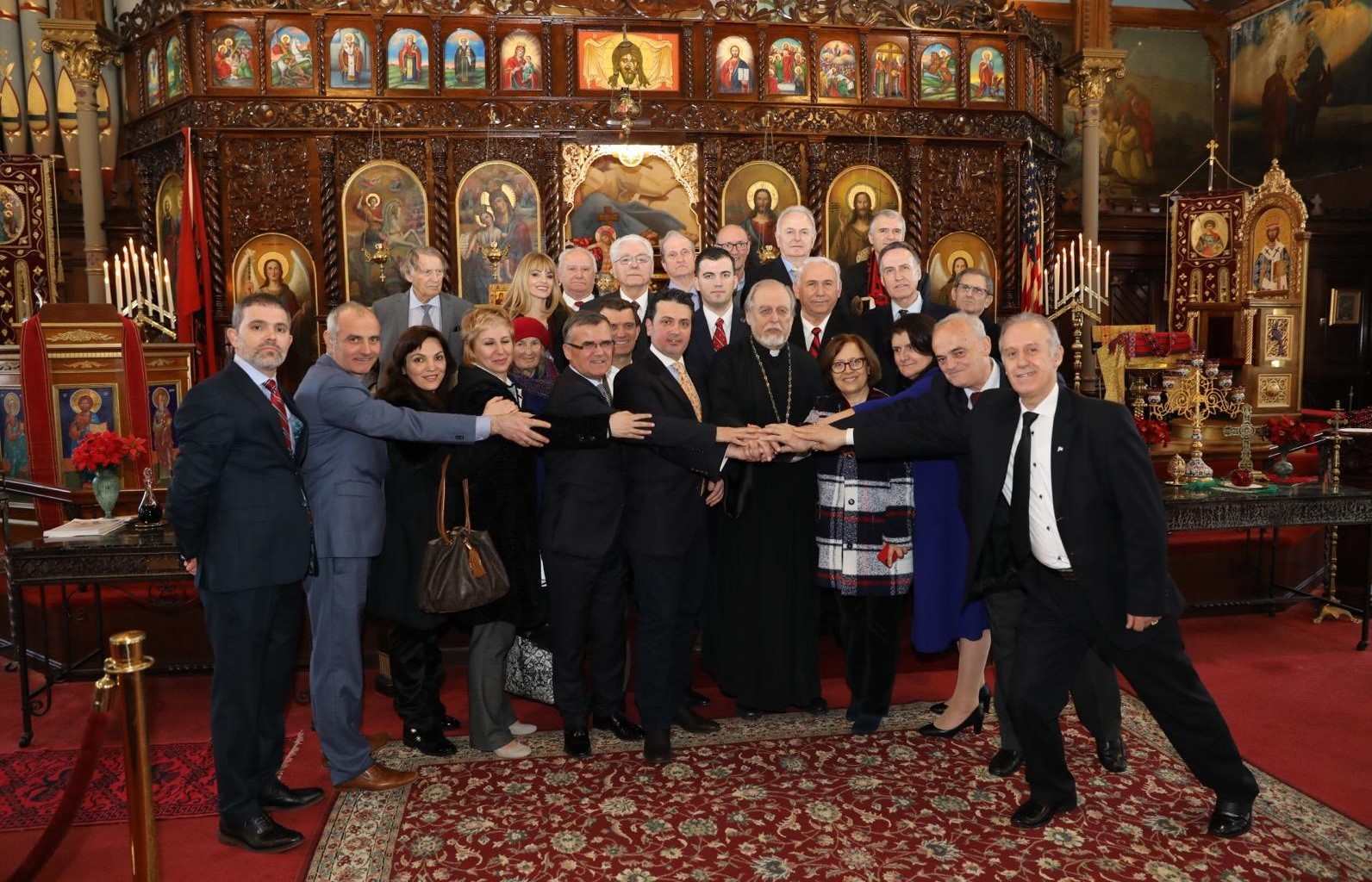
On February 16 2019, the celebration of Kosova’s eleventh year of independence was hosted by a number of Albanian American Community Organizations at the Hilton Westchester. Vatra the Pan-Albanian Federation of America proudly joined all the associations that made the event possible. Vatra’s President Dritan Mishto, Vice President Agim Rexhaj, Secretary Nazo Veliu, Treasurer Marjan Cubi. Dielli’s Editor Dalip Greca, from the Executive Council Zef Balaj, from the Board, Leke Perlleshi, Medi Hoxha, Pashko Camaj and Asllan Bushati, Veiz Belliu, Mehill Gjuraj and Pashke Maksuti joined the celebration alongside representatives of Royalists’ Party. The proceeds from the fund raiser would go to support the Bytyqi Brothers Foundation. The family members of the late Bytyqi brothers were present at the event.The main speaker and one of the sponsors of the celebration, New York City Councilman Mark Gjonaj delivered the main remarks of the evening. He thanked twenty five organizations of the Albanian American community that hosted the celebration (the full list is posted at the end of the article). In commemoration of the twentieth anniversary of Kosova’s liberation, the evening honored the Bytyqi Brothers, whose Foundation is committed to bringing justice to the deceased and missing persons. The main speaker provided an overview of the devastation caused by the war: over 100,000 structures destroyed and damaged, over 800,000 people expelled or displaced, over 20,000 girls and women raped and assaulted, over 13, 950 people killed and over 1, 620 still missing. Council Member noticed that on account of the divisive politics of the Albanian leadership and the heavy lobbing of the Serbs in Congress, the aggressor is trying to play the victim. “We are the victims!” he stated firmly. In the next part of the speech, he criticized the current positions of the politicians in relation to the borders of Kosova and the issue of tariffs which he referred to as “a public relations war’. The final criticism in Mark Gjonaj’s remarks for the evening was formulated in a form of a question” Where is the unified national agenda?” Speaking after him, Ambassador Teuta Sahatqija of the General Consulate of Kosova in New York, stated that “Victory requires sacrifices”. The freedom fighters and the families who lost their members in the war paid the ultimate price. She said that the actions and dedication of the diaspora are equally valuable in giving voice to the suffering in Kosova and providing a platform for the sacrifices of its people. The last speaker, Gani Shehu, Chairman of the Atlantic Association, said that Kosova’s army is the second biggest achievement after its independence. On December 14th the Kosova Assembly adopted the legislature to turn the Security Force into Kosova’s Army. Mr. Shehu pointed at the flags of US, Albania, Kosova and to a new black-colored flag designed to honor the missing. The Masters of the Ceremony were Besa and Shpend Xani. The national anthems were performed by tenor Riad Ymeri. The Marching Guard of the NYPD Illyrian Society of Law Enforcement Officers greeted the opening of the event. The list of entertainers included Arben Kransniqi, Artan Kola, Besim Muriqi, Donika Ukshini, Entela Ilirjani, Haxhi Zeneli, Hajro Ceka, Ida Tili-Trebicka, Kino Gara, Mirsad Ceka, Nik Carku, Sebahete Berlajolli.

Looking back a year ago, the February 2018 issue of Dielli brought to the reader messages and telegrams of congratulations for the 10th anniversary of Kosova’s independence from President Trump, former president Bill Clinton, former Secretary of State Madeleine Albright, General Wesley Clark,  Junior Senator of Iowa Joni Ernst, former US Ambassador to the UN Mrs Nicki Haley, NY Congressman Elliot Engel, the speech of Kosova’s Ambassador to the US Ms. Vlora Citaku at the diplomatic reception, reflections from Enver Krasniqi. University of Prishtina PhD Professor of Economics, Anna Di Lellio, Sociologist and Policy Analyst. In the same issue, Dielli covered the meeting of Vatra’s Executive Council Members and a delegation of Kosova’s Ministry’s of Diaspora and Strategic Investments at its headquarters, the opening of the photo exhibition “Breathing New Life” of photographers Shkelzen Rexha and Arben Llapashtica co-sponsored by Vatra at the offices of Kosova’s General Consulate in New York, the homage to Bytyci brothers at the cemetery by a joint group of Kosova’s officials documented and sponsored by Vatra’s Media Coordinator Dritan Haxhia, whereas Dielli’s editor, Dalip Greca provided a detailed account of the celebration of the 10th anniversary of Kosova’s independence at Marina del Ray, where fifteen community organizations came together for the festivities and Vatra’s Chairman Dritan Mishto delivered the main note of the evening. Such events have been part of our community’s life and Dielli has been documenting and recording them for 110 years.

*Albanian American Association Ana e Malit, Albanian American Community Association, Albanian American Cultural Foundation, Albanian American National Council, Albanian American Educators Association, Albanian American National Organization, Albanian American Open Hands Organization, Albanian American Puka Community Association, AAWO Motrat Qiriazi, Albanian Roots, Association Malesia e Madhe Ny, Atlantic Association, Dibra Community Association, Dom Simon Filipaj Foundation, Illyrian Society of Law Enforcement Officers, Kosova Lindore Association, Kraja Association, “Marigona” Albanian Woman Organization, MAASBESA, Peja Association, Plave Guci Foundation, Rugova Association, Shoqata Skenderbej, The Women’s Organization Hope and Peace, VATRA the Pan-Albanian Federation of America

Filed Under: Featured Tagged With: 11 Years, and DIELLI, of Kosova's Independence, Rafaela Prifti

SHPËTIMI I HEBREJVE NË SHQIPËRI-HOLOKAUSTI I PËRKUJTUAR

February 1, 2019 by dgreca

1 anna KohenNGA RAFAELA PRIFTI/

1 a Foto OKB

Veprimtaria “Shpëtimi i Hebrejve në Shqipëri gjatë Holokaustit” organizuar nga Shoqëria Civile e Zyrës së Komunikimit Global të OKB-së në bashkëpunim me Misionin e Shqipërisë pranë Organizatës Botërore u mbajt në kuadër të javës kushtuar viktimave të persekutimit sistematik gjatë viteve 1933-1945. Besiana

Në hyrjen e selisë së OKB-së nga ana e vizitorëve ishin paraqitur afishe të botimeve të paraqitura gjatë javës përkujtimore si dhe stenda të veprimtarive dhe fotografi të shembujve të moralit human. Shtetësitë e personave që e kundërshtuan me vepra fushatën e spastrimit etnik të hebrejve nga nazistët përfshnin një numër të vendeve si Suedia, Çekosllovakia, Peruja, Spanja, India etj. që korrespondonin me vendbanimet dhe vendstrehimet e viktimave. Ekzpozita ndërkombëtare me temën “Holokaust i Përkujtuar” shpalos idene se të drejtat njerëzore nuk njohin kufi shtetëror dhe përkatësi kombëtare.1 asllani 3

Në podiumin e sallës së konferencës ku mbajt veprimtaria e së enjtës ishin ulur organizatorët dhe folësit kryesorë. Zëvendës-Sekretarja e Përgjithshme për Komunikim Global, znj. Alison Smale mbajti fjalën e hapjes dhe prezantoi me radhë të ftuarit. Strehimi i hebrejve nga shqiptarët u vlerësua si mishërim i principeve të Deklaratës së të Drejtave të Njeriut, e cila është miratuar në sesionin e tretë te Asamblesë së Përgjithshme të OKB-së në dhjetor 1948 në Paris.c

Zeri i AmerikesAjo shprehu mendimin se sjellja njerëzore që manifestuan shqiptarët gjatë viteve të Holokaustit shërben si mbështetje për shoqërinë civile në kohën e sotme në mbrojtje të të drejtave të patjetërsueshme njerëzore. Përfaqësuesja e Përhershme e Misionit të Shqipërisë pranë OKB-së, Besiana Kadare falenderoi pjesëmarrësit dhe organizatorët duke theksuar se një aktivitet i tillë përkujtimor është pjesë e trashëgimisë të së kaluarës dhe, se rëndësia e tij lidhet me mësimet për të ardhmen. Presidenti i Kongresit Botëror të Hebrejve, Ronald Lauder, në fjalën e vet u përqëndrua të shtimi I rasteve të akteve anti-semite në Shtetet e Bashkuara dhe kritikoi qëndrimin e Organizatës së Kombeve të Bashkuara me miratimin e 21 Rezolutave kundër shtetit të Izraelit. Si shembull të një prijësi të moralshëm, ai përmendi Winston Churchill për guximin e manifestuar nga kryeministri britanik përballë presionit nazist. Në fjalën e Dr. Ana Kohen solli shembuj personal nga jeta e familjes së saj të ardhur nga Greqia për tu strehuar në Vlorë. Ndonëse familjarëve iu desh të ndryshonin emrat si mekanizëm sigurie, të gjithë e dinin se në atë vend jetonin hebrejtë dhe se kodi zakonor i besës shqiptare ishte parim i shenjtë i tyre. Znj. Kohen shtoi se ajo ndërmori përpjekjet për ta ri-emëruar rrugën për nder të kujtimit të prindërve të saj dhe atyre që jetuan aty. Me zë të emocionuar, ajo përmendi sesi pas 11 shtatorit ajo përjetoi një frikë të ngjashme të dënimit të një popullsie për shkak të përkatësisë etnike a fetare. Në vazhdim, Drejtuesja e “Eye Contact Foundation” Majlinda Myrto, e zgjeroi tablonë e portretet e të mbijetuarve me anë të dëshmisë gojore të miqësisë midis familjes së bashkëshortit të saj dhe personave që strehoheshin aty gjatë viteve të luftës. Prej asaj kohe, Shyqyriu i besimit mysliman dhe Josefi i fesë jaudite e ruajtën miqësinë deri në fund të jetes së tyre. Znj. Myrto tha se themeluesi i Foundacionit Norman Gershman ishte autori i fotografive të paraqitura në diapozitiva, pjesë e ekspozitës shetitëse për edukimin e brezave. Folësi tjetër ishte David Estrin, i cili për kujtim të gjyshit të tij që mbijetoi Holokaustin filloi një nismë për të mbajtur vigjilje bashkë me studentët e tjerë në Duke Universitety, nga zuri fillesat lëvizja ‘Kujtojmë së Bashku”. “Duke i dhënë hapësirë gjenocideve të ushtruara mbi popujt si në Kongo, Ruanda, Zambia, do arrijmë të kthejmë kujtesën në vepra” tha themeluesi i organizatës rinore “dhe të formojmë drejtuesit e së nesërmes”. Në mbyllje të programit foli

Robert Singer, shefi ekzekutiv dhe zëvendës-president i Kongresit Boteror të Hebrejve, i cili e quajti Shqipërinë ‘shtëpia e jetës’ që lartëson emrin e saj në rang botëror. Moderatorja Smale lejoi pyejte nga të pranishmit duke ia dhënë fjalën përfaqësuesit të Kongresit dhe kryetar të Komitetit të Marrëdhënieve të Jashtme, Eliot Engel. Një nga mbështetësit e hershëm të pavarësisë së Kosovës dhe përkrahës i shqiptarëve, z. Engel, kujtoi sesi gjatë një vizite në Prishtinë në takim me ish-presidentin Rugova, ai kishte dëgjuar për herë të parë për një varrezë të vogël të hebrejve në afërsi të Prishtinës.

Ai e përshëndeti veprimtarinë duke thënë se urretja ndaj çdo grupi na kujton se duhet të ndjekim shembullin e shqiptarëve. Të njëjtën mesazh e përcolli edhe i ngarkuari me postin e Ambasadorit të Shteteve të Bashkuara në OKB, Jonathan Cohen, i cili vërejti se heshtja mbjell dhunën. Duke ilustruar pasojat e qëndrimit anti-semit dhe zhgënjimin e tij, Ambasadori i Austrisë Jan Kickert vërejti konstratin midis shqiptarëve dhe austriakëve ndaj strehimit të hebrejve në periudhën e luftës. Imami Dr. Tahir Kukaj i Qëndres Islamike të Staten Island komentoi se fotografitë e paraqitura në veprimtari janë pjesë e edukimit të brezit të ri shkollor. Ambasadori i Izraelit në organizatën botërore, z. Danny Danon tha se jo vetëm individët por i gjithë vendi meriton të nderohet si e tillë nga Yad Vashem, qendra zyrtare për viktimat e Holokaustit, që vlerëson aktet e shpëtimit të hebrejve nga shtetasit anë e mbanë botës. Duke folur për konceptin e ndarjes të imponuar nga kufitë, Anëtari i Këshillit Bashkiak të qytetit Mark Gjonaj shprehu mendimin se miqësia midis popujve shqiptare dhe izraelit duhet të jap nxitje shtetit të Izraelit të njoh Kosovën. Kësaj ideje i bëri jehonë të fortë Cafo Boga, këshilltar financiar, me origjinë nga Mali i Zi, i cili evidentoi se shqiptarët kanë strehuar familjet e hebrejve në trevat e tjera përfshirë Kosovë, Çamëri, Maqedoni etj. Në bazë të kësaj të vërtetë, shtoi ai, Përfaqësuesja Zyrtare e Kosovës do të duhej të ishte pjesëtare në podiumin e veprimtarisë së mbajtur në sallën e OKB-së. Drejtuesja e programit, znj. Smale, ia dha fjalën Xhosef DioGuardi, ish-parlamentarit të Kongresit për Nju Jorkun nga 1985-1989 dhe lobist për çështjet shqiptare. Ndërsa për disa pjesëmarrës, historia e shpëtimit të hebrejve ne Shqipëri ishte pak ose aspak e njohur, DioGuardi tregoi sesi projekti ka filluar në vitet 1990 gjatë vizitës së tij dhe kongresistit demokrat për Kaliforninë Tom Lantosh në Shqipëri.

Midis pjesëmarrësve të informimit të mediave dhe përfaqësuesve të organizatave të komunitetit si edhe pushtetit lokal në aktivitetin përkujtimor ishin të pranishëm, klerikë të tri feve, dhe anëtarë të familjes Biçaku të pagëzuar me titullin “Fisnik të mbarë kombeve” si the Vatranë dhe anëtarë të Kryesisë së Federatës Pan-Shqiptare të Amerikës Vatra.

Filed Under: Featured Tagged With: ne Shqiperi, Rafaela Prifti, SHPËTIMI I HEBREJVE

VATRA MAKES A CASE FOR THE RECOGNITION OF KOSOVA TO THE APOSTOLIC NUNCIO OF ALBANIA

January 9, 2019 by dgreca

1 ambasadori e mire1 Balaj me letra1 a adm ceza treg1 dritani hap1 Lumi shkruan1 a Marko flet1 amb dalip dok1 amb shkruan1 am dera

1 a bashke

By Rafaela PRIFTI/

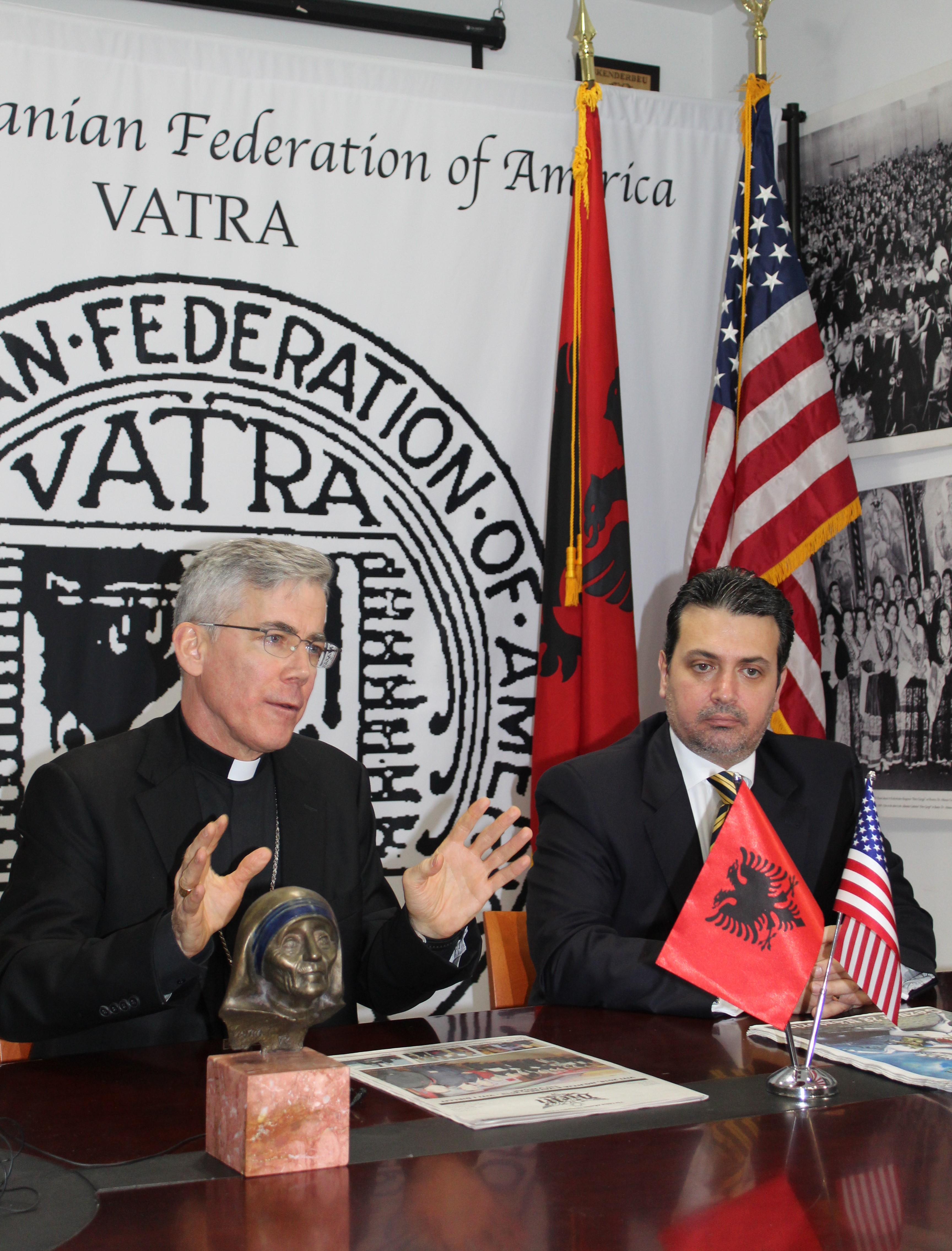
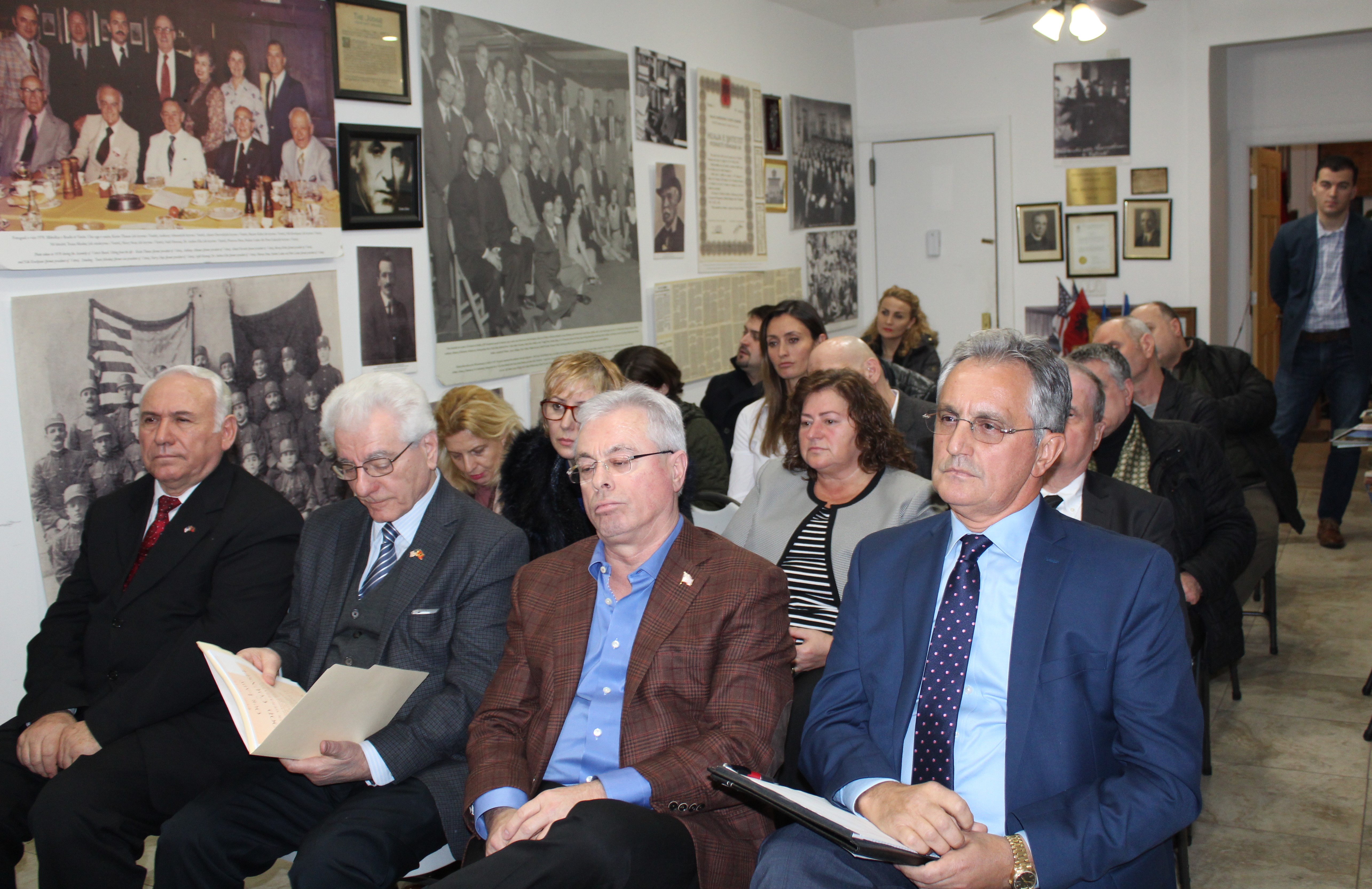
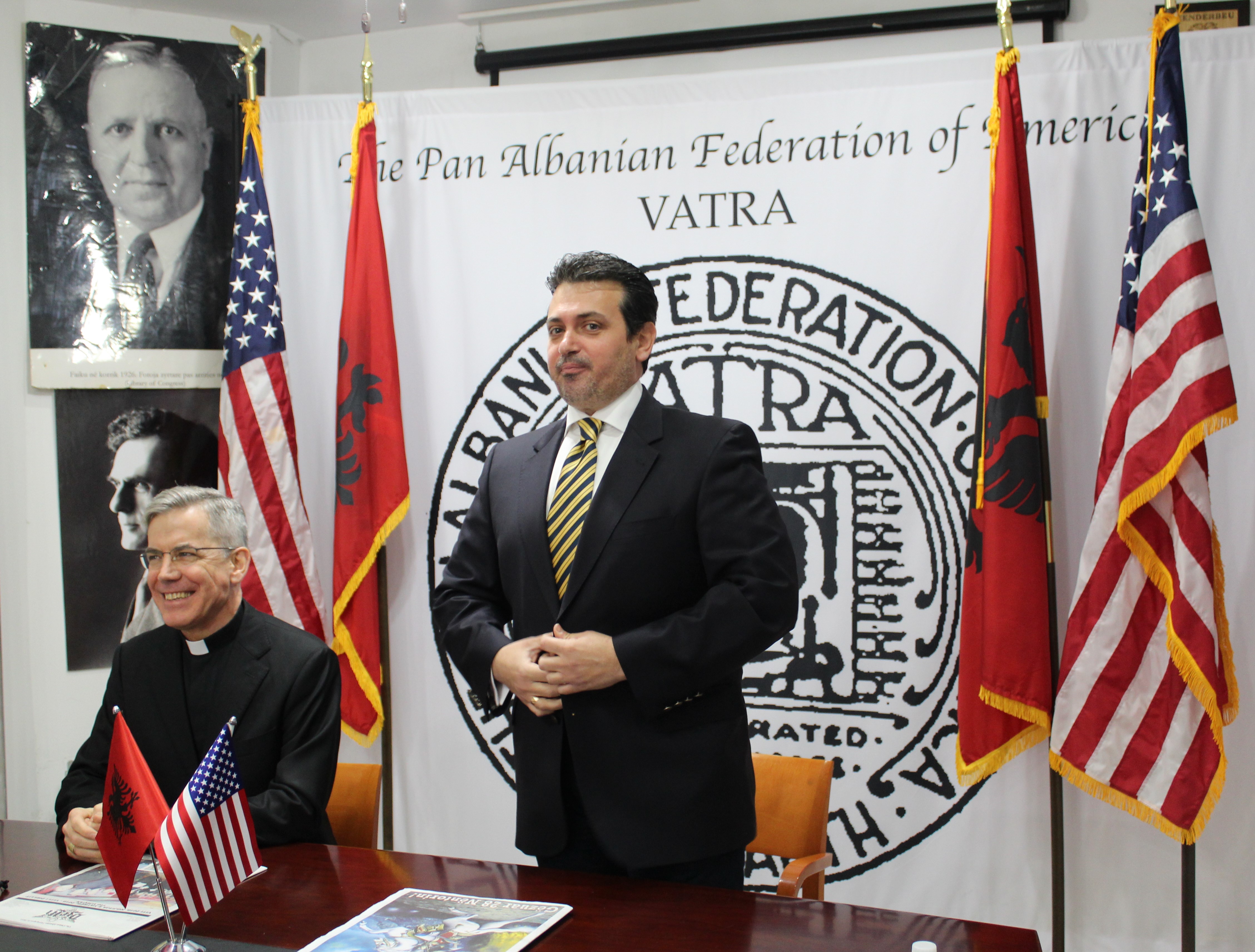
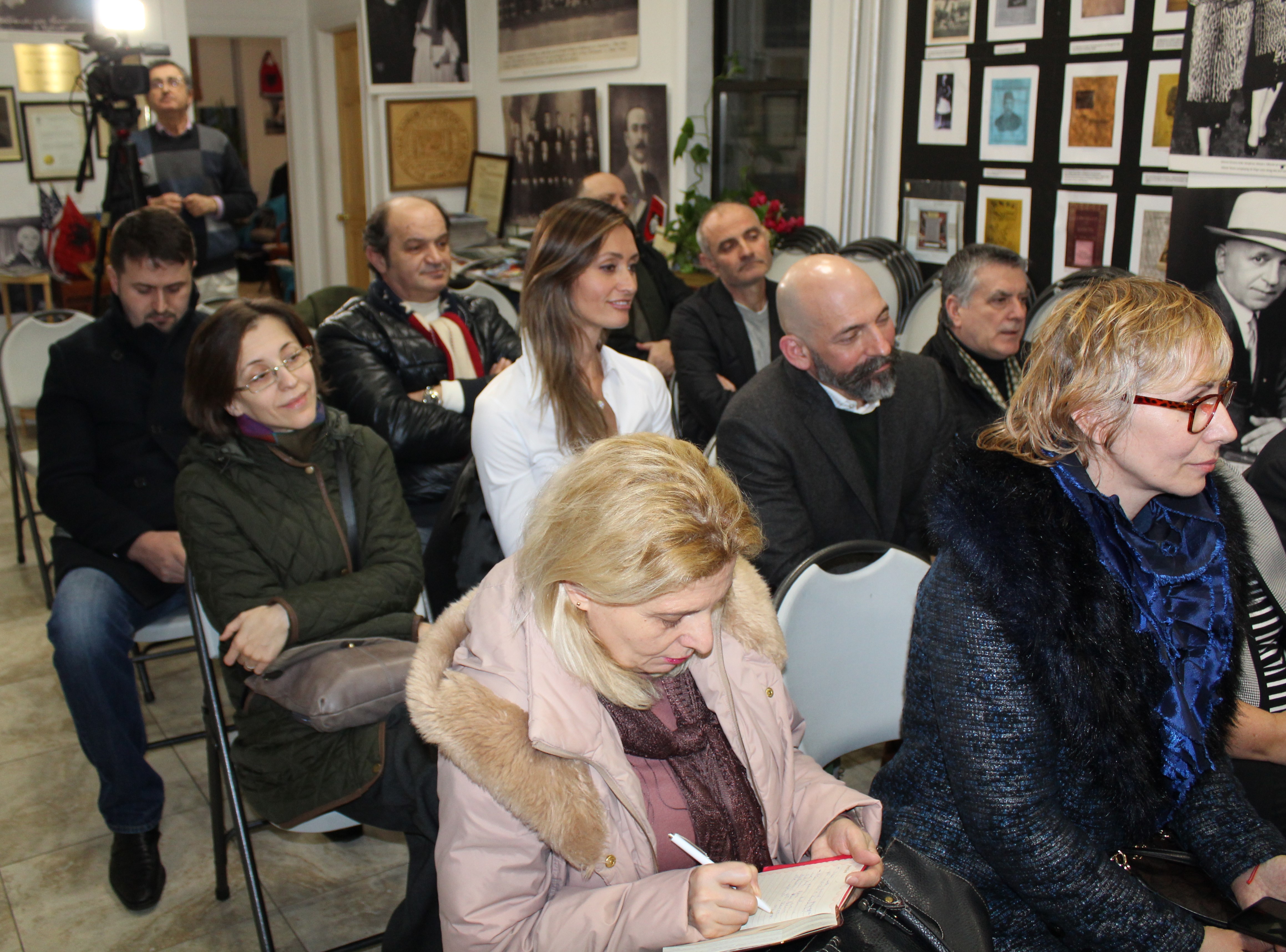
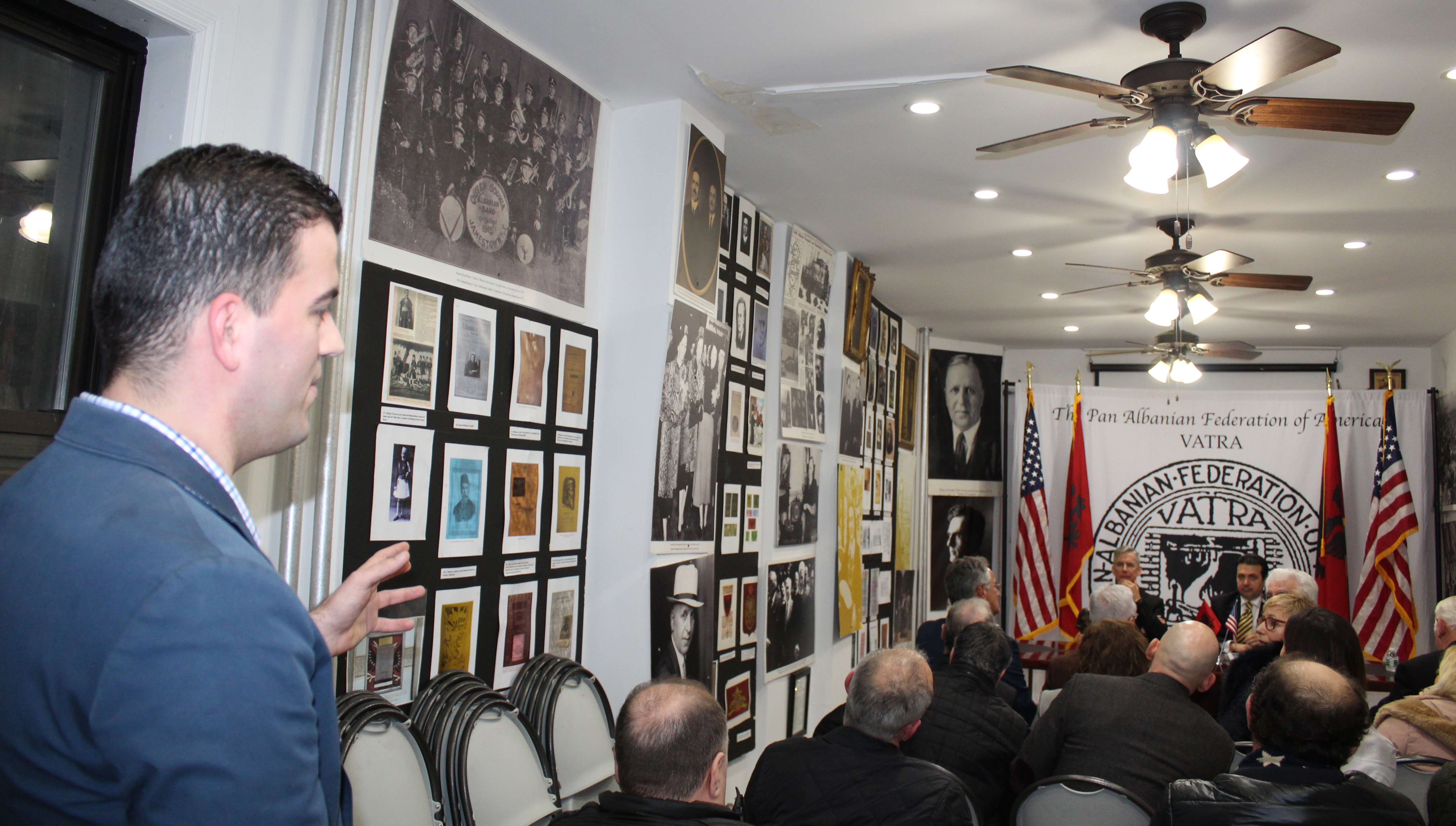
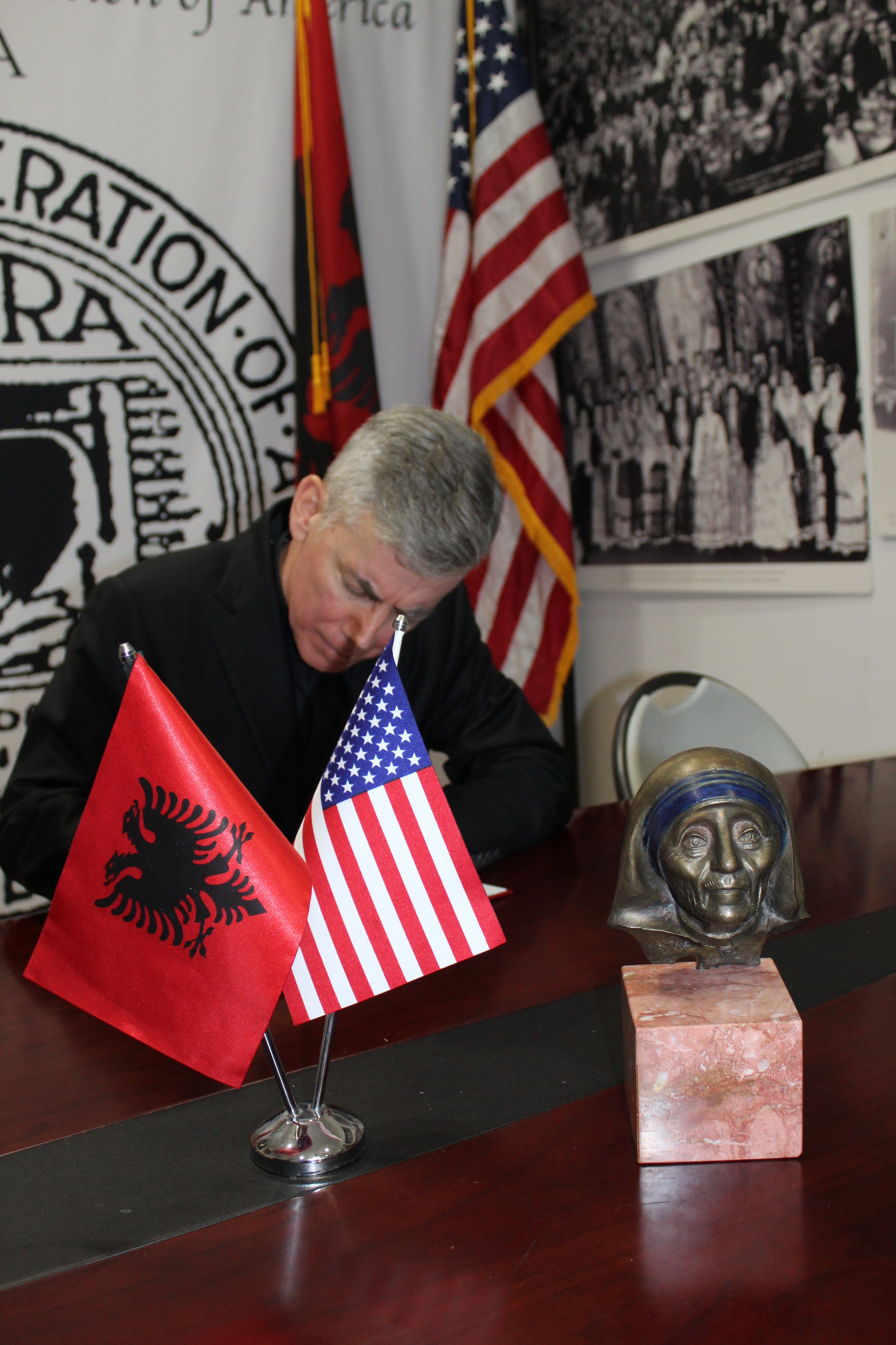
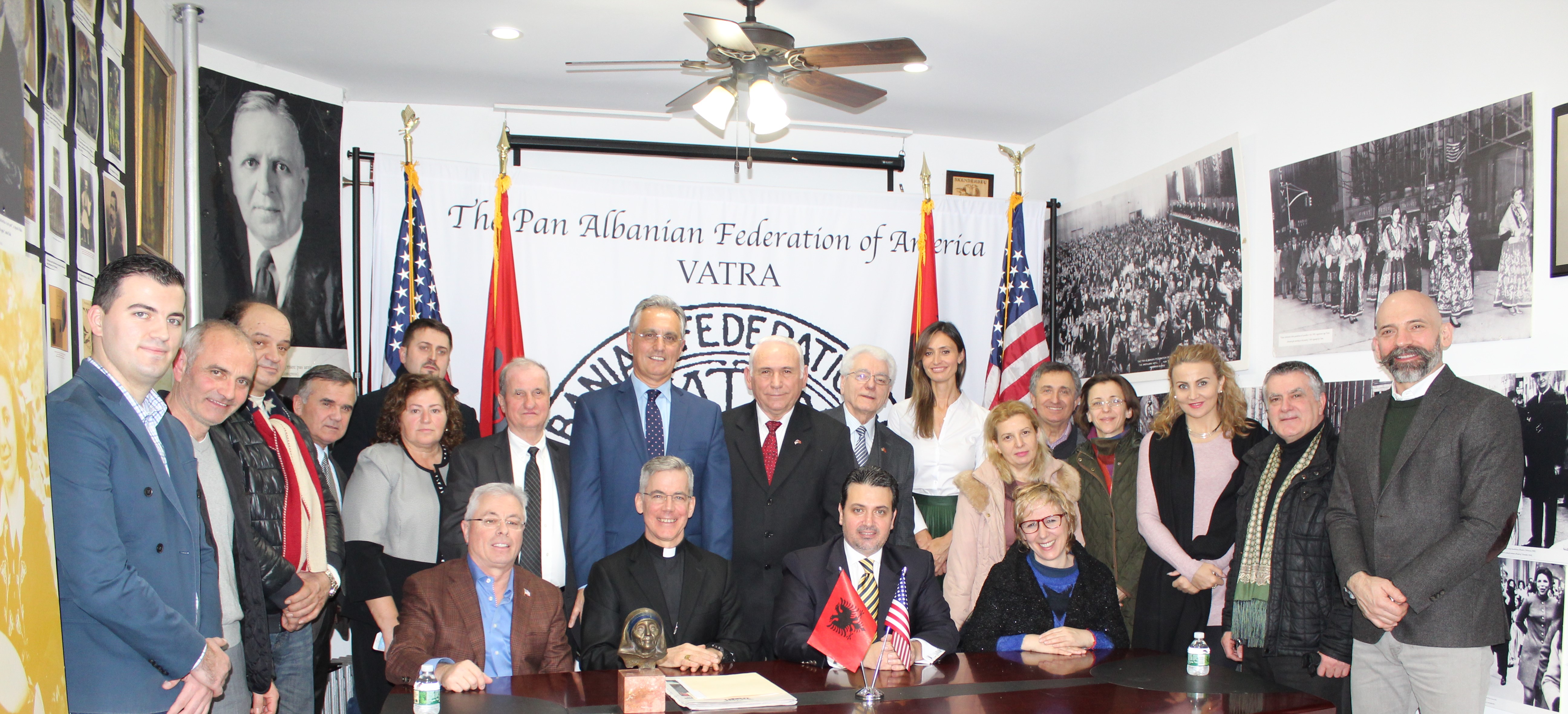
In his first visit at Vatra’s offices, the diplomatic representative of the Holy See to Albania, Archbishop Charles Brown was warmly received by several members of the Board and the Albanian-American community. On behalf of the Pan-Albanian Federation Vatra, President Dritan Mishto, expressed thanks for the efforts of the papal envoy to improve religious tolerance in Albania and pleaded with him to recognize Kosova’s independence. Archbishop Brown, who is a native New Yorker and served as a priest in a Bronx parish in the late 1980s, served a full term as the Vatican’s Ambassador in Ireland prior to accepting the assignment of Pope Francis to be the Nuncio in Albania in March 2017. During the 1990s he did a lot of work with the Missionary sisters and Mother Teresa personally, which he regards as a spiritual introduction to his current assignment. He spoke fondly about this year and a half in Albania, amidst efforts to know the people and learn the language. Indeed only a few weeks ago, the Archbishop celebrated Catholic mass in Albanian among the Albanian-American community in Washington DC. In his recent assignment, he said that the great discovery of “the preservation of some traditional values of family and respect in Albania that have really disappeared in many other places in the world” is worth-noting. He added that he was with Pope Francis before this last Christmas in Rome, and while talking about Albania, his Holiness reminded him that Albania was the first country in Europe that he visited and “he wanted that to be a sign.” Among the reasons for the Pope’s appreciation for Albania, the apostolic nuncio noted the religious harmony that exists in the country which can be a model for other places and the history of persecution of the faith. Religious believers of different faiths suffered under the time of communism. And that is a great testimony of the triumph of faith over communist materialism. “So for those two reasons, I think Pope Francis has a very special love for Albania and that love is certainly been communicated in a big way to me.” With regard to the issue of Kosova, the papal nuncio reiterated that in the last year or little more than a year, both the Prime Minister and the President of Kosova have visited with the Pope. This is an important issue that we take very, very seriously, he said and opened the floor to questions, most of which focused on Kosova. The successful developer with family origins from Peja, Harry Bajraktari raised the question of Kosova’s recognition by the Vatican and the establishing of diplomatic relations that positively encourage business and development in the country. Zef Balaj of Vatra’s Executive Board pressed for some guidance on the issue of supporting the acceptance of Kosova by the Holy See, which carries significant weight in the diplomatic community. In his response, Archbishop Brown expressed the desire of the Holy See to see a real resolution of the disputes between Serbia and Kosovo, as a condition towards moving forward with a number of issues including recognition. He admitted that at the present time, these are very difficult issues.

On the issue of inter-religious cooperation, the apostolic nuncio singled out the work of a committee of all heads of religious communities, which is very active and has issued joint letters on a number of issues. In the last year, the committee addressed various topics including European integration. When asked about his role, he answered that as the diplomatic link between the Holy See, the Vatican and the government of Albania, his task is to strengthen the relationship between the Vatican and the Catholic Church and the relationship between the Vatican and the government.

Responding to a question on the issue of properties confiscated by communism, he stated that it is a matter that affects the Catholic Church and other religious communities. On this sensitive topic, the Holy See supports and promotes the views of the Albanian Catholic Bishops. The church is not interested in displacing people to try to retain property. Aside from the restitution, there are problems of property title and ownership. The government is working on these complicated issues which are difficult to regulate, added the papal envoy.With regard to opportunities for the young people in Albania, Archbishop Brown said that they are immigrating and have a desire to emigrate in large numbers due to the economic situation. One of the elements certainly is corruption in various sectors of society that needs to be confronted and resolved. The reduction of corruption will produce a situation where there are more opportunities for young people. The government’s efforts to combat the problem of corruption are applauded and supported by the religious communities including the Catholic Church. He added that the European integration is linked to the question of corruption as the integration process moves forward that almost inevitably will require a reduction if not the elimination of corruption.

Bringing the attention back to Kosova, the community activist Harry Bajraktari provided more context to the issue of recognition by the Holy See. He stated that the Serbian Orthodox Church continues to undermine the country alongside the Serbian government supported by their historic allies. In Albania, the Orthodox Church under the influence of the Greek clergy plays a divisive role. Although Albanians are in a great place presently, the undermining efforts coming from various directions are intensifying. While commending the leadership of the Church, he noted that resolving the issue of recognition will help diffuse the rising tensions calling upon the Pope to move this matter forward.

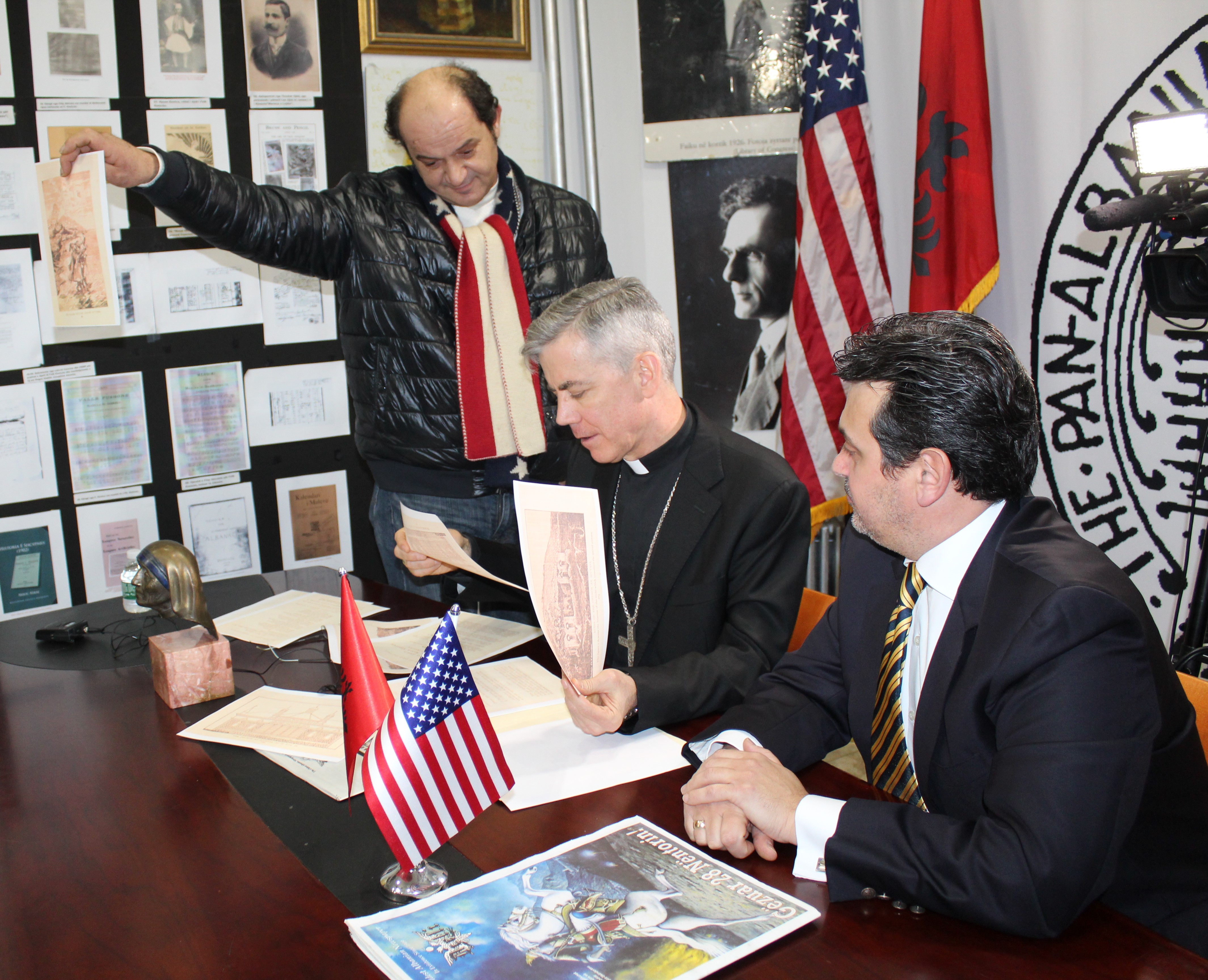
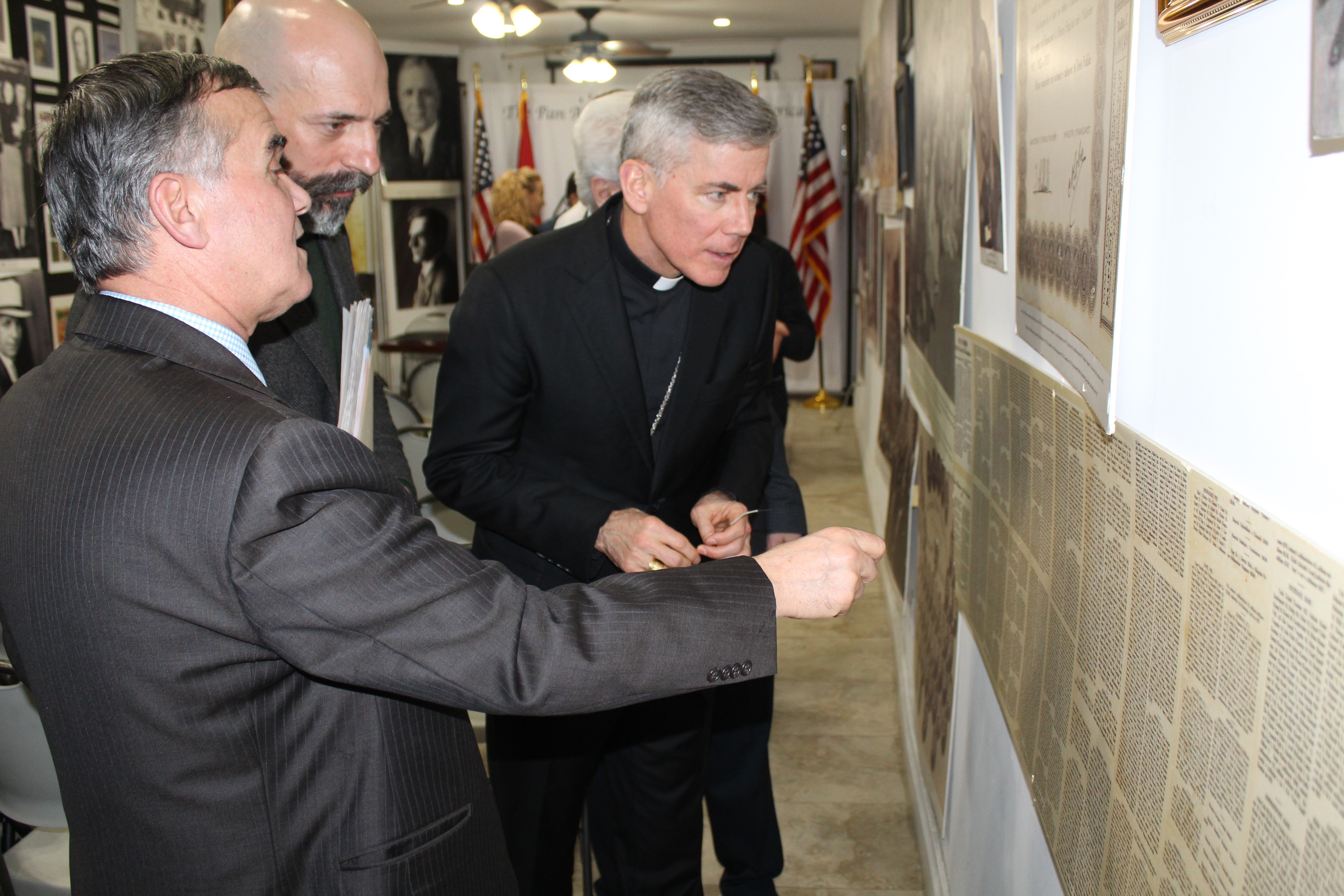
Cezar Ndreu, Executive Council Member of Vatra, brought up to the Archbishop Brown a rare find: photocopied pages from a Benziger publication titled Our Lady of Good Counsel in Genazzano: A History of that Ancient Sanctuary and of the Wonderful Apparition and Miraculous Translation in 1467 of Our Lady’s Sacred Image, from Scutari to Genazzano

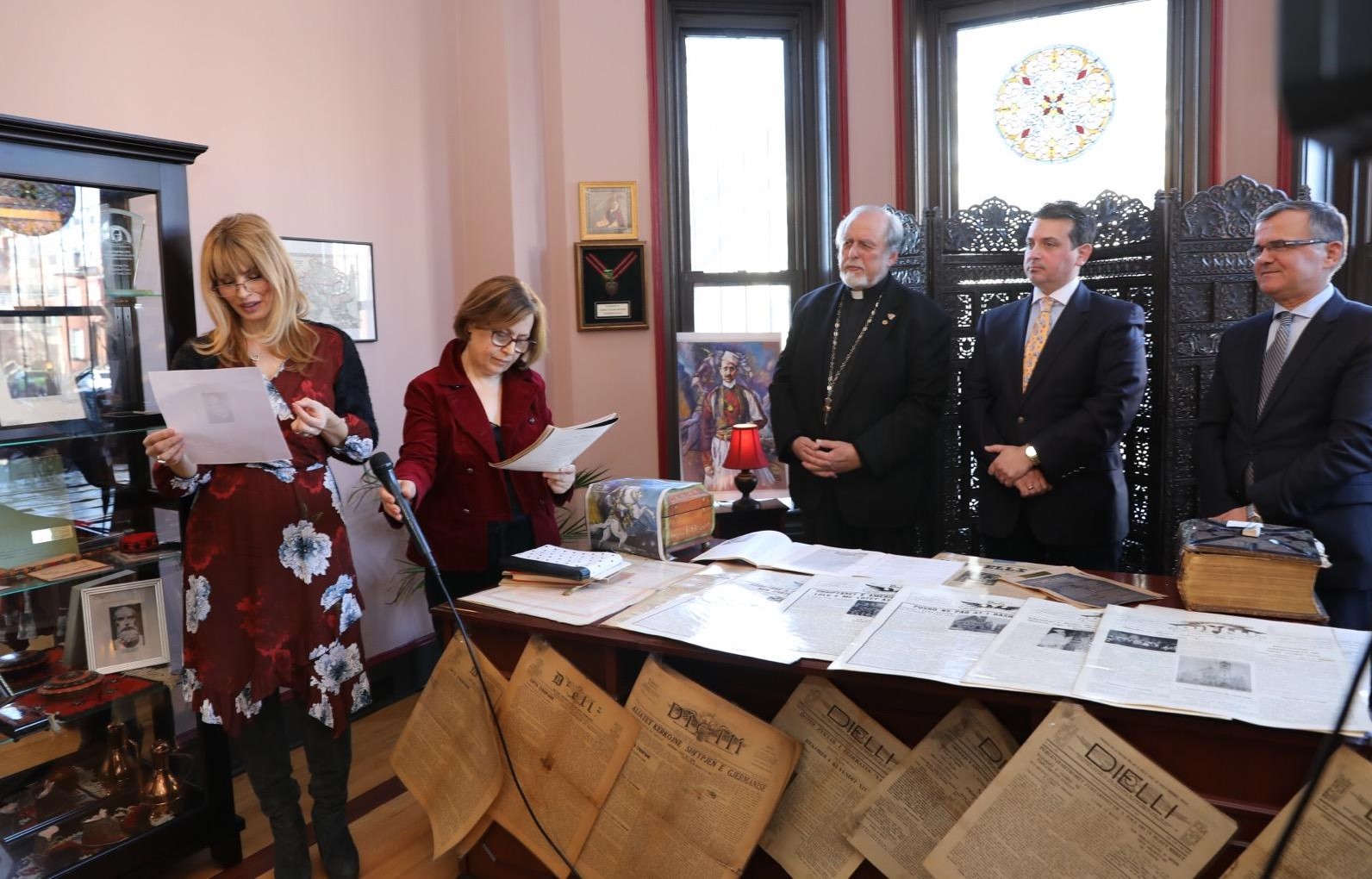
 While looking at the pages carefully, the Vatican envoy commented with excitement about the history of the church. The selection from the 1888 publication was donated to the papal nuncio along with the November and December 2018 issues of the newspaper Dielli.


Filed Under: Featured Tagged With: Rafaela Prifti, RECOGNITION OF KOSOVA, THE APOSTOLIC NUNCIO OF ALBANIA, Vatra

DIELLI’S INTERVIEW WITH SARAH-JANE CORKE

January 2, 2019 by dgreca

To continue to appreciate the influence of such an important personality such as Mithat Frasheri, Dielli interviewed the author of the book US Covert Operations and Cold War Strategy. Sarah-Jane Corke is an Associate Professor of History at University of New Brunswick. /

23 sarahjane-corke23 Libri

DIELLI’S INTERVIEW WITH SARAH-JANE CORKE/

Recent publications with reference to Mithat Frasheri were featured at the commemorative evening hosted by the Queens branch of Vatra to honor the distinguished Albanian figure.

One of them delves into the historical factors and the complex relations between the British and the Americans regarding their efforts to liberate Albania from the communists and the Soviet control after the end of WWII.

DIELLI: In the introduction of your book, you write that it ‘attempts to address the gap in the historiography to offer a more nuanced appreciation of American strategic thinking during Truman’s administration”. What is the importance of addressing such a gap in our knowledge and understanding of history?

The traditional scholarship had for a very, very long time, suggested that US foreign policy during the Cold War was a coherent strategy of containment. The term containment implied that US foreign policy was defensive and reactive. It was, in other words, it was responding to Soviet aggressions. By challenging this notion and focusing on aggressive American actions, the American role in the Cold War is problematized. We begin to understand that American foreign policy was more complicated that we previously understood.

DIELLI: Events such as the 100th anniversary of the end of WWI are moments when remembrance of sacrifice and patriotism take center stage on a wide scale. Your book takes a hard look at another war, namely the Cold War era in the US revealing a political landscape with uncertain goals and redefined front lines of intricate, treacherous and deadly nature. In broad terms, what defines the legacy of the Cold War during the second term of Truman’s presidency?

I would say that the key issue the Truman Administration faced, and an issue that still resonates today, is the difficulty in ensuring that foreign policy and intelligence operations are in sync. The breakdown that occurred at the strategic level greatly hampered the ability of the Truman administration to develop and execute successful covert operations.  When a country’s foreign policy remains vague, which happens for a number of reasons, it is difficult for operations personnel to effectively do their jobs.

DIELLI:  The declassified documents that were made available over a decade ago illustrate, among other things, a discordance between policy and strategy in the postwar years specifically with regard to Covert Operations by the American Intelligence. What new documents have come to light, if any, since the publication of your book?

There have not been a lot of new declassifications, at least that I am aware of.  But there are two important new books Operation Valuable FIEND by Albert Lulushi and The Albanian Operation of the CIA and MI6, 1949-1953 by Nicholas Bethell (edited by Robert Elsie and Bejulla Destani) that add considerable detail to the events that unfolded.

DIELLI:  Your presentation of the documents in the chapter ‘A clinical experiment’ expands the understanding of the ‘Anglo-American frictions’ with regard to covert operations that were undertaken in Albania, specifically in Operation Valuable in 1949. According to numerous documents, the British and Americans did not agree on which émigré organization to support nor on the method of insertion of paramilitary teams. How great was the impact of the discordance on the task at hand namely to help the resistance groups inside Albania to overthrow the communists?

It was very significant. The British would withdraw their support for the operation and came to view those who continued the operation in the United States as overly aggressive in their anti-communism. It caused a rift between the intelligence agencies and the two countries.

DIELLI: As it happens the fate of leading Albanian figures such as Mithat Frasheri become intertwined with the policy and strategic planning of a conflicted US administration. Under George Kennan’s plan, which represented the position of the State Department, East European ex patriots would be brought together under so-called ‘Freedom Committees’ financed by the US. One of the first to be set up was the Albanian National Committee which was to provide a nucleus for the Albanian government in exile. Mithat Frasheri became the first president of the organization. As you point out, Mithat Frasheri never lived to see Operation Valuable unfold. He passed away on October 3, 1949. Commemorating him 69 years later, the Pan-Albanian Federation Vatra brought attention to your book for providing new information on the subject and especially his important role during this period of Albania’s history. Would you please share more with our readers?

What happened in Albania was a tragedy. It became very important to me, in the course of writing the book, to point out the way in which the Albanian people, who desired nothing more than the return of their homeland, were treated by the British and Americans who were in charge of the operation. Frank Wisner called it “a clinical experiment.” It was an experiment that cost approximately 1000 lives. This was the tragedy. Frasheri was one of the Albanians who I believe was not well served by the British and the Americans. In short, neither the US nor the Brits accorded the Albanians the respect they deserved.

DIELLI: You mention tensions and serious political divisions within the Free Albania Committee which reflected the deep-rooted fractions within the Albanian society. In the same chapter, you write; ‘…this is important because it compounded the controversy over the structure of Albania’s post-liberation government. What are some of the important lessons that have emerged with respect to a dysfunctional administration during the Cold War?

The key lesson for me was to ensure that policy, strategy and operations were in sync. Within this context, I think administrators have to avoid the tendency to write broad policy statements. Often this happens so that any controversies that exist over a policy can be papered over. If there are controversies I think they need to be resolved before the policy is signed by the President. Without clear policy guidance you can have multiple strategies put into play. Sometimes, as I pointed out in the book, these strategies can contradict each other. The best example which I wrote about in the book was that given that there was no clear objectives on what US policy was, it remained unclear whether it was more important to encourage people to leave Eastern Europe or to stay behind to serve as resistance forces should a possible World War III broke out. Propaganda beamed into East European countries encouraged East Europeans to both leave their countries and to stay and serve as a resistance force. Second, once people did leave, the “West” was not prepared to provide safe places for all the refugees. Some were housed in former concentration camps and eventually returned to the East with only horror stories to tell their friends and relatives.

DIELLI: Where is the Study of Intelligence Series going next?

There have been a lot of newly released documents on American involvement in Iran in 1953 and Cuba in 1960. There will be new histories on both of these topics in the next few years. However, there has been a decline in the number of scholarly intelligence history over the last decade, for a number of reasons. Unfortunately, American intelligence history relies on the willingness of the CIA to declassify its archives. It also depends on the national archives being well funded so that they can do the declassifications in a timely fashion. Documents also come out in fits and starts and those that are declassified do not always appear in any order. Writing intelligence history can be intensely rewarding but it can also be challenging for these reasons.

Those that are interested in intelligence history should contact the North American Society for Intelligence History (NASIH).

Finally, on the anniversary of Albania’s Independence I want to send my sincere best wishes to the people of Albania, both those at home and abroad. Over the course of writing the book I met a number of wonderful Albanians who I still think of warmly today. I hope to be able to visit Albania at some point in the future. I have been told it is an absolutely beautiful country.(Rafaela Prifti)


Filed Under: Interviste Tagged With: DIELLI’S INTERVIEW, Rafaela Prifti, WITH SARAH-JANE CORKE

KOSOVA’S GENERAL CONSULATE AWARDS MEMBERS OF THE COMMUNITY

December 16, 2018 by dgreca

1 rafaela1 pa Ademin1 Koncerti Teute48376310_520073491824959_2371700195189587968_o1 richard1 Laura1 me ademin

BY RAFAELA PRIFTI/DIELLI/

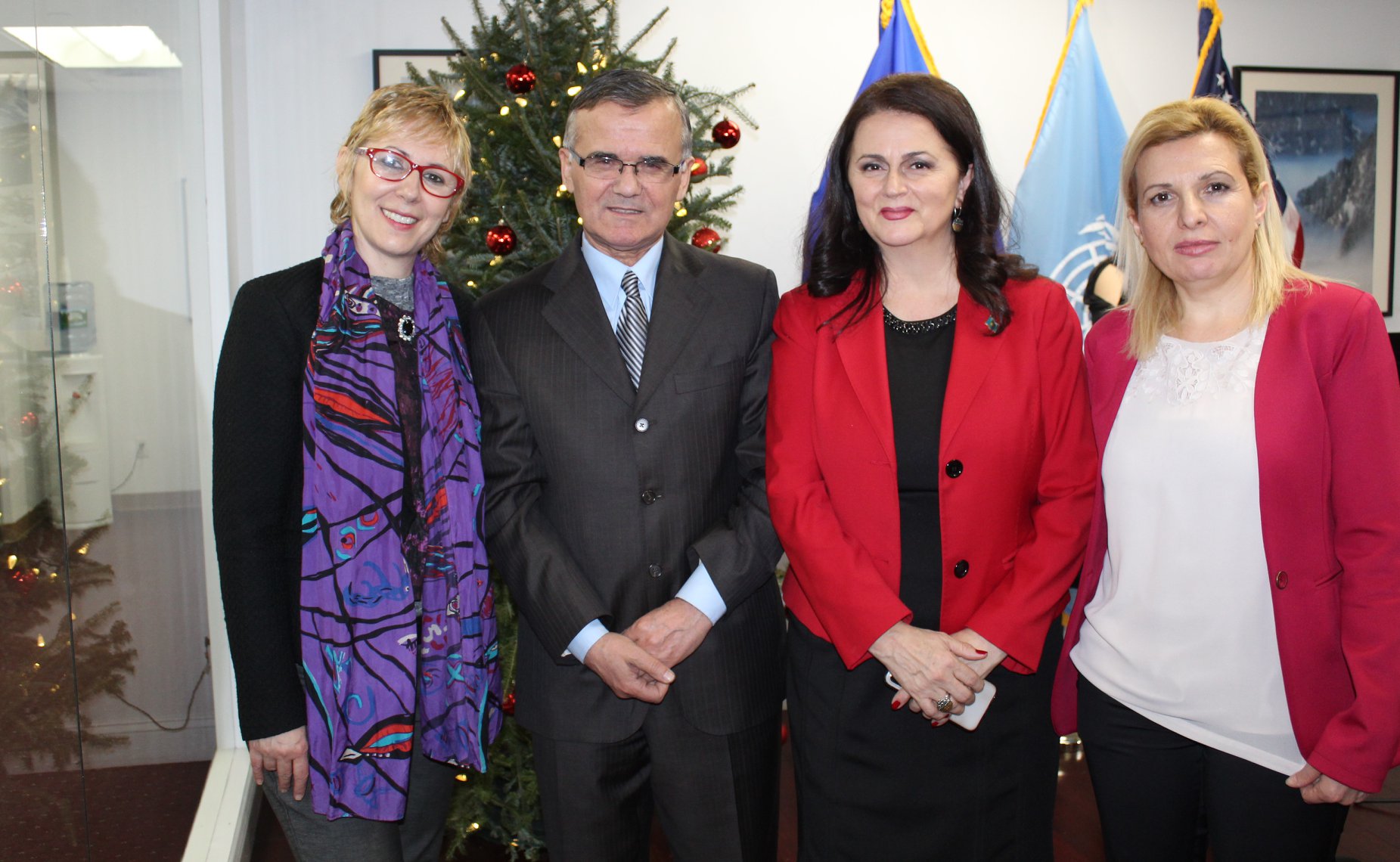
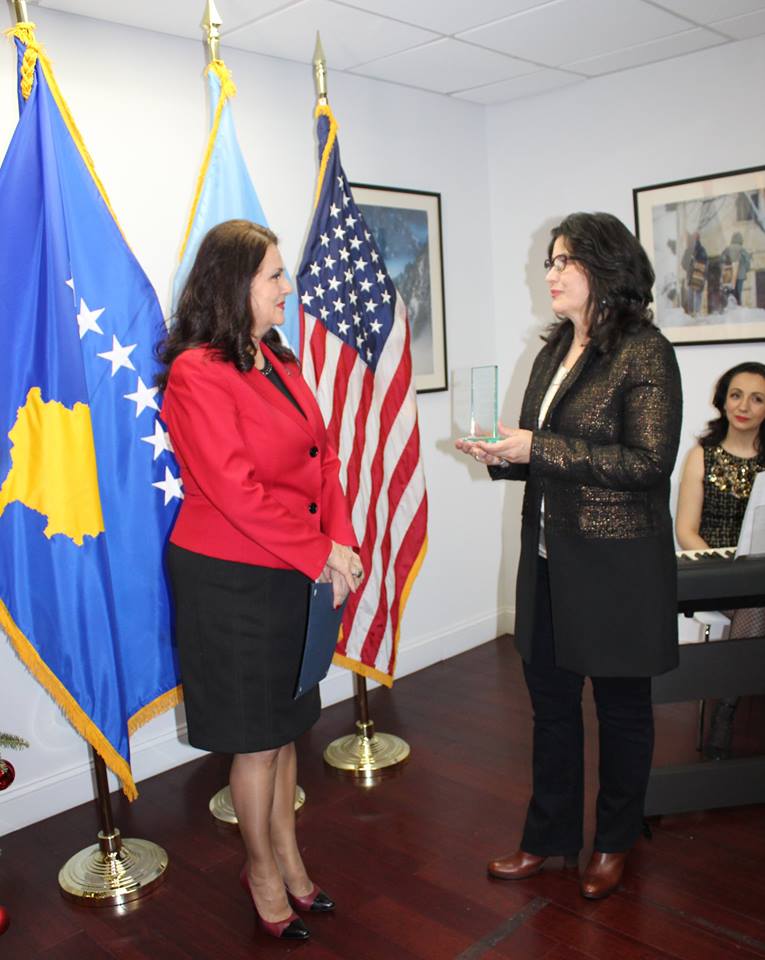
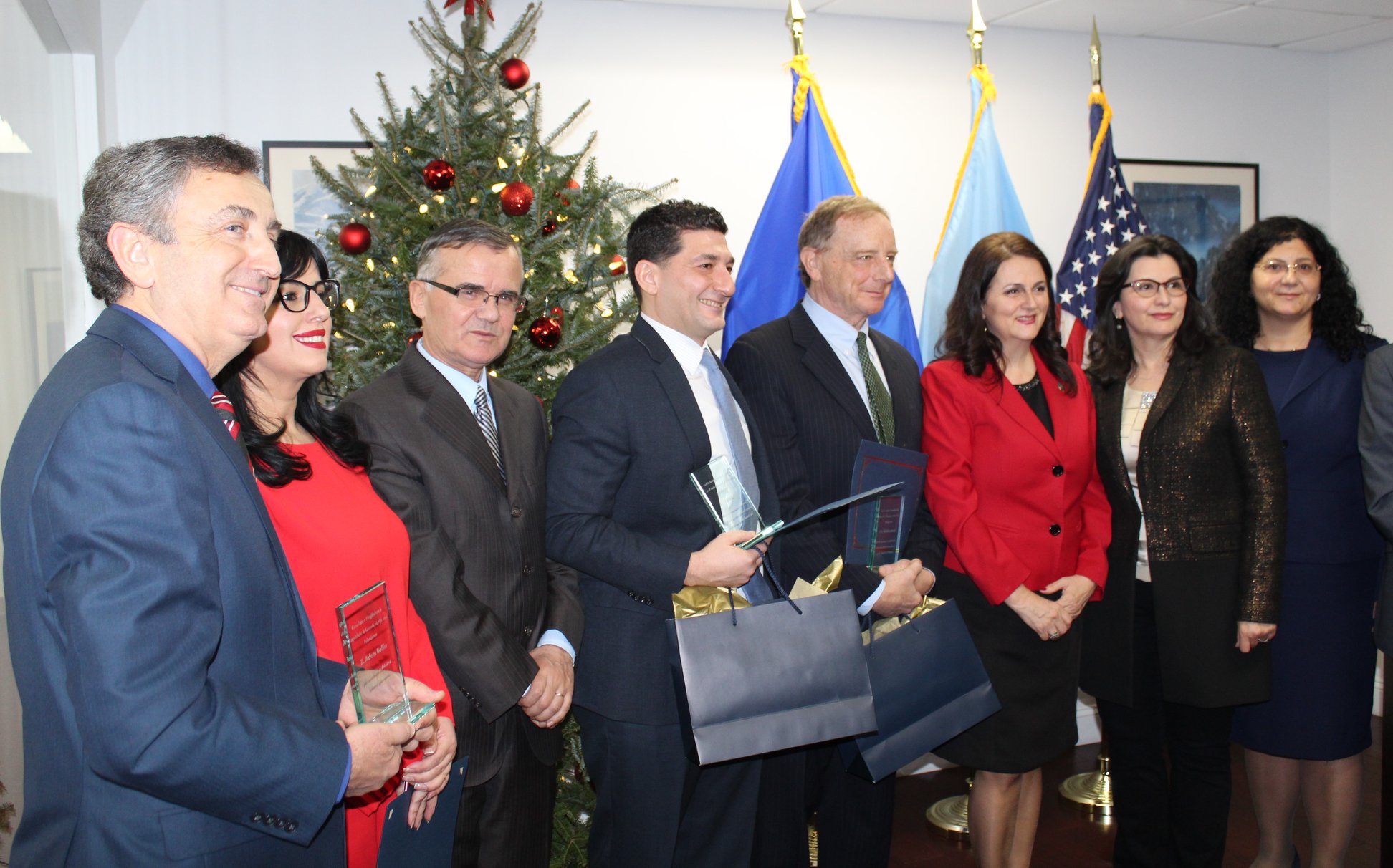
Last Thursday, the General Consulate of the Republic of Kosova in New York hosted an evening to recognize the work of several community members involved in media, education, women empowerment and professional networking. The guests were greeted warmly at the entrance by Consul Teuta Sahatqija and staff members. Pianist Elona Muca and flutist Klodina Kabashi Morina set a welcoming tone with the music arrangements of selected works by renowned Albanian composers. As the Ambassador began to deliver her remarks, the attendees gathered quietly in the main hall huddling around the cameras. “The diaspora became our voice at the time when we were not allowed to have a voice,” said the Ambassador referring to the long periods of oppression in Kosova particularly under the Milosevic rule in the 1990s.

She thanked the media outlets operating in the US for their important role in providing information and reporting the news. For the leading role in providing quality journalism, the Head of the Consulate acknowledged the Albanian Language Service at the Voice of America. Speaking on behalf of the service, Laura Konda, a senior journalist, said that VOA will continue to stay focused on the developments in Kosova. The next honoree was Halil Mula, the dedicated Chief Correspondent of Kosova’s RTV 21 since its beginnings. Since Kosova is not a member of the UN, the Consul General acknowledged Halil Mula as the unofficial liaison thanks to his accreditation at the International Organization. The next recipient was Beqir Sina, a well-recognized reporter and contributor with numerous print and online media platforms, ‘who is known for covering the stories with great efficiency’. In his accepting remarks, Beqir Sina noted that the timing of the event coincided rightfully with Kosova’s historic Assembly session concerning the transformation of the Kosovo Security Forces (KSF) into the country’s first military army. The name of TV Director Adem Belliu is synonymous with Televizioni Kultura Shqiptare, established as early as 1997. The station continuous to be a part of the community’s life. Adem Belliu thanked the diplomatic representative and praised the work of the Consulate that is setting an example for the diplomatic corps. The next honoree was the Editor in Chief of Dielli, Dalip Greca. “His role goes beyond the scope of the newspaper” said the General Counselor since he is regarded “as an historian and guardian of tradition”. In his remarks, Dalip Greca acknowledged the work of Dielli’s predecessors and reminded the audience that the oldest newspaper established in 1909 will be commemorating its 110 anniversary in the coming year.

With regards to the area of education, Ambassador Sahatqija provided a brief overview of the restrictions imposed by the Milosevic regime aiming to disrupt education and schooling in Kosova. The outcome was the development of a parallel system of education that went on for years. A decade after Kosova’s proclaiming its independence, the attention on education is ‘a priority’ for the future of the young country. Therefore, Ed Hammel of the Hartsdale Group was recognized for his role with the Kosovo American Education Fund (KAEF) that provides graduate fellowships to students for top level training at select universities in the US. Also Richard Lukaj was credited for his role in setting up the American University Kosova in Prishtina (AUK) that facilitates the integration of its graduates based on the American standards of education.

The third group of recipients were representatives of the organizations that aim to empower women and advocate on their behalf. The President of AAWO Motrat Qiriazi, Beti Beno and the Founder of the Organization Hope and Peace, Mimoza Dajci were recognized for their promotion of women’s activism. The last award of the evening went to APEN, the Albanian Professionals and Entrepreneurs Network. Speaking on behalf of the young Albanian professionals in the US, Leonard Gega said that APEN provides a solid foundation for building personal and professional goals and moving forward as a community.

Ambassador Teuta Sahatqija thanked the hard-working staff of Kosova’s General Consulate and they all joined the event’s honorees in group pictures. The evening continued with the second part of the music program. The contributions of the community members acknowledged by the Consulate serve as a reminder of the current progress and a call to rise up to the challenges ahead.

Filed Under: Featured Tagged With: AWARDS MEMBERS, KOSOVA’S GENERAL CONSULATE, OF THE COMMUNITY, Rafaela Prifti

  • « Previous Page
  • 1
  • …
  • 47
  • 48
  • 49
  • 50
  • 51
  • 52
  • Next Page »

Artikujt e fundit

  • PËR NJË NORMALITET NË MARRËDHËNIET SHQIPËRI-KOSOVË: JO FJALË BOSHE!
  • Ballafaqimi me të kaluarën, detyrë morale dhe parakusht për drejtësi, paqe dhe stabilitet afatgjatë
  • Ditët e fundit të kompozitorit të Himnit të Shqipërisë…
  • Butrinti dhe vija kushtetuese që Shqipëria nuk duhet ta kalojë
  • Universiteti i Tetovës lindi si “dielli pas errësirës”
  • MIRO TËRBAÇJA, SHQIPONJË E HISTORISË
  • Hirësia e Tij Nikodhimi, Peshkopi i Bostonit dhe Kryepeshkopatës Ortodokse Shqiptare në Amerikë kreu vizitë 10-ditore në Shqipëri
  • Shqipëria dhe Kosova në Bordin e Paqes: Nga historia e plagëve drejt arkitekturës së paqes globale
  • PAQE PËRMES FORCËS, DREJTËSI QË GARANTON STABILITET, JO PASIGURI
  • Kosova pays the price as its liberation leaders are persecuted, not prosecuted
  • Çfarë sjell shkretimi shpirtëror në një tjetër shekull zhgënjyes përmes antologjisë së nobelistit Eugenio Montale
  • FAN (1971) / “TË PISH E TË HASH NË SHQIPËRI” — REPORTAZHI EKSKLUZIV BOTËROR I TELEVIZIONIT ZVICERAN
  • Folklori çam, i gjallë edhe në botën moderne!
  • Milan Shuflaj, e vërteta historike dhe martirizimi i lirisë akademike në Evropë
  • Kontributi i Prof. Emeritus Injac Parrinos në shkencat albanologjike

Kategoritë

Arkiv

Tags

albano kolonjari alfons Grishaj Anton Cefa arben llalla asllan Bushati Astrit Lulushi Aurenc Bebja Behlul Jashari Beqir Sina dalip greca Elida Buçpapaj Elmi Berisha Enver Bytyci Ermira Babamusta Eugjen Merlika Fahri Xharra Frank shkreli Fritz radovani Gezim Llojdia Ilir Levonja Interviste Keze Kozeta Zylo Kolec Traboini kosova Kosove Marjana Bulku Murat Gecaj nderroi jete ne Kosove Nene Tereza presidenti Nishani Rafaela Prifti Rafael Floqi Raimonda Moisiu Ramiz Lushaj reshat kripa Sadik Elshani SHBA Shefqet Kercelli shqiperia shqiptaret Sokol Paja Thaci Vatra Visar Zhiti

Log in

This website uses cookies to improve your experience. We'll assume you're ok with this, but you can opt-out if you wish. Cookie settingsACCEPT
Privacy & Cookies Policy

Privacy Overview

This website uses cookies to improve your experience while you navigate through the website. Out of these cookies, the cookies that are categorized as necessary are stored on your browser as they are essential for the working of basic functionalities of the website. We also use third-party cookies that help us analyze and understand how you use this website. These cookies will be stored in your browser only with your consent. You also have the option to opt-out of these cookies. But opting out of some of these cookies may have an effect on your browsing experience.
Necessary
Always Enabled
Necessary cookies are absolutely essential for the website to function properly. This category only includes cookies that ensures basic functionalities and security features of the website. These cookies do not store any personal information.
Non-necessary
Any cookies that may not be particularly necessary for the website to function and is used specifically to collect user personal data via analytics, ads, other embedded contents are termed as non-necessary cookies. It is mandatory to procure user consent prior to running these cookies on your website.
SAVE & ACCEPT