• Home
  • Politics
  • Opinion
  • Culture
  • Sports
  • Economy
  • Interview
  • Reporting
  • Community
  • Vatra

Dielli | The Sun

Albanian American Newspaper Devoted to the Intellectual and Cultural Advancement of the Albanians in America | Since 1909

Archives for December 2019

A TECH SUMMARY OF THE LAST DECADE

December 31, 2019 by dgreca

Editors have selected this summary that has been condensed and edited for clarity. No matter who you are in life nothing has influenced you personally and your community more than technology in the last ten years. From organizing protests to self-driving cars, from our rights to privacy to markets and businesses worldwide, from seemingly insignificant memes or shows to influencers and platforms that were tied to elections, technology of the last decade has been a major part of who we are today. 

January 12, 2010 – Google pulls out of China

Prompted by a sophisticated Chinese cyber-attack, aimed at stealing trade secrets and computer codes, the search giant pulls out of the country. Google’s decision to withdraw from China reshapes the global internet, with China developing its own closed-off version of the web. The military was suspected of being behind the hacking of a civilian operation. It became the new international norm.

January 27, 2010 – Steve Jobs unveils the iPad

Following the iPhone’s success, Steve Jobs introduces Apple’s next mobile computing device, a touch-screen tablet. He returned to Apple in 1997, Refocusing on the Mac and saving Apple by rethinking the computer as a multi-touch gadget and a human interface design. In parallel to all this, iPod had taken off. Knowing that carrying one device for music and one for talking would not last long, the Apple team set out to solve the issue of creating a phone that could also replace iPod. One important item was the price, which also stun the competitors.  It was $499.

June 10, 2010 – Social networks fuel the Arab Spring

The Arab Spring is a high point about the organizing power of technology. A Facebook page, “We Are All Khaled Said,” named for an Egyptian killed by the police, becomes an icon of the movement against the region’s autocratic governments.

On the first three days, the “We Are All Khaled Said” page had 100,000 likes. The resignation of Tunisia’s president was a turning point in the Arab Spring while in Egypt, there was a call for a revolution. The government closed Facebook for a couple of days but couldn’t afford to keep it closed, because of business. When you turn off the internet right now, you’re turning off the economy. There is no system that can survive anymore without the internet.

Oct. 6, 2010 – Instagram explodes onto the scene

Two Silicon Valley entrepreneurs start a photo-sharing app that quickly became a sensation, spawning thousands of subcultures and “Kardashian selfies”. It was intended to be a multiplayer game but it became a check-in app. “I’m here, and here’s a photo.” It sounds like a small detail, but actually it made the whole product way more interesting.

October 9, 2010 – Self-driving cars hit the road

Google announces that it is testing a fleet of autonomous vehicles. The very first self-driving route was from Google to the Shoreline Amphitheater parking lot. Police actually pulled them over in multiple occasions. Larry Page and Sergey Brin, the co-founders, spent many hours scoping out what looked like the most difficult places to drive on the planet. It was Highway 1 from San Francisco to Los Angeles; it was Lombard Street; it was Market Street; it was all the bay bridges; it was through Tiburon and around Lake Tahoe. The very first course had probably every complication you could imagine. You are on a mountain road. You are driving very narrow lanes. You are driving in city traffic with stop signs and traffic lights and tunnels.

March 30, 2011 – Tech companies get off easy after privacy violations

Google agrees to settle federal charges that it used deceptive practices in the rollout of a social network called Buzz. Later that year, Facebook agrees to settle wider charges that it also deceived users. In 2010, in an effort to directly compete with Facebook, Google tried to roll out Buzz. They made some serious mistakes. Google users who had signed in were basically encouraged to go to Buzz. If they went to Buzz, information like their contacts would be disclosed. Google did a good job deflecting it by being contrite. A lot of people were seriously impacted. In some ways, what Facebook did was even worse.

Facebook was all about sharing information and allowing third-party apps to have access to its site, to make it more interesting and promote growth. And they were very successful. The problem was the user was told that the app would only be harvesting data needed for the functionality of the app, when in fact the apps took lots of personal information. Facebook was acutely aware of what was going on. 

October 4, 2011 – Siri says Hello and a lot more

Apple introduces a new way to control iPhones with speech. Apple’s personal assistant, Siri, debuted with the iPhone 4S. Usage started going viral surpassing all marketing expectations. The usage spikes were overwhelming because speech recognition is a challenge. Ultimately, it showed the world two things it didn’t know before: First was that it was possible. The challenge of being able to understand speech – companies at the time, Google and others, did not think it could be done at that scale. The second thing was that users would like it, that this was an appealing interface concept.

October 5, 2011 – Tim Cook era starts at Apple

Steve Jobs, the company’s visionary co-founder, dies at age 56 of complications from pancreatic cancer. Tim Cook, his longtime no. 2, becomes the public face of the company. When one sat in a meeting with Steve, he dominated, and he would tell you to shut up and let someone he wanted to hear from talk. Tim was completely the opposite. He listened to everybody no matter what you had to say, and he would come back to challenge them. There was a lot more openness and freedom to bring new ideas to the surface.

May 22, 2012 – Lyft grows a mustache

Drivers for the ride-hailing start-up place pink, furry facial hair on their cars. In cities across the country, they become a conspicuous symbol of the arrival of the gig economy.

The moustache was retired, the color pink lived on – and it does today. The original tagline for Lyft was “Your friend with a car.” Ten years ago, no one believed this was going to happen.

May 18, 2012 – Facebook goes public

Eight years after its birth in a Harvard University dormitory, the social network raises $16 billion in an initial public offering. Mark Zuckerberg did want to wait to go public. Facebook didn’t really need the notoriety and the validation that going public adds. It was already a household name. Users certainly knew it. There wasn’t going to be a coming-out party in the way that other companies get when they go public. The adulation in the press and adulation from users fueled the expectation that Facebook could do everything right. A few days before the I.P.O., concern over the move to mobile came out. It was not clear that Facebook had yet figured out the optimal product to offer on mobile.

September 9, 2012 – Google Glass walks the runway

The designer Diane von Furstenberg’s spring-summer fashion show features models in a special accessory: futuristic spectacles that can record video and display data. The devices are a pet project of the Google co-founder Sergey Brin. The glasses made their debut at the fashion show of Diane von Furstenberg, who said “This is technology. You can’t look at them as glasses.” 

June 5, 2013 – Edward Snowden blows the whistle on the N.S.A.

The Guardian newspaper begins to publish articles revealing secret government surveillance programs, based on classified documents stolen from the National Security Agency. The source was Edward J. Snowden, a former government contractor. He reported that in the course of his work, he discovered that the abuse of secrecy privileges was corrupting the incentives that were meant to ensure fair play by those who wielded the most power in society. Since he had sworn an oath to uphold the Constitution as a condition of his employment with the government, he said that he felt obligated to do what he could to reveal it. But because the problem was broader than one single particular surveillance program, this meant that he also had to blow the whistle on the larger system of secrecy. His hope was to help the public to understand what was going on, he said.

December 9, 2013 – Protesters block the Google bus

Frustrated with big tech companies’ domination of San Francisco’s economy and culture, activists obstruct the charter buses that shuttle workers from the city to Silicon Valley. The tactic worked. Most of the tech campuses are an hour, an hour and a half away, so the buses were the one thing that activists had access to that they can physically take action and block.

August 5, 2013 – Jeff Bezos buys The Washington Post

The founder and chief executive of Amazon, buys the newspaper for $250 million – giving one of the country’s richest people a powerful perch at the top of traditional media. The history of media is filled with billionaires and titans and industrialists who, at least with respect to newspapers in the 20th century, were in it for the business, in it for the buck, but also to curry favor too, to run an editorial page that would align with its business interest. When the internet came, it became a much less optimal business.

November 2, 2013 – Red-hot start-ups get a nickname: Unicorns

Aileen Lee, a tech investor at Cowboy Ventures, coins a term with a blog post titled “Welcome to the Unicorn Club: Learning from Billion-Dollar Startups.” “Unicorns” quickly caught on. The psychology of being a unicorn had power. It was easier to market the company to recruits, business partners and new investors. At the time there were only 40. Today, there are over 500, so the term seems less pertinent. 

April 2, 2014 -TikTok plays its first notes

A lip-syncing app called Musical.ly debuts, quickly attracting a huge and youthful audience. The app is later bought by the Chinese social giant ByteDance and becomes known as TikTok. Initially, Musical.ly had nothing to do with music and entertainment. We built the company to do something revolutionary for education, such as an online course as short as possible, three to four minutes. Lesson from the failure was to build a community where users are generating the content, only a few seconds. The logic is very similar to Instagram, in several ways. For Musical.ly, it’s like making music as a filter. Everyone can create interesting enough content based on music, just like everyone can post interesting enough photos using filters. There is a chart that ranks the influencers. And I remember checking it and thinking, “Why am I not on the top? What do I have to do to get to the top?

April 6, 2014 – ‘Silicon Valley’ premieres in Silicon Valley

A biting satire of the technology industry debuts on HBO. The tech companies after Season 1 said that they liked the show where everybody only says, ‘We’re making the world a better place.’ 

May 13, 2014 – The ‘right to be forgotten’ becomes law

Europe’s highest court rules that people in the region can demand that Google delete search results about them if those results are “inadequate, irrelevant or no longer relevant.” Mr. Joaquín Muñoz, a lawyer who filed the original “right to be forgotten” case for a Spanish citizen, said that back then there was no certainty about what a citizen had to do if he or she found information on the internet about themselves that was harmful, or not true, or obsolete. It led him to write an article, “How to Delete Personal Data from Google.”  When his client brought the case to the law firm, they went to both Google and the newspaper that had published an item that he wanted removed. Both replied that they didn’t consider themselves responsible. So they requested the protection of the Spanish Data Protection Agency, the A.E.P.D. They gave the ruling, then came the appeals, and then the final procedure before the European Court of Justice. It was on the front page of almost all the newspapers and in every TV channel. Thanks to the ruling, the right to be forgotten is included in the General Data Protection Regulation, with common rules for 747 million people all over Europe. It made people more aware of the value of their data and the benefit that large companies make of the information they generate on the internet or social media. The ruling was one of the first to set limits on large technology companies which seemed untouchable at the time.

September 19, 2014 – Alibaba goes public

The Chinese e-commerce giant lists its shares on the New York Stock Exchange in one of the biggest-ever initial public offerings, signaling the rise of China’s internet companies. The apartment where Alibaba was founded was in a new complex in Hangzhou. 2014 was a very good time for Alibaba to go public — it was two years before the election of the current president of the United States, and only two years into President Xi Jinping’s rule.

October 9, 2014 – Gamergate shows the internet’s dark side

An amorphous online movement called Gamergate, an ostensible protector of “the historic culture of video games,” takes a disturbing turn. After Brianna Wu, a developer, posts a series of mocking tweets, she is subjected to a terrifying harassment campaign. Brianna Wu wrote a piece in Polygon called “No Skin Thick Enough” about what it was like to be a woman in the video game industry and to get nonstop harassment. Gamergate eventually went after her for standing up for the women who work in games. She got death threats as did her family. The police and F.B.I. got involved. According to Ms. Wu “There is an entire generation of people who base their identity on games. People who wear T-shirts with a Nintendo or an Xbox or an NES controller. It’s like tribal markings. In the aftermath of Gamergate, there was no shortage of people and institutions swearing up and down that things were going to change.”  

November 2, 2014 #Alexfromtarget shoots to stardom

Alex Lee, 16, is at work at the Eldorado Parkway SuperTarget in Frisco, Texas, when an admirer snaps his photo and posts it online. It immediately takes off and becomes a huge meme and a viral sensation.

Social media influencers were approached by people with business ideas to take advantage of the followers. One of the suggestions was a DigiTour. 

November 24, 2014 North Korea hacks Sony Pictures

The movie studio’s system is penetrated by a group that American officials concluded was a front for Kim Jong-un’s regime. The country appeared to be retaliating for a Sony comedy about an assassination attempt against the dictator in the film “The Interview”.

Sony Pictures canceled the theatrical release of “The Interview,” a movie about a plot to kill North Korea’s leader, Kim Jong-un, after a hacking attack.  It brought to public light what a major cyber attack could look like. In a first, and very harsh, way, it also demonstrated the capabilities of the North Koreans while putting a spotlight on what should or should not be on a company’s network, whether it’s health care data or emails. No one really understood how damaging or difficult the situation was. The attack had eerie similarities to the hack of the Democratic National Committee in 2016.  

March 27, 2015 – Ellen Pao loses her suit against Kleiner Perkins

A jury in San Francisco rejects gender discrimination claims made by Ellen Pao, a junior partner at Silicon Valley’s, most famous venture capital firm. Prefiguring the #MeToo movement, the case draws attention to the lack of gender diversity in tech. The story was always about how the venture capital was trying to change the world for the better, and about it being a meritocracy – that was the narrative in 2012 when the suit was filed. V.C. funding to woman-led companies increased in 2019 to a paltry 2.8 percent. Only 12 percent of V.C. investing partners are women. Less than 5 percent of V.C. investing partners are black or Latinx. At Kleiner, the publicity from the case damaged the facade of meritocracy and changed the perception of their contribution though the firm is still successful in raising money.

June 28, 2015 – Google tags black people as ‘gorillas’

Jacky Alciné, a software engineer in Brooklyn, uploads pictures of himself and a friend to Google’s new service for image-storing photos and videos. The software labels the images “gorillas”.  In efforts to fix the issue, they just eliminated the tag “gorillas” entirely. It’s hard to undo data. There is input from a bunch of sources, and you don’t know how the bad data got in, so you’d have to do a lot of tracing and auditing and rolling back. For Google, it’s not cost efficient to do all that for one complain. Beyond a passive apology, they could have captured more photos. The labeling technology is ridiculously amazing, at the component level. 

July 15, 2015 -Amazon invents a shopping holiday

Amazon begins Prime Day, a shopping holiday geared toward its members, during the summer sales lull, reshaping the retail calendar. “Project Piñata” as it was known was ‘a deal day’ and it timed with Amazon’s 20th birthday. The first concern was to source enough inventory and deals in July. Vendors and manufacturers are all keyed up to source terrific deals in November and December. It’s a different story to do a sale where there hasn’t been one before in July. The second concern was the technology behind the website. There is a lot of traffic in a successful sale, and it has to work. It was designed to have the largest selection of deals, more deals than Black Friday, which meant more than 10,000 deals. On the day itself, the events circled the globe starting with Japan and ending in the US. It is believed to have changed the course of retail.

October 15, 2015 – Theranos begins to unravel

The Wall Street Journal publishes an expose of the medical startup. Founded by Elizabeth Holmes, it claimed to have developed technology that could run more than 200 different diagnostic blood tests using a few drops of blood. One of the main modifications they had made is that they diluted the blood to create more volume so that the Siemens machine that was used would accept it. It was a medical fraud. This was a company that had gone out and put public health in jeopardy. The mechanical engineer had been trying to get information to the company’s leadership that the device embedded in University of Tennessee oncology blood trials was defective. After the article is published,Ms. Elizabeth Holmes denies wrongdoing. It took the actions of the two main health regulators to make people realize that whistleblower had gotten the facts right. The F.D.A. and C.M.S. – the Centers for Medicare and Medicaid Services – both launched inspections of the company’s facilities. 

February 8, 2016 – India bans Facebook’s free apps

Regulators block the social network’s Free Basics program, a suite of apps that Facebook had hoped would expand internet access in the country and establish the company as a dominant platform. A comedy troupe called All India Bakchod simplified the concepts with a video. Free Basics was positioned as one entity that was impacting the freedom of the internet, and most importantly, calling it the internet when it wasn’t the internet. One site SavetheInternet.in directed people to send comments to the Telecom Regulatory Authority of India. The video went viral. This was the first pushback against a Facebook product anywhere in the world at this scale. This was also Facebook’s first global public policy loss, where they went up against citizens. In some countries, Facebook is the internet and its algorithms end up prioritizing content. That is not necessarily good for democracy. 

February 16, 2016 – A court orders Apple to unlock an iPhone

The Justice Department asks a federal court to order Apple to help unlock the encrypted iPhone of the gunman in a mass shooting in San Bernardino, Calif., setting off a battle of privacy versus security. The U.S. attorney’s office filed to get the judge to order Apple to unlock the phone. The standoff leads to a court order. In its statement, Apple says the court order would set a dangerous precedent and put the public’s privacy at risk.

The brand was on the line. There were calls for boycott.  On the eve of a March hearing in the case, things turn.

A company came with a solution. The encryption issue is much more nuanced and more complicated than it has been portrayed. With this particular case, people felt like they had to choose a side. 

March 9, 2016 – A.I. beats a champion at Go

DeepMind, an artificial intelligence lab owned by Google, puts AlphaGo, a machine it developed to play the ancient and complex game of Go, up against Lee Se-dol, the best Go player of the decade, the world champion.The matches were played in South Korea. It almost brought the country to a standstill.

April 8, 2016 – BuzzFeed blows up a watermelon

The website posts a Facebook Live video called “Watch us Explode this Watermelon one Rubber Band at a Time” The 45-minute video, featuring two BuzzFeed staff members in hazmat suits stretching 682 rubber bands around a watermelon until it bursts, is a viral sensation with nearly one million simultaneous viewers at its peak. After some initial experiment with one executives in a meeting, BuzzFeed developed a theory that people anticipating something and sharing something together was working. The watermelon was designed as a way of testing that theory. Facebook live had a hard time keeping the feed live because at that point it never had a live stream with that many concurrent. It was a more utopian time where people were more optimistic about the future and change, and the world transforming for the better. People coming together to share a moment that was completely nonpolitical, silly, fun, lighthearted, that was pretty typical of the time. 

May 18, 2016 – Moore’s Law ends

The principle which refers to a prediction made in 1965 that engineers would pack twice as many transistors onto a computer chip every 18 months, slows. The end comes when Google starts building its own computer chip, called the TPU, because standard chips can no longer keep pace with the rise of artificial intelligence. The barriers that were tackled were coming to a fundamental limit since transistors are made of atoms.

That was a prediction that Stephen Hawking made during one of his visits to Silicon Valley. Somebody asked him what the fundamental limits would be. He said the velocity of light and the atomic nature of matter, both of which are fundamental. One complication is energy efficiency. That’s become a major limitation in our ability to build chips, particularly in the mobile space, because of battery life. Artificial intelligence is also speeding the end of Moore’s Law. The home speaker, whether it’s a Google Home or an Alexa or whatever, offers speech recognition. The best speech recognition in the world is based on machine learning. When Google adopted its “A.I. first” strategy, around eight years ago, we quickly did a computation that resulted in solutions to improve efficiency dramatically with TPU. The result is, you can get about a factor of 100 in terms of computational power per watt of power. That’s like giving you an extra seven years on Moore’s Law. 

July 6, 2016 – Pokemon Go makes the real world a game

The app is an instant global hit. In an update of the old-fashioned scavenger hunt, players use augmented reality to capture creatures from the Pokemon video game franchise in the physical world. Rather than camping out in front of the TV, the creator turns to games that can be beneficial for the player, exploring the outsides and at the same time play a game. The full impact of the game’s popularity came to view quickly. Pokemon Go was the first digital game of any kind of scale that brought people together in the real world. It was self-propelling. It was a kind of real-world virality.

September 5, 2016 – A digital revolution through Mobiles 

Reliance Jio, a mobile carrier created by Mukesh Ambani, India’s richest man, begins offering free calls and 1.5 gigabytes of wireless data a day for $2 a month, opening the internet to hundreds of millions of Indians. The creators looked at the fundamental building block to the new economy. Reliance Jio offered free calls and huge amounts of wireless data for $2 a month in 2016. Jio spent six years building a 4G wireless network, including writing new apps, installing towers in rural areas and designing inexpensive new phones that worked with its technology. The device was priced at $10. In 171 days, the company had over 100 million subscribers, the fastest-growing company in any sector across any technology company anywhere in the world. 

November 10, 2016 – Facebook helps sway the 2016 election

Mark Zuckerberg, Facebook’s chief executive, says the notion that the social network played a role in putting Donald J. Trump in the White House is “a pretty crazy idea”. “Russian agents are later found to have used Facebook to spread inflammatory posts. A dedicated threat intelligence team was tasked with tracking government activity on the platform that was meant to cause harm. In 2016 there was no team dedicated to disinformation. Neither the tech companies nor the American intelligence community had one. People saw his statement and saw that one of the richest people on earth was trying to wriggle out of his responsibility by making this claim that contradicted everything his company had previously said to politicians, advertisers and businesses about their ability to reach and sway people through Facebook.

February 27, 2017 – YouTube has a 1-billion-hour day

YouTube announces a milestone: People watched more than one billion hours of YouTube videos in a single day. Up until then, the visible currency of YouTube was views. That’s how creators measured consumption of their videos. It’s how users understood the popularity of a video. So the shift from views to watch time was about moving away from something that could create incentives like clickbaity thumbnails to something that was about satisfying users. There was a previous algorithm, and a new algorithm was introduced. In the end, the metric that mattered was total watch time. The direction in which people were being pushed did not matter because YouTube was monitoring the watch times. The challenge is how to live up to the responsibility of having such an influence on the world. The problem is that the recommendation engine that handles 70 percent of views on YouTube is flawed by design, say experts. For example, if the recommendation engine is not even able to understand that the earth is not flat, it’s 2,000 years backward. So why would we want this algorithm to handle all of our political information? 

August 8, 2017 – Mark Zuckerberg’s mentor calls out Facebook

Roger McNamee, a onetime mentor to Facebook’s chief executive, publicly denounces the social network in an opinion article in USA Today for hurting democracy and spreading misinformation. McNamee began his career as a technology investor in 1982 and spent 34 years as a true believer in what technology could do to make the world a better place. He came to the realization that the same advertising tools that make marketers so successful on Facebook can be used to affect the outcome of an election. In his essay he says that he believes that the algorithms and business model of Facebook, as well as the culture, are allowing bad actors to harm innocent people. He had helped Mark keep the company independent, and for three years had been the advisor. He never expected to become an activist, an experience that he describes as ‘extremely depressing”. 

September 26, 2017 – Fortnite sweeps the world

Epic Games releases the free-to-play Fortnite Battle Royale, an online video game in which 100 players compete to be the last one standing. It becomes a global phenomenon. It encouraged a lot of athletes and other artists to admit and show their love for gaming. A lot of them started to stream and play with other streamers. Before Fortnite, gaming was a multibillion-dollar industry, operating as a subculture. Over the last 10 years, especially with Fortnite, it became acceptable to be a gamer. 

December 11, 2017 – Deepfakes stun the internet

News breaks of a video circulating on the internet that shows the “Wonder Woman” star Gal Gadot being intimate with her stepbrother. The video is not real; someone had used artificial intelligence to superimpose Ms. Gadot’s face on the body of a pornographic actress. In 2011, 2012, deep learning started taking off. The big event was, deep nets could recognize animals in photos. It took a few years until people started to make systems that could do the opposite: not take an image and recognize that it was a cat, but take the label “cat” and synthesize an image that looks like a cat — the inverse problem, making photos of really low-resolution faces. Very rapidly after that, face-swapping and deepfakes followed. The sudden attention catches researchers by surprise and the technology advanced so quickly right around those years.  It was the release of an easy-to-use piece of code that made it so that the internet went wild with it. It raised concerns over the ownership over a public image as well as the issue of what is real and what is not. 

December 17, 2017 – Bitcoin’s spike sets off a frenzy

The price of the cryptocurrency skyrockets to more than $20,000 on some exchanges before coming down to earth a few months later. On the one hand, it’s a huge gift because every time it happens, it gets another order of magnitude of people into the crypto ecosystem. On the other hand, it’s a distraction from the overall potential of what this can really be. It’s much more than just trading some new asset class.

March 17, 2018 – Cambridge Analytica scandal breaks

The New York Times and The Guardian publish articles about how the political data firm with links to Donald J. Trump’s 2016 presidential campaign had harvested personal information from the Facebook profiles of more than 50 million people. Aleksandr Kogan, an academic who used a personality quiz to harvest Facebook data for Cambridge Analytica, was collecting the data as part of a project to generate predictions about people’s personalities and politics based on their pages “likes”. It turned out the data was not useful as far as predictive accuracy. Facebook banned Kogan and Wylie, and released a press statement alleging they had engaged in fraud. It opened up the floodgates. Tech giants had been running rampant for a decade, two decades, and now for the first time really people cared. Although Cambridge Analytica couldn’t do anything useful with the data it collected, the connection with the Trump campaign captured people’s imagination.

April 10-11, 2018 – Mark Zuckerberg testifies before Congress

Facebook’s chief executive answered questions before the Senate Commerce, Judiciary Committees and the House Energy and Commerce Committee about revelations that Cambridge Analytica had improperly used personal data from users’ profiles. It foreshadows other questioning of tech executives. Mark Zuckerberg says Facebook takes responsibility for its mistakes and will fix its problems.

May 25, 2018 – Europe shields personal data through GDPR

The European Union enacts the General Data Protection Regulations, which provides sweeping new rights to keep companies from collecting and sharing personal data without an individual’s consent. A European wide data protection law was in place since 1995, before the internet took off, pre smartphone and pre major apps and platforms that were to come in the ten to twenty years that followed. It did not include social media platforms. The law required upgrading to better regulate Big Tech. People moved their lives to the digital sphere, but they didn’t bring their rights with them. GDPR allows every individual to have the possibility to be the master of his or her privacy. In March 2018, when the Cambridge Analytica story broke, it really opened up the minds of the public, politicians and others to the clear dangers of the misuse of personal data. It was a real turning point. GDPR is an exercise of rebalancing power not only in terms of data protection, but also the harmful content of the digital industry — distributing terrorist content or child pornography or hate speech or disinformation that has the potential to distract societies and do public harm. GDPR is to be expanded abroad to Japan, Korea, in Latin America etc.

November 1, 2018 – Google employees walk out

About 20,000 Google workers stage protests over how the company has given multimillion-dollar payouts to a former top executive, Andy Rubin, and other senior employees accused of sexual harassment. A huge conversation erupted at Google. A weak management response causes the protesters to organize walkouts to make a statement. The idea of the walkout goes global. Each office had their own rally. 

December 1, 2018 –Huawei Chief Financial Officer arrested

Meng Wanzhou, the CFO of Huawei and daughter of its founder, is arrested in Vancouver, British Columbia, while in transit at the airport. Her arrest by the Canadian authorities at the behest of the United States kicks off a tech Cold War with China. Few principals are willing to discuss so sensitive a topic on the record, but the event was reconstructed from court documents from Canadian immigration officials and law enforcement.

May 10, 2019 – Uber goes public

The ride-hailing giant’s initial public offering goes awry when its shares plunge on its first day of trading. It was an important financing point, providing cash for Uber to fund the future plans. Uber’s I.P.O. affected other unicorn I.P.O.s this year. It was a reminder to all: Public market investors care about good unit economics and a path to profitability.

May 31, 2019 – Antitrust regulators target Big Tech

News breaks that the Department of Justice is scrutinizing Google and whether it has used its power in anticompetitive ways, foreshadowing antitrust investigations against Big Tech companies by the Federal Trade Commission, dozens of states and Congress. It is views as the end of the long antitrust winter. After years of discussing whether Big Tech has gotten too powerful, things reached a breaking point this year. The first official action by federal and state agencies and the beginning of a national conversation, which is what antitrust does at its best, as to whether Big Tech is too powerful. There are many historical analogies. Antitrust is one way in which America has conversations about economic power and the size of individual companies. The original conversation on this topic surrounded Standard Oil in the 1870s through the 1890s, and that led to the passage of the Sherman Antitrust Act. The first great trust-busting exercise, which was roughly the first 15 years of the 20th century, was much more extensive than what is on the table now. The Gilded Age concern was that nearly every industry had been monopolized. They went after almost every monopoly in the country, and they broke up many of them. Just like Standard Oil, there’s a sense they have a power beyond our imagination and tolerance. It comes not just from market power, but a power over the distribution of information. And from that, some apparent power over elections and how elections are contested. They have a particularly personal kind of power since they know more about you than anyone, including the federal government. It is almost unprecedented other than in totalitarian societies. Facebook’s acquisitions of its main competitors were exceptionally vulnerable to an antitrust challenge. Standard Oil was broken up because of its campaign to acquire its competitors. To revitalize the law, one place to start was Facebook. 

June 13, 2019 – Google reaches ‘quantum supremacy’

The company achieves a technological feat that could allow new kinds of computers to do calculations at speeds that are inconceivable with conventional equipment. A quantum computer means that there is a possibility that there existed a more efficient way to do computations than what humanity had been doing for more than 2,000 years, since the invention of the abacus. At the time, it was only a theoretical possibility. To see it in our lifetime is revolutionary. 

October 17, 2019 – Facebook won’t fact-check political ads

In a speech at Georgetown University, Facebook’s chief executive, Mark Zuckerberg, says his social network stands for free expression and that he will not fact-check for truth in political ads.  As part of a series of conversations on democracy in the digital age, Facebook’s Mark Zuckerberg gives a speech to an interested audience of students who wanted to know, from an ethical perspective, the company’s responsibility when bad actors used Facebook for acts of war, or genocide.

Note: The edited summary highlights the groundbreaking scale of innovations in technology and the social impact and outcome on humanity. 

Source NYT https://nyti.ms/2Pqfkaf

Filed Under: Featured Tagged With: Rafaela PRIFTI-A TECH SUMMARY- OF THE LAST DECADE

REPORTAZHE FUTURISTIKE TË VITEVE TË LËVIZJES E LUFTËS PËR LIRI E PAVARËSI TË KOSOVËS….

December 31, 2019 by dgreca

Kosova, ëndrra dhe fantastikja e fundviteve 1995…1997… Reportazhet e ardhmërisë: Një ditë e një viti që vjen, Kufiri i ëndërres/

 Gazeta DIELLI nga korrespondenti në Kosovë Behlul Jashari/

PRISHTINË, 31 Dhjetor 2019/ Në Vitin e Ri 2020 bëhet çerek shekulli prej kur në fundvitin 1995 kam shkruar reportazhin futuristik “Një ditë e një viti që vjen”, ku personazhi ishte gazetari i Agjencisë Shqiptare të Lajmeve, i ardhur nga Tirana në Kosovën e lirë. Është një nga reportazhet futuristike që i shkruaja çdo fundit, një nga shumë shkrimet që meqë nuk mund të lidhesha me Tiranën  drejtpërdrejtë nga Prishtina i dërgoja me telefax në Zvicer, Gjermani, Turqi, Maqedoni, madje edhe në Australi, që t’i përcjellin.

“JU LUTEM ËPRCILLNE NË TIRANË 34230”, kam shkruar me dorë në faqen e tretë, në fund të reportazhit, të shkruar brenda një dite  të para 24 viteve për të tretën herë – së fundi në kompjuter për ta nisur me telefax, po që nuk arrita të lidhem drejpërdrejtë,  pasi nuk kisha arritur të lidhem as me telex, ku e kisha shkruar së dyti në një shirit të gjatë të shifruar, e pasi së pari e kisha shkruar me një makinë të vjetër shkrimi…

Për të katërtën herë e radhita-përshkrujta tani në llaptop nga dokumenti, që ka shpëtuar bashkë me ato pak gjëra që kisha arritur t’i fsheh brenda murit të banesës në Prishtinë  të uzurpuar nga forcat serbe pas dëbimit në Marsin 1999.

E përshkruajta krejt si është në dokument, me mbititull e titull. Në gjuhën që kam përdorur aty Telekomit i thoja Telekombi me idene e një telefonije-poste kombëtare.

Ky ishte reportazhi i parë futuristik që kam shkruar.

Ndërsa, reportazhi i dytë futuristik ishte “Udhëtimi për në Prizren…”, botuar në Prishtinë e Tiranë në 31 Dhjetor 1996 në gazetat “Bujku” e Rilindja. Nuk arrita ta kam në këtë fundvit që ta risjellë. Në kërkimet në internet-“google” në listën e shkrimeve të mia në Bibliotekën Kombëtare të Shqipërisë në “Paraqitje e shkurtër e regjistrimeve të gjetura” gjejë titullin e në “Paraqitje e detajuar e regjistrimeve të gjetura” është shkruar:

“1TitulliUdhëtimi për në Prizren :ReportazhAutorëtBehlul JashariBotuar1996NëRilindja. – Nr. 1093, 31 dhjetor, 1996, f. 18”

Atehërë në vitet e nëntëdhjeta të shekullit të kaluar e ndaluar në Kosovë, botohej në Tiranë gazeta tradicionale e Kosovës Rilindja, numri i parë i së cilës ka dalë në Prizren në 12 Shkurt 1945 dhe në 2020-tën shënon 75 vjetorin. Edhe me ribotime të shkrimeve shënojmë këtë jubile të fillimit të daljes së gazetës historike Rilindja.

            “Kufiri i ëndrrës” ishte reportazhi i tretë futuristik që kam shkruar para 22  viteve, në fundvitin 1997, botuar në 3 Janar 1998 në Prishtinë në gazetën e rezistencës e pjesë e lëvizjes e luftës për liri e pavarësi “Bujku”, kryeredaktor i parë-themelues i së cilës isha, e që sfidonte ndalimin e mbylljen e dhunëshme nga Serbia okupatore të gazetës së vetme shqiptare në Kosovë në atë kohë Rilindja. Në atë reportazh në kohë të rënda okupimi paralajmëroja “festimin gjithëkombëtar të pritjes së vitit jubilar të Lidhjes Shqiptare të Prizrenit, kuvendit historik për kufijtë e atdheut”.

Shumë nga ato që shkruaja në reportazhet futuristike atëherë e që dukeshin si ëndërra,  që ishin ngjarje të fantazuara-parashikuara, tashmë janë realizuar në Kosovën e lirë nga Qershori 1999 dhe të pavarur nga 17 Shkurti 2008.

Kur shkruaja reportazhet futuristike ishte koha kur mes Kosovës dhe Shqipërisë ishte “Muri ndërshqiptar si ‘fundi i botës’”, si e titulloja reportazhin që u botua në 19 Mars 1996, dhe kur “Sa afër e sa larg Shqipëria”  shprehesha në titullin e shkrimit botuar në 11 Gusht po atë vit.

Të gjitha këto shkrime i botoja edhe në Kosovë edhe në Shqipëri,  duke thyer kufirin e hekurt me shkrimet shqip, dhe tituj të tyre gjejë edhe sot në “Paraqitje e shkurtër e regjistrimeve të gjetur” të Bibliotekës Kombëtare të Shqipërisë.

http://www.bksh.al/adlib/scripts/wwwopac.exe?&DATABASE=catalo&OPAC_URL=/adlib/beginner/index_al.html&LANGUAGE=1&l1=Jashari,+Behlul&LIMIT=0

Reportazhet futuristike të fundviteve 1995 e 1997 janë këto:

SHKRUAR NË FUNDVITIN 1995:


KOSOVË: REPORTAZHI I ARDHMËRISË

Një ditë e një viti që vjen

PRISHTINË, 27 dhjetor /ATSH-Behlul Jashari/-Cingërron telefoni, ku ta dish për të satën herë, dhe e zgjon. “Mirëmëngjes, keni porositur zgjimin”, i thotë një zë plot gjallëri nga Telekombi i Prishtinës, pasi kishte ngritur përgjumshëm receptorin. Kishte fjetur vonë. Nuk ishte ëndërr: mbrëmë kishte parë në Teatrin e Operës e Baletit të kryeqytetit të Republikës së Kosovës “Valsin e pranverës”, pastaj me kolegët gazetarë të “Rilindjes” kishte ndejur e ngritur ndonjë gotë në restorantin “Kulla” në teracën mbi katin e gjashtëmbëdhjetë të Pallatit të Shtypit. Pastaj në dhomën e hotelit “Bozhuret” kishte shfletuar e lexuar botimin e mbrëmjes të gazetës “B” (‘Bujkut” të dikurshëm) derisa e kishte zënë gjumi. Ishte gazetar nga Tirana dhe kishte ardhë të raportojë për një kohë nga Prishtina.

Hapi televizorin. I pëlqente shumë të shikojë programin e Televizionit Shqiptar të Prishtinës që në atë orë jepte këngë dhevalle të ansamblit folklorik “Rugova”, po edhe priste padurim të shoh Teletekstin në Televizionin Shqiptar të Tiranës, ku me siguri do të emetohej lajmi i tij i parë që kishte dërguar nga Kosova nga zyrat e Agjencisë Shqiptare të lajmeve. Tek ekërkonte nëpër frekuenca kanalin e teletekstit iu kujtuan lajmet e një kohe të kaluar nga Kosova për pengesat serbe që i bëheshin depërtimit në Kosovë të sinjaleve te Radiotelevizionit Shqiptar…Nuk vonoi dhe në ekran u shfaq edhe lajmi i tij: “Në Kosovë filluan solemnisht punimet për ndërtimin e autostradës Lezhë-Prizren-Prishtinë, në shtegun e rrugës së vjetër viaignatia Lis-Dardani…”

Këtë lajm, që një ditë më parë e kishin dhënë të përsëritur disa herë radio dhe televizioni, po e përsëriste atë mëngjes edhe Televizioni Shqiptar i Shkupit, duke e plotësuar informacionin me mundësitë e lidhjes me autostradën Durrës-Shkup-Sofje-Stamboll.

Informacione të gjera për fillimin solemn të autostradës, në praninë e udhëheqësve më të lartë shtetërorë nga Tirana ePrishtina, atë ditë botonin edhe gazetat. Sapo kishte dalur nga hoteli ishte ndalur në sheshin “2 Korriku” para shtandit të gazetave, që ishte shumë i gjerë dhe me shumë gazeta e revista të Prishtinës, Tiranës, Shkupit, po edhe me gazetat erevistat kryesore të shumë vendeve të botës.

Së pari mori “Rilindjen”, botimin në Prishtinë, pastaj “Rilindjen Demokratike”, “Albaninë”, “Lajmin e Ditës” dhe ca gazeta të tjera të Tiranës, siç i merrte edhe në Tiranë, si edhe “Flakën” e Shkupit.

U kthye në teracën e hotelit, porositi kafe e konjak “Skenderbeg” të Korçës dhe filloi të shfletojë shtypin e ditës…

Nuk arriti t’i shfletojë të gjitha. Më shumë u ndal në gazetën “Flaka” që botonte lajmin ekskluziv “Shkupi heq regjimin epasaportave për shtetasit e Kosovës”. E ngriti me fund gotën dhe niset për ta dhënë këtë lajm sa më shpejt. Derisa po mendonte se do të jetë ky lajmi më i mirë që do të hyjë edhe në “pasqyrën e shtypit shqiptar”, tek ecte si në vrap e ndaloi polici dhe e qortoi vëllazërisht pse e kishte kaluar keq rrugën e automjeteve. Ballafaqimi me policion përsëri ia kujtoi pamjet e lajmet e kohëve të shkuara nga Kosova për policët serbë me pancirë që terrorizonin shqiptarët. Po, ishte tash një imazh krejt tjetër. Polici që mbante me kreni emblemen e Ministrisë së Brendshme të Kosovës, pasi kuptoi se kend e kishte ndaluar dhe pse i ngutej, e pyeti në ka nevojë ta ndalë ndonjë automobil për ta dërguar më shpejt në zyrë…

Me të parën e mori në telefon Tiranën dhe e diktoi lajmin. Në atë orë iu kujtua se vetëm në vitin 1995 ishin bërë të mundshme, për herë të parë, lidhjet e drejtpërdrejta telefonike nga Prishtina në Tiranë. Ai telexi i vjetër, po aq i mirë, qe një kohë të gjatë ishte lidhje e vetme, edhe pse shumë e vështirë, prej nga dërgoheshin lajmet nga Kosova, i ngjante në atë moment më shumë në një rearitet muzeal.

Pasi mbaroi me lajmin që i erdhi si befasisht, nisi të mendojë për punët që i kishte paraparë: një rportazh për Prishtinën, pritjen në Ministrinë e Informatave të Republikës së Kosovës, pyetjet për intervistën me presidentin e Republikës së Kosovës…

E para ishte reportazhi, dhe një sheti nëpër Prishtinë ishte e domosdoshme. Kishin ardhë ta shoqërorin edhe kolegët nga ky qytet, dhe bashkë me ta së pari u nis të vizitojë Muzeun më të ri të kryeqytetit, ku më parë ishte selia e Shoqatës së Shkrimtarëve të Kosovës, mandej e Lidhjes Demokratike të Kosovës dhe e Presidencës së Republikës së Kosovës, ku zhvilloheshin gjithë ato veprimtari kombëtare e atdhetare…Kishte parafytyrimin e asaj shtëpie të vogël-muze, ku janë bërë aq shumë punë të mëdha.

Rrugës i ranë në sy mbishkrimet, të vëna aq bukur e aq me përkushtim, shqip. Po, në ndonjë dyqan, a ndonjë vend tjetër, pa edhe mbishkrime në gjuhën serbe. Në Kosovë të gjithë i kanë të garantuara të gjitha të drejtat, askush nuk trajtohet si minoritet, se askujt nuk ia dëshirojmë këtë ndjenjë e këtë trajtim ne shqiptarët, që aq shumë kemi hequr e jemi diskriminuar nën etiketën e minoritetit që na e kishin vënë, edhe pse, si edhe sot, përbënim mbi nëntëdhjetë përqind të popullsisë dhe ishim autoktonë në trojet tona etnike, prandaj secili flet dhe shkruan në gjuhën e vet pa asnjë pengesë, i shpjeguan kolegët. I sugjeruan ta lexojë Kushtetutën e Kosovës.

Duke u larguar nga Muzeu ktheu aty afër në zyrat e Stadiumit të Qytetit për të marrë buletën për ndeshjen e futbollit midis ekipit kombëtar të Kosovës dhe atij të Gjermanisë, që do të luhet të nesërmen.

Tek shkonte në kuartin e ambasadave të takohet me personalin e Ambasadës së Shqipërisë në Prishtinë, e pastaj në Pallatin e Parlamentit të Republikës së Kosovës, që kishte paralajmëruar një mbledhje të rëndësishme pas tre ditësh, i bënë përshtypje të veçantë kupollat e dritshme të Bibliotekës Kombëtare në Kompleksin Universitar, ndërtesa e renovuare Akademisë së Shkencave dhe Arteve, Përmendorja e martirëve të lirisë e demokracisë dhe Memoriali i Skenderbeut, në qendër të qytetit të Prishtinës si në sheshin e gjerë të Tiranës.

Për një çast u ndal para reklamave të kinemave dhe kur pa repertuarin fare nuk u hamend që atë mbrëmje ta shohë filmin për Lidhjen Shqiptare të Prizrenit, të xhiruar nga “Kosovafilmi”, me aktorë nga të gjitha hapësirat shqiptare.

Nga Pallati i Parlamentit dhe i Qeverisë doli edhe me lajmin se në minierën e “Trepçës” në Stantërg fillon eksploatimi i xehes edhe në horizontin e dymbëdhjetë dhe me paralajmërimin e projektit se Elektroekonomia e Kosovës do të ndërtojë termocentrale të reja në malin e Qyqavicës e jo në tokat e bukës siç ishin ndërtuar ato më parë.

Me parafytyrimin e thellësive me ar e të lartësive më dritë dhe të fushave det me kallinj buke shkonte të shkruajë për Kosovën, po, edhe këto, edhe jeta e njerëzit ishin Shqipëria, që do të bëhet…

Gëzuar viti që vjen dhe ajo ditë që do të vijë! Ishte ky urimi shqiptar i përsëritur nëpër vite e shekuj, që po dëgjohej edhe në atë mbrëmje gëzimi bashkë me cakërrimën e gotave në lartësinë e ‘Kullës”…

***

SHKRUAR NË FUNDVITIN 1997:

KUFIRI I ËNDRRËS

(Reportazhi i Ardhmërisë – III)

Behlul JASHARI

Një qiell i akullt hënor po mbushej me dritën e mëngjesit mbi Dukagjin. Ishte imazhi që po i fanitej prej dritares së trenit, që me rrugën nga Janina e kishte kaluar edhe natën. Vajza nga Lurasi, që po mbaronte studimet në Gjirokastër, për herë të parë po udhëtonte në veri të atdheut, në kërkimet, për punim diplome, të kufijve të botës shqiptare nëpër shekuj. Nëpër pjesën e hekurudhës së sapondërtuar po hynte në Gjakovë.

“Sapo e paskam kaluar kufirin e hekurt që ishte dikur midis Shqipërisë dhe Kosovës”, ishte mendimi i parë që i erdhi pas zgjimit nga dremitja në ulësen e kupesë. “Ishte si fundi i botës, kufiri fatkeq që i ndante shqiptarët…”

Tek po përpiqej ta maste me sy madhësinë e qytetit ku po ndalonte treni, më shumë e pëlqente një krahasim të përsëritur shumë vjet: “Kosova brenda vitit shtohet për një qytet, lind fëmijë aq sa ka banorë Gjakova”.

Zbriti vetëm për pak  sa t’i shkelin këmbët në tokën e Kosovës, që nga Çamëria e parafytyronte si një takim me legjendën… “Rekord i arit në Trepçë”, ishte titulli me shkronja të mëdha në ballë të faqes së parë të botimit të mëngjesit të njërës nga gazetat që i mori t’i lexojë në vazhdimin e rrugës për në Prishtinë, ku kishte paralajmëruar arritjen për atë ditë…

Nga qendra hekurudhore në Fushë-Kosovë nëpër metronë që çon në Prishtinë arriti në Qytetin Studenti. E gjeti lehtë Zyrën e Shërbimeve Studentore, që i kishin thënë se ndodhet pranë Fakultetit Filozofik, para të cilit nga larg shihet një përmendore e lartë e Naimit.

“O, po, ju kemi pritur, e kemi marrë telegramin tuaj, ku keni paralajmëruar një qëndrim studimor. Ju kemi siguruar vend në konviktin e studentëve nr. 9”, i tha plot përzemërsi sekretarja e Zyrës Studentore.

Zyra, që e priste plot mirëpritje, po i bënte një përshtypje të veçantë me fotografitë e pikturat e varura nëpër mure, si në një ekspozitë.

“Është një pjesë e historisë”, i tha nikoqirja, duke i treguar në veçanti pamjet nga demonstratat studentore të viteve 1968, ‘81…  ’97…

Pikturën, që ishte aty e kishte parë origjinalin në Galerinë Kombëtare në Tiranë. Është “Molla e Kuqe”, një shenjë e paharrueshme e gjeografisë e historisë shqiptare.

“A do të hyjë edhe Molla e Kuqe në punimin tënd të diplomës, ajo ishte shenjë e kufirit me serbët?” – pyeti nikoqirja.

“Pikërisht edhe për Mollën e Kuqe jam nisur këndej”, tha studentja që kishte marrë udhën e largët, deri te “kufiri i ëndrrës”. Shprehja “Kufiri i ëndrrës” i erdhi nga titulli i një libri me motive të dëbimit të shqiptarëve nga Sanxhaku i Nishit në vitet 1877-78…

Gjumi e kishte zënë derisa po shfletonte një atlas të gjeografisë shqiptare, dhe ishte zgjuar herët për të shkuar në Bibliotekën Kombëtare e Universitare. Rrugës u ndal në një klub studentësh, që me kafenë e mëngjesit të shfletojë gazetat e ditës. Më shumë u ndal në shkrimet që lidheshin me interesimet e saj. Gazeta “Rilindja” paralajmëronte se “së shpejti do të fillojnë bisedime shqiptaro-serbe për rirregullimin e kufirit”, ndërsa gazeta “Bota shqiptare” shkruante se “rritet përditë e më shumë numri i shqiptarëve në Turqi që kërkojnë të kthehen në tokat prej nga janë shpërngulur të parët e tyre”…

Gjithçka kërkoi në Bibliotekë ia sollën nga arkivat në tavolinë. Kishte kaluar shumë orë shfletimi e kërkimi të përgjigjes në pyetjen se kah do të ketë qenë vija e kufirit të natyrshëm shqiptar në veri para vitit 1877, para dëbimeve masive të mbi një milon a më shumë shqiptarëve nga Sanxhaku i Nishit?

Kronikat thoshin: “Elementi shqiptar më së shumti jetonte në Qarkun e Toplicës. Toplica shtrihej në mes të Jastrebovcit të Vogël, në veri të Kopaonikut, në perëndim të Sikobicës, maleve të Arbanasit, i afrohej Moravës Jugore”… Kronikat përmendnin Jabllanicën, Qarkun e Toplicës e të Nishit, të Pirotit… “Elementi shqiptar shtrihej edhe përtej Sanxhakut të Nishit”, thoshin disa kronika, e disa të tjera se “kalonte edhe  lumin Moravë”…

Gjithë ato vende që përmendnin kronikat i kishte vijëzuar në një hartë, dhe po kërkonte vendin për të vënë shenjën e Mollës së Kuqe.

Si nga një shetitje në histori po dilte nga Biblioteka, ku do të kthente edhe disa herë ditëve të ardhme. Kishin mbetur edhe vetëm pak minuta deri në orën e takimit me shoqen e shokët që sapo i kishte njohur në Prishtinë.

E pritnin në kafiterinë “Orëjeta”, ballë hotelit “Evropa”, prej nga do të shkonin në Teatrin e Operës e Baletit, për të parë një shfaqje të trupës së artistëve nga Shkodra…

Qielli i akullt sikur po shkrihej bardh në errësirën mbi dritat e neonit shesheve e rrugëve të qytetit. Po reshte një borë e butë. Mbi bredhin e madh plot ditëza në rrugën “Nëna Tereze” nga bora që e kishte mbuluar nuk mund të shiheshin më të gjithë numrat e fundit të urimit. Mund të lexohej vetëm: Gëzuar Vitin e Ri dymijë e…”

Mbishkrimi mbi bredh ia përkujtoi të shkojë në telekom t’ia urojë në telefon Krishtlindjet familjes në Luras, dhe t’u paralajmërojë mikpritësve në Prizren shkuarjen në festimin gjithëkombëtar të pritjes së vitit jubilar të Lidhjes Shqiptare të Prizrenit, kuvendit historik për kufijtë e atdheut. Sa shumë vjet kishin kaluar…

(Botuar në Gazeta “Bujku” Prishtinë – e shtunë, 3 Janar 1998, faqe 6)3 Attachments

Filed Under: Opinion Tagged With: Behlul Jashari-Reportazhi-Lufta per liri

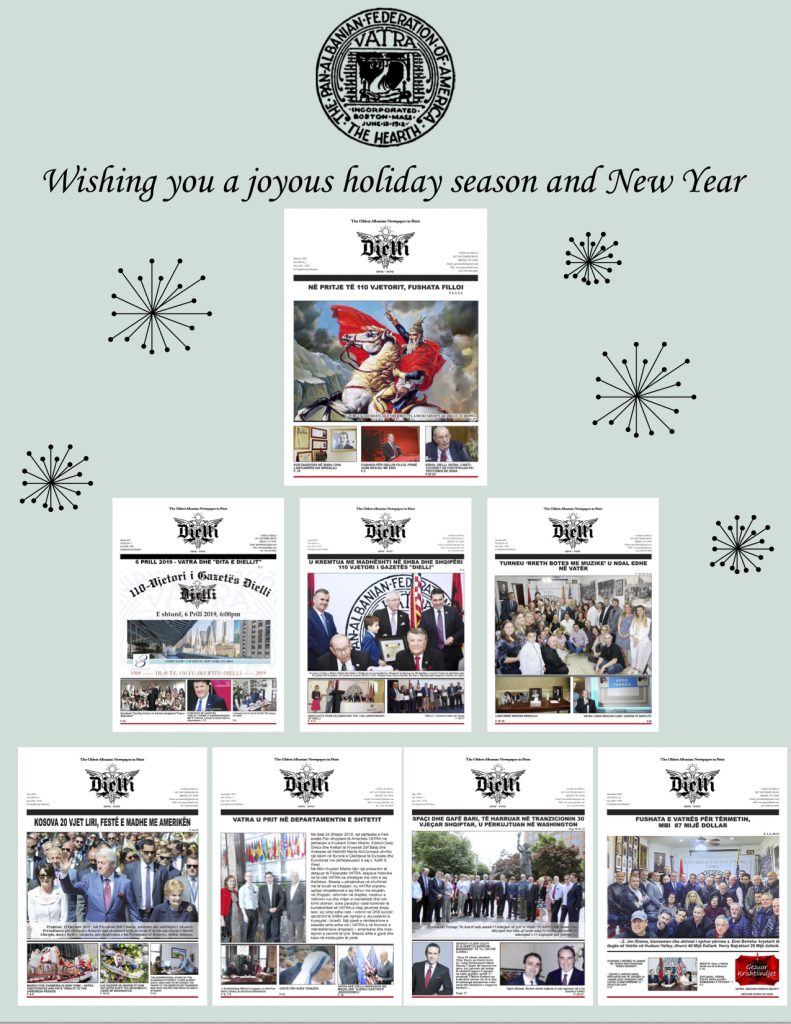
REDAKSIA E GAZETËS “DIELLI” JU URON : GËZUAR VITIN E RI 2020!

December 31, 2019 by dgreca

NGA ZEMRA JU UROJMË GËZUAR VITIN E RI 2020!

SHËNDET, PËR JU, FAMILJET, DHE TË DASHURIT TUAJ!

QOFTË NJË VIT I MBARË PËR KOMBIN SHQIPTAR!

SJELLTE MBARESI PER VATREN TONE HISTORIKE DHE HARMONI MES VATRANEVE!

QOFTË VIT I MBARË PËR ATDHEUN E ADAPTUAR- SHPËTIMTAR PËR KOMBIN TONË- SHTETET E BASHKUARA TË AMERIKËS!

URIME BASHKËPUNËTORËVE, KORRESPONDENTËVE DHE LEXUESËVE TË GAZETËS SË MOÇME”DIELLI” QË PO TROKET NË 111 VJETORIN E NUMRIT TË PARË-15 SHKURT 1909!

                   EDITORËT

DALIP GRECA   & RAFAELA PRIFTI

Filed Under: Featured Tagged With: Dalip Greca-Rafaela Prifti-Gezuar 2020

PO TROKISTE VITI I RI… SPAÇ 1986…

December 31, 2019 by dgreca

NGA PËLLUMB LAMAJ/

Është Pranverë….. Edhe ne të harruarit nga Zoti e bota kemi filluar të ndjejmë ardhjen e saj edhe pse ju shëmbëllejmë atyre leprozëve, edhe pse rreth e rrotull shikojmë vetëm tela me gjemba, ushtarë që na kanë drejtuar automatikët e mitrolozët dhe shkëmbinj të coptuar që duket se do të shkëputen në çdo moment e do të na zënë nën vehte në këtë luginë vdekjeje me emrin Spaç…  

Jemi duke lëvizur si zakonisht në atë pak hapsirë të kampit, kur në kamp ja behin policë të shumtë që shoqërojnë komandantin e burgut.Pasi qendrojnë disa minuta duke soditur të burgosurit, na japin urrdhër të futemi të gjithë në sallën e kulturës. Është ora dymbëdhjetë dhe Radio-Televizori shqiptar jep një komunikatë ku njoftohet vdekja e diktatorit… Ajo ç’ka ndjemë në ato çaste ishte një përzjereje habie, mosbesimi e gëzimi bashkë. Fshehtas filluam të vështrojmë e përshëndesim në heshtje njeri tjetrin dhe kjo heshtje më e madhe se çdo heshtje tjetër, pushtoi sallën… Ndërkohë jepet urdhëri të dalim nga salla dhe të burgosurit, me sytë që ju shkëlqejnë nga gëzimi, në heshtje, me grushtat e shtërnguar dalin nga salla dhe secili në ato çaste sublime, përfytyron Lirinë e aq dëshiruar e pritur në dekada që do të trokas së shpejti, të paktën kështu kishte ndodhur dhe në B.S. kur kishte ngordhur Stalini, por me një ndryshim, Atje miliona turmat e Siberisë kishin bërtitur e ulëritur, ndërsa ne e kishim pritur në heshtje këtë gëzim që dukej se zbriste nga qielli, në të kundërt na dukej se Demoni do të ngjallej e do të na përpinte të gjithëve.

Edhe pse e kishim dëgjuar me veshët tanë, edhe pse e kishim lutur e dëshiruar për katër dekada, prapë na dukej si ëndërr; diktatori kishte ngordhur edhe pse ishte shnëdrruar në pamundësi në ndërgjegjen e gjymtuar të popullit. Për dyzet vjet me rradhë nëpërmjet një terrori sistematik e të paparë në historinë njerëzore, ky diktator i neveritshëm kishte mundur të gjymtonte arsyen e një kombi të tërë duke e shëndërruar atë në një mit…

Fotografinë e tij të varur në mur do ta gjeje pothuajse në të gjitha familjet shqiptare dhe në këmbët e tij, që kullonin gjak do të hidheshin aq shumë lule sa që dhe vet Napoleoni, Hitleri, Stalini e gjithë mbretërit e sulltanët e botës do ta kishin zili…

Është dita e dytë e zisë kombëtare të shpallur për nder të diktatorit, flamuri qëndron në gjysëm shtize duke e nderuar atë që e tradhëtoi këtë flamur…

Me detyrim na fusin na sallën e kulturës të ndjekim ceremoninë. Është e tmerrshme, ironike, poshtëruese kur shikon që një popull i tërë poshtëron veten duke u përulur e derdhur lot përpara arkivolit të diktatorit…Të persekutosh një popull për gjysëm shekulli dhe ky popull të vajtojë vdekjen, ky është paradoksi më i madh njerëzor në histori për botën perëndimore e të civilizuar që nuk e provoi e as imagjinoi terrorin e kuq, terror që politikanët e tyre ua bënë dhuratë popujve të tjerë. Është dita e tretë e zisë dhe ceremonive dhe një i burgosur informator i komandës i shoqëruar nga policë, shkon në ç’do kapanon duke kërkuar firmën e çdo të burgosuri. Bëhet fjalë për një telegram që do ti dërgohet K.Q. P.P.SH. së dhe Ledit Makbedh, Nexhmijes… Një pjesë e madhe fatkeqësisht, por dhe ish kuadro komunistë firmosin atë paçavure, por ka dhe të tjerë kurajozë që as nuk u trembet syri… I burgosuri informator më afrohet dhe më zgjat bllokun… Pasi e shof me neveri i them të largohet.Policët që e shoqërojnë pasi më shikojnë me urrejtje duke lëvizur kokën në shenjë kërcënimi, ja bëjnë me shenjë të vazhdojë me të burgosurit e tjerë. Me sa kuptojmë, është një lojë e ndyrë e sigurimit të shtetit për t’i poshtëruar e vrarë politikisht të burgosurit e që në të ardhmen t’a përdorin si dokument poshtërues në histori. Sot është dita e fundit e ceremonive dhe turmat të perulura deri në poshtërim nga frika, mbushin me lot e lule rrugët e Tiranës së kuqe duke i dhënë lamtumirën e fundit Përbindshit të kuq. Gjithë makina e propagandës së kuqe nën ingranazhet e së cilës janë përpëlitur të gjitha institucionet, ka vetëm një devocion, nderim diktatorit.

Shiu nuk ka të pushuar sikundër dhe kortezhi njerëzor që nuk ka të mbaruar veç një gjë është e sigurtë;- Përbindshi ka ngordhur. Ditët, javët ndjekin njera tjetrën dhe asnjë shenjë Lirie nuk po shfaqet në horizont e të burgosurit natyrshëm kanë filluar të humbin durimin dhe mjerimi e shpresat që tashmë janë shnëdruar në mizori kanë filluar të mbulojnë fytyrat e tyre… Pak nga pak po i afrohemi Dimrit dhe sot ka filluar dëbora e parë e ashtu butë-butë ka shtruar çarçafin e bardhë… Më në fund trokiti dhe Dita e Vitit të Ri që shumica mendonte se do ta kalonte në Liri pranë të dashurve të tyre që dhe ata mezi i prisnin. Është kohë darkë dhe të burgosurit si zakonisht janë rreshtuar për të ngrënë darkën, atë pak supë nga mbeturinat e gjellës së ushtarëve, kur nga menca del një i burgosur i shoqëruar nga policët që i bërtasin e ulërijnë. Ai ka gjetur një krimb në supën e tij dhe ua ka treguar të burgosurve të tjerë të cilët në rradhë, njeri pas tjetrit, e kanë derdhur supën në kazanin e plehrave. Ndërkohë lajmërohet komanda dhe në kamp vjen oficeri rojës i cili pasi i ka reshtuar të gjithë të burgosurit pyet se kush prej tyre e ka gjetur krimbin. Një i burgosur, duke ngritur dorën i përgjigjet oficerit të rojës e ndërkohë oficeri rojës i bën shenjë të dalë nga rreshti e të qëndrojë përball turmës së të burgosurve dhe pastaj ju drejtohet turmës të të burgosurve; e shikoni këtë armik të betuar? Ky maskara ka hedhur krimbin në gjellë për të diskretituar komandën dhe qeverinë? Ju e dini shumë mirë që ushqimi është i bollshëm dhe i pastër dhe qeveria e partia kujdeset për ju. Ky armik i betuar i popullit nuk ka për tu reabilituar kurrë dhe do të ngordh si krimbi në burg! Dhe pasi ua bëri me shenjë policëve, duke u larguar nëpër shkallët që të çonin në zyrat e komandës, policët e mbërthyen prej krahësh fatkeqin dhe pasi e lidhën e morën në drejtim të birucave. Të burgosurit në turmë filluan të mërmërisnin ndërkohë që policia dha urrdhër të shpërndaheshin e të niseshin drejt fjetores. U nisa drejt shkallëve për të shkuar në fjetore dhe dikush më preku supet. Ishte një shoku im që gjithmonë bënte shaka, edhe në momente dramatike. Ku shkon?- më pyeti duke qeshur…E vështrova një çast pa folur dhe pastaj me buzën në gaz ju përgjigja; në krevatin e kashtës të mbuloj kokën me batanije e të pres plakun e Vitit të Ri. Në moment fytyra e tij u vrejt, më vështroi me dhimbje dhe u nis drejt dhomës së tij pa folur.

–  Ah, harrova,- i thashë me zë të ulët.

 Ai qendroi dhe me pyeti: çfarë harrove?

– Krimbi ishte dhurata më e bukur e Vitit të Ri dhe sonte do të shkruaj një dramë!

-Kujdes, më paralajmëroi ai, sonte ka shumë policë vërdallë dhe po të kapën, do të të kalbin në birucë dhe u largua. Dhe atë natë, me kokën mbuluar me batanijen e grisur e të pistë, unë shkruajta një nga dramat e shumta, por pa mundur t’a hedh në letër ngaqë policët hynin e dilnin pa pushim nëpër dhoma. Dëbora vazhdonte të binte pa pushim dhe britmat e ushtarëve që ndërronin shërbimin, dhe ndonjë fishek drite që hidhej për të ndriçuar telat me gjemba, më kujtuan se kishte trokitur Viti i Ri 1986.

Zbulova kokën dhe i hodha një vështrim dhomës, të gjithë kishin mbuluar kokat me batanije. Doja ti zgjoja, t’ju tregoja se kishte ardhur Viti i Ri, por mu duk se do t’u prishja ëndërrat. Zot, thashë me vete, çfarë të kemi bërë?! 

E ashtu në përhumbje, mbulova dhe unë kokën me batanie e nisa të mërmëris disa vargje që i kisha shkruar vite më parë vetëm e vetëm të më zinte dhe mua gjumi…….

Eh statujë,Statujë e Lirisë

Sa kurora rinie vyshkur mbi ball

Jehona dashurie që kurrë s’u dhuruan

Kafka martirësh mbetur pa varr…

Eh Statujë,Statujë e Lirisë

E vetmja dritë,i vetmi zjarr

E vetmja ëndërr ku shpresat udhëtojnë

Përzjerë me klithma,kulluar në gjak

Eh Statujë,Statujë e Lirisë

E vetmja shpresë që na mban gjallë

Por dhe po ikëm pa u takuar

Besom,do vinë të të puthin vrasësit tanë

DITARI I BURGUT Spaç 1986

Filed Under: Histori Tagged With: Pellumb Lamaj-Viti i Ri-1986-Spac

Legjenda e tri Krishtlindjeve nën dhunë- rrëfim nga Dr. Lazër Radi

December 30, 2019 by dgreca

24 dhjetori i 1924-ës… Prizren/

Dimën…/

Dimën i ashpër nordik në malet verilindore të tokës shqiptare. Qyteti im, me mantelin e bardhë të borës ndër krahë, sfidonte at bardhësi verbuese me dritën e zbehtë të hanës, pa i shpallë luftë, veç tue e pranue njeni-tjetrin në heshtje. Në qytet gjithçka zhvillohej në heshtje: edhe krimi… edhe dashnia!

Ai kishte marrë nji pamje të çuditshme!

Luftohej me hapë nji shteg kalimi n’at rrugë të verbër, po lëvizja e dyshimtë e bajonetave mbi çatitë e mbytuna nën borë, kallzonte se pusia qe kurdisë me u derdhë gjak i pafajshëm…

Ky ishte absurdi i asaj nate të shenjtë.

Si mund të mendohej për krim e gjak at natë të paqme, kur krejt atmosfera ishte mbështjellë me melodinë ëngjullore të lindjes, që valë-valë lshohej nga kisha majëkodre e shpërndahej gjithkah qytetit… Sa qartë e fuqishëm shpërthenin fjalët e melodisë: “Lavdi Zotit ndër qiej – paqe njerzve mbi tokë”.

Ishte nata e qiejve… nata e paqes për të gjithë.

Ishte 24 dhjetori i 1924-ës!

Në zemër të Kosovës, Drenica qe kthye në nji skëterrë, në nji kasaphanë e vërtetë për pushtuesit. Kryengritja s’po ndalej. Hija e Azemit shfaqej kudo te “Hani i Mushkave”, te “Kroni i Hirushës”, te “Shtegu i Drenit”, po atje ku kallte ma shumë tmerr ishte te zemrat e shkjeve.

Eh, sa e vrazhdë ajo hije: kudo kah shkonte, edhe pse pa zhurmë e pa zà, ashtu në heshtje kallte tmerr! As ushtritë e armatosuna s’po mund t’i afroheshin asaj rrezeje ku sundonin fantazma, ku mbretnonte hija e vrazhdë e Azem Bejtes… Ajo krahinë, për kënaqësinë e të gjithëve ne, quhej “Shqipnia e Vogël…”

Mesnata ishte në grahmat e fundit.

Nën qiellin e zymtë, nji qetësi hyjnore rrinte pezull nën at bardhësi të paskaj natyre… Ndigjoheshin virtytshëm tingujt e kambanave që ftonin njerzit me marrë pjesë në ardhjen e “Mesias” mbi tokë. Kambanat vazhdonin e dukeshin si ndjellse kerubinësh që fluturonin mbi at qiell të qeltë të qytetit në skaj. Njerëzia, ngutnin hapat e kjo dallohej prej hijsheve në rrugët e Varoshit, nën Kala ku fenerat në lëvizje ngjanin si xixlloja të çuditshme që vërtiteshin të çmenduna midis atij acari të dimri alpin.

Çdo çast bahej edhe ma emocionues…

dukej sikur i preknim me dorë tingujt e kambanave, sikur e ambla e asaj nate të madhnishme futej në veshë e ndër zemrat tona. Nji kangë baritone e bardhë si dëbora verbuese dilte prej gjokseve të fëmijëve në korin e kishës. Ishte zani i shelbimit që kishte pushtue jo veç qiejt e tejdukshëm t’asaj nate fatlume, po krejt shpirtnat e ishte shkri me ta.

Posa e kaluem Qafën e Pazarit, u gjendëm përballë fasatës madhështore të kishës së qytetit. Ishte e para herë që prindët e mi, më merrnin me vedi në meshën e mesnatës. Nji fantazmagori dritash e ngjyrash gjithallojshe m’i lëbyri sytë. Oh, sa iu gëzova asaj pamje magjepse. Më dukej sikur gjendesha diku jashtë bote, sikur shetisja n’nji vis përrallash… ku kambanat s’pushonin… e ndër krahë të atyne tingujve lëshoheshin jonet e korit të fëmijëve që dilnin nga kisha dhe si avull i nxehtë futej në shpirtin tim. Midis saj qe ngritë nji Betlehem i mrekullueshëm.

Dy javë ma parë, motra Angjelinë dhe murgeshat e tjera kishin punue tue derdhë krejt dashninë dhe pasionin e tyne. Ai Betlehem, për sytë e e pamësuem të nji fëmije ishte vërtet diçka magjike, nji poezi që derdhesh me muzikë e gjitha mbrenda meje…

Mbresat e asaj nate kambanash, kandilash e kangësh më krijuen në shpirt nji romantikë të tillë që më ka ndjekë në gjitha vitet e jetës…

24 dhjetor 1944 – Burgu e Ri – Tiranë!

Ishin ditë të vështira, të randa, të zeza…

Të rrethuem gjithkah me tela, me policë, me dhunë e me kërcënime për vdekje… Tashma jo nga i huaji serbo-sllav, po nga i joni, vëlla i gjakut, po që dukej bash si pjellë e të huajit… lebrozë të indoktrinuem, internacionalistë, barinj që s’u dukeshim as delet, e që meritonin at emnin fatal të Greqisë së Lashtë “a patris”, t’paatdhe…

Burgjet e Shqipnisë ishin përplot me njerëz që besonin me gjithë mend në hymnin e Perëndisë. Asaj nate, ata ndjenin të qarkullonte n’ajri kangë si: “Lavdi Zotit ndër qiej e paqe n’tokë për njerëzit vullnetmirë…”

E ndjenin në shpirt, i kapnin në fluturim ato jone të padukshme kange që lëvrinin ambël nëpër at qiell të mjegulluem me erë baroti e gjurma gjaku…

Burgu zukiste si nji koshere bletësh. Kudo që ishte nji pëllambë toke e ngurtë qindronte nji qenie e gjallë, tashma e burgosun, e përdhosun e që dikur kishte qenë njeri, e çfarë njeriu…!

At mbasdreke të 24 dhjetorit… u hapën kangjellat e dyfishta të burgut dhe në korridorin e frigorifertë u shfaq Dom Shtjefën Kurti, famullitari kosovar, tash guximtari i Tiranës. Si rrufe u përhap lajmi se Dom Shtjefni ishte mes nesh dhe se për t’parën herë në historinë e burgjeve shqiptare do të celebrohej Mesha e Krishtlindjeve…

Vrapuem të gjithë me i shkue në ndihmë.

Diku n’nji cep hapëm vend dhe sa hap e mbyll sytë e ngritëm altarin… I zbehtë dhe tepër i emocionuem, tue marrë pjesë shpirtnisht në dhimbjet e në vuejtjet tona – ai celebroi para gjithë të burgosurve, pa dallim nëse ishim myslimanë a të krishterë…

Mesha e Krishtlindjeve at natë qe nji mrekulli e vërtetë shprese dhe besimi n’ato katakombe të tmerrit shqiptar…

Ma vonë, kur dhuna e kuqe do të lëshohej si qen i tërbuem edhe mbi të, në nji qeli burgu, do të më rrëfente se mesha ma e bukur, ma solemnia dhe ma e paharrueshmja e jetës së tij, do të mbetesh ajo meshë aty në Burgun e Ri të Tiranës, të cilën për nga emocionet, e krahasonte me meshën e parë që kishte thanë kur qe shugurue prift. Sa vetë në botë do të kishin dashtë që të kishin asistue n’at meshë burgu ku elemente besimesh të ndryshme asistonin me të njejtin devocion, me atë devocion që ka veç shqiptari, për atë Zot… që na e ka dhanë jetë e frymë të gjithëve…

Si mbaroi mesha, e përcollën Dom Shtjefnin, deri te porta e daljes. Korridori u zbraz mbasi sërish do kthehej në bujtinë. Aty pamë se dyshemeja ishte lagë prej lotëve të mallëngjimit… Ai korridor i ftoftë akull qe kthye n’nji “Lëndinë Lotësh” o n’nji Mur Vajtimi. Ishin lotët tonë, lotët e atyne njerzve të pafajshëm që s’po e kuptonin pse ishin krijue aq shumë burgje nëpër botë, apo thjesht për me i mbajtë ndër pranga fajtorët e pafajmë…

***

24 Dhjetor 1953: Aeroporti Rinasit, Ura e Hasan Beut.

Mesnata e Krishtlindjeve ma të bukura n’botë.

E denjë për një skenar të mrekullueshëm filmi.

Në kampin e punës n’Aeroporti Rinasit, gjitha ditët ishin të njisojta: të randomta e të rraskapitshme. Nuk njifesh as mot me shi e as me diell, as baltë e as tokë të thatë, as diell përvëlues e as borën dy pëllëmbë trashësi. Punë, veç punë, punë pa orar, punë prej kafshe nën at qiell të hapët e në mëshirë të Zotit.

Aeroporti ushtarak na kërkohej me urgjencë. Përshpejtimi i punimeve bahej me kamxhik o me hunj gardhi, po edhe ata soseshin tue u thye mbas shpinave tona…

Dikur, ora as dita s’kishte ma asnji lloj kuptimi, fishkëlleu bilbili i grumbullimit dhe u dha urdhni për kthim. Formuem rreshtat dhe u vumë për rrugë. N’at mori njerzish të rraskapitun e të leckosun, që dukej sikur s’kish të sosun, krijuem nji treshe – Patër Meshkalla, Anton Kozmaçi dhe unë. Gjatë gjithë asaj dite kishte ra shi dhe rruga ishte përbaltë keqas… qe krijue nji llucë ngjitëse që po na e vështirsonte së tepërmi ecjen. Prej asaja morie kambësh që hiqeshin zhag, balta qe ntrashë aq sa na i kapte “tullumbat” e na i shkulte prej kambëve. Shumë i hoqëm e i morëm në dorë tue hecë zbathë n’at ditë të akullt dimni.

Dikur mbrritëm në kamp, s’ishim ma as njerëz e as kafshë: ishim reduktue në fantazma, në ca krijesa zvarranike që s’dihej prej ç’epoke gjeologjike vinim. E shifnim vedin veç te të tjerët e rrëqetheshim. Isha i bindun se as nana që na e kishte bà kokën, s’do t’na njihte n’at katandisje të mjerueme ku na kishin hjedhë…

Në gjithë at mjerim, egërsi e zymti që na rrethonte, at natë vendosëm me e festue at “ditë të bekueme!” U lamë, njashtu keq e keq, e nisëm me sajue diçka me hangër. Ai sajim, na shërbente me kalue kohën, derisa t’afronte mesnata. Kishim ndezë tri zjarre të fuqishme: në njenin zienim groshën, në tjetrin orizin dhe në të tretin hallvën. E ftuem edhe Patër Mëshkallën, n’at festë të mjerimit njerzor, po ai s’pranoi asgja, pse do të “kungohej” mbas nji ore n’at meshë… Aty pranë, farfurinte pema e Krishtlindjeve, nji degë selvije e sajueme dhe zbukurueme me do shporta e figura të bame me letra punëdore, e ndonji portokall o mollë ndër sqetullore degash.

Afër mesnate u ngritëm e sistemuam elterin në krye të kapanonit. Mbi tavolinë të mbulueme me nji çarçaf të bardhë si bora, vendosëm dy shandana me qirinj, pemën, ungjillin, kupat e mbulueme dhe pemën e zbukurueme.

Kur u lajmërue mesnata, Patër Mëshkalla, edhe njashtu i pakët kah shtati, at natë kishte pamjen e nji gjigandi. Krejt kapanoni i burgut ishte në kambë. Pa dallim feje e krahine, ishin aty, në Meshën e Krishtlindjeve në Ferr.

E ndërsa thuhej mesha, u ndezën plot qirinj që ato fantazma i mbanin ndër duer. Mund t’ishin tridhjetë, pesëdhjetë ndoshta edhe njëqind të tilla – di veç që krejt kapanoni mori nji ndriçim parajse. Ajo stallë mundimesh u shndrrue në kishë, ndoshta katedralja ma madhështore e botës… sepse aty ishin shpirtnat tonë.

U ba nji natë e mrekullueshme, dhe pse jetonim aty në skëterrë të dhunës. Disa prej pjesëmarrësve, (ata të kulturës gjermane) e dinin kangën e famshme të Krishtlindjeve “Shtilen Naht-in” e nën zà ia nisën me këndue… Pak nga pak tonet e kangës erdhën duke u naltue. Befas qe improvizue nji kor i madh, e mos t’ia kishe lakmi as Verdit te Nabuko… E gjithë mesha u përcoll nën melodinë e asaj kange të paharrueshme që i dha solemnitet atij çasti të madhërishëm, duke na ngjallë shpresa të pakufishme, se nji ditë, do të zbriste edhe ndër ne “paqja e njerëzve vullnetmirë!”

Botuar në gazetën Mapo, 27 dhjetor 2019(Dergoi per Diellin-Nikolin Kurti)

Filed Under: Politike Tagged With: Dr. Lazer Radi-Legjenda e Tri Krishtlindjeve

  • 1
  • 2
  • 3
  • …
  • 36
  • Next Page »

Artikujt e fundit

  • Dashuria që e kemi dhe s’e kemi
  • “Jo ndërhyrje në punët e brendshme”, dorëheqja e Ismail Qemalit, gjest atdhetarie dhe fletë lavdie
  • Arti dhe kultura në Dardani
  • Gjon Gazulli 1400-1465, letërsia e hershme shqipe, gurthemeli mbi të cilin u ndërtua vetëdija gjuhesore dhe kulturore e shqiptarëve
  • “Albanian BookFest”, festivali i librit shqiptar në diasporë si dëshmi e kapitalit kulturor, shpirtëror dhe intelektual
  • VEPRIMTARI PËRKUJTIMORE SHKENCORE “PETER PRIFTI NË 100 – VJETORIN E LINDJES”
  • 18 dhjetori është Dita Ndërkombëtare e Emigrantëve
  • Kontributi shumëdimensional i Klerit Katolik dhe i Elitave Shqiptare në Pavarësinë e Shqipërisë 
  • Takimi i përvitshëm i Malësorëve të New Yorkut – Mbrëmje fondmbledhëse për Shoqatën “Malësia e Madhe”
  • Edi Rama, Belinda Balluku, SPAK, kur drejtësia troket, pushteti zbulohet!
  • “Strategjia Trump, ShBA më e fortë, Interesat Amerikane mbi gjithçka”
  • Pse leku shqiptar duket i fortë ndërsa ekonomia ndihet e dobët
  • IMAM ISA HOXHA (1918–2001), NJË JETË NË SHËRBIM TË FESË, DIJES, KULTURËS DHE ÇËSHTJES KOMBËTARE SHQIPTARE
  • UGSH ndan çmimet vjetore për gazetarët shqiptarë dhe për fituesit e konkursit “Vangjush Gambeta”
  • Fjala përshëndetëse e kryetarit të Federatës Vatra Dr. Elmi Berisha për Akademinë e Shkencave të Shqipërisë në Seancën Akademike kushtuar 100 vjetorit të lindjes së Peter Priftit

Kategoritë

Arkiv

Tags

albano kolonjari alfons Grishaj Anton Cefa arben llalla asllan Bushati Astrit Lulushi Aurenc Bebja Behlul Jashari Beqir Sina dalip greca Elida Buçpapaj Elmi Berisha Enver Bytyci Ermira Babamusta Eugjen Merlika Fahri Xharra Frank shkreli Fritz radovani Gezim Llojdia Ilir Levonja Interviste Keze Kozeta Zylo Kolec Traboini kosova Kosove Marjana Bulku Murat Gecaj nderroi jete ne Kosove Nene Tereza presidenti Nishani Rafaela Prifti Rafael Floqi Raimonda Moisiu Ramiz Lushaj reshat kripa Sadik Elshani SHBA Shefqet Kercelli shqiperia shqiptaret Sokol Paja Thaci Vatra Visar Zhiti

Log in

This website uses cookies to improve your experience. We'll assume you're ok with this, but you can opt-out if you wish. Cookie settingsACCEPT
Privacy & Cookies Policy

Privacy Overview

This website uses cookies to improve your experience while you navigate through the website. Out of these cookies, the cookies that are categorized as necessary are stored on your browser as they are essential for the working of basic functionalities of the website. We also use third-party cookies that help us analyze and understand how you use this website. These cookies will be stored in your browser only with your consent. You also have the option to opt-out of these cookies. But opting out of some of these cookies may have an effect on your browsing experience.
Necessary
Always Enabled
Necessary cookies are absolutely essential for the website to function properly. This category only includes cookies that ensures basic functionalities and security features of the website. These cookies do not store any personal information.
Non-necessary
Any cookies that may not be particularly necessary for the website to function and is used specifically to collect user personal data via analytics, ads, other embedded contents are termed as non-necessary cookies. It is mandatory to procure user consent prior to running these cookies on your website.
SAVE & ACCEPT