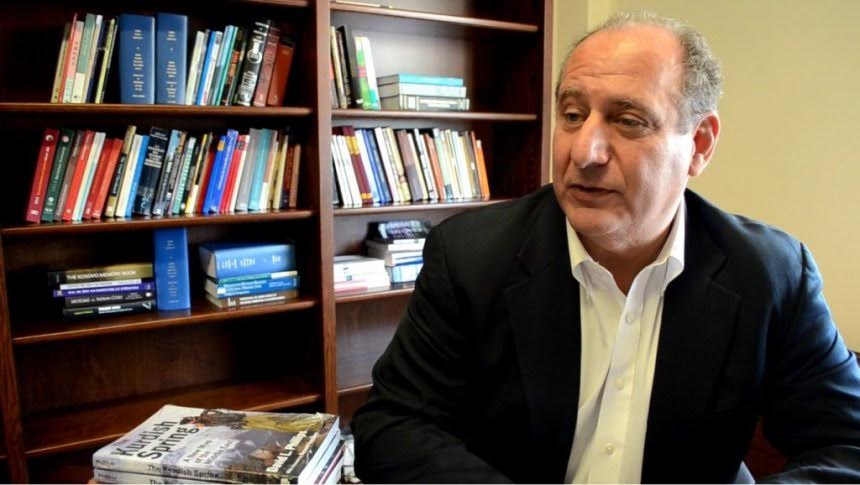
BY David L. Phillips*/
While the Trump administration believes that Iran is the source of all evil in the Middle East, Saudi Arabia’s nefarious activities necessitate a more steely-eyed assessment of both Iran and Saudi Arabia.
Saudi Arabia’s malign activities cannot be ignored. The execution of Jamal Khashoggi shows contempt for international norms. Beheading and dismembering the body of a U.S.-based dissident journalist is unacceptable.
Moreover, there is growing and well-founded concern of Saudi Arabia’s direction under the autocratic rule of Crown Prince Mohammed bin Salman, the 33-year old son of King Salman.
In Yemen, Saudi Arabia indiscriminately bombs hospitals and school buses, committing war crimes.
Saudi Arabia abets violent extremism. It has been the Taliban’s most loyal patron. Fifteen of the 9/11 hijackers hailed from Saudi Arabia. It finances mosques and madrassas across the Middle East, South Asia, Turkey, and the Balkans where youth are radicalized and become holy warriors.
Saudi Arabia funded Jihadi groups in Syria, sub-contracting with Turkey’s National Intelligence Agency to provide weapons, money, and logistics. Saudi-backed Salafist and Wahhabi warriors in Syria and Iraq morphed into ISIS, killing Americans.
Saudi Arabia’s diplomatic relations are in disarray. It kidnapped Lebanon’s prime minister, launched an embargo on Qatar, and turned a tiff with Canada into a major rupture of relations.
US Turns Blind Eye
The Trump administration is willfully ignorant. It turns a blind eye to Saudi Arabia’s offenses for three reasons.
First, Riyadh presents itself as a counterweight to Iranian influence. Its role is especially important in the wake of Washington’s decision to increase the isolation of Iran after withdrawing from the nuclear accord.
Second, Washington supports Saudi Arabia’s so-called reform agenda even though authorities jailed hundreds of female dissidents and detained scores of wealthy Saudis at the Ritz-Carlton hotel in Riyadh.
Third, Saudi Arabia spends extravagantly at Trump properties and promised to buy $110 billion in military equipment. Saudi Arabia bought $20 billion in U.S. products last year and committed $20 billion to a new investment fund run by the Blackstone Group. Who knows what was discussed at Jared Kushner’s late-night rendezvous with Mohammed bin Salman in Riyadh.
There are no angels in the Gulf. While increasing its scrutiny of Saudi Arabia, the Trump administration must not sugarcoat Iran’s malign activities.
Iran supports Syria’s President Bashar al-Assad and Hezbollah and Shiite militias in Iraq. It gives weapons to Hamas and other radical Palestinian groups, as well as to Houthi rebels in Yemen. Iran fires missiles in violation of resolutions by the UN Security Council. Prior to the nuclear deal, Iran was enriching uranium that could be weaponized in a break-out to build a nuclear bomb.
Though Iran’s threats preceded Washington’s decision to more closely align with Saudi Arabia, closer cooperation between the U.S. and Saudi Arabia may have accelerated Iran’s militarization and intensified its support for Shiite proxies.
Re-Balancing
The U.S. needs a strategic balance in dealing with Saudi Arabia and Iran. Balance would give the U.S. greater leverage over Saudi Arabia, requiring real progress on human rights and other reforms.
Greater strategic balance would also enable the U.S. to work with both Saudi Arabia and Iran on regional problems such as the civil war in Yemen. When the dust settles from the Khashoggi investigation, Washington could use its added leverage to demand a ceasefire in Hodeida, the Red Sea Port through which almost all of Yemen’s food supplies are delivered. A humanitarian pause would save many lives and lead to more vigorous diplomacy aimed at ending Yemen’s civil war.
The Khashoggi assassination is a wake-up call. The U.S. needs a more nuanced approach to enhance its influence and stability in the Gulf.
* Director of the Program on Peace-building and Rights at Columbia University’s Institute for the Study of Human Rights. He served as a Senior Adviser and Foreign Affairs Expert working for the Near Eastern Affairs Bureau of the State Department during the administration of President George W. Bush