• Home
  • Politics
  • Opinion
  • Culture
  • Sports
  • Economy
  • Interview
  • Reporting
  • Community
  • Vatra

Dielli | The Sun

Albanian American Newspaper Devoted to the Intellectual and Cultural Advancement of the Albanians in America | Since 1909

TË PIKTUROSH ATË QË NDJEN…

August 17, 2022 by s p

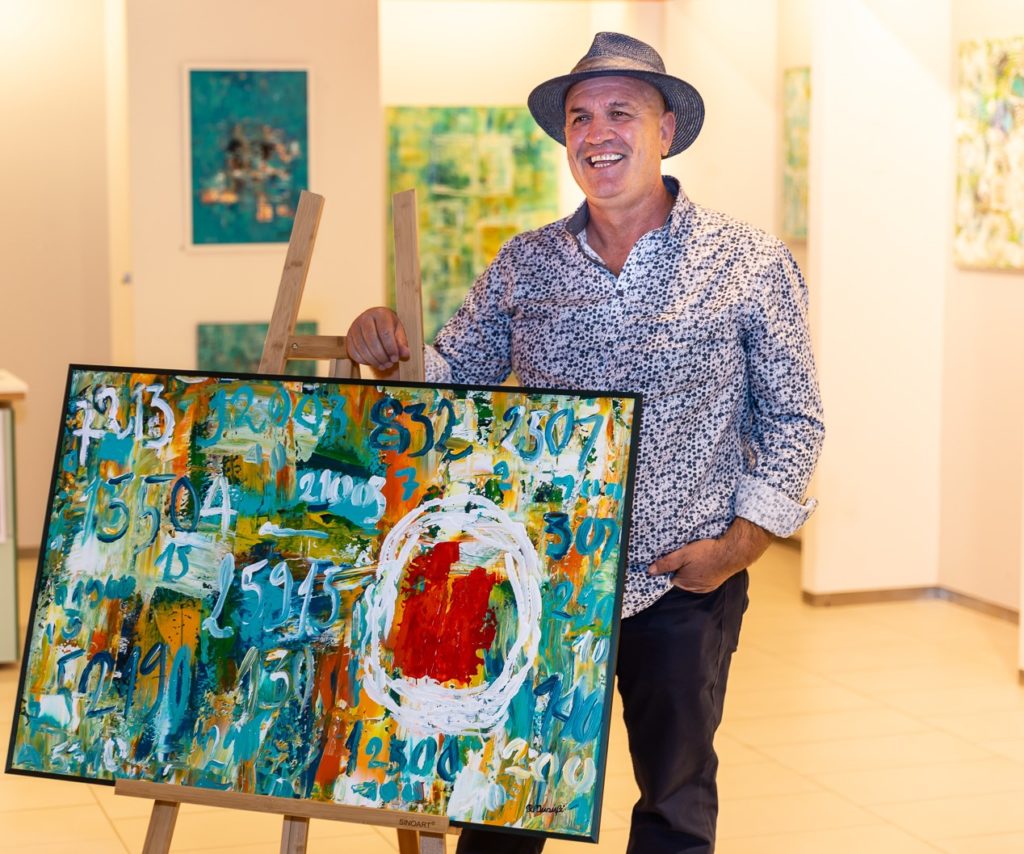
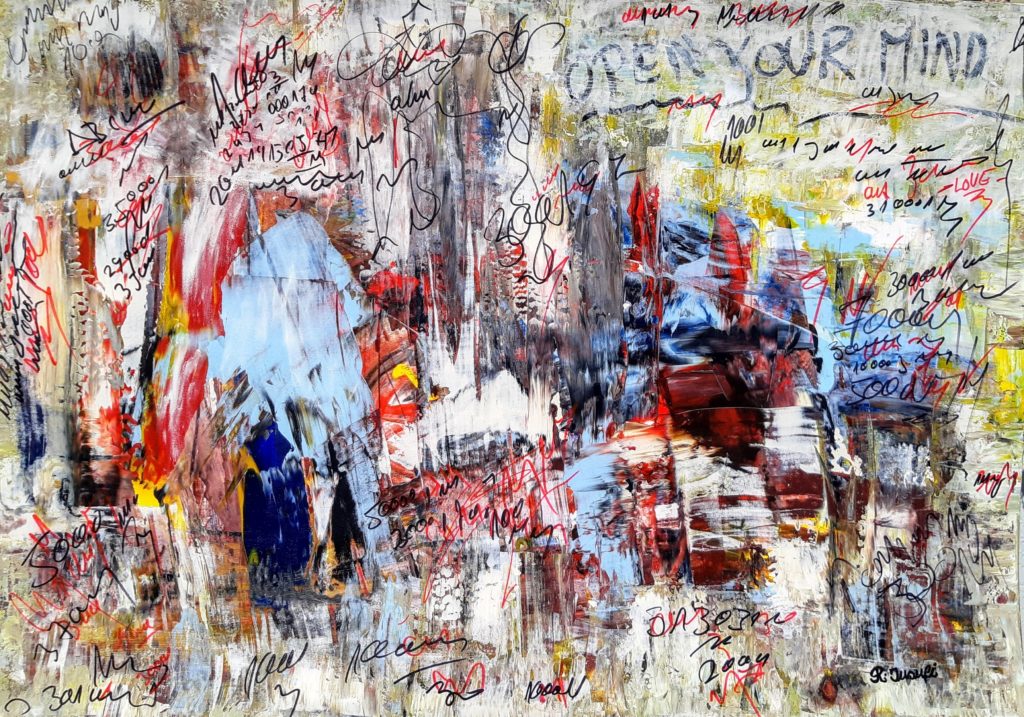
Piktori Resul Jusufi rrëfen për Diellin e Vatrës në New York, projektet e së ardhmes, emocionet, numrat, ngjyrat, ndjejat, filozofinë e artit dhe fuqinë e shëndërrimit të numrave në një emocion të veçantë në pikturë. Në një rrëfim ekskluziv dhënë Editorit të Diellit Sokol Paja, artisti Resul Jusufi zbulon për publikun hapjen së shpejti të Ekspozitës personale në New York dhe analizon pikturat e tij në akrilik, në kanavacë, karton e letër ku spikat stili i pikturave si ekspresionizëm abstrakt.

BOTA SI NJË VEND KU ARTI ËSHTË DOMOSDOSHMËRI

Arti është jetë por edhe jeta është art. Arti është ushqim shpirtëror për njeriun, jeta do të ishte vërtetë e varfër pa të, nuk do të kishte kuptim mendoj unë. Ai është memorizuesi më i mirë i kohës që ne e jetojmë. Nuk mund ta imagjinojë jetën pa art. Ura me e mirë, dhe më e lehtë e komunikimit mes njerëzve dhe e largimit të stereotipeve mes tyre, mendoj që është ajo përmes artit. Arti në kuptimin filozofik është gjithçka e menduar nga mendja e njeriut dhe e bërë nga dora e tij. Arti i përket universales, e ka fuqinë dhe magjinë përtej asaj që ne mund të mendojmë.

TË PIKTUROSH ATË QË NDJEN, JO ATË QË SHEH

Pikturoj atë që ndiej jo atë që shoh, i pikturoj ndjenjat jo objektet. Ndikimi, inspirimi për të bërë një pikturë për mua është e para vetë jeta, mund të jetë një shëtitje në natyrë, degjimi i zërit të zogjëve, shushurima e gjetheve, një bisedë e mirë me një mik, një libër me poezi, një film, një këngë, shfaqje teatri, filmi, vizitë në galeri etj. Është pak e vështirë të vlerësoj vetë pikturën time. Po tregoj ato që kam degjuar nga piktor, kolegë, kuratorë po citoj: “piktura jote Resul është unike është e veçantë”. Të pëlqyerit është relative dikush e pëlqen e dikush jo, mendoj kjo eshte shumë normale. Nese mund te theksoj një karakteristikë në pikturen time kisha me thënë janë numrat që përdori në pikturë, sidomos këto vitet e fundit. Ashtu natyrshëm ka ardhur tek unë përdorimi i numrave në pikturë. Shpesh më pyesin çfarë simbolizojnë numrat në pikturën tënde, u them numrat që shihini në pikturë ata nuk janë më numra por jane emocione.

SUBJEKTI, KONCEPTI, MESAZHI I ARTIT TË RESUL JUSUFIT

Pikturat e mia janë në akrilik, disa janë në kanavacë, karton e letër. Stili i pikturave është ekspresionizëm abstrakt. Pikturoj sepse më bën të ndihem mirë. Nëpërmjet artit kam mundësi t’i njohë të panjohurat e jetës. Gjithashtu dua të tregoj përmes ngjyrave formave abstrakte që pozitiviteti duhet jetë triumfues në jetë. Në shumicën e rasteve pikturave nuk i’u vendos tituj, nga që mendoj se i kufizoj ato duke i vënë një emër. Stili i pikturave është i tillë dhe e kërkon që ato të jenë të lira. Tjetra është secili që do të ketë mundësi t’i shikoj pikturat, të ndiejë në mënyrën e vetë jo duke u bazuar ne titull. Koncepti është një ndërthurje mes lojës me ngjyrat drejt pikës maksimale të asaj që ndiej, mendoj, në një situate apo rrethanë të caktuar. Mesazhi eshte që kurrë mos ndalo së menduari pozitivisht, pvarësisht në çfarë rrethane, situate mund të jeshë, gjithashtu dua të përcjellë edhe meszhin “paqe dhe dashuri për të gjithë njerëzit e botës kudo që jetojnë ata”.

RAPORTET: DRITË – ERRËSIRË, JETË – VDEKJE NË PIKTURË

Pa dritë nuk ka jetë, drita është e domosdoshme për jetën. Mund të them shkelëqimi i dritës dominon në shumicën e pikturave te mia. Siç e theksova dhe më herët, arti im është i orientuar drejt pozitivitetit, duke kerkuar forma të reja përmes kompozimit me ngjyrën si dhe lojës me numrat drejtë një llogaritjeje abstrakte.

TË EDUKOSH PËRMES ARTIT…

Rruga më e mirë për të promovuar vlerat njerëzore, mendoj se është përmes artit dhe kulturës. Ndërgjegjësimi i shoqerisë ndaj fenomeneve negative më lehtë arrihet përmes një vepre arti, çoftë pikturë, film, këngë etj. Unë mendoj që arti në vetëvete e ka karakterin edukues, informues, por edhe provokues. Duke na shtyrë që të mendojmë, dhe në kët mënyrë arti na orjenton drejt së panjohurës.

ARTI SI ZHVILLUES I AFTËSITË KRIJUESE

Arti është ndjenjë, imagjinatë, sa më shumë të punojmë me imagjinatën, krijojmë vepra arti, na shpie drejtë rrugës së vetëdijësimit për gjërat e pa njohura, duke na i bërë të njohura, si dhe na ndihmon të ngritemi në nivele më të larta në drejtim të vlerave njerëzore.

ANGAZHIMET PROFESIONALE TË PIKTORIT RESUL JUSUFI

Para një muaji isha në Lituani, isha pjesë e ekspozitës kolektive në muzeun Rokiskis. Gjithashtu në qyetetin Kaunas pata shumë takime me artist të ndryshëm, vizitova disa galeri dhe muze. Në galerinë “BALTA” pata dhe një diskutim me artistët e qyetetit lidhur me artin dhe ne veçanti pikturen. Ide për projekte të reja,plane mendoj se ka çdo artist. Tash së fundmi kam marre një ftesë zyrtare nga një Galeri në Manhattan të New Yorkut. Ndonjëherë për artistin është pak e vështirë në mënyrë individuale të shfaqë artin e tij pa mbështetje institucionale e sidomos për një artist shqiptar në një vend të huaj larg atëdheut nuk është e lehtë. Por kam besim dhe do të përpiqem të bëj zgjidhje që të realizohet kjo ekspozite në New York.

ARTI SI PIKËTAKIM KULTURASH, TRANSFORMIMESH DHE IDESH

Takimet në ngjarjet kulturore, si festivalet e filmit, teatrit, bienalet, ekspozitat, janë ngjarje që gjithmonë sjellin risi në rrafshin kulturor. Takime me artistë nga vende e kultura të ndryshme , shkëmbimi i përvojave me ta janë shumë frymëzuese për atistin. Pastaj dhe komunikimi direkt me publikun i japin artistit një shtysë të madhe drejtë kreativietit, kërkimeve për vepra dhe projekte të reja artistike.

KUSH ËSHTË ARTISTI JUSUFI SI AMBASADOR I PIKTURËS E KULTURËS SHQIPTARE NË AUSTRI

Prej disa viteve jeton dhe krijon në Graz të Austrisë, ka pasur disa ekspozita individuale dhe kolektive në galeri të ndryshme të qytetit, si dhe në disa vende alternative, vlen të përmendet instalacioni “këpuca e vetmuar “ e vitit 2018. Eshtë anëtar i shoqatës së piktorëve të qytetit të Grazit “KUNSTLERBUND “ (është një shoqatë thuaj se me traditë 100 vjeçare ). http://www.kuenstlerbund-graz.at/web/?c=kuenstler&sc=jusufi_resul. Gjithashtu dhe në Vienë është antëar i shoqatës së piktorëve “iG bildendekunst “ https://igbildendekunst.at/en/service/iaa-card/. Ekspozita e parë ka qenë në galerine e qyetit Chienow Poloni viti 1998, që nga ajo kohë ka pasur disa ekspozita individuale dhe kolektive në vende të ndryshme si në: Kosovë (në galerinë kombëtare të Kosovës, në vitin 2007 dhe 2008 ishte i nominuar për çmimin Myslim Mulliqi), Gjermani, Shqipëri, Kroaci, Poloni, Korenë e jugut, Taivan, Lituani, Austri, Zvicerr, dhe eskpozita e ardhshme do të jetë në Itali festivali ndërkombëtar i piktures “SORRENTO” 2022 https://www.syart.it/en/syart-sorrento-festival-vi-edition-2022/, që do të mbahet në tetor, marrë pjesë me tri piktura. Ka pasur fatin të vizitojë disa nga ekspozitat e piktorëve më eminent Austriak , e t’i takoj e të bsiedoj me ta në ekspozitat e tyre si : Hermann Nitsch, Christian Ludwig Attersee, Günter Brus, fotografin e mirënjohur Robert SACKL https://www.sackl-kahr.com/ad-personam/. E shumë artistë të tjerë, kurator, galerist, perfaqesues të kultures së qytetit te Grazit e të vienes. Takimi në nivele të tilla akademike, bisedat me ta rreth artit në Shqipëri e në Kosovë , e në përgjithësi për artin, ka qenë kënaqësi dhe nder për z.Jusufi. ai fitoi çmimin për arritje profesionle si dhe promovimi i paqes përmes artit të tij në festivalin “Peace Again”, Geoje , Koreja e Jugut , 2021 WCA (World contemporary art) në Hong Kong viti 2019, pjesëmarrës mbi 50,000 artist nga 147 vende, z.Juzufi u shpall “artist of the week”, gjithashtu është përzgjedhur një pikturë e tij “painting of the day”. https://www.instagram.com/p/B0cn3x5gkS0/?hl=en

Resul jusufi i lindur në vitin 1968, në Kosovë. Ka studuar në fakultetin teknik në Prishtinë për ndërtimari pastaj ka studiuar në akademinë e arteve të bukura në Tiranë për Teater (aktor ), si dhe ka studiuar në akademinë e filmit dhe të televizionit per regji filmi në Vrshavë të Polonisë. Ka botuar një dramë moderne me titull “NESER” (histori pa histori), botuar nga Shtëpia botuese “FAIK KONICA” Tiranë në vitin 1995. Resuli ka realizuar disa shfaqje teatarale me pantomimë në Kosovë e Poloni. Gjithashtu ka realizuar disa instalacione, videoinstalacione, filma të shkurtër, perfomansa etj Ka realizuar, organizuar shumë workshope në shumë vende të ndryshme të Evropës. Resuli verpron si artist i pavarur, me kohë të plotë.

https://www.instagram.com/jusufiresul/?hl=en
https://www.facebook.com/resul.jusufi.

Filed Under: Mergata Tagged With: resul jusufi, Sokol Paja

Nuk jepet me qera atdheu

July 30, 2022 by s p

Gezim Zilja/

Konferenca e ambasadorëve në Londër, mbajtur në 1912–1913 ishte një takim i gjashtë Fuqive të Mëdha të asaj kohe (Britania e Madhe, Franca, Gjermania, Austro-Hungaria, Rusia dhe Italia). Më 29 korrik 1913, ambasadorët vendosën formalisht për të njohur  Shqipërinë si shtet sovran të pavarur nga Perandoria Osmane.  Konferenca mori vendime që prekën gjysmën e territorit, të banuar nga shqiptarë etnikë dhe rreth 40% e popullsisë shqiptare u la jashtë kufijve të Shqipërisë. Vilajeti i Kosovës iu dha Serbisë dhe Çamëria, Greqisë. Kur qeveria shqiptare u njoh me vendimet e Konferencës së Londrës, ministrat e qeverisë dhe të tjerë patriotë u mbodhën rreth Ismail Qemalit, me lutje e thirrma të forta, kërkuan që të kundërshtohej vendimi dhe të vazhdonin luftën për Kosovë e Çamëri. Plaku i urtë iu përgjigj: “Bijtë e mi! Në kushtet kur vetëm një pjesë e vogël e vatanit është nën qeverisjen tonë dhe në Jug ka pllakosur greku e në Veri sërbi ka mundësi të humbim edhe më shumë nga ajo që na kanë caktuar. Brezat që do të vijnë pas nesh në mos e zmadhofshin dot Shqipërinë le të mbajnë këtë që do tu lemë ne të njohur nga  Fuqitë e Mëdha.” 

Njëqindedhjetë vjet më vonë Shqipëria është më në rrezik se kurrë, për copëtimin, shkatërrimin, dhënien me qira dhe humbjen e kontrollit mbi 28.000 km2 e saj. Shqipëria rrezikon të humbas një pjesë të sipërfaqes detare me Greqinë. KM-ja ynë, ky piktor aventurier dhe antishqiptar si politikan i “madh” hedh në koshin e plehrave Vendimin e Gjykatës Kushtetuese të Shqipërisë dhe e çon çështjen në Gjykatën Ndërkombëtare të Hagës, pa ia kërkuar kurrkush. Me një servilizëm të paparë dhurohen hektarë të tërë lëndinash e fushash me bukuri mahnitëse në Këlcyrë e Përmet për varrezat e ushtarëve grekë të rënë në Luftën e Dytë Botërore. Një absurd i madh po ndodh me Portin i Durrësit, nga pasuritë më të mëdha e me karakter strategjik të Shqipërisë në zemër të bregdetit Adriatik. Me vendimin e Belinda Ballukut e të KM-së, pa asnjë diskutim në komunitet e parlament miratohet dhënia falas e Portit të Durrrësit, arabëve të Emirateve të Bashkuara. Janë 80 ha tokë dhe  e 60 ha det që u dhurohet arabëve. Po projektohet që tu dhurohen toka e lëndina në Përmet për ndërtime e rezidenca. Porto Romano një pjesë u është dhuruar oligarkëve shqiptarë prapa të cilëve fshihen shoqëri të huaja mafioze, që kanë ndërtuar rezervuarë nafte jashtë çdo rregulli e kriteri. Një pjesë do t’u jepet hollandezëve për të ndërtuar Portin e Ri të mallrave, dhe po në Porto Romano, KM-ja po u lutetet amerikanëve për të ndërtuar një bazë detare të NATO-s sikur Porto Romano të jetë sa Gjiri i Meksikës. Amerikanët kanë marrë ca dhjetëra ha në Kuçovë, kanë ndërtuar një qytezë disa hektarëshe për muxhahidinët iranianë,  po dhe vende të tjera të pashpallura.  Kjo është e tepërt për një vend me sipërfaqe kaq të vogël si Shqipëria. Porti i Vlorës me 5ha tokë e 5.5 ha akuarium, në zemër të Skelës, me dy kalata 339m dhe 322m, jepet me koncesion për 35 vjet, për pallate buzë ujit, që ligji nuk e lejon. Ish Bazat Ushtarake Detare dhe bregdeti, nga Liqeni i Shkodrës deri në Sarandë, minierat, fushat naftëmbajëse, Butrinti, Syri i Kaltër, kështjellat, pyjet, ujëmbledhësit, dhe dhjetëra koncesione miliardëshe u janë dhënë e po u jepen investitorëve strategjikë, d.m.th pushtetarëve, miqve, kushërinjve, nuseve e dhëndurëve të Rilindjes, pa asnjë kriter ekonomike me kontrata skllavëruese. Prapa këtyre “investitorëve strategjikë” të emëruar nga KM-ja ku nuk mungojnë as gaztorët e estradave e njerëz me nga 100.000 lekë në banka, fshihen emra të tjerë të mafies kombëtare dhe asaj ndërkombëtare. Tani do të jepet me koncesion dhe Pallati i Brigadave dhe ç’të ketë tepruar. KM-së nuk i shkon mendja që tokat shtetërore t’u jepen si kompensim ish pronarëve e të bëhej një lloj drejtësie me pronat. Edhe sikur një ditë të vijë në pushtet një qeveri e drejtë, shqiptarët do të mbeten skllevër të etërve, bijëve, larove të diktaturës dhe peshkaqenëve të mafies së huaj me të cilët bashkëpunojnë mbi dhe nën dhe’. Nuk është çudi, që Zaho Edvin Rama, pas njëzet-tridhjetë vjetësh jo vetëm të jetë kryeministër i Shqipërisë por edhe pronar legjitim i Pallatit Mbretëror prej 36 hektarësh. Kush do ta ndalojë? Qeveritarët dhe deputetët e PS-së për turpin e përjetshëm të tyre firmosin e vulosin me një unitet absurd gjithçka, mjafton që soji dhe sorollopi i tyre të majmen e mos tu hyjë gjemb në këmbë. Në këtë Shqipëri të Rilindjes, 90% e shqiptarëve ndihen të huaj dhe pa asnjë shpresë për të ardhmen. Nëse populli nuk ngrihet në protesta për të ndalur grabitjet e mëtejshme, e rrëzuar këtë qeveri thellësisht antishqiptare, në 28 mijë km2, në vendin e shqiponjave, pas dhjetë-njëzet vitesh,  me shumë gjasa gjuha shqipe do të kalojë si gjuhë e tretë pas anglishtes dhe arabishtes. Dhe ky do të jetë fundi i Shqipërisë. 

PS.Militantët e rilindjes do të thonë se pa investime të huaja nuk ka zhvillim. Plotësisht e vërtetë. Por jo me kontrata skllavëruese ku shteti në vend të marrë, vetëm u jep para koncesionarëve. Mjafton të përmendin fushat naftëmbajtëse dhe minierat e kromit që veçse kanë shkatërruar florën e faunën  përreth, paguajnë rroga mjerane për punëtorët dhe ZERO taksa shtetit me pretendimin absurd se nuk janë shlyer ende (20-30 vjet) investimet që kanë bërë. 

Filed Under: Mergata Tagged With: Gezim Zilja

4 Korriku

July 4, 2022 by s p

Albin Kurti/

Para njëqind e gjashtëdhjetë e një vjetëve, sytë e botës ishin të fiksuar mbi një komb duke luftuar në mbrojtje të demokracisë. Ai komb ishte Shtetet e Bashkuara të Amerikës dhe ajo luftë ishte Lufta Civile Amerikane.

Në një mesazh të posaçëm drejtuar Kongresit më 4 korrik 1861, presidenti Abraham Lincoln, një shkrimtar i shkëlqyer me një intuitë të mprehtë për historinë, shpjegoi me fjalë të qarta implikimet e jashtëzakonshme të luftës për të ardhmen e qeverisjes demokratike. Çështja e luftës, shkruante Lincoln, “i parashtron të gjithë njerëzimit pyetjen nëse … një demokraci … mundet, apo nuk mundet, të ruajë integritetin e saj territorial kundër armiqve të saj të brendshëm. Ajo paraqet pyetjen nëse individë të pakënaqur, shumë të paktë në numër për të kontrolluar administratën… , munden gjithmonë … të prishin qeverinë e tyre, dhe kështu praktikisht t’i japin fund qeverisjes së lirë në tokë. Na detyron të pyesim: ‘A ekziston, në të gjitha republikat, kjo mangësi e natyrshme dhe vdekjeprurëse?’ ‘A duhet që një qeveri, medoemos, të jetë ose tepër e ashpër për liritë e popullit të vet, ose tepër e butë për të ruajtur ekzistencën e saj? ‘”

Lufta në Ukrainë, e cila sot po e tërheq vëmendjen e botës, nuk është, sigurisht, një luftë civile: Kërcënimi për qeverinë e lirë, në këtë rast, nuk vjen nga brenda vendit, por nga jashtë tij. Por, njëjtë sikurse përpjekja e pavend e Jugut Amerikan për shkëputje në 1861, pushtimi i pajustifikuar i Federatës Ruse në Ukrainë në 2022, gjithashtu mbart implikime të jashtëzakonshme për të ardhmen e qeverisjes demokratike. Për t’i kuptuar këto implikime, duhet t’i drejtohemi një dijetari të madh, veprën e të cilit Lincoln ka shumë gjasë ta ketë lexuar: filozofit gjerman Immanuel Kant. Është një mrekulli e vogël që Kanti, një njeri i cili nuk u largua kurrë nga afërsia e qytetit të tij të lindjes, Königsberg, i cili sot mban emrin Kaliningrad, Rusi, megjithatë kuptoi thellësisht marrëdhëniet ndërkombëtare. Në esenë e tij të rëndësishme të vitit 1795, Drejt Paqes së Përhershme, Kanti parashtronte tezën e tij të famshme, se demokracitë nuk shkojnë në luftë me njëra-tjetrën. Kjo tezë e ka dëshmuar veten jashtëzakonisht mirë gjatë 227 vjetëve të fundit. Siç ka theksuar filozofi i famshëm amerikan John Rawls, “mungesa e luftës midis demokracive kryesore të vendosura është po aq afër sa çdo gjë që dimë me një rregullsi të thjeshtë empirike në marrëdhëniet midis shoqërive”.

Historia na ka dëshmuar që sundimtarët autokratikë, të cilët nuk i përgjigjen askujt përveç vetvetes, e përdorin shpeshherë luftën si mjet për glorifikimin personal, zgjerimin territorial apo përfitmin financiar. Për dallim nga ata, llogaridhënia ndaj popullit bën që shtetet demokratike në përgjithësi të mos jenë të prirura për luftë. Po të ishte Rusia një demokraci e mirëfilltë, ajo me shumë gjasë nuk do të pushtonte kurrë Ukrainën. Dhe po ashtu, po të ishte Serbia një demokraci e mirëfilltë, ajo nuk do të përbënte një kërcënim kaq serioz për paqen në rajonin tonë. Në këtë kuptim, përpjekjet e rëndësishme të presidentit Biden për të promovuar vlerat demokratike në mbarë botën, mund të kuptohen njëkohësisht si përpjekje për të ruajtur paqen ndërmjet kombeve. Mirëpo, është pikërisht mospëlqimi ndaj konfliktit të armatosur nga ana e shteteve demokratike në përgjithësi, ajo e cila i shtyn autokratët si Putini, dhe Millosheviqi përpara tij, që të mendojnë se sulme ndaj kombeve demokratike më të vogla do të kalojnë pa ndëshkim. Dhe kjo na detyron për të pyetur: A duhet që një qeveri, medoemos, të jetë ose tepër autokratike për të ruajtur paqen me fqinjët e saj, ose tepër demokratike për të mbrojtur vetveten, dhe demokraci të tjera, prej agresionit nga jashtë?

Kjo është sfida e madhe të cilën lufta ilegale e Rusisë ia ka parashtruar botës demokratike. Ukraina, deri tani, ka kaluar bindshëm provën e saj. Me gjithë shpresën e Putinit për të nxitur një kapitullim të shpejtë nga ana e Ukrainës, blitzkrieg-u i Rusisë ka dështuar në mënyrë spektakolare. Megjithatë, sprova më të mëdha po vijnë, jo vetëm për Ukrainën, por edhe për Evropën. Putini është përgatitur për një luftë të gjatë shkatërruese ndaj Ukrainës dhe po llogarit në një dimër të ashpër për t’iu shkaktuar vuajtje maksimale shteteve evropiane të varura prej gazit rus. Për këto arsye, mes të tjerash, rezistenca efikase ndaj agresionit të Putinit do të kërkojë më shumë sakrificë se kurrë nga demokracitë e botës.

Këtë 4 korrik, pra, kur po e festojmë demokracinë, le të kujtojmë, bashkë me Lincoln, se demokracia nuk e mbron vetveten; përkundrazi, ne popujt e botës demokratike duhet ta mbrojmë. Le të zotohemi, pra, se do të vazhdojmë të bëjmë gjithçka që mundemi, me çdo kusht, për të siguruar që demokracia e Ukrainës do të dalë fitimtare ndaj autokracisë së Rusisë. Dhe, duke qëndruar prapa Ukrainës dhe qytetarëve të saj, le t’ia dëshmojmë të gjithë botës, demokratëve dhe autokratëve njëkohësisht, vendosmërinë tonë të palëkundur, që “qeverisja e popullit, nga populli dhe për popullin, nuk do të zhduket nga toka”.

Filed Under: Mergata

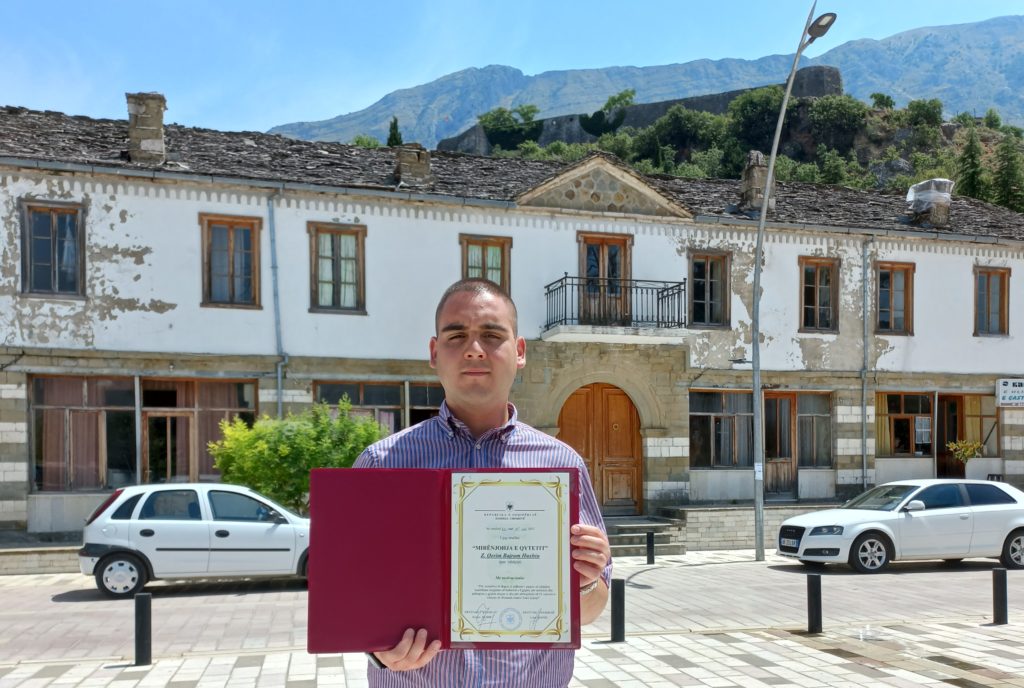
KËSHILLI BASHKIAK LIBOHOVË I JEP TITULLIN “MIRËNJOHJA E QYTETIT” (PAS VDEKJES) ATDHETARIT QERIM BAJRAM HAXHIU

July 1, 2022 by s p

Këshilli i Bashkisë Libohovë në mbledhjen e muajit qershor me Vendim Nr.32,Datë 15.06.2022 i dha atdhetarit të shquar shqiptarë në Koloninë e Shqiptarëve të Egjiptit Z.Qerim Bajram Haxhiu titullin “Mirënjohja e Qytetit” (pas vdekjes) me motivacion:

-“Për kontribut të shquar si atdhetar i paepur në çështjen kombëtare shqiptare në koloninë e Egjiptit,për mësimin dhe përhapjen e gjuhës shqipe si dhe për përkujtimin në 21 vjetorin  e vdekjes së rilindasit Andon Zako Çajupi”.

Çertifikata e titullit “Mirënjohja e Qytetit” Z.Qerim Bajram Haxhiu (pas vdekjes),u tërhoq në datën 29.06.2022 në Bashkinë Libohovë nga Z.Kevin Haxhiu i cili falenderoi Këshillin Bashkiak Libohovë dhe Bashkinë Libohovë për këtë vlerësim të atdhetarit.

Vlerësimi nga Bashkia e Libohovës është një prej vlerësimeve që i janë bërë atdhetarit të shquar Qerim Haxhiu.

-Në vitin e 100 vjetorit të lindjes së atdhetarit (1920-2020),Këshilli Bashkiak Lushnje me Vendimin me Nr.67 Datë 28/07/2020 vendosi të vlerësojë me titullin “QYTETAR NDERI I LUSHNJES” Z.Qerim Haxhiu (pas vdekjes) me motivacionin:-“Bir i një familjeje shumë të njohur lushnjare,zoti QERIM HAXHIU mbetet një atdhetar i madh midis diasporës shqiptare në botë.Në Egjiptin e largët,ku jetoi e punoi ,për gati 60 vite ai krijoi një Lushnje e Shqipëri të vogël,bëri gjithçka për mësimin dhe përhapjen e gjuhës sonë të lashtë dhe lartësoi vlerat e bukura morale e kulturore të vendit tonë”.

-Në muajin shtator 2020 Shoqata Çamëria Kosovë vlerësoi me Çertifikatë “Mirënjohje” me motivacionin: -“Per kontribut atdhetarë” (pas vdekjes ) atdhetarin Qerim Haxhiu në vitin e 100 vjetorit të lindjes së tij (1920-2020).

-Në muajin shtator të vitit 2021 Federata Panshqiptare e Amerikës “VATRA” nderoi me vlerësimin më të lartë “Mirënjohja e Artë” Z.Qerim Haxhiu (pas vdekjes) me motivacionin:-“Për kontribut të jashtëzakonshëm për çështjen kombëtare jashtë atdheut,ruajtjen e identitetit shqiptar,ruajtjen e gjuhës shqipe,mbështetjen e studentëve shqiptarë në Egjipt dhe lidhjet e vazhdueshme me Vatrën dhe Gazetën “Dielli””.

-Në muajin mars 2022 Kryetari i Bashkisë Gjirokastër Z.Flamur Golemi vlerësoi me Certifikatë Mirënjohje atdhetarin Qerim Haxhiu (pas vdekjes) me motivacionin:-“Për veprimtarinë  e spikatur patriotike për mbrojtjen e gjuhës dhe identitetit shqiptar si dhe kontributin e dhënë për çështjen kombëtare jashtë atdheut”.

-ATDHETARI QERIM HAXHIU lindi më 7 shkurt 1920 në Lushnjë,në një familje qytetare,fisnike,patriotike të Lushnjes.Djali i patriotit të shquar shqiptarë Bajram Haxhiu i cili ishte një nga Anëtarët e Komisionit Nismëtar të Thirrjes dhe Organizimit të Kongresit të Lushnjës dhe i vëllai i legjendës së sportit shqiptar Abdurrahman Roza Haxhiu.Në vjeshtën e vitit 1938 Qerimi u nis nga Lushnja me tranzit në Selanik dhe mbërriti në Aleksandri.Kjo rrugë e gjatë për Qerimin ishte e paharruar për faktin se për të ishte rrugë pa kthim mbrapa në atdhe gjerë sa ndërroi jetë por në vitin 1967 arriti të merrte një leje për vizitë në atdhe.Patrioti Qerim Haxhiu fizikisht ishte në Egjipt,por me shpirt e zemër ishte gjithmonë në Shqipërinë Etnike.Ai botonte gjithnjë artikuj për atdheun Shqipërinë dhe çështjen kombëtare në gazeta,revista të diasporës shqiptare të Egjiptit.Qerimi e kishte pasion letërsinë që në rininë e tij të hershme ndaj dhe shfletonte pothuajse të gjitha botimet që dilnin në atë kohë.Ai gjithashtu ka shkruar dhe poezi nga më të ndryshmet.Haxhiu ka qënë nismëtarë i shumë organizimeve si dhe hartues i disa memorandumeve,peticioneve të gjitha këto për çështjen kombëtare Shqiptare.Qerim Haxhiu ishte atdhetar i paepur për çështjen kombëtare shqiptare në Koloninë e Shqiptarëve të Egjiptit dhe gjithë jetën dhe veprimtarinë patriotike ia kushtoi atdheut Shqipërisë,Kosovës,Çamërisë dhe të gjithë trevave shqiptare.Haxhiu ishte antikomunist i flakët,demokratë dhe nacionalist i madh.Qerim Haxhiu kishte njohuri të thella për historin shqiptare dhe gjithnjë fliste për Rilindasit e gazetat që ata botuan,të cilët kontribuan në zgjimin dhe ndërgjegjësimin kombëtarë të shqiptarëve të Egjiptit.Në 21 vjetorin e ndarjes nga jeta të Andon Zako Çajupit (11 korrik 1930-11 korrik 1951),atdhetari Qerim Haxhiu mbajti një fjalim mbi jetën dhe veprën e Çajupit,gjatë homazheve që zhvilluan atdhetarët e kolonisë shqiptare të Egjiptit,në varrin e Andon Zako Çajupit në Egjipt.Nga të gjithë veprimtarët e Kolonisë Shqiptare të Egjiptit Qerim Haxhiu ishte i vetmi që shkruajti një përmbledhje (histori) për diasporën shqiptare të Egjiptit qe i duhej Federatës Pan-Shqiptare “Vatra” në Amerikë.Patrioti Qerim Haxhiu ka mbajtur lidhje të vazhdueshme në të gjallë të tij me Federatën Pan-Shqiptare të Amerikës”VATRA” dhe ishte i abonuar në Gazetën “DIELLI”.Gjithashtu Qerimi ka bashkëpunuar me Drejtuesit e Vatrës edhe në një projekt historik të Diasporës Shqiptare në Egjipt,projekt që e ndërmori “Vatra” dhe që u realizua nga Qerim Haxhiu në bashkëpunim me studentët shqiptar në Egjipt.Shtëpia e patriotit Qerim Haxhiu në Kairo ishte një mjedis totalisht shqiptarë në tokë të huaj.Biblioteka e Qerim Haxhiu-t ishte burim dijesh dhe e njohur nga të gjithë ata të cilët (kryesisht studentët shqiptarë me studime në Kairo,me origjinë nga Shqipëria,Kosova,Çamëria dhe nga të gjithë trevat shqiptare) që kishin vizituar patriotin dhe kishin lexuar libra nga biblioteka e tij apo edhe ishin këshilluar me të për çështjet atdhetare.Biblioteka përbëhej nga një literaturë e çdo lloji dhe e zgjedhur në disa gjuhë si:shqip,turqisht,italisht,anglisht,frëngjisht,etj.Qerim Haxhiu ka kontribuar në fillim të viteve ‘90 në përpilimin e librit “Shqiptarët e Egjiptit” me informacionet e tij të shumta për Historinë e Diasporës Shqiptare të Egjiptit.Qerim Haxhiu me pak fjalë ishte erudit por që nuk arriti dot që të jepte kontributin e tij në Shqipëri sepse në atë kohë regjimi diktatorial-komunist personaliteteve intelektuale të arsimuar jashtë si atdhetari Qerim Haxhiu nuk ia hapi “derën” për të kontribuar në atdhe,në Shqipëri.Megjithatë ai e vazhdoi në Egjipt veprimtarinë e tij patriotike me kontributin e madh për çështjen kombëtare shqiptare.Emri Qerim Haxhiu është shënuar me shkronja të arta në historinë e Kolonisë Shqiptare të Egjiptit.Ai ishte Rilindasi i Fundit në Koloninë e Shqiptarëve të Egjiptit.Qerim Haxhiu u nda nga jeta më 1 Janar të vitit 2003.Për Qerim Haxhiu-n janë shkruar disa faqe në librin “Shqiptarët e Egjiptit”-Autor,Emin Azemi,Shkëlzen Halimi-Botuar,Logos-A, 1993 Shkup.Në Gazetën Illyria,1209,21-23 Janar 2003 është botuar një artikull nga Prof.Beqir Ismaili me titull “U largua nga kjo jetë edhe një veprimtar i diasporës shqiptare:Qerim Haxhiu (1920-2003)”.Në Konferencën Shkencore Ndërkombëtare “Roli i Mërgatës në Shtetformim”,Prizren,10-13 qershor 2012 e organizuar nga Ministria e Diasporës Kosovë me rastin e 100-vjetorit të Shtetit Shqiptar,Prof.Dr.Beqir Ismaili në kumtesën që ka mbajtur në këtë konferencë ndër të tjera ka përmendur edhe veprimtarinë e atdhetarit të shquar shqiptarë Qerim Haxhiu.

Filed Under: Mergata Tagged With: Kevin Haxhiu

SAINTS AS PROMOTERS OF GOOD NEIGHBORLINES

June 20, 2022 by s p

Case Study: MOTHER TERESA

Dr. Etleva Lala

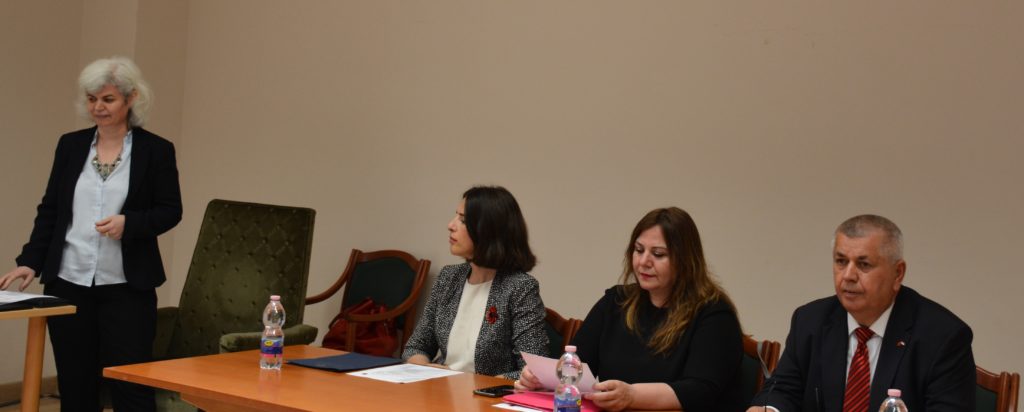
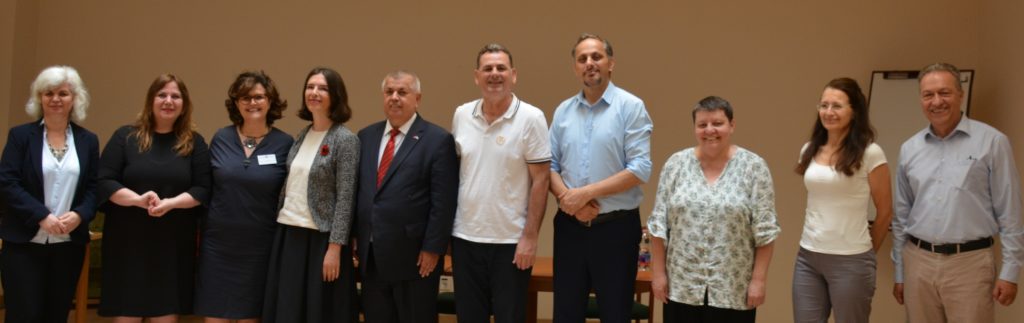
On 9-10 June 2022, the Albanian Studies Program at the Eötvös Loránd University (ELTE BTK), Budapest and the Embassy of the Republic of Albania in Hungary organized the International Conference “Saints as Promoters of Good Neighborliness: Case study: Mother Teresa”, with a keynote lecture by the well-known scholar of Mother Teresa, Prof. Dr. Ines Murzaku, who is Professor of Religion, Chair and Director of Catholic Studies Department and Program at Seton Hall University and International Federation of Catholic Universities and also Head of Catholic Studies International Group. 

Saints are often celebrated beyond their national, territorial, political, and even religious borders, becoming living examples of how to love others and how to promote neighborliness, even and especially when such neighborliness seems to be impossible for human nature. Nevertheless, this is still a field of research, which has not attracted much scholarly attention in the Balkans. Studying Mother Teresa as a case study, who was born and grew up not only in times of turmoil, but also in a region where people who had ethnic, religious, economic, cultural, and educational differences were clashing in the most extreme ways, is an attempt to approach such a topic from the scholarly perspective. The power of a saint is most often shown in these times and places of turmoil, as the saint brings peace. Particularly, devotion to saints who lived in areas of conflict is known to encourage unity and peace. In this conference, we aimed at displaying how Mother Teresa unites the world through her love for humanity. By highlighting as much as possible her uniting and peace-bringing spirit, we explored not only how a person may change the world, but also how people unite and interact around the saints, improving their relations with one another.  

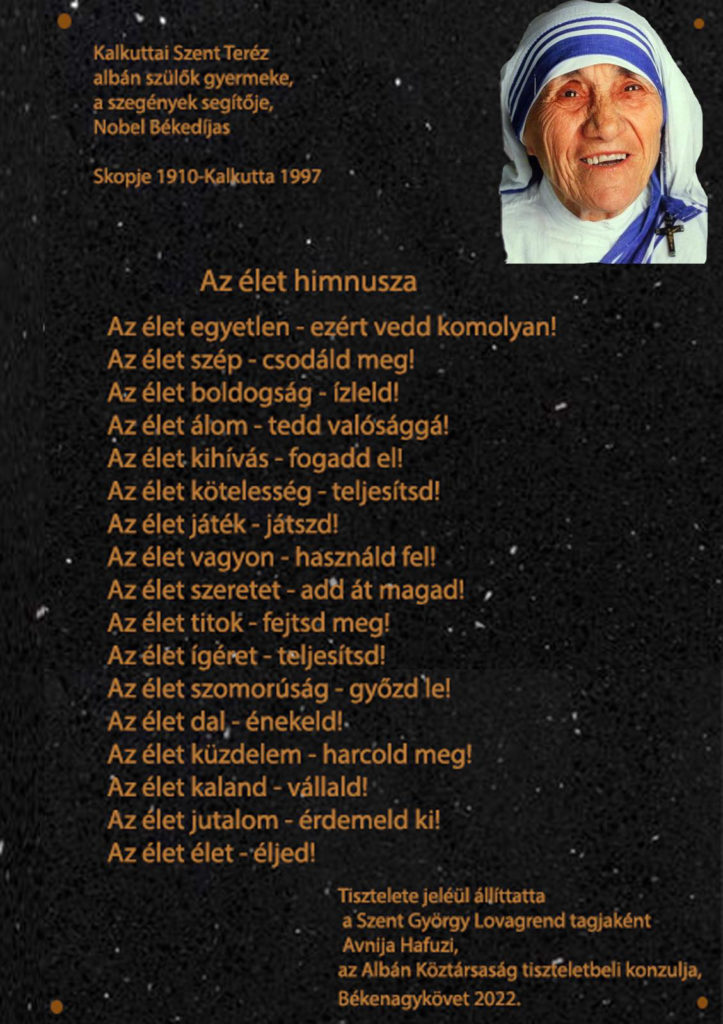
On the first day of the conference, 9 June 2022, at 10:00, the participants of the event were greeted warmly by Ms. Gentiana Mburimi, Charge d’Affaire of the Republic of Albania in Hungary and H.E. Ms. Gjeneza Budima, ambassador of the Republic of Kosovo in Hungary. Mr. Avni Hafuzi, Honorary Consul of the Republic of Albania in Pécs, Hungary, supported the conference with the necessary logistics during the coffee breaks, making it pleasant for the participants to continue their presentations and discussions. Mr. Hafuzi also displayed some of near future plans on this occasion, the most relevant of which is the placement of two commemorative plates with the hymn of Mother Teresa in two Hungarian cities: Pécs and Ajka. 

The plenary speech of Prof. Dr. Ines Murzaku, titled “Balkan Women: Nurturers of Mother Theresa’s Revolution of Tenderness”, offered a deep insight into how Mother Teresa can be approached not only as a saint, but also as a Balkan woman, who was nurtured by the local tradition and turned that tradition into a universal one. She focused especially on the revolution of tenderness, who changed the world not through power and violence, but through little gestures done with great love, like smiling five times a day, not only who are perceived as ‘nice’, but especially to the other ones. This panel lecture of Prof. Dr. Murzaku reflects a lot from her book “Mother Teresa, Saint of the Peripheries”, published by Paulist Press (New York/ Mahwah, NJ) in 2021. 

The Academician Shaban Sinani, from the Academy of Sciences of Albania sent his paper: Some data about the Fatherland of Mother Teresa. In his contribution, acad. Sinani focused on the visits of Mother Teresa in Albania in the late 1980s. Her first visits have been rightly rumored, he states, as if Mother Teresa were not well received, and were not given the reserved honors she deserved. In all these, there are partial truths, according to acad. Sinani. The very fact, however, that Mother Teresa did not interrupt her visits to Albania since 1989, shows that her contacts were stable. When it comes to the sources, they show that the visits of Mother Teresa in Albania and the attitude of state authorities of the time have changed for the better. This is also reflected by the expression of the decision of these authorities to offer the Albanian state passport to Mother Teresa. This was certainly not an easy task in the Communist Albania, although for Mother Teresa it was almost a routine to get passports: in addition to the Italian, Vatican, British and Indian passports, she also had an American passport. Meanwhile, the Albanian state, for almost half a century, had rejected it to her, as well as the entrance to the land where the graves of her parents and family members were to be found. 

In early 1991, the former President Ramiz Alia initiated the first attempt to obtain the necessary information, whether Mother Teresa would accept the granting of an Albanian passport to her. For this mission, the state authorities of the time, sought the help of the Christian community of San Egidio, who had confidential relations with Mother Teresa, in order that in the case Mother Teresa would reject it, that would remain only an orally addressed issue. As expected, Mother Teresa did not object the reception of the Albanian passport, but on the contrary, she immediately confirmed its acceptance. Since the establishment of the Order of Mother Teresa in Albania seemed almost impossible at that time, it was decided to hand the passport over to Italy, counting always on the mediation and support of the San Egidio’s community. 

Since 1991, thus, Mother Teresa had officially an Albanian passport, in addition to the other passports mentioned already, which were not accidental: Vatican and Italian passports were associated with the center of Western Christianity, around which the mission of Mother Teresa’s Order operated. The British passport was bound with her relatively long stay for schooling and training, up to entering the path of the mission of charity and humanism. The passport of India was connected to the capital of her service. American passport was the expression of her global dimension as a personality. The Albanian passport expressed the relationship with the land of her ancestors. 

Accepting a passport, in legal terms, means accepting citizenship of the country that issued it, just as the issuance of a passport is a legal act, which has to do with the recognition of citizenship and the obligation of protection of citizenship. Mother Teresa was given a diplomatic passport by the Albanian authorities, the highest degree of official state identification. All these actions have certainly left their mark on the written practice of the main institution of the Albanian state and its consular services. We do not know, if Mother Teresa had a chance to use the passport of the Albanian state. It is well known the fact that she had no need for that passport at all when she entered Albania. The decision to accept it, however, was a decision to express a specific relationship with Albania. 

In the afternoon session, Arben Arifi, a scholar from Kosovo, who also teaches at the University of Prishtina, spoke about The influence of the Albanian tradition in the formation of Mother Teresa. Born in Skopje, into an Albanian Catholic family, Mother Teresa was faced with extremes of social levels among the rich and the poor since her childhood. The solidarity, humanity and charity, prevailing among the Albanians, was according to Arifi, what paved her journey since childhood. The Albanian tradition from which Mother Teresa came, as her parents were both coming from the territories of present-day Kosovo, shows that she herself is the most modern example of that devotion that came from the Albanian Christian tradition with apostolic roots. 

In the question session, there was a debate about the origin of the parents of Mother Teresa. It is already a well-established fact that the father of Mother Teresa came from Prizren, but whether the mother of Mother Teresa originated from Bishtazhin or Novosello, at the municipality of Gjakovo in Kosovo, that is sometimes questionable.   

Musa Ahmeti, Researcher at the Center for Albanian Studies, Budapest, talked about some letters of Mother Teresa, which shed light on the first visit of Mother Theresa in Albania. The procès-verbal of the first visit of Mother Teresa was extremely interesting, as it documented all that was done in this visit. The letters were given to Dr. Ahmeti by Kolec Çefa, an Albanian scholar, who has a rich archive in Catholic sources during Communism and in the years after the fall of Communism. Most of these sources are now housed at the archive and library of the Franciscan Order in Shkodra. These letters shed light on how Mother Teresa was received by the president Ramiz Alia on her first visit, and how she paved the way for religious tolerance in Albania. It is interesting to see that she Mother Teresa was not only confident in receiving what she was asking for, namely houses for her sisters in Albania, but she was also suggesting a new way of thinking to a society, which considered religion as a sacrilege. 

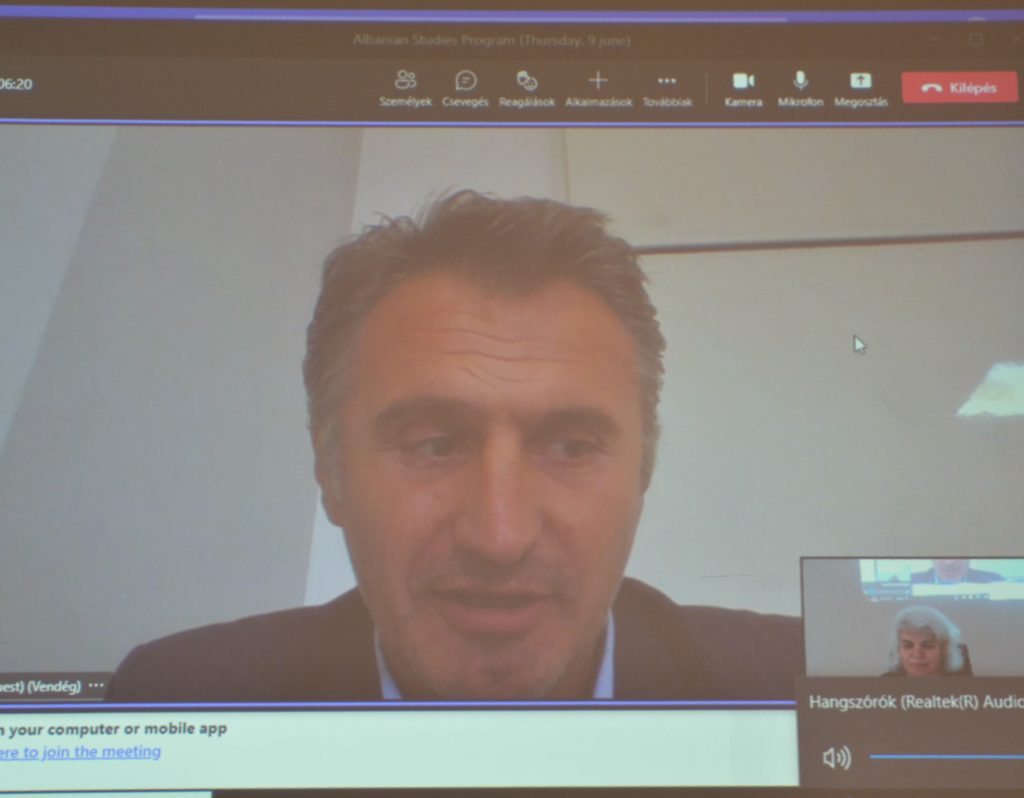
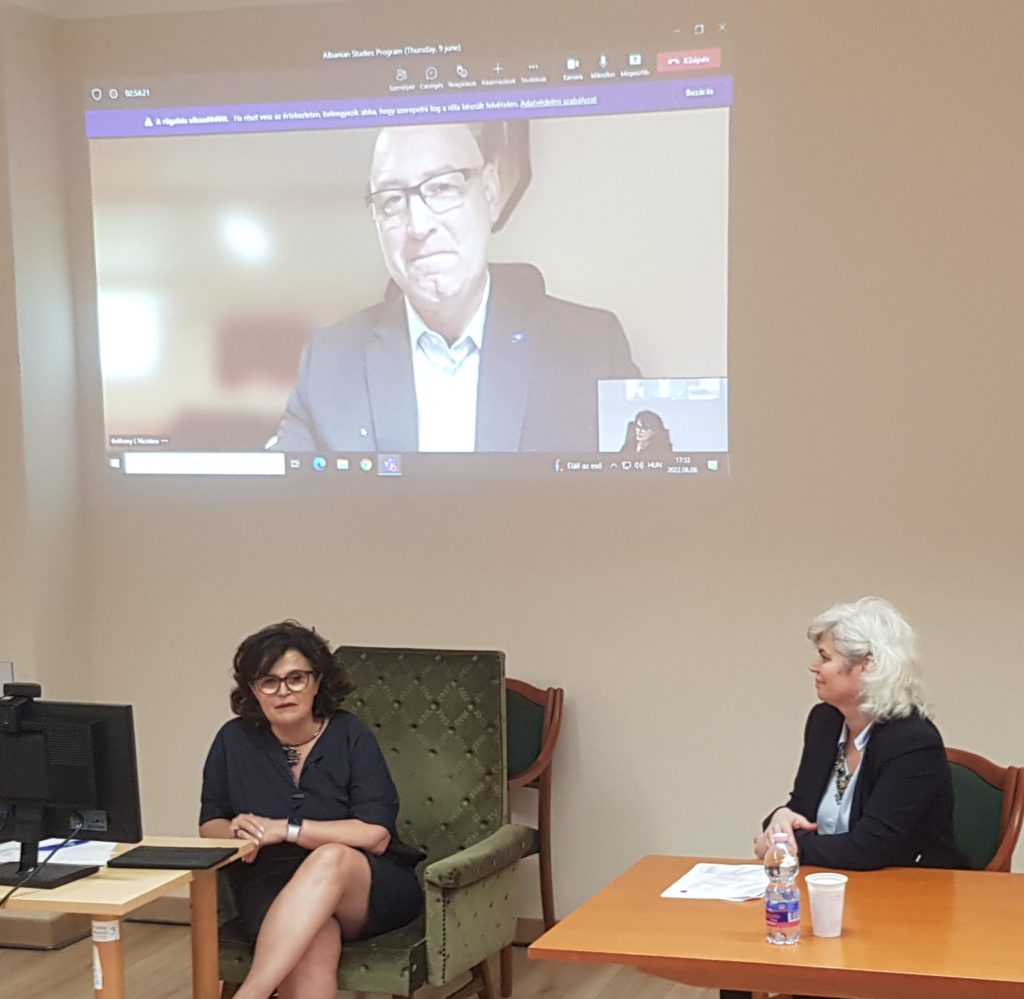
Sokol Paja, Chief Editor of the Oldest Albanian Newspaper in the USA “Dielli/The Sun”, presented (through Paulin Marku) a paper about the visits of Mother Teresa in Albania according to the oldest Albanian Newspaper “Dielli/The Sun”. In this paper, we were not only informed about all the cases, when Dielli reported about Mother Teresa in general, but also offered an analysis on how these reports boosted the identity of the Albanians in the USA, by regularly showing the origin of Mother Teresa and how she related to the Albanians. 

Anthony Nicotera, JD, DSW, LSW, Assistant Professor at Seton Hall University and director of NYU’s PostMaster’s Certificate Program in Spirituality and Social Work, presented paper titled “Where is the Love? Mother Teresa and Seton Hall University’s Catholic Social Thought in Action Academy.” In his contribution he utilized concepts developed by him like ‘the See, Reflect, Act Circle of Insight process’ as a tool for exploring lessons learned about love and good neighborliness from time spent living and working in Calcutta with Saint Mother Teresa and the Missionaries of Charity. His interest about this topic, started during his time in Calcutta, when Mother Teresa asked him “Where is the love?” Inspired by this question, Dr. Nicotera, in collaboration with Drs. Dawn Apgar and Ines Murzaku, cofounded Seton Hall University’s Catholic Social Thought in Action Academy, at the intersection of Catholic Studies and Social Work, which seeks to promote a spirituality of love and service, centering those on the periphery, consistent with Mother Teresa’s insights and sacred, prophetic witness. 

The commitment and vision of the Academy beckons us to see, in the words of Mother Teresa, “if we have no peace, it is because we have forgotten that we belong to each other.” Through service, research, teaching, conversation, workshops and conferences, the Academy challenges students, and its community to embrace the inherent dignity and interconnectedness of all human persons, all life. In the spirit of Mother Teresa, the Academy calls to a pedagogy and practice of holiness, belonging, beloved community, interbeing, revolutionary love, and a spiritually sensitive, socially just, transformative social work practice, which is developed also by scholars like Murzaku (2021; Teresa, 1997, 2007), Dr. King (2000), Thich Nhat Hanh (1993, 2014), and Valerie Kaur (2020), Canda, (2020), Dudley (2016), Nicotera (2019, 2022), Pyles (2018). 

Asked whether he was influenced by Paulo Freire and his Pedagogy of the Oppressed, Dr.Nicotera confirmed that Freire’s work had been a seminal work to his research and work as an educator and activist, but certainly upgraded through the Catholic philosophy of Mother Teresa. 

Etleva Lala, head of the Albanian Studies Program, ELTE University, Budapest, talked about Mother Teresa’s Way of Neighboring vs. Traditional Neighborhood in the Balkans. In the beginning, she talked about her experience with sources of the Holy Penitentiary in the Vatican Secret Archive and how the Holy Penitentiary created a Christian culture in the Catholic West, where public forgiveness and public positive and purposeful forgetfulness are institutionalized in such a way, that the individual cannot use his feelings to act on the common peace and culture of the community. 

The Holy Penitentiary, Sacra Penitentiaria Apostolica (SPA) emerged in the twelfth century and was par excellence the instrument by which the Pope bestowed grace. The task of SPA was to adjudicate petitions of those who had in any way transgressed religious-canonic norms and eventually pardon them. At the beginning, only those wishing to enter or preserve clerical status applied to the SPA, seeking to amend some irregularity (illegitimate birth, physical defects, etc.) or to atone for a crime, or to receive a benefice (alleviation of fasting, permission to change monastic order, etc.). Gradually, however, the competence of the SPA grew so as to deal with all social groups and various kinds of transgressions. The task of the SPA was formulated as “the provision of medicine and remedy for sins,” and since almost any deviation or misconduct in the Middle Ages was perceived as a sin, by the mid-sixteenth century the SPA possessed nearly universal juridical competence.

The reason why the Holy Penitentiary is mentioned in the Balkan context, is that Mother Teresa came from a Catholic Christian tradition and she could compare the impact public forgiveness and forgetfulness had onto the social life of the Western Christianity and especially onto the neighborhood. By taking over the responsibility to handle conflicts and crimes, the Holy Penitentiary offered redemption to the whole society, because after being absolved from the Holy Penitentiary, crimes could be forgiven and forgotten not only in heaven, but most importantly in the neighborhood. Upon receiving absolution from the Holy Penitentiary, nobody was allowed to bring up the forgiven sin/ crime, because that was already dealt with and no person is higher than God, whose representative, in this case, was the Holy Penitentiary. 

In the Eastern Church there was no institution which would replace the Holy Penitentiary, in the sense that it offers absolution for committed sins and crimes and redemption not only to the sinner/criminal, but to the whole society. The Eastern Orthodox Church does not have the institutional power to forgive publically a crime, but only to condemn it and to distance itself from it. The individual who commits a crime is, thus, not only condemned officially by the ruling authorities, and with a bad reputation culturally, but also unofficially, by the victim’s family and network, who take the matter on their hands and seek revenge. The memory of the criminal continued and continues to live not only in the present generation, but is transmitted to the next generations, making it a poisoned tradition of hatred and judgment. These old memories create a neighborhood, which is never as reliable as one would like it to be. 

Not being able to know or to predict the attitude of the neighbors, whose distant past may be unknown, creates a background of distrust in connecting to them, which shows up especially in times of crises and/or wars. Most of the time, it is the neighbor, who is reported to be alienated without a visible or understandable reason and who acts more violently and aggressively than the others, and when asked about this behavior, they report old histories coming from previous or ancient generations. Even if the crime was committed unwillingly and the criminal had repented, there was no way of undoing it and escaping the consequences for the whole family and future generations.  

Besides the Christian (Catholic and Orthodox) communities, Skopje had and continues to have a huge Muslim community. When talking about crime and neighborhood, the Muslim religion has introduced the sacrifice of a lamb and of other material goods, or even a trip to Mecca as a way of redemption from the sins. The bigger the sin, the higher the material sacrifice they have to pay, but to some certain extent that brings redemption to the society also. The memory of the sin, however, remains in the community and is a basis for mistrust. 

If we consider a vertical analysis in the history of the Muslim conversion, at least in the Balkans, another element of distrust may be added to the Muslim communities, seen from the perspective of Christian neighbors. The Ottoman rule did not force a Muslim conversion as it was done in the West through the moto “Cuius regio, eius religio”. In the beginning, the Muslim rule gave freedom to the individual to stay Christian and pay taxes or convert and live tax-free. For that reason, those who converted to Muslim religion fell into two categories from the perspective of the Orthodox Christians: If the individuals had the means to pay the taxes, but still preferred to convert in order to profit more privileges, they fell into that group, which was considered as drifters and opportunists. The other group, which did not have the means and choose to convert, because that was the only way to survive materially, did not enjoy a better reputation either, because poverty was considered a spiritual deficiency, made visible through this state of being. Being poor was not a virtue either, as it was transformed in the West, mainly by Mendicant orders.    

Besides the orthodox Muslims, in Skopje there were also the Bektashis, a Muslim sect, which is not accepted by the Muslim religion. Bektashis introduced a different dimension of religious perception of the individual, namely that: “The good and the bad exist within each of us.” While all the other religions fight the bad in every person and try to make people distant themselves not only from the bad as a concept, but also from the person, who has exhibited a sign of badness in him/herself, the Bektashis’ progressive understanding of the bad and the good as existing in every human being as two inseparable parts of everything that exists, brings to a large extent a relaxation to the tense neighborhood. Everybody is a potential criminal, according to the Bektashis, because the bad exists already in each of us. This new perception offers a great tolerance for the otherness not only within the Bektashi communities, but to the whole Albanian community, as the Bektashis became the leaders of the national movement in Albania, promoting “Albanianism” above any religion. 

Mother Teresa, thus, grown up in such a milieu, as Skopje was a multicultural city, with various ethnic and religious populations, was early introduced to such a neighborhood, poisoned by all the above-mentioned Weltanschaungen. The proud rich Orthodox (remember that they had been paying taxes to the Ottoman rulers in order to survive as Orthodox) looked down to the poor Muslims, who either because of poverty of because of greed, had changed religion and thus represented no good neighbors to the Orthodox Christians. On the other hand, nomen est omen and Orthodox meaning right, represented the drive of the Orthodox religious to be as right as possible in order to feel accepted by God, hence avoiding sinners was a must for them. Catholic, on the other hand, meaning universal, was a drive to reach the world for Christ, and not to avoid it. Hence the Catholics have developed so many social approaches, which in extreme cases went as far as to Holy wars and missionary conquests. 

Mother Tereza was certainly faced very early in her life with all these contradictions within her relatively small city. She was probably not conscious of the roots of these opposing forces, as presented above, but she was definitely aware of their existence as the situation was and is still visible nowadays in Skopje. If in her prayers, she wanted to know her place in this world, following Jesus was obviously the answer of all her prayers, as that would become visible in her actions. Jesus changed the way people related to God and to each-other, creating different values, and so did Mother Teresa. She understood that it is family and neighborhood the starting point of a society and she started implementing her mission there with what she was given.

The new neighborhood Mother Teresa promoted was totally based on the image of Jesus. Jesus washed the feet of the disciples, humbling himself to people, who otherwise considered themselves unimportant and so did Mother Teresa. Mother Teresa humbled herself to unknown and unimportant people, by serving their terrestrial bodies, while touching, serving and treating them. As a provider, Jesus offered food to the hungry (fish, bread, wine), and so did the Mother: she provided food to the hungry. Jesus did not feed only the terrestrial bodies with material food, but also their souls: he gave peace to the frightened in the storm, to the worried about the future, to the greedy, to the sick, to the weak and so did Mother Teresa: besides the material goods, she also had a word of encouragement, which is still valid for each of us today and also for her sisters. What is more important, Mother Teresa used to think out of box, just like Jesus did: Jesus did unorthodox things, which shocked the world around him: not only did he talk to a Samaritan woman, to a prostitute, to a tax-collector and made himself dirty by the woman, who touched him in order to get healing for her issue, but he desacralized the Sabbath by ‘working’ on that day, and put mud or other dirty material onto the blind eyes of poor men. Mother Teresa was also very bold and courageous, by being radical in many ways, not fearing any secular powers, but only God. 

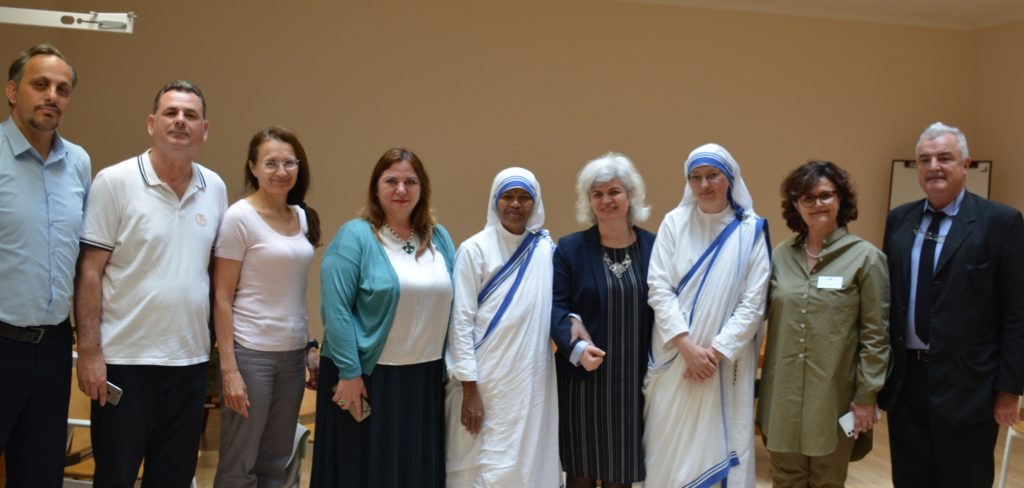
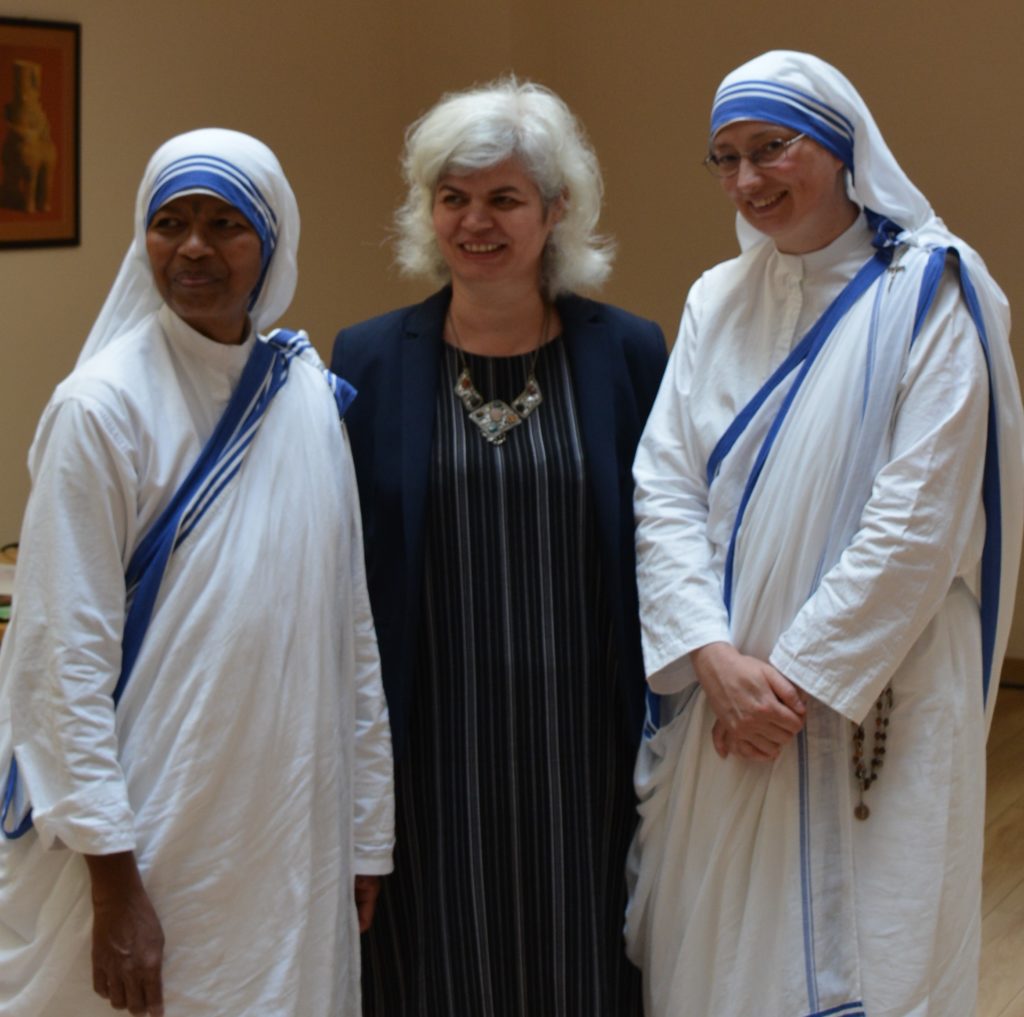
On the morning of Friday, 10 June 2022, the conference started with a round table discussion with Mother Teresa’s Sisters in Budapest, led by Bilung Mary Romana MC Leader sister and moderated by Prof. Dr. Ines Murzaku and Dr. Etleva Lala. It was a unique experience to have such a wise and peace-bringing people at the spot, not only narrating about their life-style and mission as Sisters of Mother Teresa, sharing also personal experiences with Mother Teresa herself, but also displaying a profound wisdom generated by the rule, which goes beyond religious differences and restores the human dignity in a divine way. They showed examples of how they treat people in need without burdening them with religious teachings, restoring them physically and spiritually to the best version of themselves and yet at the same time letting them religiously freedom of choice. The conference participants had the chance to ask questions and even to share personal experiences which related to the social, religious, ethnic, economic or other differences that the Sister of Mother Teresa, just like her, were challenged to face in the daily life. 

Besnik Rraci and Sadik Krasniqi, who work at the State Muzeum of Kosovo, followed up very nicely the contribution of the Sisters in the society. The Contribution of “Mother Teresa” humanitarian association during the years 1990-1999 in Kosovo, displayed the same spirit that the Sisters had reported in the morning. The ‘Mother Teresa’ humanitarian association, which had operated in 1990-1999 in Kosovo and beyond, had become extremely influential and widespread among Albanians in Kosovo and abroad, just because it approached individuals without considering their religious background. Albanians in Kosovo profited greatly from the services offered voluntarily by various professionals inside and outside Kosovo and also from the huge amounts of money collected from Albanians abroad and the system was so well organized and documented that absolutely no abuse was ever recorded or even rumored about this association.  

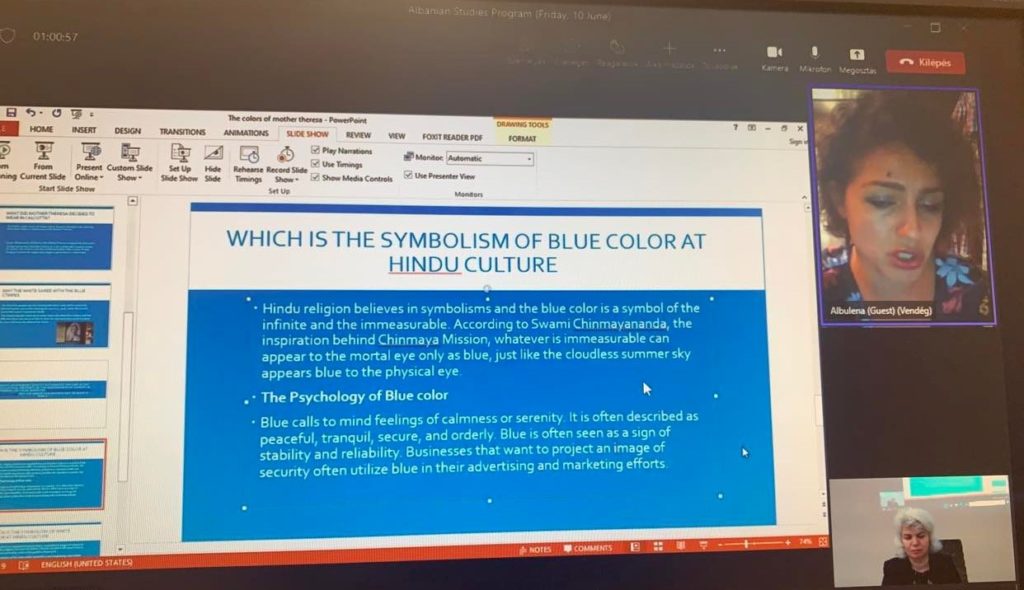
The only Ph.D. candidate we had in this conference, Albulena Bilalli, spoke about The Colors of Mother Teresa, presenting them from a scientific point of view, as she is a scientist of colors and light, working on the effect various colors have on the psychology of the individuals. How the colors of the dress of Mother Teresa were chosen, the effect they have, the tradition they follow and how they got institutionalized as a distinct symbol of a great mission, were only some of the questions she approached in her presentation and we look forward to have her paper in a publishable form, where she will also respond to questions, whether covering the head with a white kerchief is a continuation of the Albanian habit of the old women and men in Mother Teresa’s case.  

In conclusion, we discussed the ways, how religious subjects, like saints, and the relation of the people in the Western Balkans to supernatural can become an object of scholarly debate and be treated in a scholarly way, for the purpose of shedding light into that aspect of the local culture, which was always part of the human being. The rejection of religious subjects is so extreme in the Albanian historiography: even medieval sources are rejected on that basis, as it is often the case with the Statutes of the Cathedral Chapter of Drishti. Opening the scholarly debate where the religious element should be part of the scholarly discourse, is certainly a long way, but since there are so many good examples to follow from the existing scholarship, it is not an impossible mission either.

Filed Under: Mergata Tagged With: Etleva Lala

  • « Previous Page
  • 1
  • …
  • 42
  • 43
  • 44
  • 45
  • 46
  • …
  • 105
  • Next Page »

Artikujt e fundit

  • VATRA URON BESIMTARËT KATOLIKË: GËZUAR DHE PËRSHUMËVJET PASHKËT
  • Ndërroi jetë Agim Bardha, “Vatra” e “Dielli” ngushëllojnë familjen patriotike të Ekrem Bardhës për humbjen e vëllait
  • Dita Ndërkombëtare e Librit për Fëmijë – Magjia e Leximit
  • Shoqëria shqiptare ka nevojë të kujtojë dhe reflektojë…
  • Balshajt dhe Cërnojeviçët në territorin e Zetës së dikurshme…
  • Divorci prindëror dhe funksionimi akademik dhe social në adoleshencën e hershme (moshat 10–15): Një rishikim teorik zhvillimor-ekologjik
  • HOMAZH PËR SHQIPTARËT QË HUMBËN JETËN NË MASAKRAT E TIVARIT DHE DUBROVNIKUT
  • Kush ishin 12 Apostujt?
  • NATO dhe e ardhmja euroatlantike e Kosovës: Garancia e sigurisë dhe perspektiva strategjike
  • Basorelievi i Gjergj Kastrioti Skënderbeu në Castello de Monti, Pulia, një prani që tejkalon gurin dhe kohën
  • Noli në Asamblenë e Lidhjes së Kombeve
  • Një Moment Historik për Komunitetin Shqiptar në Chicago
  • Dom Kelmend Spaqi, in memoriam…
  • “Këngë të përshpirtshme të kolonive shqiptare në Sicili”- Giuseppe Schirò
  • “HEDH NJË KAFKË TE KËMBËT TUAJA”!

Kategoritë

Arkiv

Tags

albano kolonjari alfons Grishaj Anton Cefa arben llalla asllan Bushati Astrit Lulushi Aurenc Bebja Behlul Jashari Beqir Sina dalip greca Elida Buçpapaj Elmi Berisha Enver Bytyci Ermira Babamusta Eugjen Merlika Fahri Xharra Frank shkreli Fritz radovani Gezim Llojdia Ilir Levonja Interviste Keze Kozeta Zylo Kolec Traboini kosova Kosove Marjana Bulku Murat Gecaj nderroi jete ne Kosove Nene Tereza presidenti Nishani Rafaela Prifti Rafael Floqi Raimonda Moisiu Ramiz Lushaj reshat kripa Sadik Elshani SHBA Shefqet Kercelli shqiperia shqiptaret Sokol Paja Thaci Vatra Visar Zhiti

Log in

This website uses cookies to improve your experience. We'll assume you're ok with this, but you can opt-out if you wish. Cookie settingsACCEPT
Privacy & Cookies Policy

Privacy Overview

This website uses cookies to improve your experience while you navigate through the website. Out of these cookies, the cookies that are categorized as necessary are stored on your browser as they are essential for the working of basic functionalities of the website. We also use third-party cookies that help us analyze and understand how you use this website. These cookies will be stored in your browser only with your consent. You also have the option to opt-out of these cookies. But opting out of some of these cookies may have an effect on your browsing experience.
Necessary
Always Enabled
Necessary cookies are absolutely essential for the website to function properly. This category only includes cookies that ensures basic functionalities and security features of the website. These cookies do not store any personal information.
Non-necessary
Any cookies that may not be particularly necessary for the website to function and is used specifically to collect user personal data via analytics, ads, other embedded contents are termed as non-necessary cookies. It is mandatory to procure user consent prior to running these cookies on your website.
SAVE & ACCEPT