• Home
  • Politics
  • Opinion
  • Culture
  • Sports
  • Economy
  • Interview
  • Reporting
  • Community
  • Vatra

Dielli | The Sun

Albanian American Newspaper Devoted to the Intellectual and Cultural Advancement of the Albanians in America | Since 1909

Iran is the Big Winner

November 2, 2017 by dgreca

1 David L. Phillips

By David L. Phillips/

1 Iran

Iraq’s attack on Kirkuk was directed by Iran and coordinated with the Iranian Revolutionary Guard Corps (IRGC). According to Rudaw, a news outlet in Erbil, Iranian media revealed:“Chief of staff for Iran’s Supreme Leader, Mohamadi Gulpaigani, stated that the fall of Kirkuk was based on instructions from Ayatollah Khamenei that were carried out by the commander of the Quds Force in order to spoil an American-Israeli plan to create an independent Kurdistan in Iraq, dubbing it a second Israel in the Middle East.”

Iraq is a weak state that relies on security, diplomatic, and economic assistance from Iran. Premier Heider al-Abadi paid homage to Ayatollah Khamenei in Tehran just a few days after the Kirkuk operation. Khamenei warned of America’s “tricks”, admonishing: “You should never trust them.” Iran views America as the “Great Satan” and wants to limit U.S. influence in the region.

Khamenei disparaged America’s allies in Iraqi Kurdistan. He blasted its independence referendum an act of “sedition.” Iran fears that an independent Iraqi Kurdistan might destabilize Iran. It could inspire twelve million Kurds in Iran to demand greater autonomy.

Preventing Iraqi Kurdistan’s independence also advances Iran’s goal to pressure Israel. Iran has long wanted to establish a corridor of contiguous territory for supplying weapons to Hezbollah in Lebanon. In turn, Hezbollah supplies Hamas, which launches rockets into Israel. The Kirkuk operation advanced the creation of a Shiite crescent, extending from Tehran to Baghdad, to Damascus, and Beirut.

Israel and Iraqi Kurdistan have common ground. For starters, both are surrounded by hostile Arab neighbors bent on their destruction.

In 2014, Prime Minister Benjamin Netanyahu cited “the collapse of Iraq” and endorsed “Kurdish aspirations for independence.” According to Netanyahu, “Kurds are a fighting people that has proved its political commitment, political moderation, and deserves political independence.” The late President Shimon Peres said, “The Kurds have, de facto, created their own state, which is democratic.”

Relations between Israel and Iraqi Kurdistan date back to the 1960s when Israel sought peripheral alliances with non-Arab states and peoples in the region. Israel trained Mustafa Barzani’s peshmerga. It offered the Kurds with technical expertise in water management and dry-land farming. It provided humanitarian assistance after the Gulf War of 1991.

Israel and Kurdistan developed commercial relations. Israel was the first customer of oil exported from Iraqi Kurdistan. At least 4 tankers delivered Kurdish oil from the Turkish port of Ceyhan to the Israeli port of Ashkelon between January and June 2014.

They also established security cooperation. After the Islamic State attacked in 2014, Israel discreetly transferred weapons to Iraqi Kurdistan and provided intelligence. Kurdistan acted as a bulwark against Sunni Islamist extremism and a buffer against Iran’s regional ambitions.

Kurds are an important constituency within Israel. About 200,000 Jews of Kurdish descent live in Israel. Both the Jewish people and Kurds have survived attempts to exterminate them.

Israeli-Kurdistan cooperation was extensive, but it occurred below the radar. A Kurdish official told me that Kurdistan tries to be discreet. “We don’t want to offend anyone.”

The fall of Kirkuk to Iraqi security services and IRGC-backed Shiite militias sent shock waves through the region

Of course, the loss of Kirkuk most directly affects the Kurds. Their dream of independence deferred.

By abandoning the Kurds and turning a blind eye to Iran’s involvement, America’s reputation has been soiled. Washington’s singular focus on defeating ISIS has undermines broader U.S. strategic interests.

Israel loses Iraqi Kurdistan as a potential partner in the Middle East. Israel’s adversaries are emboldened.

Iran and Hezbollah are the big winners. With America’s demise in the region, Iran now has the potential to project its power unchecked in the region.

David L. Phillips is Director of the Program on Peace-building and Rights at Columbia University’s Institute for the Study of Human Rights. He served as a Senior Adviser and Foreign Affairs Expert to the U.S. Department of State under Presidents Clinton, Bush, and Obama.


Filed Under: Analiza Tagged With: David L Phillips, Iran is the Big Winner

Albania: The country searching for hundreds of mass graves

November 2, 2017 by dgreca

By Andrew Hosken & Albana Kasapi/

1 Nikolin Kurti

Photo: Nikolin Kurti at the site of the mass grave he uncovered in 2009/

A generation after the fall of its Communist dictatorship, Albania is starting to uncover evidence of thousands of people executed by the former regime.

More than 30 years after his death, the country is beginning to come to terms with the terrible legacy left by the Communist dictatorship of Enver Hoxha. And it was ordinary people who began the search for the truth about the labour camps, mass graves and secret police which characterised those times.

“Please don’t ask me how difficult this was. I can’t even begin to tell you how difficult it was. We were just digging out bones and skulls, trying to piece things together. It was very grim.”

So says retired chemical engineer Nikolin Kurti, 68, who took us to the outskirts of the Albanian capital, Tirana, and then up Mount Dajti. It was here, now overgrown with bushes and brambles, that he had excavated a mass grave in 2010, uncovering the remains of 14 people.

“It all started when a policeman told me that my uncle was buried here,” he explained. That uncle, a Catholic priest called Father Stephen Kurti, was executed in 1971 after he had been found guilty of secretly baptising a child.

Enver Hoxha had criminalised all forms of religion and Father Kurti paid the ultimate price for disobeying a totalitarian state that has often been compared to today’s North Korea.

Now Albania itself has begun the difficult journey into its own tragic past that may result in the search for possibly hundreds of mass graves.

Presentational grey line

Albania’s troubled past

1939 Italy invades. Albania’s King Zog flees

1944 Following German occupation, Communist Enver Hoxha becomes leader

1946 Non-Communists purged from government positions. Regime will outlaw religion, murder political opponents and run labour camps

1961-78 After breaking with the USSR, Albania allies with China

1985 Hoxha dies, replaced by Ramiz Alia

1989 Communist rule in Eastern Europe collapses. Ramiz Alia signals changes to economic system

1991 First multiparty elections

Presentational grey line

Enver Hoxha’s was one of the most brutal and paranoid of Communist regimes. An estimated 200,000 people passed through the labour camps that were modelled on Stalin’s Gulag. More than 6,000 went missing. Now thousands of their relatives and friends want to know what happened to them.

Nearly all the missing people are believed to have been executed or died of neglect or torture in the camps. Many were political prisoners, suspected of opposition to the regime.

Recently, Albania’s socialist government has entered negotiations about the possibility of locating and possibly opening mass graves.

Some mass graves are likely to be located near the work camps, including the particularly notorious Spac prison in northern Albania.

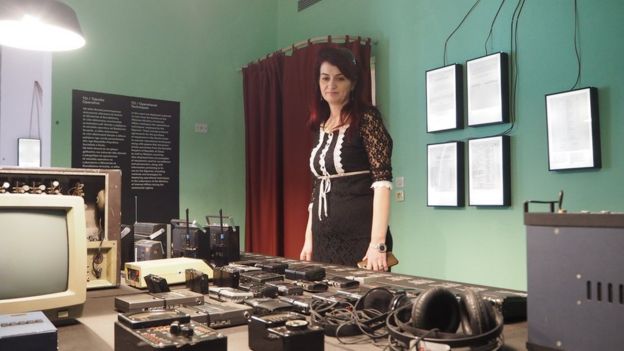
Etleva Demollari, director of the House of Leaves, with Sigurimi gadgets
Image captionEtleva Demollari, director of the House of Leaves, with Sigurimi gadgets

In September, Albania’s Prime Minister Edi Rama met Kathryne Bomberger, director general of the International Commission for Missing Persons. The ICMP is an intergovernmental body that works with governments on the issue of missing persons.

It has helped to discover mass graves elsewhere in the Balkans, resulting mainly from the wars in the former Yugoslavia in the 1990s. The organisation also provides the DNA testing needed to identify remains.

The government and the ICMP have discussed the next steps in establishing a programme to help locate missing people. The initial phase will concentrate on the remains discovered by Nikolin Kurti on Mount Dajti and at another site in Ballsh in southern Albania.

Matthew Holliday, head of the ICMP for the Western Balkans programme, said it was important for relatives to establish both the fate and the location of missing persons.

He said: “The issue of the missing is not about the dead; it is about the living. These are families that have a right to know. They need to know the fate of their missing relatives, and to have received the remains, to have them identified and to give them a dignified burial.”

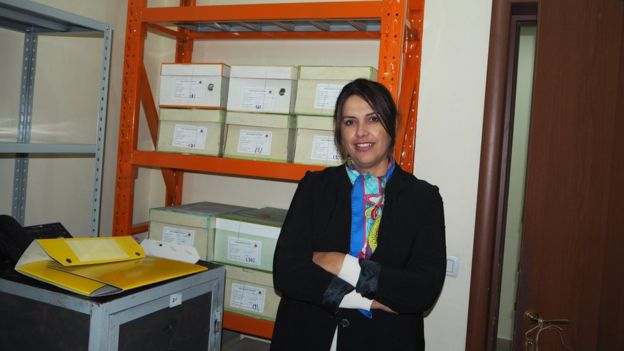
Gentjana Sula with some of the Sigurimi files
Image captionGentjana Sula with some of the Sigurimi files

And the country’s quest to come to terms with its past has manifested itself in other ways, too.

In recent months, Albania has opened as a museum the so-called House of Leaves, in the old headquarters of Hoxha’s much feared secret police, the Sigurimi. It has also opened up the Sigurimi’s files.

Gentjana Sula, the head of the newly created Authority on Access to Information on Sigurimi files, said: “I think the interest is high and, according to our research, about 70% of people want to know and see a benefit of knowing more of the files. The right to truth has been denied for all these years.”

Ambassador Bernd Borchardt, head of presence in Albania for the Organisation for Security and Co-operation in Europe, welcomed the opening of the files, adding: “Knowledge is the basis for liberalising narrative, for the reconstitution of a nation’s memory.

“It played an important role in Germany where fortunately the files were captured by civil society at an early stage. Here it took much longer, but now the government and the parliament have decided to open these files.”

Nikolin Kurti asked for DNA tests to be carried out on remains he was convinced belonged to his uncle. Sadly the tests proved negative. His search for the final resting place of Father Kurti goes on.(BBC)

Filed Under: Politike Tagged With: Albania: The country searching for hundreds, By Andrew Hosken & Albana Kasapi, of mass graves

CIA publikon 470,000 dosje nga bastisja e Bin Ladenit

November 2, 2017 by dgreca

CIA ka publikuar afro 470,000 dosje të sekustruara gjatë vrasjes së ish-udhëheqësit të Al Kaidës, Osama Bin Laden, në vitin 2011.

FILE - In this 1998 file photo made available on March 19, 2004, Osama bin Laden is seen at a news conference in Khost, Afghanistan. Bin Laden, was on the FBI's Ten Most Wanted Fugitives list before the terrorist attacks of 9/11, put there for his role in the 1998 deadly bombings of U.S. Embassies in Tanzania and Kenya, appearing as Usama bin Laden. When he was killed in 2011, the FBI updated the list to include a large red-and-white "deceased" label atop his photograph. (AP Photo/Mazhar Ali Khan, File)
FILE – In this 1998 file photo made available on March 19, 2004, Osama bin Laden is seen at a news conference in Khost, Afghanistan. Bin Laden, was on the FBI’s Ten Most Wanted Fugitives list before the terrorist attacks of 9/11, put there for his role in the 1998 deadly bombings of U.S. Embassies in Tanzania and Kenya, appearing as Usama bin Laden. When he was killed in 2011, the FBI updated the list to include a large red-and-white “deceased” label atop his photograph. (AP Photo/Mazhar Ali Khan, File)

Materiali i ri përfshin ditarin e tij personal, dokumente dhe video.Ky është publikimi i katërt nga CIA i materialeve të gjetura gjatë bastisjes së strehës së Bin Ladenit në Abotabad të Pakistanit.

Megjithatë, disa materiale nuk janë publikuar sepse mund të dëmtojnë sigurinë kombëtare, tha agjencia amerikane e inteligjencës.

Sipas deklaratës së CIA-s, dokumentet e publikuara “ofrojnë njohuri për origjinën e ndarjeve që ekzistojnë sot midis Al Kadiës dhe Shtetit Islamik (v.j. grup militant), si dhe “mosmarrëveshjet strategjike, doktrinare dhe fetare brenda Al Kaidës dhe aleatëve të saj”.

Filed Under: Kronike Tagged With: 000 dosje, 470, Bin Laden, CIA

Saipov e planifikonte sulmin në Nju Jork që një vit

November 2, 2017 by dgreca

Presidenti amerikan, Donald Trump, shkroi në Twitter se ai duhet të dënohet me vdekje/1 SaipovI dyshuari kryesor për sulmin me kamion në Nju Jork, ku nga goditja kanë mbetur të vrarë tetë veta, u tha hetuesve se ai e ka planifikaur atë që një vit.

Sayfullo Saipov, 29 vjeç, tha se ka pasur qëllim të vrasë sa më shumë njerëz dhe se “ndjehet mirë” për sulmin e së martës, në Natën e Shtrigave.

Imigranti uzbek, i cili përballet me akuzat për terrorizëm, tha se është frymëzuar nga grupi militant Shteti Islamik.

Ai është qëlluar dhe plagosur nga policia në vendin e ngjarjes.

Presidenti amerikan, Donald Trump, shkroi në Twitter se ai duhet të dënohet me vdekje.

Filed Under: Komente Tagged With: akti terrorist, i vit i planifikuar, Sayfullo Saipov

Ellis: Njohja e Kosovës nuk është e pakthyeshme

November 2, 2017 by dgreca

Pranimi i shteteve sipas të Drejtës Ndërkombëtare paraqet një akt politik dhe si i tillë nuk ka edhe ndonjë ndalesë për tërheqjen e njohjes, thotë Mark Ellis, drejtor ekzekutiv i Shoqatës Ndërkombëtare të Avokatëve me seli në Londër.1Mark Ellis

Komentet e tij, pasojnë deklaratat e shefit të diplomacisë së Serbisë, Ivica Daçiq, sipas të cilit, Republika e Surinamit ka tërhequr vendimin për njohjen e shtetit të Kosovës.

Institucionet e Kosovës, thonë se nuk kanë marrë asnjë informatë zyrtare nga Surinami, dhe potencojnë se në të Drejtën Ndërkombëtare nuk njihet praktika e tërheqjes së njohjes, por sipas Qeverisë së Kosovës, mund të ekzistojë vetëm ngrirje e raporteve mes shteteve.Në lidhje me këtë, Mark Ellis ka thënë për Radion Evropa e Lirë se në të Drejtën Ndërkombëtare ekzistojnë dy teori kryesore rreth njohjes së shteteve – ajo konstituive dhe teoria deklarative.Sipas teorisë konstituive, sqaron Ellis, njohja nga shtetet e tjera është kriter për vetë shtetësinë.“Një shtet konsiderohet shtet vetëm kur njihet si i tillë nga një numër i konsiderueshëm i shteteve të tjera. Shtetet kanë diskrecion nëse do të njohin apo jo një shtet të ri. Për më tepër, vetëm me njohjen nga shtetet e tjera bën që shteti i ri të ekzistojë, të paktën në kuptimin juridik”, ka thënë ai.

Kurse përmes teorisë deklarative, nënvizon ai, thjesht vlerësohet nëse shteti përmbush kriteret objektive për shtetësi. Sipas kësaj teorie, njohja nga shtetet e tjera (siç është edhe tek teoria konstituive) është e parëndësishme për statusin e shtetësisë.Ai rikujton Neni numër një të Konventës së Montevideos, ku përcaktohen katër kritere për shtetësinë, të cilat janë të pranuara nga organizatat ndërkombëtare si deklaratë e saktë e të drejtës zakonore ndërkombëtare.

Shteti si pjesë e të Drejtës Ndërkombëtare duhet të posedojë këto kualifikime: popullsi të përhershme, një territor të përcaktuar Qeveri dhe kapacitetin për të hyrë në marrëdhënie me shtetet tjera.

“Në përgjithësi, në bazë të teorisë deklarative, njohja e një shteti, sipas të Drejtës Ndërkombëtare paraqet një akt politik, ndryshe nga ai ligjor. Prandaj, nuk ka asnjë detyrim në të Drejtën Ndërkombëtare për të njohur shtetin ose të drejtën e shtetit për t’u njohur”, thekson Ellsi.

Ngjashëm, thotë ai, edhe tërheqja e njohjes është një akt politik, dhe si i tillë, nuk ka ndalim të përgjithshëm ose detyrim rreth tërheqjes së njohjes së ndonjë shteti të pranuar paraprakisht, siç është rasti me Republikën e Surinamit.

“Prandaj, mendoj se është e vështirë që Kosova ta vërtetojë apo dëshmojë se njohja e shtetit është përgjithmonë e parevokueshme“, thotë Ellis.

Ekziston edhe një argument tjetër te çështja e njohjeve, thotë Ellis, e që lidhet me traktatin e Vjenës.

“Në këtë skenar thuhet se veprimet e njëanshme, siç është njohja e shtetësisë, nuk janë të modifikuara, përveç nëse ka një ndryshim të rëndësishëm në rrethanat, siç është zhbërja e një shteti, siç ishte rasti meJugosllavinë. Sidoqoftë, unë nuk jam mbështetës i këtij argumenti”, thotë Ellis.

Ministria e Punëve të Jashtme e Qeverisë së Kosovës ende nuk ka marrë ndonjë dokument zyrtar nga Republika e Surinamit, nëse ky vend e ka tërhequr njohjen e Republikës së Kosovës. Një vendim i tillë eventual nuk është konfirmuar deri më tash as nga Qeveria e Surinamit, përderisa i vetmi që ka deklaruar këtë “tërheqje të njohjes”, është shefi i diplomacisë serbe, Ivica Daçiq.

Duke mos u ndërlidhur vetëm me rastin e Surinamit, ambasadori i Shteteve të Bashkuara të Amerikës në Prishtinë, Greg Delawie u ka bërë thirrje shteteve që ta njohin Kosovën.

“Mbështetja e Shteteve të Bashkuara për Kosovën është e palëkundur dhe e pandryshueshme. Fakti i pavarësisë së Kosovës është i pakthyeshëm”, ka deklaruar Delawie, për Radion Evropa e Lirë.

Surinami e ka njohur pavarësinë e Kosovës më 8 qershor, 2016. Ky vend ndodhet në Amerikën Jugore, me sipërfaqe prej 163.820 kilometrash katrorë dhe ka mbi 550 mijë banorë.

Që nga shpallja e pavarësisë më 17 shkurt të vitit 2008, Kosovën e kanë njohur 114 shtete.

Filed Under: Politike Tagged With: e pakthyeshme, Ellis: Njohja e Kosovës, NUK ESHTE

  • « Previous Page
  • 1
  • …
  • 1702
  • 1703
  • 1704
  • 1705
  • 1706
  • …
  • 5724
  • Next Page »

Artikujt e fundit

  • NDAA i SHBA-së dhe pozicioni i Kosovës në arkitekturën e sigurisë
  • Alis Kallaçi do të çojë zërin dhe dhimbjen e “Nân”-s shqiptare në Eurovision Song
  • Garë për pushtet…
  • Njëqind vjet vetmi!
  • “Shënime për historinë antike të shqiptarëve”*
  • Si funksionon sistemi juridik në Shqipëri dhe pse ai ka nevojë për korrigjim?
  • Emisionet postare festive të fundvitit në Kosovë
  • JAKOBSTADS TIDNING (1939) / MBRETI ZOG, SHUMË BUJAR ME BAKSHISHE. — EMRI I TIJ NUK DO TË HARROHET KAQ SHPEJT NGA PRONARËT DHE PERSONELI I HOTELEVE NË VARSHAVË.
  • HAFIZ SHERIF LANGU, DELEGATI I PAVARËSISË TË CILIT IU MOHUA KONTRIBUTI PËR 50 VJET ME RRADHË, KLERIKU DHE VEPRIMTARI I SHQUAR I ÇËSHTJES KOMBËTARE
  • RIPUSHTIMI I KOSOVËS – KUVENDI I PRIZRENIT 1945
  • Nikola Tesla, gjeniu që u fiksua pas pëllumbave dhe u dashurua me njërin prej tyre
  • Bahamas njeh Kosovën!
  • Legjenda e portës shkodrane, Paulin Ndoja (19 dhjetor 1945 – 16 prill 2025) do të mbushte sot 80 vjeç
  • “Roli dhe kontributi i diplomacisë shqiptare në Maqedoninë e Veriut nga pavarësia deri sot”
  • Marie Shllaku, kur një jetë e re u shndërrua në përjetësi kombëtare

Kategoritë

Arkiv

Tags

albano kolonjari alfons Grishaj Anton Cefa arben llalla asllan Bushati Astrit Lulushi Aurenc Bebja Behlul Jashari Beqir Sina dalip greca Elida Buçpapaj Elmi Berisha Enver Bytyci Ermira Babamusta Eugjen Merlika Fahri Xharra Frank shkreli Fritz radovani Gezim Llojdia Ilir Levonja Interviste Keze Kozeta Zylo Kolec Traboini kosova Kosove Marjana Bulku Murat Gecaj nderroi jete ne Kosove Nene Tereza presidenti Nishani Rafaela Prifti Rafael Floqi Raimonda Moisiu Ramiz Lushaj reshat kripa Sadik Elshani SHBA Shefqet Kercelli shqiperia shqiptaret Sokol Paja Thaci Vatra Visar Zhiti

Log in

This website uses cookies to improve your experience. We'll assume you're ok with this, but you can opt-out if you wish. Cookie settingsACCEPT
Privacy & Cookies Policy

Privacy Overview

This website uses cookies to improve your experience while you navigate through the website. Out of these cookies, the cookies that are categorized as necessary are stored on your browser as they are essential for the working of basic functionalities of the website. We also use third-party cookies that help us analyze and understand how you use this website. These cookies will be stored in your browser only with your consent. You also have the option to opt-out of these cookies. But opting out of some of these cookies may have an effect on your browsing experience.
Necessary
Always Enabled
Necessary cookies are absolutely essential for the website to function properly. This category only includes cookies that ensures basic functionalities and security features of the website. These cookies do not store any personal information.
Non-necessary
Any cookies that may not be particularly necessary for the website to function and is used specifically to collect user personal data via analytics, ads, other embedded contents are termed as non-necessary cookies. It is mandatory to procure user consent prior to running these cookies on your website.
SAVE & ACCEPT