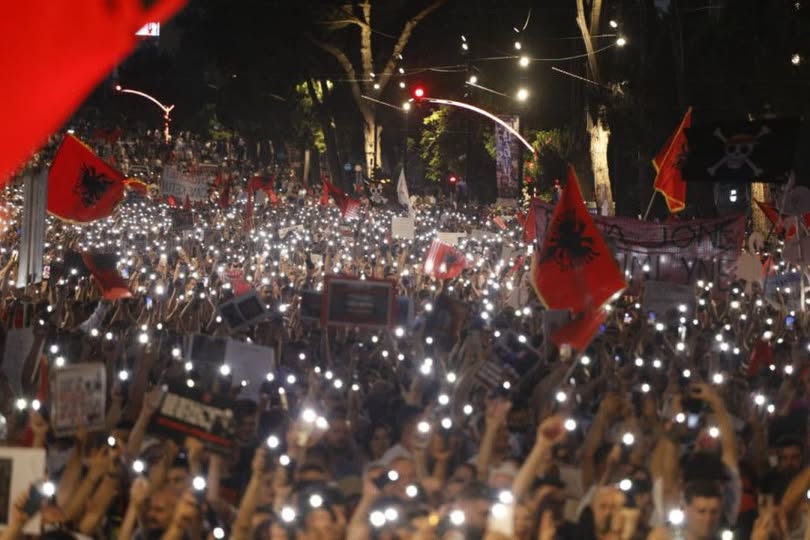
The Flamingo Revolution Must Now Choose Between Organization and Irrelevance
By Cafo Boga, M.S. Diplomacy – September 14, 2026
For more than one hundred days, Albanians have returned to the streets of Tirana with remarkable persistence. What began in Zvërnec as resistance to development in a protected coastal area grew into something far larger: a civic revolt against corruption, political arrogance, concentration of power, environmental destruction, lack of accountability and a political system that many citizens believe no longer represents them.
That achievement should not be minimized.
The Flamingo Revolution broke through fear. It brought citizens—rather than political parties—back into the center of public life. It attracted international and European attention, mobilized the diaspora, and forced questions concerning Zvërnec, protected areas, strategic investors and government transparency onto the national agenda.
But after more than one hundred days, an uncomfortable truth must be confronted:
The movement has not achieved its principal objectives.
The Zvërnec project has not been cancelled. The controversial legal framework governing protected areas and strategic investments remains substantially in place. Prime Minister Edi Rama has not resigned and remains openly defiant. Neither has Sali Berisha, leader of the principal opposition party, whom many protesters hold equally responsible for Albania’s prolonged political dysfunction and stalemate. There has been no caretaker government, no fundamental electoral reform and no systemic change in the exercise of political power. On the contrary, effective political power remains dangerously concentrated in the hands of the Prime Minister and a narrow circle around him.
Independent assessments acknowledge this contradiction. Citizens.al concluded at the 100-day mark that the movement’s principal political demands remained unmet and that there was still no evidence of systemic change in institutional transparency.
BIRN identified an even more fundamental question. Political analysts distinguished between a protest and a movement: a protest reacts to what has happened; a movement must offer a project for what should happen next.
That question can no longer be postponed.
One Hundred Days Is Enough to Know What Is Not Working
I have written repeatedly in support of this movement and its peaceful democratic objectives. But support does not require silence when something is going wrong. Those who genuinely want it to succeed have an obligation to speak plainly.
Marching through the same streets, gathering before the same buildings, repeating the same slogans and demanding the same resignations cannot indefinitely substitute for strategy.
A protest that repeats the same ritual without measurable progress risks becoming a spectacle, where curiosity about what will happen tonight begins to replace commitment to why people entered the streets in the first place.
Governments understand something demonstrators sometimes forget: time can be a political weapon.
A government facing demonstrations does not necessarily need to defeat them. Sometimes it needs only to survive them—and that appears to be precisely the strategy Rama has chosen.
He waits.
Crowds become smaller. Citizens become tired. Media attention moves elsewhere. Disagreements emerge. Provocations occur. Frustration replaces enthusiasm.
Eventually, a movement that once frightened those in power risks becoming part of the daily scenery.
More than one hundred consecutive days of protest is remarkable. But the number of days cannot itself become the achievement.
History does not award political victories for attendance.
Where Is the Leadership?
Another question can no longer be avoided:
Who has the legitimate authority to speak for this movement?
At the 100-day point, Citizens.al described the Flamingo Revolution as operating without a single leadership structure and bringing together people with many different grievances and objectives.
That diversity was initially a strength. It protected the movement from domination by Albania’s traditional political parties. But what is an advantage during the birth of a protest can become a weakness during its political maturation.
A crowd can protest. A movement must negotiate, formulate policy, communicate with institutions, engage international partners and make decisions.
Those responsibilities cannot be exercised indefinitely through an open microphone.
Albania does not need another self-appointed leader, political messiah or personality cult. But rejecting authoritarian leadership does not mean rejecting leadership altogether.
The movement needs democratically legitimate, accountable and transparent representation.
I proposed this weeks ago. I repeat it today with considerably greater urgency.
Convene a National Civic Convention
Representatives of the movement from throughout Albania should join youth and civil-society organizations, academics, professionals, environmental groups, businesspeople, respected public figures and representatives of the diaspora in a National Civic Convention.
Its purpose should not be to create another political party, but to answer the question that more than 100 days of protest have left unanswered:
Who speaks for the movement?
Through a transparent process, the Convention should select a small Representative Leadership authorized to communicate and negotiate on its behalf.
These individuals should not be chosen because they shout the loudest, attract the most cameras or command the largest social-media following. They should be selected for integrity, competence, judgment and the confidence of those they represent.
A movement opposing concentrated and unaccountable political power must practice internally the democracy it demands nationally.
Create a Citizens’ Council
Alongside this leadership, the movement should establish an independent Citizens’ Council composed of respected constitutional scholars, economists, retired judges, academics, environmental experts, entrepreneurs, former diplomats, civil-society representatives and members of the diaspora.
Its members should not view the protest as a shortcut to political office. Their responsibility should be to provide professional and constitutional guidance, evaluate proposals, guard against reckless decisions and develop credible alternatives.
The movement cannot continue telling Albanians only what it opposes.
It must explain what it proposes.
That is the difference between protest and leadership—and ultimately between civic anger and democratic renewal.
Put a Written Roadmap Before the Country
Within weeks, not months, the movement should publish a concise democratic roadmap stating clearly what it seeks, how those objectives can legally be achieved and what comes next.
It should address a constitutional pathway toward a temporary caretaker or technical government if the necessary political agreement can be reached; genuine electoral reform; implementation of international election recommendations; transparent campaign financing; safeguards against abuse of state resources; judicial independence; parliamentary accountability; transparency surrounding strategic investments and public assets; environmental protection; and safeguards against excessive concentration of political power.
Then formally present that program to Parliament, the Government and Albania’s political forces.
Let everyone answer publicly.
Who accepts dialogue? Who rejects reform? Who supports genuinely competitive elections? Who prefers preservation of the existing system?
Then let the Albanian people judge.
Do Not Give the Government the Gift of Violence
On one matter there must be absolutely no ambiguity.
The confrontation following the 100th day, when protesters clashed with police near Parliament and objects were thrown at officers and vehicles, should be treated as a warning.
Violence would be disastrous.
It would not demonstrate strength. It would surrender the movement’s greatest advantage.
More than three months of peaceful civic resistance have given these demonstrations moral legitimacy. A single image of serious violence can replace one hundred images of peaceful citizens.
Those who want this movement to fail would welcome that transformation.
Do not give it to them.
Every organizer, speaker and participant must understand that discipline is not weakness. Discipline is power.
Civic pressure can intensify. Demonstrations can grow. Peaceful resistance can expand throughout Albania. But the boundary against violence must remain absolute.
Take Albania’s Case to Europe—Professionally
European institutions are paying attention. Albania’s environmental obligations and questions surrounding protected areas have entered the European debate.
But visits by European politicians and sympathetic statements do not constitute an international strategy.
A legitimate movement leadership, supported by a professional Citizens’ Council, should prepare documented submissions to the European Parliament, European Commission, Council of Europe, OSCE and Albania’s other democratic partners.
Not propaganda. Not emotional appeals.
Facts, documents, legal arguments and clearly stated democratic demands.
International institutions cannot and should not choose Albania’s government. Albanians must do that themselves.
But Albania is an EU candidate state whose government has voluntarily accepted democratic, electoral, environmental and rule-of-law obligations. Its European partners have every right to insist that those commitments be honored.
The Movement Must Decide
One hundred days ago, the greatest danger was that Albanians would remain silent.
Today the danger is that an extraordinary civic awakening will exhaust itself because nobody had the courage to transform it into an organized democratic force.
The movement has already proved that it can bring people into the streets.
It has not yet proved that it can lead them somewhere.
I say this precisely because I want these demonstrations to succeed.
Peaceful protest must become organization; organization must produce legitimate leadership; leadership must produce a program; and that program must create a constitutional path toward democratic change.
After more than one hundred days, these are no longer suggestions.
They are necessities.
Convene the Civic Convention. Choose legitimate leadership. Create the Citizens’ Council. Publish the democratic roadmap. Demand formal constitutional dialogue. Mobilize the diaspora and international partners professionally. Remain absolutely peaceful.
And give Albania something more powerful than another protest:
Give it a credible alternative and a path forward.
If the movement continues doing essentially what it has done for the past hundred days while expecting a fundamentally different result, time will cease to be its ally.
It will become the government’s ally.
The Flamingo Revolution has demonstrated courage.
Now it must demonstrate political maturity.
The next hundred days must not look like the first hundred.