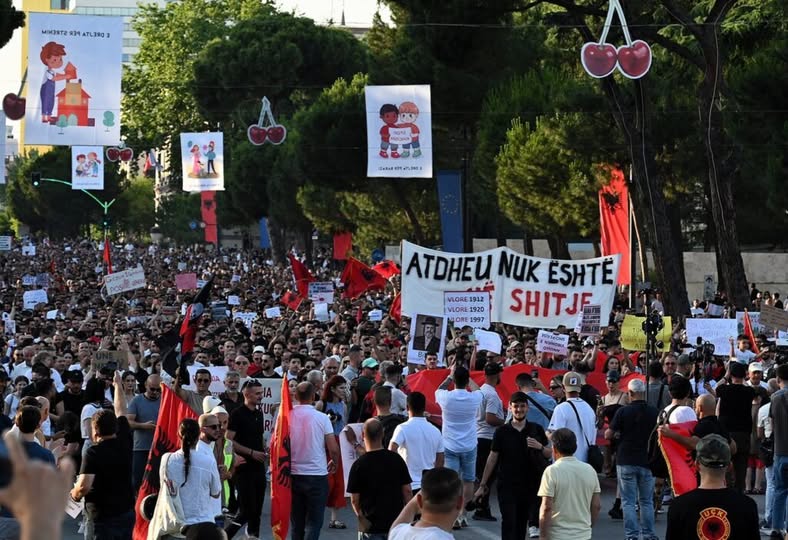
A reflection on the youth-led protests, democratic renewal, and the responsibilities of leaders, police, and citizens alike.
By Cafo Boga, M.S. Diplomacy
Every generation inherits a nation; only a few are given the opportunity to renew it. For more than three decades, Albania’s political life has been shaped largely by the same personalities, the same rivalries, and often the same disappointments. The demonstrations unfolding across Albania and throughout the Albanian diaspora suggest that a growing number of citizens—particularly young people—are asking whether the time has come to turn the page. Their answer appears to be yes.
Seven days ago, when the first protests began in Tirana and other Albanian cities, many questions remained unanswered. Who was organizing them? What were their true objectives? Were they driven by hidden political interests, foreign influences, or something else entirely?
Today, many of those questions have been answered.
What we are witnessing is not simply a reaction to a handful of controversial investment projects, disputed public lands, or concerns about government transparency. Those issues may have ignited the spark, but the fire runs much deeper. These demonstrations have evolved into a broader call for political renewal, democratic reform, and a different vision for Albania’s future.
The Rise of a New Civic Generation
The overwhelming majority of protesters are young Albanians—educated, informed, and determined to shape the future of their country. Their message is clear: Albania deserves better governance, stronger institutions, greater accountability, and a political class that reflects the aspirations of the twenty-first century rather than the divisions and rivalries of the past.
Perhaps the most remarkable aspect of these protests has been their discipline and maturity. The organizers have repeatedly insisted that the demonstrations remain peaceful and independent. They have rejected violence, discouraged political opportunism, and warned against anyone attempting to hijack their movement for personal or partisan gain.
This represents a profound change in Albania’s political culture.
For decades, public demonstrations were often associated with party rivalries, confrontations, and divisions. Today’s movement is different. It is civic rather than partisan, future-oriented rather than ideological, and constructive rather than destructive.
Whether one agrees with every demand being made is ultimately secondary. What matters is that a rising generation of Albanians has decided that it will no longer remain a spectator. It wants to participate, to lead, and to hold those in power accountable.
When young people stop asking for permission and begin accepting responsibility for their country’s future, nations often enter periods of renewal and transformation. That is precisely what appears to be happening today in Albania.
This should not be feared. It should be welcomed.
Every successful democracy periodically renews itself through the energy, ideas, and idealism of its youth. Albania is no exception. The emergence of a politically conscious, peaceful, and engaged civic movement is not a sign of instability—it is a sign of democratic health.
A Message to Albania’s Political Leaders
To Albania’s political leaders—both those in government and those in opposition—the message from the streets should not be viewed as a threat but as a warning and an opportunity.
No generation has a permanent claim on power. The men and women who have dominated Albanian politics since the fall of communism undoubtedly played an important role in the country’s journey. They have experienced successes and failures, victories and defeats. Yet every political era eventually reaches its natural conclusion.
The protesters are not calling for revenge. They are calling for renewal.
Wise leaders recognize when history is turning a page. They do not attempt to stop it by force, nor do they seek to divide citizens against one another. Instead, they facilitate an orderly transition, preserve democratic institutions, and ensure that change occurs through peaceful and constitutional means.
The true strength of a democracy is measured not by the longevity of its leaders but by its ability to renew itself peacefully through democratic processes.
Albania does not need another political confrontation. It does not need violence, instability, or a struggle between competing factions. The nation has paid too high a price throughout its history for division and internal conflict.
Both the government and the opposition should listen carefully to the concerns being expressed by the country’s youth, engage in genuine dialogue, and help create the conditions for new leadership to emerge. Their greatest legacy will not be how long they remained in power, but whether they possessed the wisdom and patriotism to place the interests of Albania above their own political ambitions.
True patriotism is not preserving the past at all costs; it is preparing the nation for the future.
The game of politics is not about individuals; it is about the nation. Individuals come and go, but Albania remains. Those who recognize this truth will leave the political stage with dignity and earn the respect of future generations.
A Message to the Police and the Protesters
At this critical moment, both the police and the protesters carry a special responsibility toward Albania and its future.
To the police, I would say: remember that the young men and women in the streets are not your enemies. They are your fellow citizens, your neighbors, your children, and the future of the nation you have sworn to serve. Your duty is to maintain public order and protect lives and property, not to suppress legitimate democratic expression. Professionalism, restraint, and respect for constitutional rights will do more to preserve peace than force ever can.
To the protesters, I would offer the same advice: respect the police officers who stand before you. Most of them are not policymakers or political leaders. They are public servants performing a difficult duty under challenging circumstances. Do not provoke them, insult them, or treat them as opponents. Your greatest strength lies in your discipline, dignity, and commitment to peaceful democratic action.
The world is watching. Albania has a unique opportunity to demonstrate that meaningful political change can be achieved not through violence, destruction, or hatred, but through civic engagement, mutual respect, and democratic participation.
No Albanian should raise a hand against another Albanian. The future of the country will not be decided by force, but by wisdom, dialogue, and the will of its citizens expressed peacefully and freely.
A Defining Moment for Albania
The future of Albania does not belong to any political party, government, or individual leader. It belongs to its people, and increasingly to the young citizens who are demonstrating that they are ready to assume responsibility for it.
If these protests remain peaceful, independent, and grounded in democratic principles, they may come to represent far more than a disagreement over specific policies or projects. They may mark the moment when a rising generation decided it was time to take ownership of the nation’s future.
History rarely announces the beginning of a new chapter. More often, it reveals itself through the actions of ordinary citizens who refuse to believe that tomorrow must look exactly like yesterday.
Albania now stands at such a moment.
Whether this becomes a story of democratic renewal or another missed opportunity will depend on the wisdom of its leaders, the professionalism of its institutions, and the discipline of its citizens.
History moves forward when wisdom guides those who leave and courage inspires those who arrive.
The young people in the streets have delivered their message. It is now up to the rest of the nation to listen.