A Legacy Preserved: The Initiative to Share and Safeguard an Historic Audio Archive
By: Joanne Prifti-Nicholas
The upcoming distribution marks the first public step toward preserving this legacy for future generations while ensuring proper attribution and historical context.
Early Years and Career at the Voice of America (VOA) 1951-1982
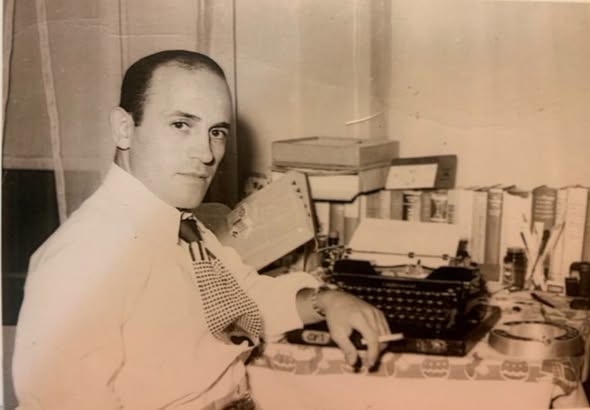
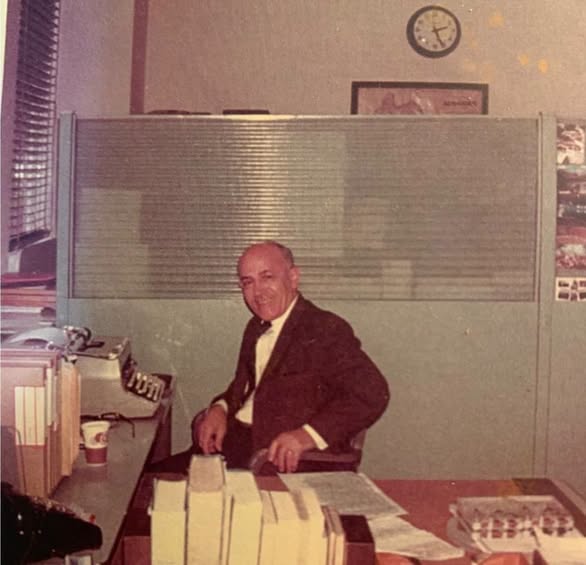
Louis M. Prifti (1914-1984) was born in Borova, Albania. He immigrated to the United States in 1931, settling in Philadelphia where his father worked as a stonemason at the Philadelphia Museum of Art. In 1941, Mr. Prifti enlisted with the Army Air Force, and was awarded the Distinguished Flying Cross, Silver Star, The Presidential Unit Citation, and the Air Medal with five oak leaf clusters for his service as a ball turret gunner on B-17s. On July 6, 1943, he learned that his parents, along with other villagers in Borova, had been massacred by Nazis. Mr. Prifti lived in Philadelphia until 1951 when he moved to Bridgeport, Connecticut, and commuted to the Voice of America office in New York. In 1952 he married, and when the VOA relocated to Washington, D.C. in 1954, he and his family followed. He was a pioneering journalist and central figure in the Albanian Service during the Cold War, serving as the Deputy Chief, a Radio Script writer, Editor, Producer, On-Air Broadcaster, and Special Events Correspondent.
Methods and key historical figure interviews
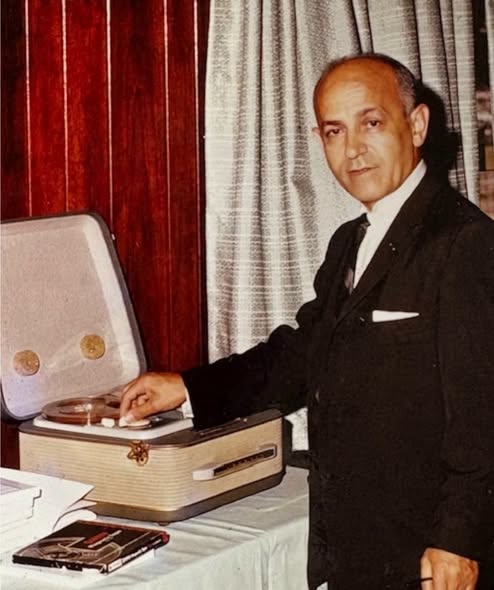
While many staffers were hired strictly as writers or editors, as a producer, he managed the technical delivery, pacing, musical and audio formatting of the twice daily radio programs. As the Special Events Correspondent he was instrumental in recording and preserving many speeches and interviews of the prominent Albanian American Archbishop, Fan S. Noli, including his funeral proceedings, and Harvard Symposium celebrating the centennial of his birth. His recordings also included interviews with influential Albanian American figures including Anthony Athanas, Dr. Andrew D. Elia, Guiseppe Schiro, Bekim Femihu, Dorothy Lambert, Rev. Arthur Liolin, and Elias Mitchell.
Preservation of a historic audio archive and why it remains valuable today
The entirety of this archive was captured and personally archived at a time when the original tapes were often reused or discarded. Most of these recordings have not been heard since they were broadcast from the VOA, and as such, this collection represents a unique and irreplaceable cultural record. Mr. Prifti’s effort as an advocate for preserving Albanian American heritage, not only ensured the safekeeping of the material, but it also honors his legacy as a journalist, highlighting his integrity and cultural insight. This collection provides a rare glimpse into the language, culture, religion, and history of the Albanian diaspora through the eyes of some of its most important cultural figures. It offers a valuable opportunity for intergenerational dialogue, fostering cultural pride and identity within the Albanian community, and a lasting resource for clergy, authors, historians, and scholars.
Collaboration and teamwork at the VOA
As one of the early Albanian American voices during the Cold War, Mr. Prifti worked closely with other distinguished VOA colleagues such as Joseph Paskal (Service Chief), Xhevat Kallajxhi (publisher and journalist), Peter Tyko (Eastern European Specialist, Editor), Kleanth Mima (a long-time contributor to the Albanian service), Talat Karagjozi (broadcaster, producer, editor and later Service Chief), and Frank Shkreli. Mr. Shkreli, who was trained by Mr. Prifti, later went on to work for the Albanian Service for many years as an International Broadcaster, Special Events Reporter, Producer, and Senior Editor before being promoted to Director of the European Division, overseeing all VOA broadcasts to Europe and Eurasia. Together, they broadcast free press and uncensored news into a then-isolated Albania. They formed an intellectual core and formidable team that defined VOA’s Albanian presence for decades, helping to inform the Albanian American public and keep ties with the homeland during a challenging historical period. Working from the VOA headquarters in Washington, D.C., Prifti helped maintain a daily lifeline of accurate and balanced news twice a day to Albania, where the Hoxha regime had banned foreign media. These Albanian American intellectuals and patriots have made a valuable contribution to the mission and efforts known for the national cause, especially in the promotion of democracy through the press and diaspora organizations.
Legacy of the Albanian Service: Mr. Prifti and his colleagues are mentioned by former VOA Albanian Service journalists, such as Frank Shkreli and Elez Biberaj as heroes of the era who defended the truth through free speech when communist regimes in Europe sought to censor outside information.
Community and faith connection: Mr. Prifti’s insight for the importance of social community was also instrumental in his role as a leading founder of the AANO in 1946 – the Albanian American National Organization, a non-religious, non-political federation seeking to preserve Albanian heritage. AANO still unites the diaspora through celebrating youth, networking, cultural initiatives, and an annual national convention. Prifti was the Editor of the organization’s newspaper “Shqiptari.” He saw tight knit Albanian communities fragment after the war when veterans received funds from the GI Bill for college degrees, job training, or home loans. As they moved away from ethnic urban enclaves to the suburbs, the Albanian community began its shift from multi-generational households to modern nuclear families. To keep their heritage alive, families stayed connected through the AANO’s annual events. Mr. Prifti’s daughter met her husband at one of these conventions. Mr. Prifti held deep ties to the Albanian Orthodox community and maintained connections with St. John’s Chrysostom in Philadelphia.
What distinguishes this archive and efforts to digitize the recordings as the next step of stewardship of this archive.
Over the last few years, material related to the Works has been organized in order to maintain provenance and protect historical context. High fidelity, digitized versions of each reel-to-reel recording are now complete. This process reproduces sound with maximum accuracy to the performance created from the original seventeen Noli recordings. This digitized format ensures accessibility and is complete with audio introductions, full citation and attribution information, summaries of each specific recording’s content, the content itself, and closing remarks. Companion documents include a Schedule of Works and an Excel spreadsheet with detailed information about the audio files including Recording Numbers, Speaker(s), Dates, Locations Recorded, Running Time, Collection Information and Summaries. Several raw transcripts have also been drafted. For scholars, the academic citation is a fundamental tool for tracing the lineage of the material. Beyond merely informing the audience, proper citation upholds the highest standards of academic integrity by guaranteeing the appropriate attribution to the original recordist that they deserve. Currently, the Works are being regifted to the Albanian Archdiocese of America in Boston, Noli’s Church, and the original location Mr. Prifti first entrusted the material. The Library of Congress is undergoing their acquisition process and will receive the original reel to reel tapes for provenance. Presently, a distribution list is being developed to offer the Works to archives, libraries, scholars, and diaspora groups within the United States and abroad, so that others may continue to learn about our shared heritage. As Mr. Prifti’s daughter, I have a clear mission and vision to honor my father’s legacy with a shared stewardship approach to distribution and usage. This collection benefits most when it is preserved through cooperation among religious institutions, archives, libraries, scholars, and diaspora organizations, while maintaining proper attribution and historical context. This approach reflects a commitment to collaborative care, preservation, accuracy, relationships, integrity, and respect for the cultural, religious, and historical significance of material. It becomes a “living project.”
Attribution and Recognition:
Mr. Prifti’s life’s work is deserving of respect for provenance and intellectual attribution – by use of the requested citation and attribution whenever the material is used, shared, reproduced, distributed, quoted, excerpted, referenced, published, or used in public display. As a condition of receiving these materials, the Recipient / Institution will be asked to include the following full citation and attribution wherever the Works are used: “Courtesy of the Audio Archive of Louis M. Prifti, Deputy Chief, Radio Script Writer, Editor, Producer, On Air Broadcaster and Special Events Correspondent of the Voice of America, Albanian Service 1951–1982.” Those who find value in or make use of the Works are welcomed to consider a voluntary donation in recognition of preserving this cultural heritage and may be directed to AAOA, The Albanian Archdiocese of America in Boston, Massachusetts. To ensure your donation is directed properly, please include a note designating your gift for the Noli Archives Project. 617-268-1275. https://albanianarchdiocese.org/ .