When Opposition Turns Obstruction into Strategy, Democracy Itself Is at Risk
“Salus populi suprema lex esto.” — Cicero
The welfare of the people shall be the supreme law.
By Cafo Boga – April 28, 2026
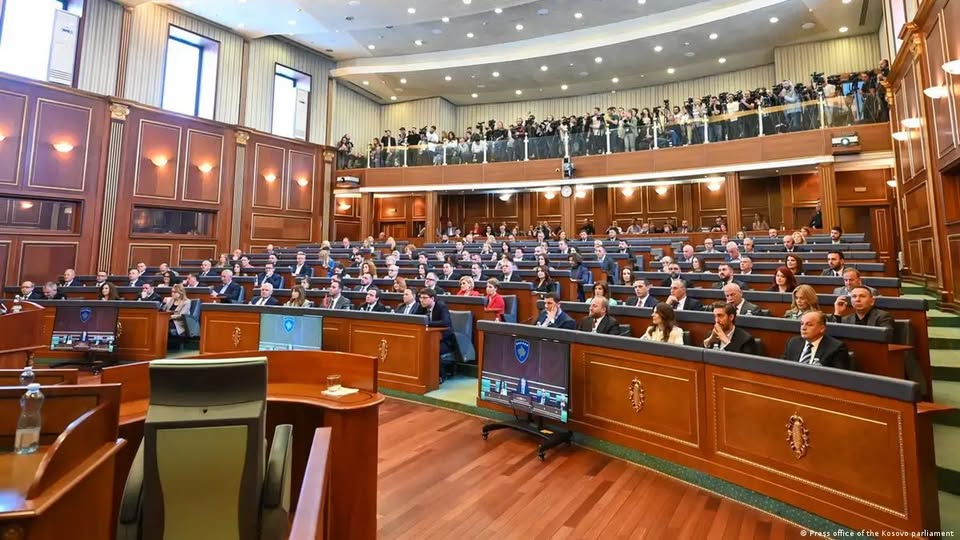
Once again, Kosovo’s Parliament has failed to elect a President—not because a candidate was debated and defeated through democratic vote, but because opposition parties again chose non-participation, depriving the Assembly of quorum and preventing the institution from carrying out one of its most basic constitutional duties. This was not an accident but the culmination of a strategy. Prime Minister Albin Kurti reportedly offered several avenues to break the deadlock—consultations, procedural compromises, and invitations for opposition participation—yet those offers went unanswered. That raises a fundamental question: was the objective ever to resolve disagreement, or has paralysis itself become the political objective?
That question matters because there is a profound difference between opposition and obstruction. One corrects power; the other corrodes institutions. When elected representatives boycott Parliament not as temporary protest but as a method of preventing the state from functioning, they cease merely opposing a government and begin converting institutions into hostages. For a young republic such as Kosovo, that is not ordinary political hardball. It is dangerous.
A Crisis of Politics — And of Constitutional Design
This is not only a political crisis; it is exposing a constitutional vulnerability. Kosovo’s founders imposed a high threshold for electing a President to ensure legitimacy through broad consensus and to prevent domination by a temporary majority. The logic was noble. Yet when consensus rules are weaponized through deliberate absence, a mechanism designed to protect democracy can instead be used to paralyze it. That is the constitutional gap this crisis has laid bare.
No democratic minority should be able to transform nonattendance into a permanent veto.
No republic should permit absence to become stronger than law. Other democracies have learned this lesson through painful experience. Turkey’s deadlock in 2007 led to constitutional reform and direct presidential elections. Moldova endured years of paralysis before corrective mechanisms emerged. Lebanon has repeatedly paid a heavy price when quorum became a political weapon. The lesson is universal: systems that require broad consensus must also contain anti-deadlock safeguards. Kosovo now needs such safeguards.
Paths Forward
Several reforms deserve serious consideration. Kosovo could preserve parliamentary election of the President while lowering thresholds after repeated failed rounds, moving from a qualified majority to a simple majority if necessary. It could prevent boycott from becoming veto by ensuring repeated refusal to participate cannot indefinitely block proceedings. It could require attendance while preserving the right to oppose, abstain, or vote against, thus protecting dissent while denying sabotage. Or Kosovo may wish to seriously debate direct popular election of the President, returning the decision—if Parliament repeatedly fails—to the sovereign people themselves.
These are not radical departures. They are democratic safeguards against institutional hostage-taking. Constitutional design must protect not only consensus, but continuity.
The Deeper Problem: Veto Politics
Yet constitutions alone do not explain this crisis. There is a political mentality at work—one that risks institutional breakdown, costly elections, delayed governance, and even potential harm to Kosovo’s European trajectory simply to weaken a political rival. This is the mentality of veto politics: a politics in which defeating an opponent becomes more important than preserving the republic.
In mature democracies, parties compete to govern; in fragile democracies, they too often compete to prevent others from governing. That is not healthy opposition. It is democratic decay. Madison feared faction when it elevates narrow interest above the public good. Cicero warned that when party rises above the commonwealth, the republic begins to erode. The same principle applies here. If resentment toward one leader becomes stronger than responsibility toward the state, opposition ceases to be corrective and becomes corrosive.
No democracy can mature under permanent sabotage.
A Young State Cannot Afford Old Habits
For Kosovo this danger is magnified by geography and history. This is not an old and insulated democracy cushioned by centuries of institutional habit. It is a young state in a difficult strategic neighborhood, with sovereignty hard won, institutions still consolidating, and alliances essential to security. For such states, internal paralysis is never merely domestic dysfunction; it can become geopolitical vulnerability.
Thucydides understood what smaller states ignore at their peril: “The strong do what they can and the weak suffer what they must.” For smaller nations, institutional self-sabotage is not theater. It is risk. And it is precisely because Kosovo remains a fledgling republic that it cannot afford political habits that belong to exhausted party systems rather than mature democratic culture.
The Voters Also Have a Role
Ultimately, constitutions alone cannot rescue a democracy from political irresponsibility. Voters must. The ballot is where democracies discipline destructive behavior. Citizens must ask whether parties are solving crises or manufacturing them; whether they are exercising opposition or normalizing paralysis; whether they seek to govern or merely deny others governance.
Parties that treat boycott as leverage, crisis as opportunity, and paralysis as strategy should face democratic consequences. If obstruction is rewarded, it will continue. If it is sanctioned, politics may renew itself. This does not mean supporting one leader uncritically. It means refusing to legitimize a political culture that weakens the state itself.
Some parties may not merely need electoral defeat; they may need renewal—new leadership, new thinking, perhaps generational replacement. For outdated political habits, if repeatedly rewarded, become permanent political pathology. And republics have fallen from less.
Beyond This Crisis
This moment is more than a parliamentary impasse. It is a test of Kosovo’s democratic maturity. Will institutions remain vulnerable to boycott politics, or will this crisis produce reforms that strengthen the republic? That is now the central question.
Because the principle at stake is simple but profound: a minority must always have the right to oppose; it must never have the power to paralyze. Kosovo deserves an opposition that contests power, not one that disables the republic. It deserves constitutional rules strong enough to ensure no faction can hold democracy hostage again.
Lincoln once warned that “a house divided against itself cannot stand.” For Kosovo, that is not historical rhetoric but a present democratic test. No party is greater than the republic, no grievance greater than the state, and no political resentment worth risking the future of a nation still completing its democratic journey. If Kosovo learns anything from this crisis, it should be this: Opposition may challenge power — but it must never endanger the republic.