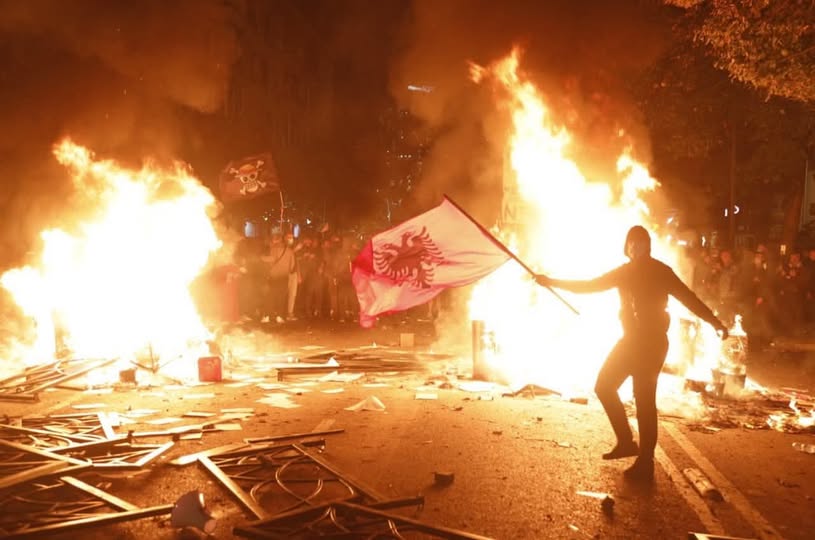
Parliament must act before a political crisis becomes a national tragedy.
By Cafo Boga, M.A. in Diplomacy – October 16, 2026
Albania has reached a dangerous moment.
For months, citizens have demonstrated against the government of Prime Minister Edi Rama. Now students and young people have joined in large numbers, protests have spread, buildings have burned, protesters and police officers have been injured, and Tirana has become a scene of fire, tear gas and confrontation.
Yet Edi Rama remains defiant. He refuses to resign, disparages those opposing him and invokes his electoral mandate as though winning an election gave him ownership of Albania for the duration of his term.
It does not. Albania does not belong to Edi Rama.
WHEN A LEADER BECOMES PART OF THE CRISIS
Rama has governed Albania since 2013—more than thirteen years. His government has faced persistent allegations of corruption, misuse of public resources, concentration of political and economic power, questionable public-private arrangements and an unhealthy relationship between government, business and political influence.
Meanwhile, hundreds of thousands of Albanians have left the country. Today, a deeply frustrated population is telling its government that enough is enough.
Rama’s answer is essentially: I won the election, therefore I stay.
That may be constitutionally defensible. Politically, under present circumstances, it is increasingly irresponsible.
Democratic leaders across Europe have resigned after losing parliamentary confidence, becoming engulfed in controversy or concluding that their continued presence was damaging their countries. Resignation is not necessarily an admission of guilt. Sometimes it is an act of statesmanship—the recognition that the country matters more than the political survival of its leader.
The question is therefore no longer simply whether Rama can remain Prime Minister, but whether Albania can afford the consequences of his determination to remain.
IF RAMA WILL NOT GO, PARLIAMENT MUST ACT
Rama has made clear that he does not intend to resign voluntarily. Responsibility therefore moves to Parliament—and particularly to the Socialist deputies whose votes keep him in power.
They face a simple question:
Are they representatives of the Albanian people or representatives of Edi Rama?
Their oath is not to Rama. Their responsibility is to Albania.
Marjana Koçeku has already demonstrated that a Socialist MP can leave the parliamentary group and become independent. Others can do the same. If Socialist deputies privately believe that the situation has become untenable but continue supporting Rama because of party loyalty, political pressure or concern for their careers, they must accept responsibility for the consequences.
The opposition should therefore move the confrontation from the streets into Parliament and initiate the appropriate procedure to test confidence in the government.
Let every deputy be counted. Let those who still support Rama do so openly, and let those who believe Albania needs another direction have the courage to say so.
THE PRESIDENT CANNOT REMAIN A SPECTATOR
President Bajram Begaj cannot simply dismiss Rama, dissolve Parliament at will or appoint a caretaker government on his own. But neither should the President remain a passive observer.
The Constitution makes him Head of State and representative of the unity of the people. He should use the moral and institutional authority of that office to urge Parliament to resolve this crisis constitutionally before confrontation in the streets produces irreversible consequences.
Albania’s institutions exist precisely for moments like this.
They should be used.
THERE IS A WAY OUT
The solution is neither complicated nor revolutionary.
Rama should resign.
If he refuses, Parliament should determine whether his government still commands the confidence necessary to govern. If that confidence is withdrawn, Albania should move toward a broadly acceptable transitional or technical government with a limited mandate: restore stability, safeguard the institutions, establish credible electoral conditions and prepare early parliamentary elections.
Then let the Albanian people decide.
Such a transition must not simply replace Edi Rama with Sali Berisha. Albania’s present crisis is larger than either man. After 35 years of post-communist politics dominated by many of the same personalities and networks, the country needs political renewal and a new generation of leadership.
The people demonstrating today are not asking merely for another rotation of familiar faces. Many are demanding a different political culture—one in which the state belongs to its citizens rather than to whichever party happens to control it.
VIOLENCE IS NOT THE ANSWER
Those burning buildings, attacking police officers or destroying private property are damaging their own cause. Violence cannot become an acceptable method of changing governments.
But the government cannot use the misconduct of some protesters to delegitimize an entire movement, nor can excessive police force become the answer to political dissent.
Protesters must reject violence. Police must exercise restraint. Political leaders must stop inflaming an already dangerous situation.
The streets can demand change, but constitutional institutions must deliver it.
That is why Parliament must act.
ALBANIA BEFORE PARTY
Edi Rama has made his choice: he intends to stay. Now the Socialist parliamentary majority must make its own.
Its members must decide whether loyalty to one leader is more important than responsibility to the country they were elected to serve.
No office is worth a human life. No political career is worth the stability of a country. And no election gives any leader ownership of the state.
Albania still has a peaceful and constitutional way out: parliamentary action, an orderly transition, a limited technical government and credible early elections.
That is not revolution.
That is democracy.
And it offers Albania something urgently needed—a way out before this crisis becomes irreversible.
The choice should not be between Rama and Berisha, between protesters and police, or between government and chaos.
It should be Albania before party, country before leader.
Mr. Rama, after more than thirteen years in power, the time has come to recognize a fundamental democratic truth:
Albania does not belong to you.
It belongs to the Albanian people.