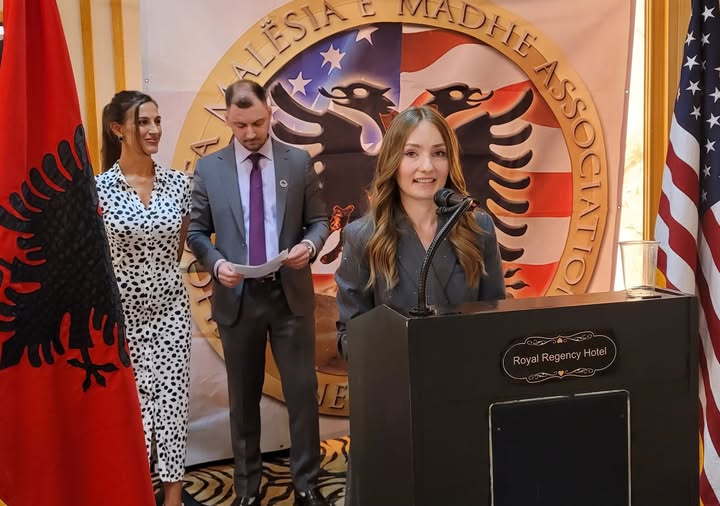
Av. Linda Nikaj/
Festojmë një moment të madh në historinë tonë — Kryengritjen e Malësisë, e udhëhequr nga heroi kombëtar Dedë Gjon Luli. Më 6 prill 1911, e ngritëm flamurin tonë etnik, flamurin tonë i cili simbolizon identitetin tonë, mbijetesën tonë.
Tonight, I stand before you not only as a proud member of this organization, and also the President of the Albanian-American Women’s Bar Organization, but most importantly as a proud malsore.
Being a malsore is not simply a matter of geography — it is a way of life; an identity deeply engrained in my DNA. It is a spirit shaped by our mountains, by resilience, by a history that demands strength, honor, responsibility from every generation.
Edith Durham once wrote: “A woman in the mountains… is in many ways freer… She speaks freely to the men; is often very bright and intelligent and her opinion may be asked and taken.” She saw what we already know: that the women of Malësia not only carry but amplify the brilliance of our culture. They work, endure, advise, protect, and thrive, and when honor is at stake, they stand as fiercely, if not more, as the men. That is our legacy. And that is why tonight’s celebration of the 1911 uprising of Malësia e Madhe holds profound significance for every Albanian.
At the heart of the 1911 uprising stood Dedë Gjon Luli — not a politician, not a man backed by institutions or armies, but a leader shaped by the mountains themselves. His authority came from trust. From tradition. From the contract between a leader and his people — a lived version of the social contract Thomas Hobbes explored in Leviathan.
Dedë Gjon Luli led men who were outnumbered, out-armed, and facing one of the largest empires of the time. Yet he led with clarity, conviction, and an unbreakable belief in who they were: Malësorët.
We honor one of the most defining moments in our ethnic story; a revolt. A revolt fueled by centuries of pressure — disarmament, taxation, forced military service, and efforts to weaken Malësi identity and autonomy.
But in Malësia, that pressure was met with something stronger: a people who refused to surrender their identity. The uprising united entire communities — Hoti, Gruda, Trieshi, Kelmendi, Shkreli, Kastrati — in a powerful moment of collective purpose.
Fighting spread. Villages burned. Families displaced. Yet the resistance did not break. Then… April 6, 1911. In Deçiq, after fierce fighting, the Albanian flag was raised — openly, defiantly, proudly!
That flag raising was a declaration. We are still here. We will not disappear and accept defeat. We will not forget who we are. Its political vision was later expressed in the Greçë Memorandum — demanding recognition of Albanian identity, language, and self-governance. However, Kryengritja e Malësisë is significantly more than just a declaration. It is a symbol — a symbol of dignity, existence, sacrifice, and unwavering, unshakeable identity.
And that brings me to something deeply meaningful. As President of the Albanian-American Women’s Bar, and in partnership with Trojet Tona, I am proud to announce a new initiative in the works and launching in the coming months: a volunteer legal program to support those who wish to legally restore their original Albanian surnames.
As a teen, I casually mentioned to a cousin that her true family name is Hoti. She was shocked. She lived her entire life under a name she never questioned. But the moment she learned the truth — the history — something shifted inside her. It wasn’t just information. It was recognition; pride. She began using Hoti publicly, even though she was only a high school student.
Identity is powerful. It shapes how we walk through the world. It anchors us. It strengthens us. For many Albanians — especially those whose families endured forced assimilation, displacement, or political pressure — restoring a surname is not merely a legal act. It is an act of taking back what history tried to strip away but also an act of honoring those who came before us… because those who fought for us — from Dedë Gjon Luli in Deçiq to those who sacrificed during the war in Kosovë — did not fight so that our identity could fade. They fought so our identity will endure — flourish!
Tonight, as we honor the uprising of 1911, we honor not just endurance, perseverance, but triumph, only achievable at such scales through unity. We honor the moment when a small region stood against a vast empire and declared its existence to the world.
The flag raised on that mountaintop became the spark that led to Albanian independence in 1912. It shaped who we became, who we are, and who we will become.
May each of you achieve greatness as enduring and as powerful as the mountains of Malësia e Madhe.