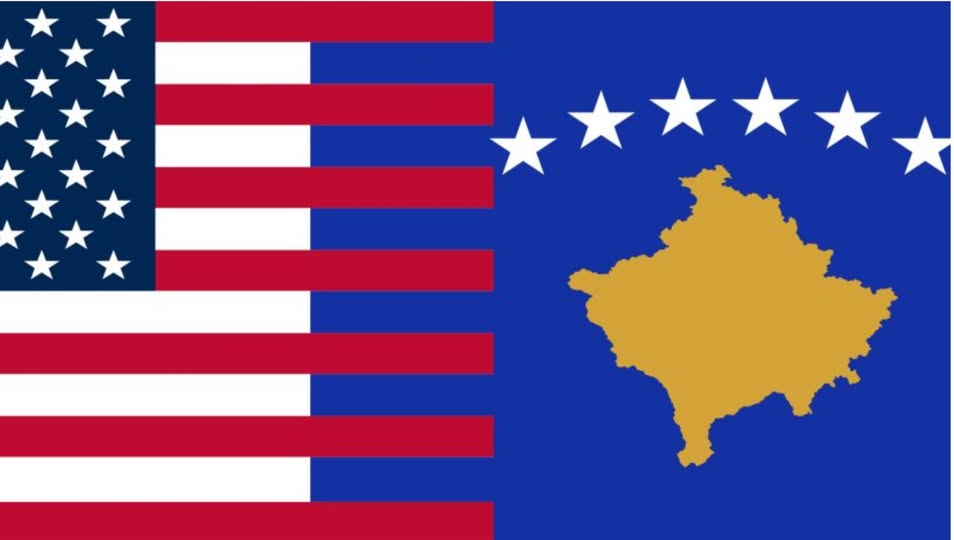
Kosovo’s IRGC designation is not a first step. It is the completion of a framework built early on in alignment with the United States, and sustained across partisan change in both capitals.
by Elmi Berisha | 20 April 2026
The Government of Kosovo approved on Monday a draft decision designating the Islamic Revolutionary Guard Corps as a terrorist organization within the territory of the Republic of Kosovo. Prime Minister Albin Kurti framed the measure as a strengthening of Kosovo’s legal and strategic basis for international security cooperation, and as a clear alignment with strategic allies.
The decision will be reported across regional and international media as a diplomatic gesture, a small state lining up behind the United States, Canada, the European Union, Israel, Saudi Arabia, and Bahrain on an Iran file already settled elsewhere.
That read is not wrong. It is incomplete, and for audiences in Washington it is misleading in a specific way.
Monday’s decision is not Kosovo’s entry into a counter-Iran legal framework. It is the completion of one, and the framework has been transatlantic in its operation from an early stage.
The 2020 precedent, and its provenance
In June 2020, under Prime Minister Avdullah Hoti, the Government of Kosovo and the Assembly adopted a full designation of Hezbollah as a terrorist organization, covering both its military and political wings and explicitly rejecting the bifurcated approach then maintained by the European Union.
The proposal originated from the Ministry of Foreign Affairs. It was announced publicly. It was not, however, undertaken in isolation. The designation was adopted in the course of the U.S.-mediated Kosovo-Serbia normalization track, months before that track produced the September 2020 Washington Agreement signed in the Oval Office and co-signed by Belgrade and Prishtina. The Washington Agreement later incorporated a parallel commitment by both sides to designate Hezbollah in its entirety, recognizing the Kosovar measure already on the books and obligating Belgrade to follow. Kosovo’s commitment to place its diplomatic presence in Jerusalem formed part of the same framework.
This provenance matters. Kosovo’s counter-Iran legal architecture was not a standalone choice made in Prishtina. It was built early on in alignment with the United States, and later consolidated within the U.S.-mediated normalization framework formalized in Washington.
That alignment has now held without reversal under three Kosovar governments: Hoti, Kurti I, and Kurti II. It survived a change of coalition. It survived a change of parliamentary majority. It survived, notably, partisan change in Washington across three administrations. It has been treated, across partisan lines in both capitals, as settled policy.
Monday’s decision does not introduce a counter-Iran posture into Kosovar law. It closes the last remaining gap in a framework that the United States helped design.
Kosovo had designated the most significant external operational arm of the IRGC in 2020. It had not designated the IRGC itself. That asymmetry was legally conspicuous and politically available for future closure. On Monday, it was closed.
The doctrinal convergence
Within that continuity, the language of Kurti’s public justification is worth reading closely.
The IRGC, he said, has been identified as a structure that uses terrorism and organized violence as an instrument of foreign policy, contributing to regional and global destabilization.
This formulation is not generic. It mirrors language that has recently entered European security discourse, particularly in responses to Russian hybrid aggression: the use of organized violence and deniable instruments as tools of state policy. It also mirrors longstanding U.S. counterterrorism doctrine, which has treated the IRGC as precisely such an instrument since the 2019 Foreign Terrorist Organization designation under the first Trump administration.
The convergence is significant. American and European doctrinal frameworks, historically out of step on Iran, have aligned over the past eighteen months. Kosovo has placed itself inside that alignment through a legal instrument already structurally prepared to receive it.
This is why the decision reads as seamless rather than improvised. The infrastructure was in place. The doctrinal language was available on both sides of the Atlantic. What was required was the political moment. It arrived.
The portability problem
Once the category exists inside Kosovar law, it is available for application to any state actor whose conduct meets its criteria. The criteria are behavioral, not geographic.
Regional governments engaged in the targeted use of non-military instruments against Kosovo, including coordinated disinformation operations, proxy political networks, and covert financial facilitation, are now within the formal definitional field of an instrument that did not exist in this form six years ago and did not carry this doctrinal weight before this week.
The drafters of a legal category do not control its subsequent application. The instrument does.
Whether a future Kosovar government chooses to apply the framework to conduct originating closer to home is a political question. Whether it can apply it is no longer open. The instrument now exists, and it is calibrated to conduct, not to flag. Washington, which helped build the framework, should understand what it has underwritten.
The absent evidence
One feature of Monday’s announcement merits separate analytical attention: what it does not contain.
The public justification does not identify specific IRGC activity within Kosovar territory. No incident is named, no operation is described, no prior intelligence finding is cited.
This matters because the standard pattern in comparable designations involves the identification, at least in general terms, of a documented predicate. The February 2026 European Union designation of the IRGC was grounded in reference to the Iranian state’s crackdown on domestic protests and in the accumulated evidence of IRGC-linked operations on European soil. Albania’s 2022 rupture of diplomatic relations with Iran followed a specific cyber operation attributed to Iranian state-linked actors against Albanian government infrastructure.
Kosovo’s decision, by contrast, is not triggered by a public incident. Two readings are possible.
The first is that relevant intelligence exists and has not been disclosed, either because it remains operationally sensitive or because the government has chosen a preemptive rather than reactive posture.
The second is that no specific predicate exists, and the designation is primarily normative, closing the gap left open after 2020 and synchronizing Kosovo with the post-February 2026 European baseline and the longstanding U.S. position.
Of the two readings, the second carries greater explanatory weight. Kosovo has not publicly indicated any IRGC-linked activity within its territory, and the structure of the decision aligns more closely with legal completion than reactive disruption. This suggests that the designation is primarily preemptive: a synchronization with allied frameworks, executed once the political and doctrinal conditions converged.
That does not exclude the existence of undisclosed intelligence. It does, however, indicate that the decision does not depend on it. Kosovo, in other words, did not need to be attacked to stand with its allies. It chose to.
The regional position
Kosovo is not the first government in the Western Balkans to take a public position against the IRGC. On 19 February 2026, the Council of the European Union formally designated the IRGC as a terrorist organization. In the weeks that followed, Albania, Bosnia and Herzegovina, Montenegro, North Macedonia, and Serbia aligned themselves with that decision under the standard mechanism through which non-EU states adopt Common Foreign and Security Policy positions during their accession process. Belgrade’s alignment was confirmed only after the initial list was published in mid-March, and the circumstances of its addition have not been publicly explained.
This context clarifies rather than diminishes the significance of Monday’s decision.
CFSP alignment is a declaratory mechanism. It records a candidate state’s political adherence to an EU position for the purposes of accession progress. It does not, by itself, install the designation into the domestic legal order of the aligning state. In most cases it requires subsequent national legislative or regulatory acts to take operational effect on financial regulators, law enforcement agencies, and prosecutors.
Kosovo does not have access to this mechanism. It is not an EU candidate, and its sovereign standing is contested by five member states. Kosovo cannot align under Chapter 31 of the acquis, because Chapter 31 is not open to it.
What Kosovo did on Monday is therefore categorically different. It is a sovereign national act of designation, installed directly into Kosovar law, with full domestic operational effect. It does not depend on Brussels. It does not depend on accession. It does not depend on a supranational framework to which Kosovo is not a party.
The contrast with Belgrade illustrates the difference on both files. Serbia’s alignment with the EU IRGC designation arrived late, under circumstances that have not been explained, and through a mechanism that produces a declaratory position rather than a legally binding domestic instrument. On the parallel Hezbollah file, Belgrade’s September 2020 commitment, praised at the time by the U.S. Department of State, was never translated into a formal government decision. Subsequent implementation reviews of the Washington Agreement confirmed that Serbia’s national security framework does not categorize Hezbollah as a terrorist organization, and it does not do so to this day.
Kosovo, by contrast, formally designated Hezbollah in June 2020 through a government decision and parliamentary process, maintained that designation across three governments, and has now extended the framework to the parent organization through the same kind of sovereign legal act.
Within the Western Balkans, Kosovo is the only state with a self-standing, domestically legislated counter-Iran architecture covering both the IRGC and Hezbollah. Its neighbors have declarations. Kosovo has law.
The difference is structural, and it is visible in the enforcement capacity that flows from each.
The correct frame
The media framing of Monday’s decision will emphasize alignment and symbolism. Both are present. Neither is the principal dimension.
The decision is the completion of a counter-Iran legal framework that began under Hoti in 2020 and was subsequently embedded within a U.S.-mediated normalization framework, survived three governments in Prishtina and partisan change in Washington, and had one conspicuous remaining gap. That gap closed on Monday.
For Washington, this should be read clearly. Kosovo is one of the few states in Europe that has built its counterterrorism architecture through sovereign domestic legislation in sustained alignment with the United States, rather than through the declaratory channels open to EU candidates. That alignment has not depended on bilateral incidents. It has not depended on incentives. It has held because Prishtina made, and has continued to make, a strategic judgment that its security and the American security posture belong in the same framework.
In a period when transatlantic alignment is under strain elsewhere, that judgment deserves recognition, and reciprocity.
Architecture, once built, outlasts the government that builds it. The 2020 Hezbollah designation has now outlasted three prime ministers and three U.S. administrations. Monday’s IRGC designation will outlast this one.
What remains is not whether the framework will be used again, but where. The category now embedded in Kosovar law is behavioral, not geographic. It does not distinguish between distant adversaries and regional actors. The decision taken on Monday closes one gap. It quietly opens others. It also reaffirms, at a moment when the reaffirmation matters, that Kosovo and the United States still build security architecture together.
Elmi Berisha holds a PhD in National Security Studies. He is a prominent Albanian-American community leader and businessman based in the New York area, and serves as President of the Pan-Albanian Federation of America “Vatra” (Federata Panshqiptare e Amerikës VATRA), the oldest Albanian patriotic organization in the United States, founded in 1912.
ISSN: 3070-2186