• Home
  • Politics
  • Opinion
  • Culture
  • Sports
  • Economy
  • Interview
  • Reporting
  • Community
  • Vatra

Dielli | The Sun

Albanian American Newspaper Devoted to the Intellectual and Cultural Advancement of the Albanians in America | Since 1909

Art Show by Sherry Shqiponja Nebiaj Wondering Mind June 10, 2023

April 25, 2023 by s p

Visitors are invited to the Art Show Wondering Mind by Sherri Shqiponja Nebiaj.

Her art collection, the first of its kind, can be viewed as a map of “her artistic journey” as Nebiaj puts it.

The show runs from 10 to 5 on Saturday, June 10, 2023 at Farmingdale Public Library, New York.

All are welcome!

Filed Under: Kronike Tagged With: Farmingdale Public Library, Rafaela Prifti, Sherri Shqiponja Nebiaj

Premiera e filmit dokumentar Kujtesa e Gurëve për arkitektin shqiptar të shekullit XV Andrea Alesi hap rrugën për njohjen e figurës së tij

April 24, 2023 by s p

Rafaela Prifti/

Premiera e filmit dokumentar shqiptar Kujtesa e Gurëve në sallën e Producers Club në Manhattan, Nju Jork të shtunën ishte prezantim filmik i një figure të Rilindjes evropiane, Andrea Alesi, (c. 1425-1505) me të cilin shqiptarët duhet të krenoheshin nëse do ta kishin njohur. Në gurin e varrit të tij të cilin sipas dëshmive e ka punuar vetë mjeshtri pak vite para vdekjes, Alesi e ka lënë të gdhendur identitetin e tij “epirot nga Durrësi”. Një nga arkitektët më të kërkuar dhe më të suksesshëm përgjatë shekullit XV, veprat dhe punimet e Alesit janë të pranishme në vende të qytetëruara evropiane të shtrira nga Sllovenia në Kroaci deri në Italinë qendrore e jugore. Megjithatë ky personalitet i artit të Rilindjes Veneciane, Italiane e Europiane është pak ose aspak e njohur nga bashkatdhetarët e tij në shekullin 21.

Me këtë shtytje Gëzim Gjyrezi, gazetar veteran i Televizionit shqiptar, u bë nismëtari i idesë si edhe skenarist i dokumentarit Kujtesa e Gurëve. Në paraqitjen përpara premierës, Gjyrezi tha se nxitjen e parë e mori nga studimet e Profesor Ramadan Sokolit dhe Profesor Shyqyri Nimanit. Intervistat me personalitete kroate si arkitekti i mirënjohur kroat Andrea Mutnjakoviç, mjeshtri fotograf Luka Mjeda dhe Meri Kunçiç sjellin të dhëna me shumë interes për Andrea Alesin si një emër i cili është “në radhën e parë të artistëve dalmatinë.” Megjithatë ato përfaqësojnë vetëm një pjesë të literaturës akademike kroate kushtuar atij i cili ka realizuar “monumente që ruhen edhe sot, ose të mbrojtura nga shteti ose nga UNESCO,” vërejti Gezim Gjyrezi në hapjen e premierës.

Xhirimet dhe pamjet e dokumentarit paraqesin disa nga punimet e mrekullueshme në mermer dhe gur të Andrea Alesit, si edhe portrete në katedralen e Shibenikut, pageimoria e Katedrales së Trogirit, relievi i pagëzimit të Krishtit në krahët e Shën Marisë si dhe Shën Jeronimi. Sipas dëshmive historike, Andrea Alesi e ka punuar të paktën tetë herë portretin e Shën Jeronimit, dijetarit për të cilin Profesor Ramadan Sokoli teorizon se është me origjinë ilire dhe të cilin mendohet se Alesi e ka krijuar si autoportret. Nëpërmjet hulumtimeve dhe dëshmive, dokumentari jep imazhe filmike të artit të krijuar nga Alesi të cilat vizitori mund t’i shoh në Evropë tek ndërtimi i Kapelës së Kishës së Shën Ungjillorit, sarkofagu i Orsinit te Bekuar, Peshkopi i parë i Trogirit në Kroaci deri te zbukurimi i hyrjes së pallatit Nimira dhe komplekseve të tjera urbane. Ndonëse jeta e tij filloi në varfëri të plotë, talenti si gurëgdhendës e ngriti në sferat më të larta të shoqërisë dalmate të kohës në Mesjetë.

Skenaristi Gëzim Gjyrezi tha se regjisori i mirënjohur Ylli Pepo, i cili nuk mund të udhëtonte nga Tirana për premierën, në bashkëpunim me ekipin e tyre, të përbërë nga profesionistë të dokumentarit si Xhemal Reçi, Lorina Pepo, Gjergji Pano, kanë punuar me përkushtim ndonëse me mbështetje të kufizuar financiare nga Ministria e Kulturës dhe Arsimit në Shqipëri. Ndërsa ekziston një shumësi me studime kroate për skulptorin shqiptar Andrea Alesi, për të gjenden vetëm pak faqe në shqip.

Krijuesit e dokumentarit Kujtesa e Gurëve vënë në dukje kontrastin e theksuar në studime si edhe mungesën e kësaj figure në historiografinë shqiptare, dhe duke hedhur dritë mbi atë hapin rrugën për njohjen e veprave të Andrea Alesit në forma të thelluara si në antologjinë e artit shqiptar, po ashtu në teologji, arkitekturë etj. Ia vlen t’i kushtosh vëmendje varianteve të emrit të mjeshtrit të madh në literaturë dhe studimet akademike. Për shkak se jetoi dhe punoi në disa vende evropiane, paraqitja e artistit të daltimit të gurit merr trajta lingustike të përshtatura të tilla si Andrea Alessi, Andrija Aleši, (Lleshi), Andreas Alexii, Andrea di Niccolo da Durazzo. Mbase nga të gjitha punimet dhe veprat e lëna në gur në objektet fetare dhe sekulare, nënshkrimi i tij në gurin e varrit si “epirot nga Durrësi” mund të jetë “pasaporta” dhe amaneti e tij për bashkëkombasit.

Premiera e filmit dokumentar të shtunën pati edhe disa befasi për pjesëmarrësit e ardhur në Producers Club. Në pjesën prezantuese të premierës u paraqitën dy video mesazhe si vlerësime të karrierës së Gëzim Gjyrezit nga kineasti dhe gazetari Petro Lati dhe regjisori i televizionit shqiptar Jani Tane. Në përfundim të premierës, familja Gjyrezi, nëpërmjet mbesës ftoi të pranishtmit të këndonin së bashku urimin Gëzuar ditëlindjen! për Gëzim Gjyrezin. Më pas vijoi një séancë me pyetje përgjigje nga audienca midis të cilëve kishte kolegë dhe të njohur të gazetarit dhe familjes së tij. Duke komentuar për angazhimin dyvjeçar si edhe orët pagjumë dhe intensitet kushtuar projektit, e shoqja e tij Mira, tregoi se kur konsumimi në punë i Gëzimit arriti deri aty sa ajo në vend që ta thërriste me emrin e tij, një ditë e thërriti “Andrea”. Salla menjëherë reagoi me të qeshura dashamirëse. Edhe po të mbaronte këtu rrëfimi do mbahej mend, por Mira e ndezi sallën edhe më shumë kur tha: “Dhe ai mu përgjigj!”

Një nga pyetjet e audiencës ishte interesimi për ta parë dokumentarin Kujtesa e Gurëve në ekran dhe platforma të tjera. Adem Belliu, pronar dhe drejtor i TV Kultura shqiptare, i cili po xhironte premierën tha se do ta ketë në programin e transmetimeve. Përsa i takon projektit të ardhshëm, Gjyrezi tha se “ky cikël do të ketë në vijim figura të tilla si Kërpaçio” e më pas Bazaiti, Mikeli i Vlorës, Albani dhe Durazzo.

Filed Under: Politike Tagged With: Rafaela Prifti

Does Love Overpower Defiance in the end? Visar Zhiti says, Yes

April 19, 2023 by s p

Rafaela Prifti/

At Michigan University Ann Arbor “Lets Save the Poems” was a one-hour talk by Visar Zhiti, a celebrated Albanian author and prominent poet, also a survivor of imprisonment in communist Albania. The recipient of poetry’s grand prize of 2022 “Le Grand Prix De Poésie” presented an insightful exploration of the quest for freedom that was well incorporated and weaved into the Albanian Literature of Exile coursework, created and taught by Dr. Lisandri Kola since 2019 in Language Science Arts at the Department of Slavic Languages in the prestigious two-hundred-some-year old research university in the Midwest. Dr. Kola says that “Visar Zhiti is the first guest speaker he has invited to the class.” At a quick glance of the poet and his works one could understand why. In literature, Zhiti embodies a rarity that could be hard to find in the category of rarities. He is simultaneously both unique and representative of the spirit of resistance from inside out. Visar Zhiti was condemned and thrown in prison for over a decade in communist Albania for his free thinking! In this respect, his story resembles many imprisoned poets and writers of countries behind the iron curtain. In a relentless search to be free, poetry became his form of self expression that cannot be bound. On the one hand, Visar Zhiti is one of them. His books have elevated to prominence the body of work created at or stemming from within prison walls by those who were condemned by the regime not to be seen, not to be heard and particularly not be allowed to share the “free thinking” with the fellow men! In what are effectively acts of defiance towards the oppression, his manuscripts were smuggled out of prisons as did other fellow poets who suffered similar punishments by the regimes in East Europe. On the other hand, there is only one of him. The Albanian poet saved the poems against all odds and, in the end, overcame defiance with love. Visar Zhiti stands out even in his story of persecution given the minute number of poets from the Eastern European block that got the poems out of prison through memorization, as he did. Because of their visibility in society and ability to shape public opinion, prominent literary figures were among the first targets of Communist repression, torture and incarceration,” writes the publisher of “The Walls Behind the Curtain – East European prison literature, 1945-1990” by Harold Segel, professor emeritus at Columbia University. Precious few publications are available in English on the work of imprisoned writers by countries of the Soviet bloc “who wrote during or after their captivity under communism” notes the publisher pointing at “Authors such as Alexandr Solzhenitsyn (that) famously documented the experience of internement in Soviet gulags.” Visar Zhiti is featured along remarkable novelists, poets, writers such as Vaclav Havel, Eva Kanturkova, Adam Michnik, Milan Šimečka, Paul Goma, Tibor Dery and more.

Rea Hajredini, a sophomore student, who participated at Friday’s event said that “the Albanian writer and poet Visar Zhiti spoke of his experiences in prison under the Albanian communist regime and how writing gifted him with determination and a willingness to persevere.”

Although Zhiti speaks of his own manuscripts by drawing from personal experience, the resounding message of defiance across the communist block at the time is heard clearly at Ann Arbor’s auditorium. “His work is recognized as a symbol of literary resistance against communism in Eastern European countries. In this context, he is as much East European as he is an Albanian poet,” says Prof. Kola, adding that he “is very pleased with the whole event, Zhiti’s lecture and the follow-up session that it prompted in the class.” Dr. Kola, who is also a published poet, has collaborated with Zhiti in a recent project that dwells deeper into the political culture and the key questions that the present literature grapples with in Pyetja Nr. 19 Tirana, Onufri, 120pp (Question Nr. 19) Although inviting guest speakers to his class is not “an established practice,” Lisandri Kola points out that the class benefited measurably from “Zhiti’s presentation (that) brought into focus his own prison manuscripts, through valuable archival materials, rare footage, translated poems as well as some original works.”

Indeed the student audience responded to the message of the poetic journey reinforced by the visual presentation and powerful delivery. Reflecting on the talk, Rea says that “it was truly inspiring to listen to Visar Zhiti speak of his efforts in writing poetry during his time in prison and to hear the emotion and passion in his voice as he shared the traumatic experiences of his past. It was intriguing to hear him speak about the challenges and hardships he faced in prison, but it was even more inspiring to hear that Zhiti was able to overcome this suffering through poetry. I found it very fascinating how he was able to create poetry in his mind during times when he had no access to paper nor writing tools.”

One of the most impactful images for students was the poet’s smuggling the poems out of prison, hidden in articles of clothing at the visitation times with his family. “Later on, Zhiti secretly wrote poetry and hid the papers in clothing and inside the straw mattress of beds. During visitations with his family, he would quickly pass his writing to his family for safekeeping, which proved that prison literature was able to escape even the fierce and brutal censorship of the prisons under the reign of communism,” comments the Ann Arbor sophomore.

While rooted in Albania’s past, similar to East European countries, ruled by a ruthless communist regime for half a century, Zhiti’s writing are in essence about humanity. As such, the Chicago based poet speaks directly to the audience regardless of their countries of origin or ethnicity. I asked Dr. Kola to tell me how students who are in their early 20s in a different time and space approach such themes. Dr. Kola acknowledges that “Although there are students in his class who have non-Albanian nationalities and come from different backgrounds, they are quite interested in the Albanian Literature of Exile course that encompasses the communist era 1944-1991. Also, each year, there are Albanian American students who are keen on the academic pursuit of the arts under totalitarianism and the diaspora literature.”

As for Rea Hajredini, who is of Albanian descent, Friday’s presentation by the guest speaker broadens our perspective on the subject of communism while elevating our understanding of one another. “I greatly enjoyed this event and was captivated by Zhiti’s experiences because I think that learning about the experiences of others allows us to become more aware and perceptual on the nature of communism and human experience, giving us the chance to empathize with others and learn from the past,” Rea notes. In terms of the biggest takeaway, she says is the power of love. The call To Save the Poems – the title of the talk – is the poetic and personal journey that starts within prison walls as an act of defiance in the face of extreme deprivation, and ends up overpowering darkness with light. “One of the greatest messages of Visar Zhiti’s presentation was when he remarked: “Let us remember that the most beautiful poem in the world is that of Love.”

Photo Credit: ArTTon: Visar Zhiti talk Lets save the poems Michigan University Ann Arbor, April 14, 2023

Pyetja Nr. 19 – Bisede per doreshkrimet e fshehta te burgut, Zhiti Visar, Kola Tirana, Onufri, 2022, 120pp

The Walls behind the Curtain : East European prison Literature, 1945-1990 Segel, Harold B., author; Pittsburgh : University of Pittsburgh Press 2012

Filed Under: ESSE Tagged With: Rafaela Prifti

What We Need Is Albanians of Fan Noli’s Stature, What We Have are the Words of his “Albumi”

March 27, 2023 by s p

Rafaela Prifti

The book Albumi is a unique publication in many respects. It was designed to celebrate Fan Noli through some of his works in the first half of the 20th century. The 2022 reprint that’s being promoted at St. George’s Cathedral in Boston underlines a void that is present in the lives of Albanians everywhere while paying tribute to the power of Noli’s words. Before attempting to talk about it, I will quickly point to two curious clarifications that are worthy of note in terms of both historical context and accuracy.  

First, the original publication of 1948 has a dedication that reads: “Kryetrimave që e çliruan Shqipërinë nga fashistët, nga nazistët, nga bejlerët, u dedikohet ky album prej Federatës Vatra” (Albumi by Vatra Federation is dedicated to the valiant men who liberated Albania from the fascists, the Nazis, the landlords/Turkish governors) Whether the dedication was written by Fan Noli or inserted by Vatra to perhaps get the book in Albania and into the hands of Albanians in the immediate years after WWII, it is unclear.

Second, the publication is purported to be “the Album of his Eminence’s  40 years in America”. Yet, historically, in the span of those four decades, Fan Noli resided in America for about 25 years. He was in various different countries in Europe including Albania for a total of roughly one and a half decade. This makes sense considering that in the timeframe of 1906 to 1946 there were two major global events, namely two World Wars.

Those two clarifications aside, the collection of poems, artistic literary creations and adaptations in the book Albumi are but a fraction of his superb body of work and genius mind. One thing is clear: today Albania and Albanians need Fan Noli. Perhaps the 2022 publication of Albumi will serve to awaken the Albanian ideal “ideali shqiptar” as Mitrush Kuteli puts it in the book’s introduction of the 1948 edition, Boston, Massachusetts.

What is also clear is that today is a good day! Noli would have been very pleased with this event.  Whether a few miles from here at his final resting place or inside this church in spirit, Noli would be content that the presentation of Albumi brought us here today. 

More specifically, he would be pleased that it brought at Saint George’s Church, the Albanian writers, the Library and Vatra. And here is why: He founded the Albanian Orthodox Church as a center of the independence movement and to raise awareness that, contrary to the Greek’s state propaganda, religion does not equal nationality. Noli and other Albanian visionaries also founded Vatra to allow for all Albanians to gather and organize their efforts for a national awakening. Yet, neither the Church nor Vatra would be here, were it not for the most powerful gift he had: the word – and that’s what the members of the Albanian American Writers Society celebrate with the book presentation of Albumi – the power of the word.

It is through words that Fan Noli elevated the Albanian language to heights it didn’t know it could achieve. And Noli was aware of it. To illustrate this point, I will share a story that the Very Reverend Father Arthur Liolin shared with me. It goes back to the time of his youth. While he played organ at church, he would, now and then, catch glimpses of Noli sitting at the throne with his eyes closed seemingly asleep. After noticing this a few times, the young Liolin brought it up to others at Church who were also in agreement that Noli appeared to be sleeping while the music was playing. Someone decided to approach him with that question. “Sleeping?” was Noli’s response. “I am listening to the choir’s singing my own translations.”

Today, I imagine Fan Noli with the eyes closed listening to the music playing here and very likely nodding in admiration of his own words.

Filed Under: LETERSI Tagged With: Rafaela Prifti

“Gjergj Kastrioti Skenderbeu Way Honors the Old and New Generation of Albanians,” Petitioners and Worcester Councilors Say

March 22, 2023 by s p

Rafaela Prifti/

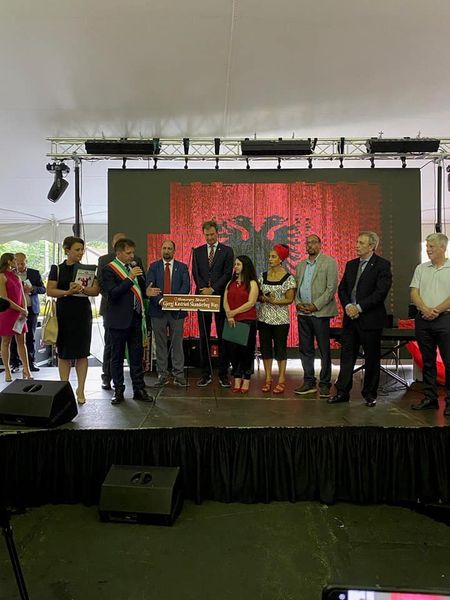
Gjergj Kastrioti Skenderbeu Way was granted the Honorary Name Designation by the Worcester City Council. The petition applies to adjacent blocks on Salisbury Street that might have a second sign as soon as this summer just in time for the Albanian Festival in early June. Addressing last night’s Council meeting on behalf of The Sons of St. Mary’s, an active entity in the Albanian community for 50 years, its President Frank Zdruli said that the “name designation of Skenderbeu, Albania’s national hero, bestows an honor onto all Albanians.” Inside the meeting hall and up at the balconies, there were representatives of Vatra Worcester, Sons of St. Mary’s and young Albanians. Zdruli encouraged the young Albanian Americans in particular to be inspired and strive for the highest offices of public service.

Greg Steffon of The Son’s of St. Mary’s put the emphasis on the unifying effect of a figure like Skenderbeu. Similar to the old generations of Worcester honoring the Salisbury name of Anglo-Walsh origin, “the Albanian families including mys predecessors who migrated here in the early 20th century became part of the fabric of the city ” said he in addressing the Council meeting. Over the years “the old” became a network and support system for the new waves of immigrant Albanians, some of whom came after the war in Kosovo. Steffon pointed out that the name designation of the crucially important historic figure “honors the old and the new generations of Albanians.” In fact the two Worcester City Councilors Donna M. Colorio and Ethel Haxhiaj who jointly filed the application for the ceremonial street sign with the City Clerk Nikolin Vangjeli, illustrate the point adequately. Councilwoman Colorio who is of Albanian descent and Councilwoman Haxhiaj who came to the city from Albania in 1997 exemplify achievements that are made possible thanks to support by the whole community. Other Councilors endorsed the petition calling it “a well deserved recognition for Albanians – the largest growing community in Worcester.”

Behind the organizing efforts of the petition is The Sons of St. Mary’s, an active entity in the Worcester community for 50 years. Though the pandemic delayed a few of their projects, they are determined to bring back the Albanian Festival, a bountiful event and a proud manifestation of Albanian culture and heritage. This year the ceremonial naming coincides with the 555th death anniversary of Albania’s national hero Gjergj Kastrioti Skenderbeu (1405-1468) It is very fitting therefore to have the music, food, crafts and lots more under the street sign with his name on it.

Both Zdruli and Steffon made it a point to reference the new designation of Gjergj Kastrioti Skenderbeu Way as the “only way to find the Festival”.

Joseph Petty, Mayor of Worcester, who presided the City Council meeting, approving the Yes vote, said that “Albanians are a big part of Worcester’s history and will be a part of its future.”

Filed Under: Politike Tagged With: Rafaela Prifti

  • « Previous Page
  • 1
  • …
  • 11
  • 12
  • 13
  • 14
  • 15
  • …
  • 52
  • Next Page »

Artikujt e fundit

  • VATRA PËRKUJTON PATRIOTIN ZEF BALAJ NË 4 VJETORIN E KALIMIT NË PËRJETËSI
  • ATË QË KA MONOPOL GJENIU NUK MUND T’IA MARRË DOT NJERIU!
  • Idriz Balani, një nga mjeshtrat e skulpturës monumentale
  • HUNGARIA DHE ZËRA TË SHKRIMTARËVE TË SAJ NOBELISTË. FAJIN E KA…DHE LETËRSIA?!
  • Vatra Chicago ofron një mundësi të shkëlqyer për talentet shqiptare në futboll
  • President Franklin D. Roosevelt 1882-1945, Presidenti që e ktheu filatelinë në instrument solidariteti gjatë Luftës së Dytë Botërore
  • Diaspora midis unitetit dhe instrumentalizimit politik
  • KANUNORE E FEDERATËS VATRA 1926
  • Posta nga Haga – Frankfurter Allgemeine Sonntagszeitung, 12.04.2026
  • Bedri Dedja (20 nëntor 1930 – 13 prill 2004)
  • Aty ku historia nuk lexohet, por përjetohet…
  • Pafajësia kolektive…
  • Diaspora shqiptare në botë: Nga “Të ndërtojmë Amerikën” tek “Të ndërtojmë Shqipërinë”
  • Noli dhe Konica në dritën e “Diellit”
  • Personalitete kombëtare në New York nderuan jetën dhe veprën e Eliot Engel

Kategoritë

Arkiv

Tags

albano kolonjari alfons Grishaj Anton Cefa arben llalla asllan Bushati Astrit Lulushi Aurenc Bebja Behlul Jashari Beqir Sina dalip greca Elida Buçpapaj Elmi Berisha Enver Bytyci Ermira Babamusta Eugjen Merlika Fahri Xharra Frank shkreli Fritz radovani Gezim Llojdia Ilir Levonja Interviste Keze Kozeta Zylo Kolec Traboini kosova Kosove Marjana Bulku Murat Gecaj nderroi jete ne Kosove Nene Tereza presidenti Nishani Rafaela Prifti Rafael Floqi Raimonda Moisiu Ramiz Lushaj reshat kripa Sadik Elshani SHBA Shefqet Kercelli shqiperia shqiptaret Sokol Paja Thaci Vatra Visar Zhiti

Log in

This website uses cookies to improve your experience. We'll assume you're ok with this, but you can opt-out if you wish. Cookie settingsACCEPT
Privacy & Cookies Policy

Privacy Overview

This website uses cookies to improve your experience while you navigate through the website. Out of these cookies, the cookies that are categorized as necessary are stored on your browser as they are essential for the working of basic functionalities of the website. We also use third-party cookies that help us analyze and understand how you use this website. These cookies will be stored in your browser only with your consent. You also have the option to opt-out of these cookies. But opting out of some of these cookies may have an effect on your browsing experience.
Necessary
Always Enabled
Necessary cookies are absolutely essential for the website to function properly. This category only includes cookies that ensures basic functionalities and security features of the website. These cookies do not store any personal information.
Non-necessary
Any cookies that may not be particularly necessary for the website to function and is used specifically to collect user personal data via analytics, ads, other embedded contents are termed as non-necessary cookies. It is mandatory to procure user consent prior to running these cookies on your website.
SAVE & ACCEPT