Rafaela Prifti/
By placing the echoes of Albanian musical heritage alongside classical masterworks, the concert made a resonant statement: these traditions deserve to be celebrated and passed on. “Echoes of Albania and Classical Masters Concert: A Journey Through Albanian Heritage and Timeless Compositions” was presented by the Albanian American Educators Association (AAEA) at the Scarsdale Woman’s Club Mansion, on Friday evening. At the opening, hosts Lucrezia Lindia, Vice President, and Nereida Katrini, Secretary, described the Westchester-based nonprofit as a strong advocate for arts education. Friday’s performance at this historic place marked the first official presentation of the Organization Music Educators Association (OMEA) founded by professor Ismail Mehmeti, clarinetist Igli Tuga and baritone Kreshnik Zhabjaku. The three founders are bringing a long-held vision to life uniting live performance and music education.
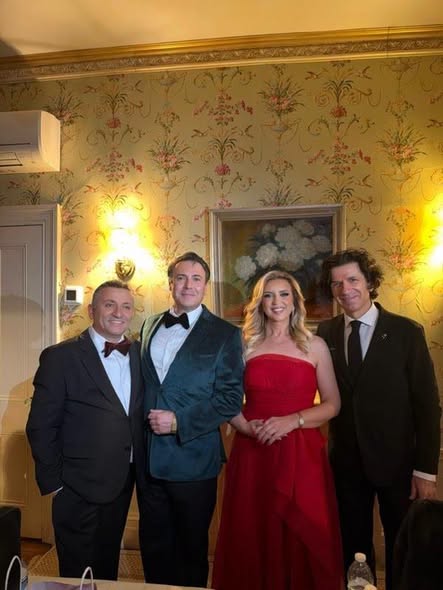
The program moved between Albania’s rich folk, urban songs and selected classical works, allowing each artist’s strengths to shine. Paris-based pianist-composer Genc Tukiçi shaped the concert with his compositions bringing a delicate touch and a unifying presence. During rehearsals, soprano Deshira Ahmeti-Kerliu described his distinctive style as a “silk” thread running through the program. She performed solo and duet repertoire drawing on her extensive operatic experience including the role of Donna Anna in Don Giovanni. Clarinetist Igli Tuga, whose work spans classical, folk, klezmer, and contemporary Albanian music, provided a natural link across the concert’s diverse selections. Baritone Kreshnik Zhabjaku paired a smooth yet powerful voice with a compelling stage presence.
Each of the four artists has decades of stage experience. Their artistry was reflected in a program that ranged from classical selections including “Toreador, en garde!” from Carmen, a selection of Lehár’s “The Merry Widow”, and “Musetta’s Waltz” from Puccini’s “La Bohème” to the beloved French chanson “La Boheme”. But the concert’s strongest echoes came through in the breadth and beauty of Albanian music, with Avni Mula’s “Agimet shqiptare”, Shkodra songs such as “Margjelo” performed by soprano Deshira Ahmeti and folk favorites including “Hajde Gjyle” and “Bishtalecat” performed by baritone Kreshnik Zhabjaku. “Those are the songs my parents knew and that I grew up listening to,” said to me Jacqueline Kapaj-Vieira, President of the AAEA, after the concert.
The carefully crafted performances interwove classical music and Albanian heritage coming to embody a cultural story we share. Near the concert’s close, Nermin Daja Zhabjaku, Kreshnik’s mother and an acclaimed figure in Albanian music, leaned toward a friend seated behind her in the music room. “I got emotional, thinking about how his dad didn’t get to see his son grow up to be a great artist,” she whispered. Ismail Zhabjaku, a prominent cinematographer in Albania, who came from a distinguished Shkoder family, passed away when Kreshnik was very young. In another moving moment, pianist Genc Tukiçi greeted the audience and recalled his father, the celebrated Albanian singer, Ibrahim Tukiçi, a beloved son of Shkoder. This year marks the centennial of Ibrahim’s birthday and Genc asked that the concert serve as a tribute to his memory. Another father onstage, Igli Tuga, co-founded OMEA, the acronym spells his daughter’s name, making the initiative especially close to his heart. Together, these tributes gave the evening a deeply personal resonance, carrying our shared stories forward.