If there is one issue that should unite the entire political spectrum of Kosova and Albanians everywhere, it is the demand for justice for Ylli, Agron, and Mehmet Bytyqi.
They were sons of Kosova and American citizens who answered the call of their people in the struggle for freedom and national survival. The Bytyqi brothers were not killed on the battlefield. After the war had ended, they fell into the hands of Serbian authorities. They were arrested at the border, imprisoned, and, after completing their sentence, taken back into custody and transferred to Petrovo Selo, where they were executed. Their bodies were later discovered in a mass grave on the grounds of a Serbian police training facility.
This was not only a crime against three unarmed Albanians from Kosova. It was also the murder of three citizens of the United States of America and, as such, has remained an unresolved issue in U.S.–Serbia relations for more than two decades.
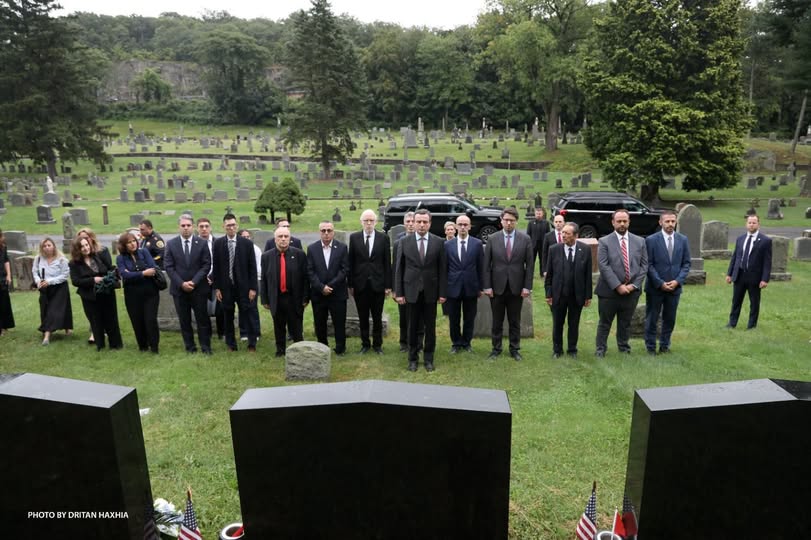
On September 20, 2026, together with Prime Minister of the Republic of Kosova Albin Kurti, members of the Bytyqi family, and other representatives, we paid tribute at the graves of Ylli, Agron, and Mehmet in Yonkers, New York. At the meeting after the tribute, Prime Minister Kurti reaffirmed the determination of the Republic of Kosova to continue working together with the United States until those who ordered and carried out this crime are brought to justice.
The U.S. Department of State has long described the Bytyqi case as a priority in bilateral relations with Serbia. Washington has called for accountability not only for those who carried out the executions, but also for those who ordered and oversaw the killings and those responsible for covering up the crime.
The United States Congress has also noted that Serbian President Aleksandar Vučić made commitments to senior American officials that justice would be delivered in the Bytyqi case. Yet no one has been convicted for the murders.
The United States has taken at least one significant individual measure. In 2018, the Department of State publicly designated former Serbian Ministry of Internal Affairs official Goran Radosavljević as ineligible for entry into the United States, stating that he had been credibly implicated in the murder of the Bytyqi brothers. But one individual measure and more than two decades of diplomatic demands have still not produced justice. The time has therefore come for Kosova and its international partners, first and foremost the United States of America, to consider new, concrete, and coordinated steps aimed at achieving accountability.
The Republic of Kosova could propose to Washington the establishment of a joint Kosova–U.S. institutional mechanism or working group dedicated to the Bytyqi case and, where legally appropriate, other unresolved crimes. Within the respective legal jurisdictions of both countries, such a mechanism could facilitate the exchange of documentation, diplomatic coordination, and the identification of obstacles that have prevented justice.
Kosova’s institutions could also ask the U.S. Congress and the Administration to consider additional individual measures against persons for whom credible evidence exists of participation in the crime, responsibility for issuing orders, or obstruction of justice. Appropriate diplomatic and economic measures, consistent with U.S. and international law, should also be considered if Serbian authorities continue to fail to cooperate effectively in resolving this case.
The European Union should likewise treat Serbia’s cooperation in investigating and prosecuting war crimes as a serious component of its assessment of the rule of law and Serbia’s obligations in the European integration process. The Bytyqi case cannot be viewed entirely in isolation from the broader problem of impunity for crimes committed during the 1990s or from the security challenges that have continued in the region.
The armed attack in Banjska on September 24, 2023, in which Kosova Police Sergeant Afrim Bunjaku was killed, demonstrated once again the danger posed by organized violence in northern Kosova. The European Union has called on Serbia to prosecute those responsible for that attack. The attack on the Ibër-Lepenc water canal in November 2024 was another serious assault on Kosova’s security and critical infrastructure. Those responsible must be identified through a thorough investigation and brought to justice.
Serbia must seriously confront the legacy of the crimes of the 1990s and any structure or individual that uses violence as a political instrument. President Aleksandar Vučić bears a special political responsibility due to his position within the Milošević regime and the continuation of its aggressive policies in the Balkans.
Kosova must also do its part.
The principal institutional responsibility belongs to the Government and other competent institutions of the Republic of Kosova, but this must never become an issue belonging to one political party or one government. Government and opposition should stand together in demanding justice.
Justice for the Bytyqi brothers is not a partisan issue. It is a human, state, and national issue.
Kosova needs stable and fully functioning institutions so that it can defend its interests with strength and credibility in Washington, Brussels, and elsewhere. Therefore, the election of a consensual president before October 6 is of vital importance for Kosova. Those who persist in blocking the parliament will bear historical responsibility for the state’s failures and will be punished by the popular vote.
After 27 years, the Bytyqi family should not simply continue hearing that justice will come. They deserve to see justice being done. Justice for Ylli, Agron, and Mehmet Bytyqi is an obligation to their family, to Kosova, to America, and to the truth. Friendship with America is not honored by words alone. It is also honored by persistently seeking justice for three American citizens who sacrificed their lives for the freedom of Kosova. May Ylli, Agron, and Mehmet Bytyqi be eternally honored and remembered.
Agim Aliçkaj
Executive Director
Albanian American Civic League
On September 27, 2026