• Home
  • Politics
  • Opinion
  • Culture
  • Sports
  • Economy
  • Interview
  • Reporting
  • Community
  • Vatra

Dielli | The Sun

Albanian American Newspaper Devoted to the Intellectual and Cultural Advancement of the Albanians in America | Since 1909

Dielli and the Challenges of Albanian Democratic Consolidation

April 15, 2019 by dgreca

By Dr. Elez Biberaj – Director, Eurasia Division
Voice of America* /

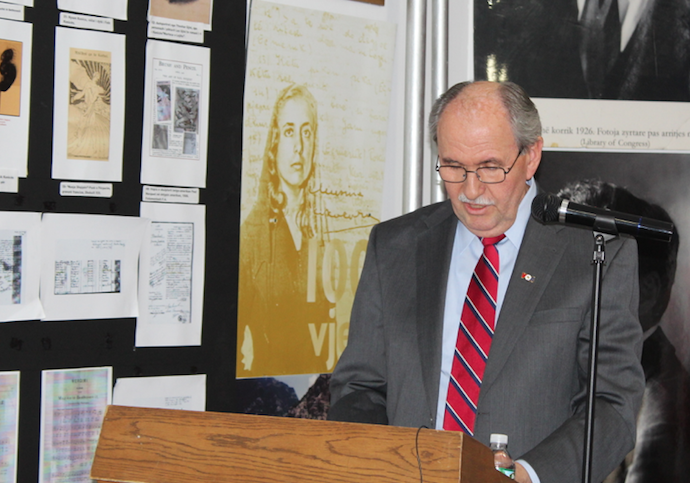
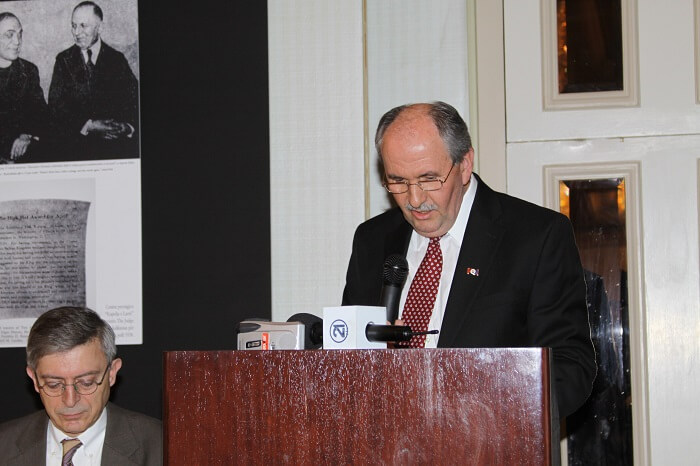
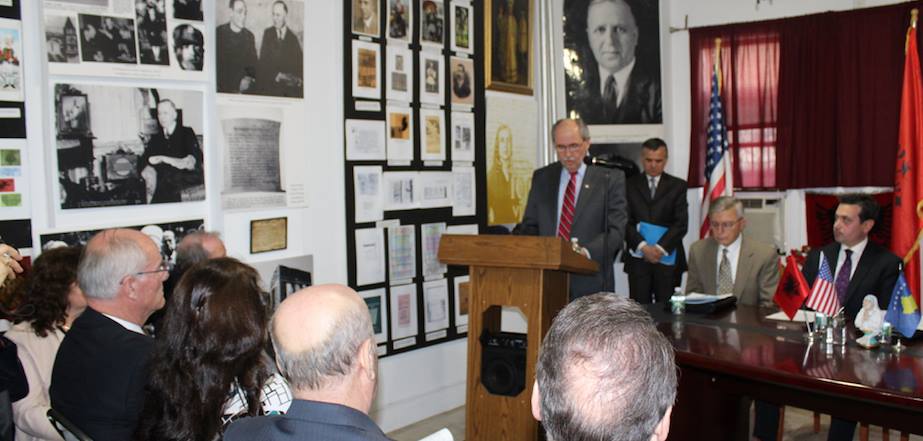
Presentation at the 110th Anniversary Celebration of Dielli[1]

New York, April 6, 2019/

Thank you very much for the invitation to participate in this important conference on the 110th anniversary of the publication of Dielli.  Congratulations to VATRA’s membership, leadership, and particularly to Dielli’s editor Dalip Greca, for achieving such a historic milestone. 

Dielli has played a critical role in faithfully chronicling the troubled history of the Albanian nation, supporting the Albanian national cause, highlighting the developments in our great Albanian-America community, and promoting the creation of democratic, just and prosperous Albanian societies. Like every media outlet and institution, Dielli has had its ups and downs over its long history.  But, with its multifaced contributions, Dielli has rightfully earned a cherished place in the annals of the Albanian history.

            Recently, the Voice of America also marked an important milestone: the 77th anniversary of its establishment in February 1942.  On May 13, 2019, VOA will mark the 76th anniversary of its first Albanian-language broadcasts. The Voice of America is a well-known and influential brand and prides itself in consistently producing journalism of exceptional value in support of freedom and democracy. While the last seven decades have witnessed dramatic changes, one thing that fundamentally has not changed is VOA’s mission – to empower its audiences with accurate, objective and balanced news and information so that they may make informed decisions about their societies and governments.

Dielli and VOA, of course, have different missions.  But they share common objectives of providing coverage of the Albanian-American community, its many contributions to the American society, the strengthening of bonds between American and Albanian peoples, and promoting democratic values in the Albanian lands.

Throughout the decades, we have had a very close relationship. Dielli’s and VATRA’s activities have been prominently featured in VOA programs.  Hours of original recordings of VATRA’s conventions and meetings as well as speeches by Fan Noli and other prominent Albanian-Americans, professionally recorded by VOA’s Lou Prifti, were given to VATRA’s president Anthony Athanas and the Albanian Orthodox Church in Boston.  My understanding is that these were delivered in the 1980s to the National Library in Tirana. Three prominent VOA journalists have served as editors of Dielli – Piro Tyko, Nelo Drizari, and Xhevat Kallajxhi.  And my former VOA colleague Rafaela Prifti now serves with distinction as Dielli’s English-language editor. Many other VOA journalists – Fehime Pipa, Frank Shkreli, Gjek Gjonlekaj, Idriz Lamaj, Ilir Ikonomi, and Astrit Lulushi – have collaborated with Dielli.  

I personally have had the fortune of a long relationship with VATRA and Dielli and am very proud of the fact that my first writings were published in Dielli. I had the honor and the great pleasure of interacting with many prominent VATRA and Dielli personalities, but on this occasion, I would like to pay tribute to Xhevat Kallajxhi.

            Mr. Kallajxhi became editor of Dielli after his distinguished, three-decade carrier with the Voice of America and served in that position from 1976 to 1986.  He revived Dielli, raised its journalistic standards, broadened its scope of coverage, and focused prominently on the challenges facing the diaspora, Albania, Kosova, and Çamëria.

Mr. Kallajxhi was particularly interested in bridging the gap between the older and younger generations of Albanian-Americans.  He provided a wide range of young journalists and scholars with an outlet for their articles and informed comments. Mr. Kallajxhi was a person of high integrity, was widely respected, and had a great appreciation for the importance of objectivity and fairness, which are closely tied to credibility – the most cherished asset of any media outlet. While he encouraged the expression of different perspectives and welcomed passionate debates, Mr. Kallajxhi had no tolerance for those who engaged in malicious allegations, character assassination, self-promotion and phony patriotism.

I first became acquainted with Mr. Kallajxhi during one of his visits to New York, soon after he became editor of Dielli. At that time, I was pursuing my doctoral studies at Columbia University.  Mr. Kallajxhi encouraged me to write for Dielli and to speak at events organized by VATRA.  Thus, I participated in the conference on the occasion of the 100th anniversary of the Albanian League of Prizren and at the Flag Day celebration.

I am grateful to Mr. Kallajxhi for prominently featuring my articles in Dielli, and, on several occasions, publishing them as guest editorials.  My writings focused on communist Albania’s foreign and domestic politics, the prospects for reform, and the plight of Albanians in Kosova.

I am particularly proud of two pieces I published during Mr. Kallajxhi’s tenure.  The first, written with the pseudonym Albanicus and published on January 1, 1979, was an attempt by me to address frankly some of the problems that our community and our nation faced.  The article caused quite a stir in the community.

The second was devoted to U.S. Ambassador Herman Bernstein’s collection on Albania, which is deposited at the Yivo Institute for Jewish Research in New York.  Bernstein, a prominent writer, journalist, and an authority on the Jewish question, was America’s ambassador to Tirana from 1930 to 1933. The existence of the collection was discovered by coincidence.  My brother Hasan, while doing graduate work in history at Columbia University, met a classmate who had come across Bernstein’s collection while doing research on the persecution of Jews in Eastern Europe.  The collection is a valuable source for scholars interested in Albanian developments and U.S.-Albanian relations in the early 1930s. My article, disclosing the existence of this collection and summarizing its contents, was published on October 15, 1980.

             Mr. Kallajxhi set a high bar for Albanian journalists and has left us a rich legacy – a legacy of high commitment to journalistic standards, objectiveness, fairness and respectability, and strong democratic and patriotic convictions.

On such significant anniversary occasions as this one, it is only natural that we dwell on past achievements.  But it is also important to look to the future.

The Albanian-American community has played a remarkable role in efforts to influence U.S. foreign policy on Albanian issues. After the peak of the euphoria that followed Kosova’s independence, Albanian-American activism, however, has declined significantly.  The community now seems largely demobilized.  It is important that the community remain engaged.  Dielli, as well as the other major Albanian-American newspaper, Illyria, is well positioned to promote community activism.

Let us be realistic: the potential role of diaspora newspapers on developments in Kosova and Albania is likely to be limited for many, and objective reasons.  Nevertheless, Dielli and Illyria can contribute by pursuing a fact-based approach to news and information, offering a wide range of spectrum of opinion on top issues, and providing a forum for public debate.

Albanians in Kosova, Albania, Macedonia, Montenegro and Eastern Kosova rightfully should be proud of their national, political, economic and social achievements in recent decades. Nevertheless, this progress is now being threatened by negative political, social and economic trends, which are corrosive for the establishment of a prosperous and truly democratic society. Albanian societies suffer from dangerous political polarization, poor governance, pervasive corruption, and lack of a credible voice for compromise and moderation. 

            Twenty years after its liberation, Kosova has made lots of progress, but remains a fragile state. Prishtina seems consumed with the issue of negotiations with Serbia, making it difficult for the leadership to focus seriously on pressing domestic issues.  Recently Kosova’s position has been undermined by Prishtina’ s grievous missteps and ugly leadership squabbles.

The lack of consensus on fundamental issues, such as negotiations with Serbia, have damaged Kosova’s international standing and created ill will among Kosova’s strongest supporters, including the United States.  These self-inflicted wounds are the result of the failure of key actors to participate in a joint policy development, coordination and implementation process.

            President Hashim Thaçi appeared confident that he could reach a deal with his Serbian counterpart for a “border adjustment,” in return for Belgrade’s recognition of Kosova. His plan seems to have backfired because he failed to engage other key actors, particularly Prime Minister Ramush Hajredinaj, or secure buy-in from the public, for a land swap. This caused serious problems within the political elite and undermined Kosova’s position in future negotiations with Serbia.  The public airing of policy disagreements in Prishtina gave ammunition to those who question the very idea of a Kosova state – and this at a time of significant changes in the international political landscape, most of them favorable to Serbia.

The continuation of the current political stalemate, dysfunctional relationship between key actors, and decision-making paralyses could lead to Kosova’s progressive decline, domestically and internationally. Kosova’s leaders must find ways to bridge the political divide and map out a way forward.  They cannot afford to be complacent or to take for granted America’s commitment.  And Albanian-Americans cannot be oblivious to actions that might damage the special relationship with the United States.

            Meanwhile, Albania is facing its most serious predicament since its implosion in 1997 – a deteriorating political situation, the practical dismantling of the check-and-balance system, and a seemingly collapsed judiciary.  Institutions that sustain a rational, all-inclusive, democratic decision-making process are weak. Polarization is striking and there is no political center, which makes compromise very difficult.

Albania finds itself in the unenviable position of being one of Europe’s poorest and most corrupt countries. Although Albania has averaged an annual real GDP growth of 4 percent, one third of the population still lives in extreme poverty, subsisting on less than one dollar per day. Many Albanians believe the current system is rigged against them.  They have lost hope, seeing little opportunity to shape their country’s future.  According to recent Gallup surveys, some 60 percent of Albanians would like to emigrate. Since the early 1990s, more than a million-and-a-half Albanians have emigrated, with those between the ages of 20 and 40 leaving in the largest number.  Albania’s population today is estimated at 2.9 million – the same as it was in 1989 – and within the next thirty years is expected to decline to 2.6 million.

Having won a clear mandate in the 2017 elections, Prime Minister Edi Rama has been riding high. But his rule has been tarnished by poor governance, pervasive corruption, and economic mismanagement, and his leadership style has alienated many.

As is the case with some other East European leaders, Rama has become decidedly more authoritarian, corrupt, arrogant, and less transparent. He has attempted to maximize his power, shrinking public space, undermining independent institutions, stacking the judiciary with loyalists under the guise of reforms, and marginalizing the opposition. Rama has instituted a kleptocratic model of governance, granting no-bid contracts worth hundreds of millions of dollars to companies close to the government.  The patron-client relationship between government officials and prominent businessmen has deformed the government decision-making process, violating the basic rules of the game, distorting market competition, and leaving ordinary Albanians without meaningful ways of effecting change.

The media environment has become less free and independent. The Prime Minister has steadily challenged the very notion of an independent media, launching his own, online outlet, ERTV.  He has steadily undermined the media, using an increasingly aggressive and threatening rhetoric, and characterizing them as “trashcan media.”  His recent attacks on the VOA, for airing a report on collusion between Socialist Party officials and organized crime groups during the 2017 elections, were breathtaking in their audacity.

Many journalists, vulnerable to political and economic pressure, practice self-censorship and avoid reporting about taboo topics. It is troubling that in 2019, the Albanians must rely on the international media, including the VOA, for reporting on sensitive issues.

Rama has refused to address the many scandalous revelations of corruption, including the publication of wiretaps revealing the involvement of senior Socialist officials with organized crime groups in vote buying during the 2017 elections. He has unabashedly provided impunity to high officials despite clear evidence of corruption and collusion with organized crime groups and drug traffickers.

The State Department’s 2019 International Narcotics Control Strategy Report, released in March 2019, identified Albania as a key transit country for narcotics distribution and “a base of operations for organized crime organizations operating in the United States, Europe, the Middle East, and South America.”  The report listed Albania as a major money-laundering country, and added that, “Official corruption is pervasive and fosters an environment in which drug traffickers are largely able to operate with impunity.” The State Department report noted that justice reforms were undermined by “pervasive corruption.”

It was against this background that the Democratic Party-led opposition decided, in February 2019, to withdraw its deputies from parliament.  This unprecedented step pushed Albania into a state of increased tensions, which risks violence, governance breakdown, and the postponement of Albania’s EU integration. Rama has dismissed Democratic Party leader Lulzim Basha’s demands to resign and create a technical government as simply an attempt to grab power. Despite the urgency of the situation, the Prime Minister has thus far made no serious effort to reach out to the opposition.

There is no question that the Democratic Party and other opposition parties had a litany of legitimate grievances.  But by withdrawing from parliament, they simply abdicated their responsibilities to their electorate and made it easier for Rama to move in a more authoritarian way.  Arguably, Basha could have pursued a two-track policy: remain in parliament and challenge Rama’s governance and power structure, while at the same time mobilize support for nation-wide protests, develop an alternative platform, and work to position his party as best as possible to win the next local and parliamentary elections.  While Albania’s elections have in general been problematic, they offer the best and most realistic opportunity for the opposition to dislodge the governing party.

Basha took this hugely important decision in the absence of a real, honest debate about the rationale and potential risks of such a course and without any serious effort to enlist international support. Few Democrats had the courage and opportunity to question the assumptions under which the decision was made.  As should have been expected, the United States and the European Union expressed support for the government and criticized the opposition.

While Basha has been able to organize large protests in Tirana, it is not clear to what extent the opposition’s message has resonated with the populace.  There has not yet been a critical mass of public pressure that would force Rama to resign or radically adjust his position. The society at large seems disillusioned and increasingly disinterested in politics and unwilling to act. Despite growing discontent with government policies, ordinary Albanians have displayed little enthusiasm for societal activism that would bring much desired changes, apparently believing that they have no influence over the political system.  It is not clear if Basha has a strategy to broaden his party’s appeal and engage the civil society, which would help the opposition sustain the protests and convince Rama to compromise. There is a huge disconnect between the means at his disposal and his desired ends. Lack of a road map and Rama’s staying power could lead to an erosion of support for Basha and fragmentation of the opposition bloc.

Rama does not seem to comprehend the magnitude of the challenges his country faces and has adopted an uncompromising position.  The international community’s criticism of Basha’s decision and reluctance to seriously scrutinize the government’s policies and actions, have emboldened Rama, giving him confidence in his grip on power. His strategy has been to portray a sense of normalcy, embark on the offensive with his own rallies, hoping that in due time support for the opposition will vanish.

This is a short-sighted policy.  The longer the crisis continues, the greater the risk that Albania will face a potentially combustible situation.

            Albanians today appear dangerously adrift and without a clear vision for the future.  They seem to have lost trust and confidence in their leaders and in themselves.  They are likely to suffer further setbacks unless they make some critical choices and develop a strategy that will not only reverse their current backsliding but will set their country on a clear democratic path.

In past crisis, Albanian leaders were able to forge, at the last minute, unexpected and face-saving deals.  While there has been a serious breakdown in trust and communication between the government and opposition, there is still time for a compromise to end the cycle of escalation that is essential for maintaining the nation’s social cohesion.  But this requires political will on both sides to deescalate the conflict and pull back from maximalist demands. Thus far, political will has been missing and the current situation could easily settle into a prolonged stalemate.

However, unless Albanian leaders make serious efforts to find a compromise, Albania will likely descend into a quagmire.  An early test will be the local elections, scheduled for June.  It is in the interest of both sides, that the opposition takes part in the elections.  If Basha boycotts the elections, the opposition will deprive its supporters of representation and face the risk of being further marginalized.  On the other hand, it would be shortsighted for Rama to go ahead with the elections in the absence of the opposition’s participation or to attempt to create his own opposition to dislodge the official one.

Current Albanian leaders are facing a crisis of their own making.  Clearly, they have a responsibility to their nation to find ways to de-escalate the conflict and alter their country’s dysfunctional trajectory before Albania slides into a full-blown national emergency, with a high probability of civil conflict. The crisis could be defused with an agreement on the local elections, followed by changes in the electoral code and a deal on holding early parliamentary elections. It has become imperative that the 2008 constitutional changes be revisited with the objective of strengthening independent institutions and empowering the parliament. The current electoral law, which has led to a dangerous distance between the people and their elected representatives, must be changed. There is an emerging consensus that Albania should return to a mixed or winner-take-all system and shift away from the current proportional system.

But ultimately, any arrangement in the absence of a complete national overhaul and real, fundamental reforms will not necessarily deliver a clean break or revitalize the country’s political system.  Albania desperately needs a restart and a national compact – an agreement on shared national goals, and principles of good governance – that would reshape the country’s political order.

The next phase could determine if Albania will evolve into a consolidated democracy or take a pro-authoritarian, one-party direction. The established political leaders, which have dominated the country’s politics since the early 1990s and are responsible for Albania’s lagging behind, have run out of steam and can no longer serve as a catalyst for fundamental change.  Let us hope that three decades after the demise of communism, the Albanian society is able to produce new elites that will display the real statesmanship that the road ahead demands.

***

* www.gazetadielli.com


* The views expressed herein are the author’s and do not represent the position of the Voice of America.
Filed Under: Politike Tagged With: Dr. Elez Biberaj

REMARKS AT THE BOOK PROMOTION “DEMOKRACIA NUK PRET” BY FRANK SHKRELI!

July 11, 2018 by dgreca

4 Elez Biberaj

By Dr. Elez Biberaj/

It is my honor and privilege to participate in the book promotion of my friend and colleague, Fran Shkreli, who has given and continues to give a valuable contribution in the Albanian journalistic landscape, in general, and the advancement of Albanian issues, in particular.

I am very happy to be here at our VATRA and in the company of well-known personalities, friends and colleagues. I would like to express my gratitude to VATRA for the care that it has always shown and continues to show in promoting the works of the members of our community.

Before talking about Fran’s book, I would like to acknowledge the close ties that have historically existed between Voice of America and VATRA, going back to the difficult years of the Cold War years to this day. Voice of America has always aimed to cover the activities and services of the Albanian-American organizations and associations, especially those of VATRA.

The Voice of America archives contain a number of broadcast recordings of events, meetings, and high-profile personalities of our community. The collection includes Fan Noli’s speeches, which, through VATRA, were donated to the National Library in Tirana. Prominent journalists of Voice of America have played an important role in VATRA and Dielli – Xhevat Kallajxhiu, Idriz Lamaj, Gjek Gjonlekaj, and others. Some of us, including me, have published our first stories in the newspaper Dielli.

Frank Shkreli has a long, outstanding and fulfilling career. Throughout his work, he has been a staunch defender of free speech and freedom of the press, human rights, and an advocate for the Albanian issue.

Frank Shkreli’s media related career extends nearly five decades. It began shortly after his immigration to the United States and the college years. Initially, he focused his attention on Albanian topics – the challenges facing our Albanian-American community as well as Albanians in their homeland.

Having distinguished himself in this field, Frank broadens his scope to include regional and global issues of importance. He acquired extensive knowledge on international relations, in general, and the former communist bloc, in particular. Frank is equipped with comprehensive political awareness and has vast insights into the US foreign policy including the politics of Washington.

Frank has the ability to examine and analyze current regional and international issues. After retirement, he made a 360-degree turn to go back where he started his activity, focusing once again on issues and developments concerning Albanians.

This is reflected in his comprehensive campaign to raise awareness in the United States on the situation, the demands and aspirations of Albanians, the establishment of democracy in the Albanian territories, and the development of inclusive democratic societies.

The outcome of his work is the book presented here, Demokracia Nuk Pret! In his writings, especially the ones featured in this publication, Frank examines issues, events and subjects of a wide variety with honesty and objectivity. He covers themes from our past – the positive and negative aspects, the pains and joys – as well as contemporary issues. He analyzes it all critically yet always draws a constructive conclusion that could benefit the Albanian decision-makers in confronting the current strategic and diplomatic challenges. In his articles, he makes a strong case for Albanians to consolidate their Western orientation.

What is the importance of Fran Shkreli’s writings? What does he offer to the reader at a time when the Albanian media landscape has expanded and changed dramatically?

As a professional journalist and analyst, his greatest asset is the high level of credibility that the reader has assigned to him thanks to his ability to be objective and balanced. Frank is aware that while journalists today have abundant opportunities and sophisticated tools, the mission of news reporting is always to tell the truth even when it is bitter. He has always been in search of the truth.

With respect to the readers, Frank’s point of view is that of a well-known Albanian-American media professional who is deeply invested in consolidating Albanian democracy and solidifying the strategic partnership between Albanians and the United States. He reminds Albanians that these relations should be continually fostered and a stronger partnership depends on the Albanians’ embracing of democratic values: respect for human rights, the rule of law, a strong and accountable governance.

In this regard, I believe Frank reflects the views and hopes of our community for a more righteous and democratic society in the Albanian territories.

Demokracia Nuk Pret is an important reference for journalists, students, scholars and politicians. Frank Shkreli’s book offers an important insight into the Albanian political and media debate. The tone and content of his writings are unique in the Albanian media landscape.

The timing of the publication is appropriate and relevant.

Albanians, in Albania, Kosovo, Macedonia, and elsewhere, should rightfully be proud of their accomplishments in the last quarter century. This week, Albania received very good news from Brussels, the recommendation for launching membership talks in the European Union.

However, as Frank points out in his book, Albanians cannot be content with the current political, economic, and social status.

While Brussels’ recommendation is hopeful, it presents a crucial point for the governing elites, not only in Albania, but also in Kosovo and Macedonia, to reflect on what I would call golden opportunities that Albanians have missed over the last years and even decades, which have slowed down their pace towards a stronger democracy. The accession talks in the European Union should have started years ago. It should be acknowledged that this chance and other golden possibilities for Albania and Kosovo are largely lost as a result of the flagrant lack of leadership by the Albanian decision-makers.

Today, Albanians face significant challenges: economic problems; high unemployment and poverty; corruption at all levels of government and society; illegal practices and the absence of the rule of law; weak institutions; irresponsible politicians who tolerate and attract corruption and use undemocratic practices to secure and retain power.

These domestic challenges are exacerbated by issues in the international arena: the erosion of democracy regionally and globally; the empowerment of authoritarian alternatives in Turkey and in Russia; and the shifting of the Balkan and European political landscape.

Meanwhile, the major Western players are showing signs of fatigue with the Albanians, who continue to generate crises, which require attention and resources. These negative international trends can undermine the positions of Albanians and cause a deterioration in their political and economic progress.

Today there is no talk of a dynamic or certainty of reforms in Albanian territories. Instead, there is stagnation, sluggishness, general decline, loss of hope, and extreme political polarization, with dangerous consequences for the future.

If something does not change soon, these negative trends will hamper the efforts of Albanians to position themselves decidedly in the family of Western democratic countries and societies.

In order to disrupt this general downturn, Albanians must undertake radical changes that would result not only in taking a new direction but would bring about a serious transformation of the Albanian society.

In order to achieve these goals, it is imperative that:

  • The current style of governance changes fundamentally and focuses on principal national interests rather than the intentions of political parties or short-term political objectives.
  • The main political forces agree on a vision for the future of the country and on the compilation and implementation of major policies that will lead towards this vision.
  • The establishment and promotion of truly independent institutions that are capable of establishing the rule of law and driving out corruption.
  • The freedom of media from the pressure of political and financial interests.
  • The decision-making process on key issues to be inclusive, thus ensuring the participation of main actors, interest groups, civil society, and experts.
  • And finally, the whole society needs to undergo a total transformation in the ways it thinks and acts. Albanians should be more demanding and hold their politicians liable by seeking greater accountability, transparency and responsibility.

These are very challenging objectives which require political will and time.

Albanians in general, not just their leaders and politicians, face a historic test: to accept the current situation or to wake up from stagnation, seize the moment and take the necessary steps towards the fulfillment of their democratic potential.

Filed Under: Opinion Tagged With: "DEMOKRACIA NUK PRET", Dr. Elez Biberaj, Frank shkreli

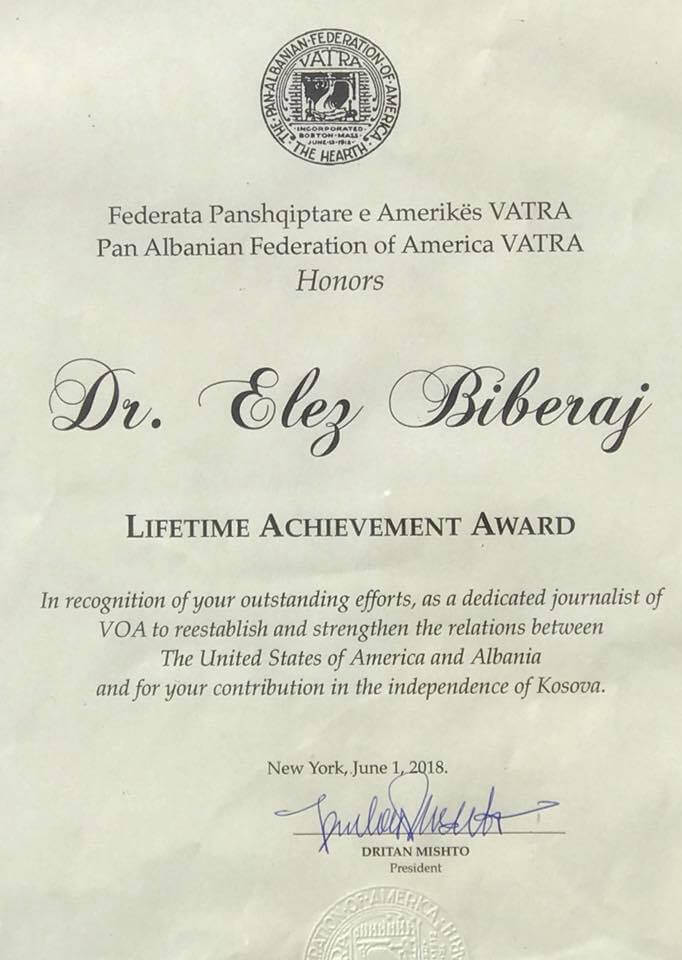
DR. ELEZ BIBERAJ: ESHTE PRIVILEGJ I MADH TE NDEROHESH NGA VATRA

June 2, 2018 by dgreca

Dr. Elez Biberaj/

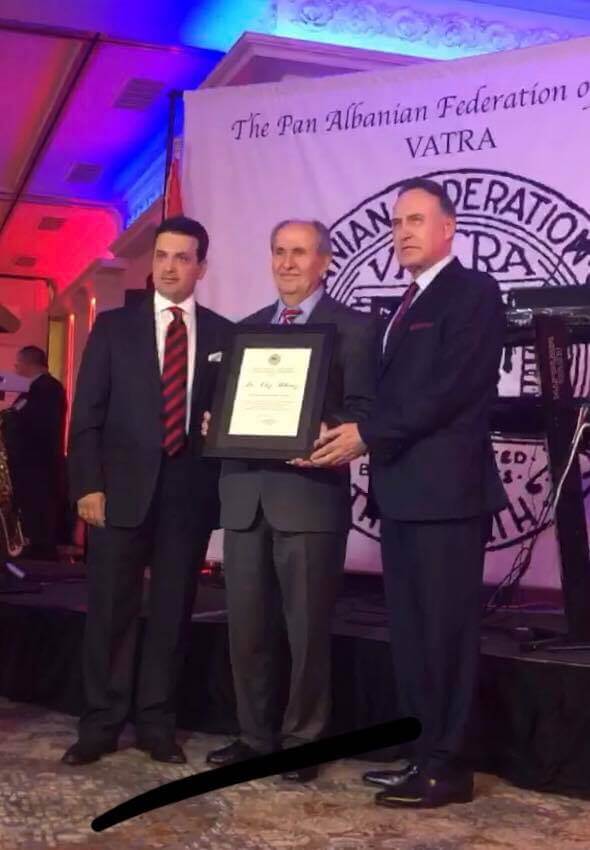
Fjala në Ceremoninë e Vlerësimit për Arritjet Jetësore-/1 Elez dritan agimVATRA/

Nju Jork/

1 qershor 2018/

I nderuar zoti Mishto!/

Ju falenderoj Ju personalisht, anëtarët e kryesisë, dhe anëtarët e VATRES për këtë vlerësim për arritjet jetësore.

Të nderohesh nga VATRA, nga kjo organizate historike qe ka shërbyer si qendër e veprimtarisë patriotike të shqiptarëve të Amerikës dhe që ka dhenë një ndihmesë të madhe për lirinë, pavarësinë dhe demokracinë e kombit tonë, është ndere dhe privilegj i madh.Elez 2

Për mua ky është ndër vlerësimet më të çmuara. Unë kam patur lidhje te gjata dhe të ngushta me VATREN.  Veprimtarinë time publicistike e kam filluar pikërisht në VATREN tone të përbashkët dhe prandaj ju falenderoj përzemërsisht.

Më lejoni të shfrytëzoj këtë rast për t’i shprehur mirënjohjen më të thellë familjes, veçanerisht bashkëshortes sime, Kadires, femijeve te mi, vellezerve e motrave.  Një mirënjohje të veçante prindërve te mij – Hysen dhe Ajshe Biberaj. Ishin ata që na ushqyen me dashurinë dhe krenarinë për kombin tonë, dhe me ndjenjën që e kemi për detyrë të përpiqemi, me aq mundësi që kemi,  të ngrejmë lart vlerat e kombit dhe të atdheut tone të dashur.

Falenderoj edhe kolegët dhe bashkëpunëtorët e shumët, të cilët me kanë ndihmuar gjatë karierës sime.

Ky vlerësim nga VATRA është edhe më domethënes për mua për arsye se përkon me një përvjetor të rëndësishëm për familjen tone. Dje, me 31 maj, ne kemi shenuar 50 vjetorin e imigrimit në Amerike – në kete vend te lirise dhe te mundësive të shumta.Familja jonë është shumë me fat që ka realizuar ëndren amerikane dhe për këtë i jemi shumë mirënjohës këtij vendi të bekuar demokratik.

Shtetet e Bashkaura na kanë dhënë mundësinë të jemi shtetas besnikë amerikanë dhe, në të njejtën kohë, të përpiqemi të japim një ndihmesë modeste në mbështetje të aspiratave te kombit tone për liri, pavarësi dhe demokraci.

Edhe njëherë, Ju falenderoj përzemërsisht dhe me mirenjohje të thellë.

Filed Under: Ekonomi Tagged With: Dr. Elez Biberaj, Privilegj, te dnerohesh nga VATRA

SHQIPTARET PARA NJE PROVE HISTORIKE

April 22, 2018 by dgreca

– TE PAJTOHEN ME GJENDJEN E TANISHME OSE TE ZGJOHEN NGA AMULLIA ….të kapin momentin dhe të ndërmarrin hapat e nevojshëm për të realizuar potencialin e tyre të plotë demokratik.Siç thekson Frank Shkreli, Demokracia nuk pret!./
1 elezi 1

Dr. Elez Biberaj/

Drejtor i Drejtorisë së Euroazisë- Zëri i Amerikës/

Fjala ne Promovimin e Librit te Frank Shkrelit, Demokracia nuk pret!

VATRA, New York

21 prill 2018

Ju falenderoj përzemërsisht për ftesën për të marrë pjesë në këtë takim. Është nder dhe privilegj për mua që të marrë pjesë në promovim të libirt të mikut dhe kolegut tim, Fran Shkreli.

Frani ka dhënë dhe vazhdon të japë një ndihmesë të çmuar në publicistikën shqiptarë, në përgjithësi, dhe në avancimin e çështjeve shqiptare, në veçanti.

Jam shumë i lumtur që ndodhem këtu ne VATAREN tone dhe në shoqërinë e personaliteteve të njohura dhe të miqve e kolegëve.

Deshiroj te shpreh mirenjohje per VATREN, per kujdesin qe gjithmone ka treguar dhe vazhdon te tregoje per promovimin e veprave te anetareve te bashkesise sone.

Para se te flase per librin e Franit, do te kisha deshire te theksoj lidhjet e ngushta qe kane ekzistuar historikisht midis Zerit te Amerikes dhe VATRES – qe nga vitet e veshtira te Luftes se Ftohte e deri ne ditet tona. Zeri i Amerikes gjithmone eshte perpjekur te pasqyroje veprimtarine dhe angazhimin e organizatave dhe shoqatave shqiptaro-amerikane, veçanerisht ato te VATRES.

Arkivi i Zerit te Amerikes permban regjistrime te shumta te ngjareve, takimeve, dhe personaliteteve me te rendesishme te bashkesise sone.  Ketu perfshihen fjalimet e Fan Nolit, te cilat nepermjet VATRES iu dhuruan Bibliotekes Kombetare ne Tirane.

Gazetare te shquar te Zerit te Amerikes kane luajtur rol te rendesishem ne mbarevajtjen e VATRES dhe te Diellit–  Xhevat Kallajxhiu, Idriz Lamaj, Gjek Gjonlekaj, e te tjere.  Disa prej nesh, perfshire edhe mua, shkrimet e para i kemi botuar ne gazeten Dielli.

Frank Shkreli ka nje kariere te gjate, te shquar e te pasur.  Gjate gjithe veprimtarise se tij, ai e ka deshmuar vehten si mbrojtes i flaket i lirise se fjales e te shtypit, i te drejtave te njriut, dhe si avokat i çeshtjes shqitare.

Veprimtaria publicistike e Frank Shkreli shtrihet ne gati pese dekada. Karieren e tij ai e ka filluar menjehere pas imigrimit ne Shtetet e Bashkuara dhe gjate studimeve universitare.  Fillimish, ai u perqendrua ne çeshtjet shqiptare – sfidat e ndryshme me te cilat ballafaqohej bashkesia jone shqiptaro-amerikane si dhe shqiptaret ne vendlindje.

Pasi e dallon veten ne kete fushe, Frani zgjeron horizontin e tij dhe fillon te merret me ceshtje rajonale e globale – me çeshtje me madhore. Ai zhvillon njohuri te gjere per marredheniet nderkombetare, ne pergjithesi, dhe ish-blokun komunist, ne veçanti.

Frani ka nje ndergjegjesim te larte politik dhe njohuri te jashtezakonshme mbi politiken e jashtme amerikane dhe funksionimin e Uashingtonit.

Frani ka aftesi te analizoje dhe te shkruaj mbi çeshtje aktuale rajonale dhe nderkombetare. Por pas daljes ne pension, ai ben nje kthese 360 gradesh, duke u kthyer aty ku e kishte filluar veprimtarine e tij publistike: Ai vendos t’ia kushtoje vemendjen kryesore çeshtjeve dhe zhvillimeve shqiptare.

Kjo pasqyrohet ne angazhimin e tij te gjithaneshem per ndergjegjesimin e Shteteve te Bashkuara mbi gjendjen, kerkesat dhe aspiratat e shqiptareve, vendosjen e demoracise ne trevat shqitare, dhe krijimin e shoqerive demokratike e gjitheperfshirese.

Fruti i kesaj veprimtarie eshte libri qe kemi perpara, Demokracia nuk pret! Ne shkrimet e tij, dhe veçanerisht ne ato qe jane perfshire ne kete liber, Frani trajton çeshtje, ngjarje dhe tema nga me te ndryshme dhe e ben kete ne menyre te besueshme dhe objektive. Ai trajton te kaluaren tone – anet positive, ato negative, dhimbjet, gezimet – si dhe problemet bashkekohore. Frani i analizon te gjitha keto me nje sy kritik, por gjithmone duke arritur perfundime te rendesishme qe mund t’u hyjne ne pune vendim-marresve shqiptare ne perballimin e sfidave te dukshme strategjike dhe diplomatike me te cilat ballafaqohen.

Ne artikujt e tij, Frani thekson me force domosdoshmerine qe shqiptaret te konsolidojne orientimin e tyre perendimor.

Shtrohet pyetja: pse jane shkrimet dhe pikepamjet e Fran Shkreli te rendesishme?  Çka u ofron ai lexueseve ne nje kohe kur peisazhi mediatik shqiptar eshte zgjeruar dhe ndryshuar ne menyre dramatike?

Fran Shkreli eshte gazetar dhe analist profesionist. Pasuria e tij me e madhe eshte niveli i larte i besueshmerise qe ai ka arritur te krijoje tek lexuesit e tij. Kete besueshmeri ai e ka siguruar fale aftesise per te qene objektiv dhe duke anashkalluar qendrime te njeaneshme.

Frani eshte i vetdijshem se ndersa sot gazetaret kane mundesi te jashtezakonshme dhe mjete te sofistikuara, misioni i gazetarit vazhdon te jete po ai qe ka qene gjithmone – qe te tregohet e verteta, edhe kur ajo eshte e hidhur. Ai ka qene gjithmone ne kerkim te se vertetes.

Frani bashkebisedon me lexuesit e tij nga nje kendveshtrim i veçante – nga kendveshtrimi i nje publicisti te njohur shqiptaro-amerikan, i cili eshte thellesisht i interesuar ne konsolidimin e demokracise ne trevat shqiptare dhe ne thellimin e partneritetit strategjik midis shqiptareve dhe Shteteve te Bashkuara.

Ai u kujton shqiptareve se keto marredhenie duhet kultivuar ne vazhdimesi dhe se thellimi i tyre varet nga perfaqesimi, nga ana e shqiptareve, te vlerave demokratike – respektimi i te drejtave te njeriut, vendosja e sundimit te ligjit dhe qeverisja e mire dhe llogaridhenese.

Ne kete drejtim, besoj se Frani pasqyron pikepamjet dhe deshirat e bashkesise sone per krijimin e nje shoqerie me te drejte dhe me demokratike ne trevat shqiptare.

Libri i Franit, Demokracia nuk pret, eshte nje burim i rendesishem per gazetaret, studentet, dijetaret dhe politikanet.  Me kete veper, Fran Shkreli ka dhene nje nidhmese te rendesishme ne debatin politik dhe mediatik shqiptar.  Toni dhe substanca e shkrimeve te tij jane te veçanta ne peisazhin mediatik shqiptar.

Libri i Franit eshte botuar ne kohen e duhur dhe eshte shume aktual.

Shqiptaret – kudo qe ndodhen, ne Shqiperi, Kosove, Maqedoni, dhe vende te tjera – kane te drejte te ndihen krenare per arritjet e gjithaneshme ne krahasim me gjendjen e tyre para nje çerek shekulli.  Dhe kete jave, Shqiperia mori nje lajm shume te mire nga Brukseli – rekomandimin per fillimin e bisedimeve per anetaresim ne Bashkimin Evropian.

Por, siç ve ne dukje Frani ne librin e tij, shqiptaret kurresesi nuk mund te te jene te kenaqur me stadin e tanishem politik, ekonomik, dhe shoqeror.

Ndersa rekomandimi i Brukselit eshte shpresedhenes, ai paraqet nje moment te volitshem qe elitat qeverisese, jo vetem ne Shqiperi, por edhe ne Kosove e ne Maqedoni, te reflektojne mbi ato qe do ti quaja raste te artaqe shqiptaret kane humbur gjate viteve dhe dekadave te fundit dhe qe kane ngadalesuar rrugen e tyre per konsolidimin e demokracise. Bisedimet per anetaresim ne Bashkimin Evropian duhet te kishin filluar vite me pare. Duhet pranuar se ky dhe raste te tjera te artaper Shqiperine dhe per Kosoven, jane humbur kryesisht si rrjedhim i i mangesive te theksuara udheheqese te vendim-marresve shqiptare.

Sot, shqiptaret perballen me sfida te dukshme:  problemet ekonomike; papunesia e larte dhe varferia; korrupcioni qe ka depertuar ne te gjitha nivelet e qeverisjes dhe te shoqerise; paligjshmeria dhe mungesa e shtetit ligjor; institucionet e dobeta; dhe politikane te papergjegjshem qe tolerojne e nxisin korrupcionin dhe perdorin praktika jodemokratike per te siguaruar dhe mbajtur pushtetin.

Ketyre sfidave te brendshme tani u shtohen edhe disa probleme te jashtme: prirja rajonale dhe globale e rreshqitjes se demokracise; forcimi i alternatives autoritare, si ne Turqi dhe Rusi; dhe ndryshimi i peisazhit politik balkanik dhe evropian.

Nderkohe, aktoret kryesore perendimore po tregojne shenja lodhjeje me shqiptaret – te cilet vazhdojne te prodhojne kriza, qe pastaj kerkojne vemendje dhe burime te medha. Keto prirje negative nderkombetare mund te minojne pozitat e shqiptareve dhe te shkaktojne nje perkeqesim ne ecurine e tyre politike dhe ekonomike.

Sot nuk flitet me per nje dinamizem ose ritem te sigurt reformash ne trevat shqiptare.  Perkundrazi, ndihet nje ngecje, zvarritje, renie e pergjithshme, humbje shprese, dhe polarizim i skajshem politik, qe mund te kene pasoja te rrezikshme per te ardhmen.

Ne qofte se nuk ndryshohen se shpejti, keto prirje negative do te veshtiresojne perpjekjet e shqiptareve per t’u ankoruar qartesisht ne familjen e vendeve dhe shoqerive demokratike perendimore.

Qe te nderpritet kjo renie e pergjithshme, shqiptaret duhet te ndermarrin ndryshime radikale, qe do te rezultonin jo vetem ne nje kurs te ri drejtimi por do te transformonin rrjenjesisht shoqerine shqiptare.

Per te arritur keto objektiva, eshte e domosdoshme qe,


  • Stili i tanishem i qeverisjes te ndryshoje me themel dhe te perqendrohet tek interesat themelore kombetare e jo tek ato partiake ose tek objektivat politike afat-shkurtera.
  • Forcat kryesore politike te bien ne ujdi mbi vizionin per te ardhmen e vendit dhe mbi perpilimin dhe zbatimin e politikave madhore qe do te çonin ne realizimin e ketij vizioni.
  • Te krijohen dhe te fuqizohen institucione me te vertete te pavarura dhe te afeta per vendosjen e shtetit ligjor dhe çrrenjosjen e korrupsionit.
  • Media te çlirohet nga trysnia dhe interesat politike dhe financiare.
  • Procesi i vendimmarrjes per çeshtje te rendesishme te jete gjitheperfshires, me pjesemarrjen e aktoreve kryesore, grupeve te interesit, te shoqerise civile, dhe eksperteve.
  • Dhe se fundi, e gjithe shoqeria duhet te ndryshoje thellesisht – menyra si mendon dhe si vepron ajo. Shqiptaret duhet te jene me kerkues dhe ndeshkues ndaj politikaneve te tyre dhe te kerkojne llogaridhenie, transparence dhe pergjegjshmeri me te madhe.


Keto jane objektiva shume te veshtira dhe duhet vullnet politik dhe kohe qe ato te arrihen.

Por shqiptarët në përgjithësi, e jo vetëm udhëheqësit dhe politikanët e tyre, ndodhen para një prove historike: të pajtohen me gjendjen e tanishme ose të zgjohen nga amullia, të kapin momentin dhe të ndërmarrin hapat e nevojshëm për të realizuar potencialin e tyre të plotë demokratik.

Siç thekson Frank Shkreli, Demokracia nuk pret!


Filed Under: Featured Tagged With: "DEMOKRACIA NUK PRET", Dr. Elez Biberaj, NJE PROVE HISTORIKE, SHQIPTARET PARA

SOT- DEBAT NE VATER: DEMOKRACIA NUK PRET

April 16, 2018 by dgreca

2 ElezBiberaj

TE PRANISHEM DR. ELEZ BIBERAJ DHE GAZETARI FRANK SHKRELI, AUTOR I LIBRIT”DEMOKRACIA NUK PRET”-/

1 ok Frank shkreli

Njoftohet komuniteti Shqiptar se të Shtunën, dt. 21 Prill 2018, Ora 11.00, në selinë e Vatrës, organizohet bashkëbisedimi “DEMOKRACIA NUK PRET”. I pranishëm autori i librit “DEMOKRACIA NUK PRET” , ish drejtori i Divizionit të Euro-Azisë në “Zërin e Amerikës”, z. Frank SHKRELI, folës: Drejtor aktual i Divizionit të Euro-Azisë të Zërit të Amerikës Dr. Elez Biberaj, Ish gazetari  i Zërit të Amerikës  Idriz Lamaj.  Seanca drejtohet nga Kryetari i Organizatës Pan-Shqiptare Vatra, z. Dritan Mishto dhe nga Kryeredaktroi i gazetës Dielli, z. Dalip Greca.

Përshëndetje të veçanta me këtë rast nga Prof. Sami Repishti, Profesor Nick Pano, Profesor Thanas Gjika dhe Akademik Jusuf Buxhovi, ndër të tjerë.  Pritet të marrë pjesë edhe Deputeti i Kuvendit të Shqipërisë, Dr. Halim Kosova.

Nuk është thjesht një promovim, por një bashkëbisedim për fatet e Demokracisë Shqiptare dhe kontributin e Diaspores.  Bëhuni pjesë e debatit duke ardhur në këtë veprimtari të veçantë.  E para e këtij lloji.


Filed Under: Opinion Tagged With: Demo0kracia nuk pret, Dr. Elez Biberaj, Frank shkreli

  • « Previous Page
  • 1
  • 2
  • 3
  • 4
  • Next Page »

Artikujt e fundit

  • Me lot, dhimbje e respekt, familja, farefisi e shqiptarët e Amerikës i dhanë lamtumirën e fundit Lisa Milicaj Bajraktarit
  • Shqiptarët, një histori midis Lindjes dhe Perëndimit
  • 100 vjet nga fillimi i gërmimeve arkeologjike të Luigi Maria Ugolinit në akropolin e Finiqit
  • NDRE MJEDA (20 Nëntor 1866 – 1 GUSHT 1937)
  • Homazh për fëmijët e vrarë në Kosovë nga regjimi gjenocidal serb
  • PROF. DR. REXHEP KRASNIQI NJË JETË NË SHËRBIM TË ARSIMIT, KOMBIT DHE LIRISË
  • Pse Serbia kërkon të rihapë konsullatën e saj në Shkodër
  • “Vështrim psikologjik mbi çështjen çame”
  • Prof. Gjovalin Gjadri – Personalitet i shquar i inxhinierisë shqiptare dhe themelues i shkencës moderne të konstruksioneve në Shqipëri
  • Konsullata serbe, apo kur historia troket përsëri në portën e Shkodrës
  • Vatra homazhe nderimi pranë shtatores së Shenjtores Nënë Tereza dhe Dr.Ibrahim Rugovës në Klinë të Kosovës
  • Lugina e Preshevës meriton vëmendje maksimale. Mediat Publike shqiptare të akreditojnë reporterët zyrtarë në zonat ku jetojnë shqiptarët etnikë
  • Seminari XIX Mbarëkombëtar për Mësimin Plotësues në Gjuhën Shqipe në Diasporë
  • Sulmet ndaj UÇK-së, fyerje ndaj historisë dhe cënim i themeleve morale e shtetformuese të Republikës së Kosovës
  • Kujtojmë ditën e themelimit të Klubit “Bashkimi” të Manastirit

Kategoritë

Arkiv

Tags

albano kolonjari alfons Grishaj Anton Cefa arben llalla asllan Bushati Astrit Lulushi Aurenc Bebja Behlul Jashari Beqir Sina dalip greca Elida Buçpapaj Elmi Berisha Enver Bytyci Ermira Babamusta Eugjen Merlika Fahri Xharra Frank shkreli Fritz radovani Gezim Llojdia Ilir Levonja Interviste Keze Kozeta Zylo Kolec Traboini kosova Kosove Marjana Bulku Murat Gecaj nderroi jete ne Kosove Nene Tereza presidenti Nishani Rafaela Prifti Rafael Floqi Raimonda Moisiu Ramiz Lushaj reshat kripa Sadik Elshani SHBA Shefqet Kercelli shqiperia shqiptaret Sokol Paja Thaci Vatra Visar Zhiti

Log in

This website uses cookies to improve your experience. We'll assume you're ok with this, but you can opt-out if you wish. Cookie settingsACCEPT
Privacy & Cookies Policy

Privacy Overview

This website uses cookies to improve your experience while you navigate through the website. Out of these cookies, the cookies that are categorized as necessary are stored on your browser as they are essential for the working of basic functionalities of the website. We also use third-party cookies that help us analyze and understand how you use this website. These cookies will be stored in your browser only with your consent. You also have the option to opt-out of these cookies. But opting out of some of these cookies may have an effect on your browsing experience.
Necessary
Always Enabled
Necessary cookies are absolutely essential for the website to function properly. This category only includes cookies that ensures basic functionalities and security features of the website. These cookies do not store any personal information.
Non-necessary
Any cookies that may not be particularly necessary for the website to function and is used specifically to collect user personal data via analytics, ads, other embedded contents are termed as non-necessary cookies. It is mandatory to procure user consent prior to running these cookies on your website.
SAVE & ACCEPT